










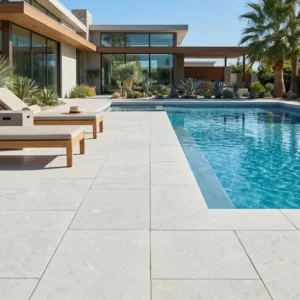
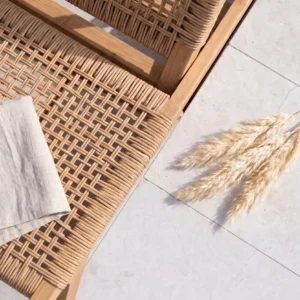
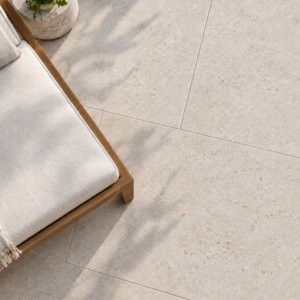

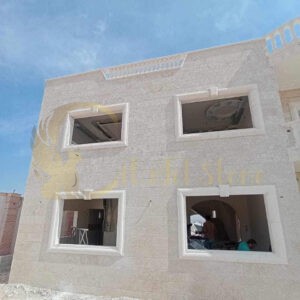
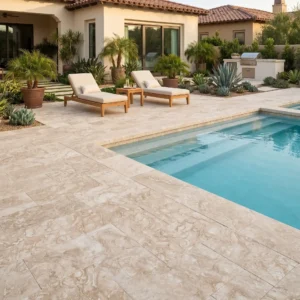
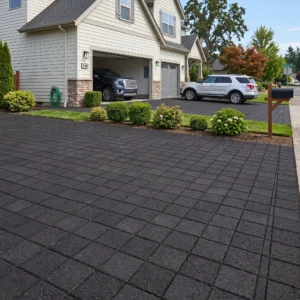

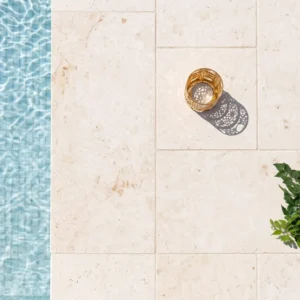
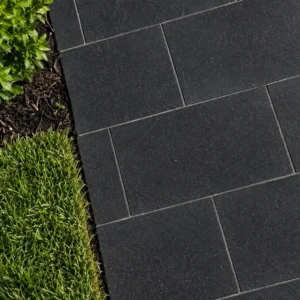



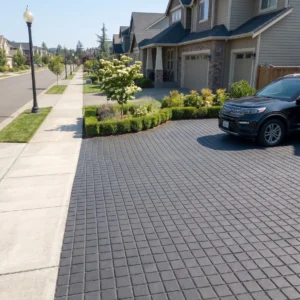
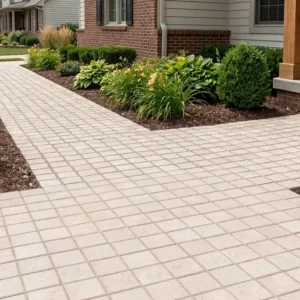
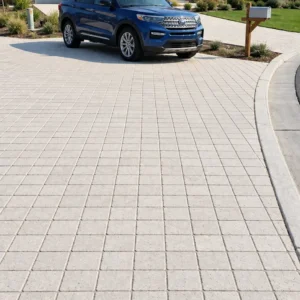
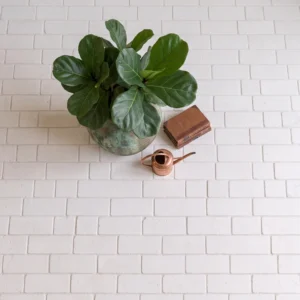



Travertine pavers get specified on appearance and judged on the details nobody photographs — how the voids were filled, what nominal thickness actually arrived on the pallet, whether the setting bed drains, and how the surface reads after five summers of direct sun. Most of the complaints that surface in year three trace back to a decision made in the first ten minutes of the material conversation. The open pore structure that makes this stone pleasant to walk on is the same structure that makes drainage detailing non-negotiable. What follows is the working detail — cut direction, fill type, format, setting method, sealing intervals, weathering behavior and delivery logistics — that separates an installation aging gracefully from one being lifted early.
How the Pore Structure of Travertine Pavers Drives Every Other Decision
Travertine forms where mineral-rich groundwater reaches the surface and drops its dissolved calcium carbonate layer on layer, trapping gas bubbles and plant debris as the deposit builds. Those trapped voids — the vugs — are the defining feature of every travertine natural stone paver you will ever handle, and they run in bands parallel to the original bedding. That geometry tells you more about how a unit will behave in service than any brochure paragraph, and federal geological data on carbonate rock explains why the porosity is structural rather than incidental.
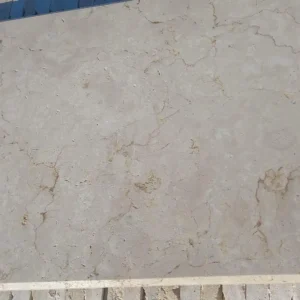
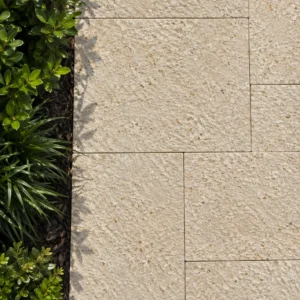
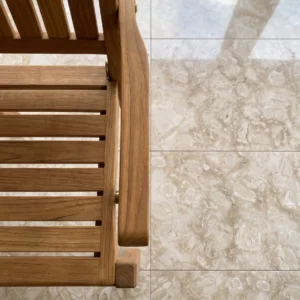
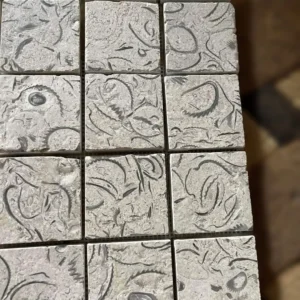
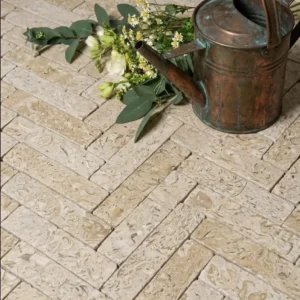
Cut direction is the first fork in the road. Vein-cut units are sawn perpendicular to the bedding and show long linear striations with elongated voids; cross-cut material, sometimes called fleuri, is sawn parallel to the bedding and shows cloudy rounded figures with more circular voids. Vein-cut travertine stone pavers read as directional and suit long running-bond walkways, while cross-cut reads calmer and forgives small layout inconsistencies across a broad terrace.
Here’s what most specifiers miss: elongated voids in vein-cut material intersect the paver edge far more often, so tumbled vein-cut units arrive with more open edge pockets. That isn’t a defect — it’s geometry — but it changes how your joints look once sand or grout goes in, and it’s worth seeing on a sample before the order is cut.
- Cross-cut faces conceal small void openings better than vein-cut faces from the same quarry bed
- Vein-cut material is directional — lay it all one way or deliberately alternate, never randomly
- Travertine marble pavers is a trade phrase, not a geological one; both stones are calcium carbonate, but travertine is a freshwater precipitate and marble is metamorphosed limestone
- Absorption and strength vary by quarry bed rather than by color name, so request the test report instead of assuming
- Natural travertine pavers drawn from one block will always sit closer in tone than units pulled from several production runs
Filled or Unfilled — the Choice You Make Before Anything Else
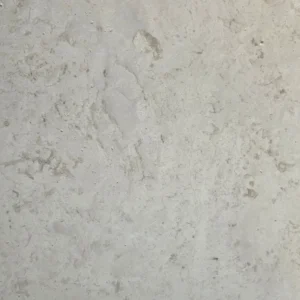
Filled travertine pavers have their surface voids packed at the plant, usually with a cementitious grout tinted to the stone or with a clear resin. Unfilled units leave the vugs open, which is the traditional look and the one that reads most obviously as natural stone from three feet away. Both are legitimate; they simply fail differently.
Cementitious fill is repairable on site with a matching grout and tends to shed a plug here and there over several freeze-thaw cycles. Resin fill holds tighter mechanically but ambers under sustained ultraviolet exposure, which shows most on pale stone. You can request sample units in both fill types from Citadel Stone before the specification is locked, and comparing them outdoors in real daylight settles the argument faster than any photograph.
Color, UV Exposure, and How the Surface Weathers in Full Sun
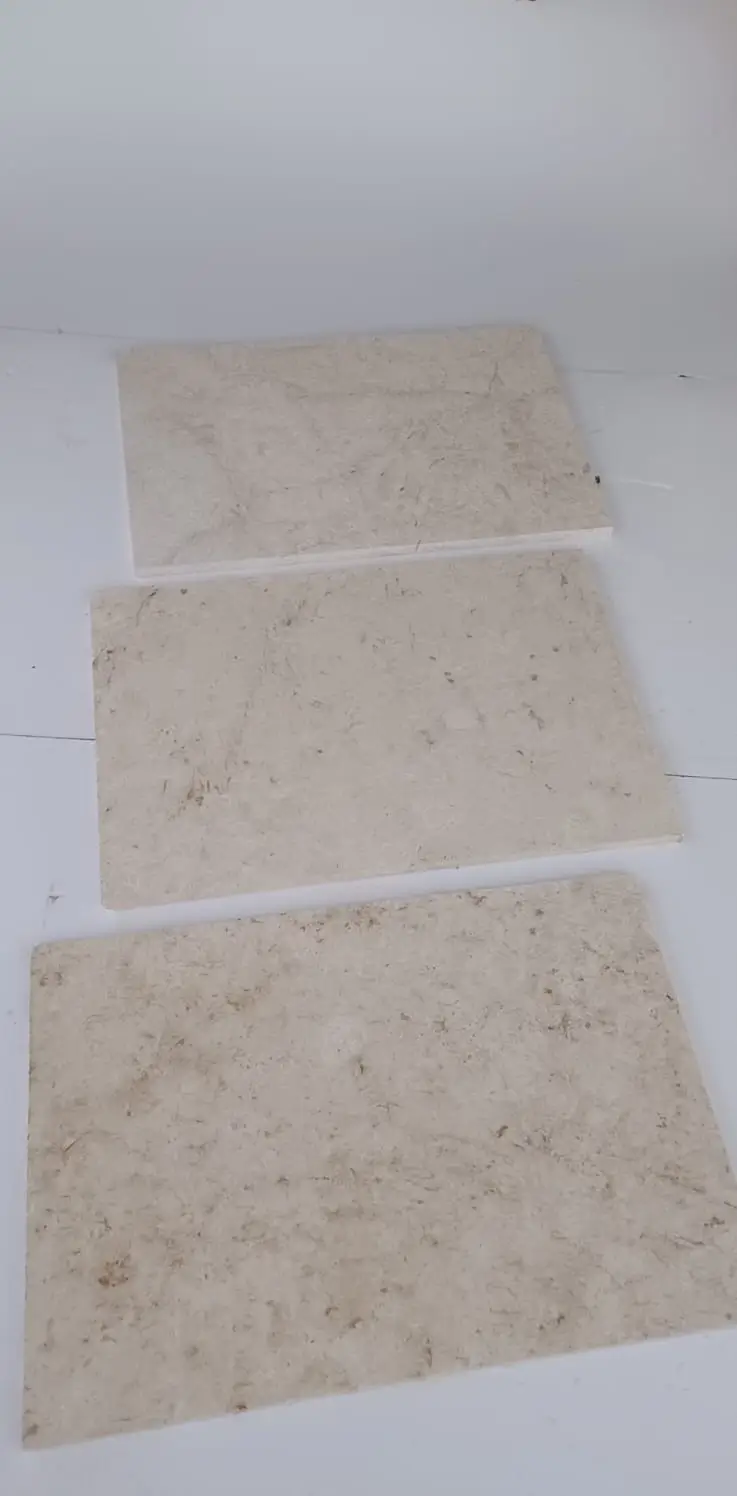
Carbonate stone doesn’t photo-degrade the way a polymer does. The coloring agents in outdoor travertine are mostly iron and manganese oxides already stable in daylight, so the base tone of a well-selected unit shifts very little over a decade. What actually changes under heavy ultraviolet load is everything you add to the stone, plus a handful of mineral reactions at the surface.
Film-forming acrylic sealers chalk, cloud and sometimes yellow on south-facing terraces long before the stone underneath shows any change; clear resin fill ambers on the same schedule. Meanwhile, scattered iron inclusions oxidize and bloom as small rust-brown halos, and shaded north edges of the same patio darken with biological growth while the sunlit field stays pale.
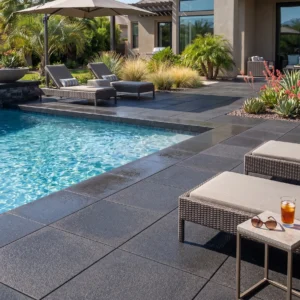
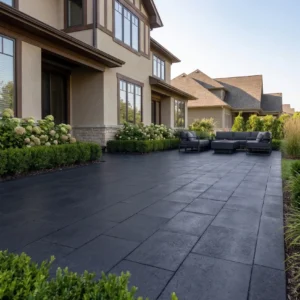
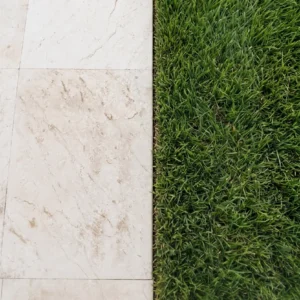
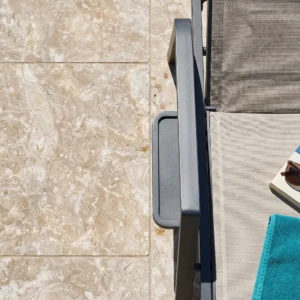
Tone selection interacts with all of this. Light travertine pavers reflect more solar radiation and stay cooler underfoot than walnut or noce tones, but they also show organic staining and rust spotting more plainly. Darker material hides staining and shows differential weathering at the joints instead. According to industry data on travertine’s outdoor behavior, the interconnected pore network is what drives both the surface temperature behavior and the moisture movement that produces those patterns.
- Choose a penetrating impregnator over a film-forming coating on any high-UV exposure — you’re protecting against staining, not trying to build a shell
- Expect a modest patina within two to three seasons; exterior travertine pavers rarely look factory-new after a full year outdoors, and that’s normal
- Classic travertine pavers in ivory and beige ranges hold their appearance well in strong sun, while resin-filled pale units are the ones most likely to show ambering
- Shellstone travertine pavers, with their visible fossil shell fragments, weather with more surface relief as softer inclusions erode slightly ahead of the matrix
- Keep planter runoff and irrigation spray off the field — mineral-heavy water leaves deposits that read as fading but are actually surface residue
A travertine backyard patio under continuous sun also dries faster after rain than a shaded one, which reduces the persistent damp that feeds algae — one reason sun-exposed areas usually need less cleaning intervention than the shaded perimeter.
Decoding the Names, Spellings, and Grades You’ll See When You Shop
Shopping for this material means wading through half a dozen naming conventions, and knowing what they signal saves real money. Travertino pavers is simply the Italian and Spanish form of the word; travertina pavers turns up in Spanish-language quotes and in typed searches. Neither indicates a different stone or a different grade.
Grade names are where the confusion has commercial consequences. Terms like classic, premium, standard and select are supplier conventions rather than standardized classifications, so the same word can describe different sorting rules at two different sources. Travertine classic pavers from one supplier may allow more void density than classic travertine pavers from another.
- Queries that mix pavers and travertine in every possible word order almost always describe the same product — focus on thickness, fill and sorting rather than phrasing
- Searches for travertine pavers floor and decor or stoneworks travertine pavers are usually people comparing big-box retail ranges against quarry-direct supply; ask both for the same three data points
- Business-name searches such as natural stone us travertine & paver or pavers travertine and more are half-remembered vendor names, not material specifications
- Travertine tiles and pavers are cut from the same blocks, separated mainly by thickness and edge treatment
- Anyone searching travertine tiles pavers is generally weighing a thin interior tile against a full-thickness exterior unit — a genuine decision, covered further below
What actually distinguishes premium travertine pavers from budget material is sorting discipline: void density, thickness tolerance, corner integrity and shade consistency across the pallet run. Before you buy travertine pavers from any source, ask how many units per pallet are permitted to fall outside the sorting standard, and whether replacements for edge-damaged pieces are handled at delivery or after the fact. Specifying travertine for outdoor patio work without that conversation is how overage budgets get destroyed.
Sizes, Thickness, and Formats That Work Outdoors
Format selection drives labor cost more than material cost. The four-piece French pattern remains a widely used outdoor layout because it absorbs dimensional variation across a field and breaks up the visual rhythm without demanding precision cutting. Modular sizes in 16×24, 12×24, 24×24 and 6×12 cover most straight-run terraces, and metric formats such as travertine pavers 600 x 400 appear on imported schedules — that’s roughly a 24-by-16 unit in working terms.
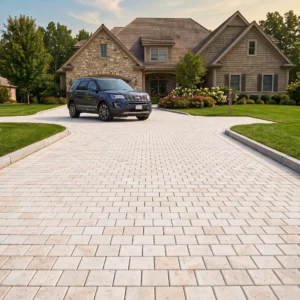
Large travertine pavers change the calculus. A 24×36 unit looks superb on a broad terrace and reduces joint count dramatically, but it also demands a flatter screed, because a large plate telegraphs every high spot as a rock. Large outdoor travertine pavers are also a two-person lift at full thickness, so plan the handling route from the truck to the setting area before the crate arrives.
- Smaller modules tolerate an imperfect base; large-format units expose it
- French pattern reduces visible shade banding because four sizes distribute tone variation across the field
- Travertine paving slabs in oversized formats need more generous joints to absorb dimensional tolerance
- Travertine tiles pavers and coping are typically cut from the same block to different thicknesses and edge profiles
- Order a sensible cutting overage on any diagonal or radial layout — waste rises sharply the moment the pattern stops running square
Thin Overlay or Full Thickness? Decide From the Substrate Up
Thin travertine pavers in the half-inch to three-quarter-inch range exist for one job: bonded overlay on a structurally sound existing slab where you can’t afford the height gain. Used there, they’re excellent. Used over sand, over a failing slab, or anywhere vehicles travel, they crack, and no setting material rescues them.
Full-thickness units — the nominal inch-and-a-quarter range that dominates exterior work — carry point loads, tolerate sand-set installation and survive lifting for future access to utilities. Whether a quote says travertino pavers or travertine paving slabs, confirm the nominal thickness and the tolerance band in writing. Citadel Stone cuts to order at our selected quarries, so non-standard thicknesses and sizes are a scheduling question rather than a stock question, and lead times are quoted with the order.
Base Preparation and Setting Methods for Outdoor Travertine Pavers
Base failure accounts for more replaced patios than material failure ever will. For sand-set work, the sequence that holds up is compacted subgrade, compacted aggregate base placed and compacted in lifts rather than all at once, a thin screed layer, then the paving. Skipping the lift discipline is a common shortcut, and it shows as differential settlement along the perimeter within two wet seasons.
Drainage geometry matters more than base depth in most residential situations. Pitch the finished surface away from structures — roughly an eighth to a quarter inch per foot is the slope commonly specified for exterior paving — and make sure the base itself drains rather than forming a bathtub under the stone. In freeze-thaw regions, water held in a saturated base beneath natural stone travertine pavers is what generates the pressure that lifts joints and spalls edges.
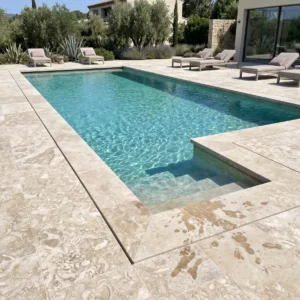
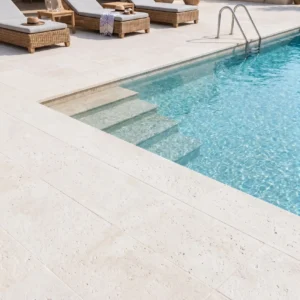
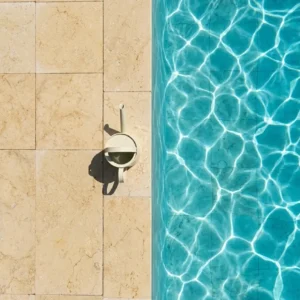
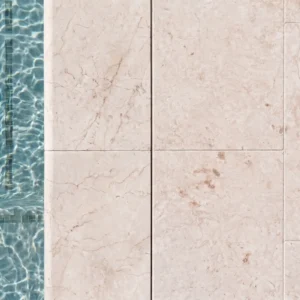
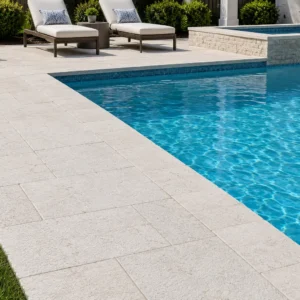
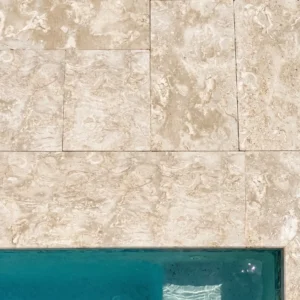
Mortar-set installation over a concrete slab is the right answer where you need a bonded, rigid travertine pavement — around pool decks, on structural slabs and over occupied space. It also requires honest movement-joint planning, perimeter joints at every restraint, and a drainage layer or bond-breaker where water can otherwise sit at the bond line. ASTM C1527 is the dimension-stone specification written specifically for this material, and the travertine dimension stone specification is the document a supplier’s test report should reference — the values themselves belong on a certificate, not in a sales sheet.
- Dense-graded base compacts tightly and sheds water laterally; open-graded base drains vertically and suits permeable designs — mixing the two philosophies mid-project causes problems
- Polymeric sand can haze on heavily textured or unfilled surfaces, so test it on spare units and sweep the field genuinely clean before activating it
- Edge restraint is not optional on sand-set fields; without it the perimeter migrates and the joints open
- Thin travertine pavers belong only on sound, clean, properly sloped concrete with an appropriate bonding mortar
- Temperature swings change the working time of setting materials, so follow the product’s stated temperature window rather than the crew’s usual schedule
Patios, Backyards, Walkways, and Stepping Stones
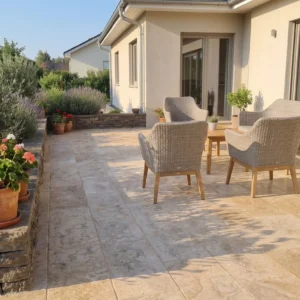
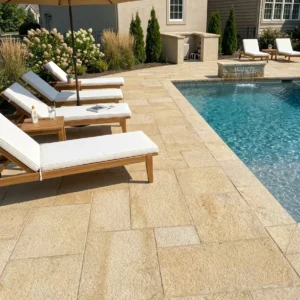
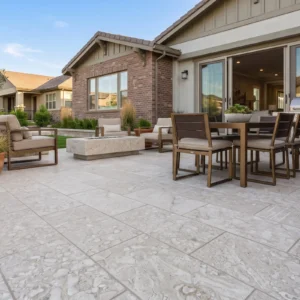
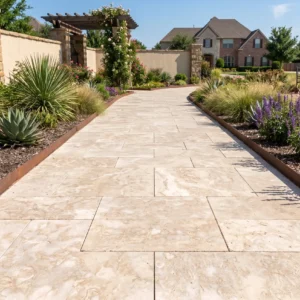
Backyard travertine pavers succeed or fail on layout logic as much as material quality. Start by locating the fixed constraints — door thresholds, existing slab edges, pool coping lines — and run the pattern off those, rather than centering the field and fighting the leftovers at the perimeter. A travertine backyard that reads as intentional almost always has its cut pieces pushed to the least visible edge.
Generous field sizes suit travertine for outside patio use. In a compact yard, large-format units make the space feel bigger because there are fewer joint lines interrupting the plane; in a sprawling one, a French pattern keeps the eye moving. Spanish-language quotes listing travertina pavers describe the same material, and the same layout rules apply regardless of how the order is written.
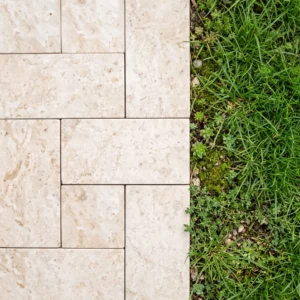
Stepping stones running through lawn need different detailing entirely. Set each unit on its own compacted pad, hold the top surface flush with or slightly below the finished turf so a mower passes cleanly, and space them on a natural stride rather than an even mathematical interval. Travertine pavers stepping stones at a uniform spacing that ignores human gait are what make a path feel wrong without anyone being able to explain why.
- Travertine landscape pavers work well as a transitional material between a formal terrace and planted areas because the tone bridges hardscape and soil
- Run the first course off a string line from the most visible sightline, not from the building wall, which is rarely as straight as it looks
- Blending from three or four pallets simultaneously prevents shade banding across a large travertine backyard patio
- Keep a small reserve of travertine stone pavers from the same run for future repairs — later production will not match precisely
Sealing, Cleaning, and Maintenance That Actually Holds Up
Sealing is a stain-management decision, not a waterproofing one. A quality penetrating impregnator reduces the rate at which oils, tannins and pigmented liquids enter the pore network, buying you time to clean up spills. It doesn’t stop moisture vapor moving through the stone, and you don’t want it to — trapped moisture under a film coating is what produces cloudy white patches on outdoor travertine.
Application timing is where most sealing jobs go sideways. The stone must be genuinely dry through its depth, not just dry to the touch, and applying in direct midday sun flashes the carrier off before it penetrates. For the full sequence, including how to test coverage and when to recoat, the guidance in how to seal travertine pavers walks through product selection and application windows in detail. Reseal on the interval your sealer manufacturer states for exterior horizontal exposure, adjusted shorter for heavy-UV south elevations.
Cleaning discipline is simple and non-negotiable: nothing acidic. Vinegar, citrus cleaners, and masonry acid washes etch calcium carbonate on contact, leaving dull patches that no sealer conceals. Use a neutral-pH stone cleaner, rinse thoroughly, and address organic growth with an appropriate outdoor biocide rather than aggressive pressure washing, which erodes the softer laminae and opens voids prematurely.
- Top up joint sand after the first full wet season — settlement is expected, and re-compacting early prevents edge chipping
- Popped plugs in filled travertine pavers are repairable with a color-matched grout; catch them before debris packs the void
- Rust spotting from iron inclusions responds to a dedicated rust remover formulated for calcareous stone, never to general-purpose acid
- Natural travertine pavers in unfilled finishes need periodic debris clearing from surface voids, particularly under deciduous trees
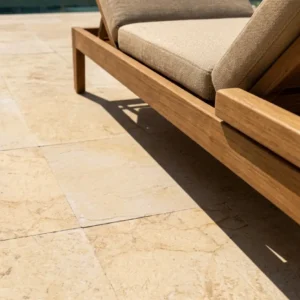
- Furniture glides prevent the point-load scuffing that shows worst on honed surfaces around a travertine pavers backyard seating area
Wet Surfaces, Finish, and What the Slip Standard Measures
Questions about wet surfaces come up on every pool-adjacent or entry project, and the honest answer starts with the measurement method rather than the material. The current standard is ANSI A326.3, and it is measured wet — replacing the ASTM C1028 static test withdrawn in 2014. The finish, not the stone type, is the variable the test responds to, and where a tested value exists for a specific finish, the test report is available on request.
Describing finishes accurately helps more than adjectives do. A tumbled finish leaves eased edges and an open, matte surface with void openings exposed at the face. Brushed finishes retain subtle relief following the stone’s own laminae. A filled and honed surface presents a flat, closed, even plane with a soft sheen. Those are texture facts, and they’re what contractors comparing concrete pavers and travertine should actually be discussing.
Specify the finish at the quote stage rather than after delivery, because it is applied at the fabrication end. For any travertine pavement in a commercial or accessibility-regulated setting, ask which finishes have been tested to the current wet method and request documentation for the specific material, since a travertine natural stone paver in one finish is not interchangeable with the same stone in another.
Sourcing, Delivery, and Site Access Planning
Delivery planning belongs in the conversation before the order is confirmed, not the week it ships. Full-thickness stone is heavy, crated and banded on pallets, and the constraint is almost never the road — it’s the last eighty feet. Low branches, soft turf, narrow gate posts and a curb the pallet jack can’t cross are what turn a straightforward delivery into a hand-carry.
Confirm three things early: whether the delivery truck can physically reach the offload point, what offload method is available, and who supplies it. A truck with a rear lift gate places pallets at the curb; a forklift or telehandler on site places them where the crew actually needs them. Offloading arrangements are confirmed before the delivery date, and lead times are quoted with the order.
- Order overage above the measured field area to cover cuts, breakage and a future repair reserve — more on diagonal layouts
- Inspect crates at delivery for transit damage and photograph anything questionable before the driver leaves
- Travertine outdoor paving slabs in large formats need a staging area close to the work; double-handling heavy units wastes a day quickly
- Buyers arriving from searches like natural stone us travertine & paver are usually trying to work out whether they’re dealing with a reseller or the source — ask directly
- Retail-branded lines such as stoneworks travertine pavers or a travertine pavers floor and decor range may ship in limited formats; confirm sizes before designing around them
Comparing travertine pavers suppliers comes down to whether the quote includes sorting standards, thickness tolerance, finish specification and documented test reporting. Citadel Stone quarries, cuts to order and arranges nationwide delivery, and material is checked against the agreed specification before it ships. Metric formats including travertine pavers 600 x 400, along with coping and step treads to match a travertine landscape pavers scheme, are cut alongside the main field order so the tone stays consistent.
Buy Travertine Pavers Direct — Citadel Stone
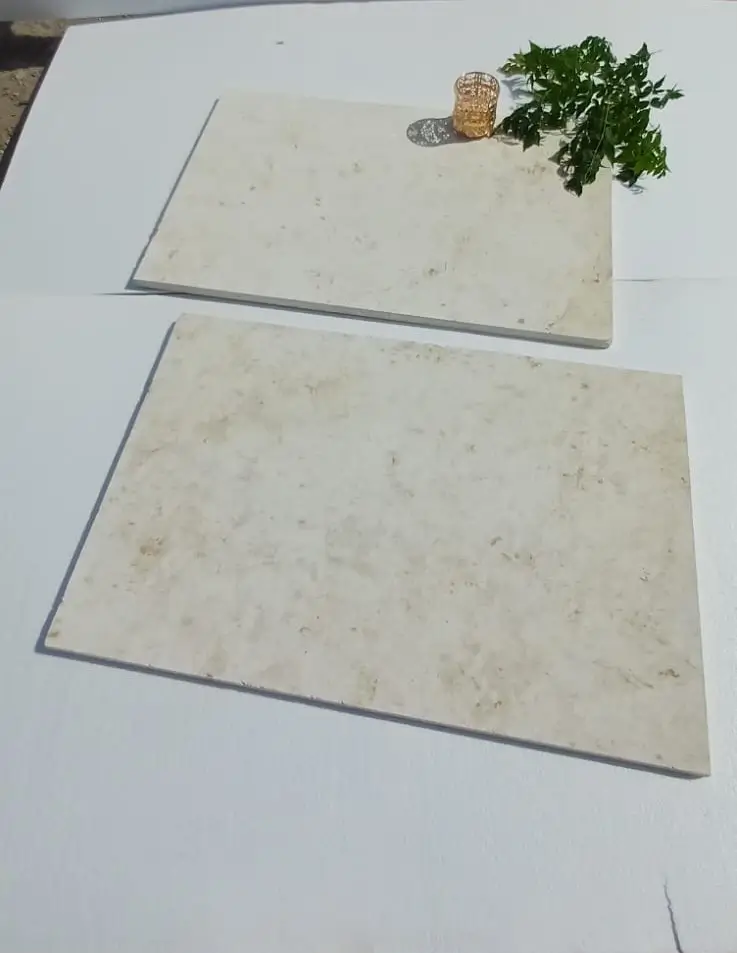
Citadel Stone cuts travertine to order at our selected quarries in the Middle East, in modular sizes, French pattern sets, large formats and matching coping, with filled or unfilled surfaces and tumbled, brushed or honed finishes. Samples and written specifications — nominal thickness, tolerance, finish and sorting standard — are available on request before you commit, and test reports are provided for the material being quoted. Trade and wholesale enquiries are handled with volume pricing and phased release schedules, and travertine pavers for sale are quoted per project rather than from a fixed list. Delivery is arranged and managed to the jobsite, with offload method confirmed in advance. Whether you need premium travertine pavers for a single terrace or a full landscape package, contact the team for a quote with quantities, formats and your site access details.
Beyond paving, the same stone runs indoors where fewer joints are the goal — large-format travertine tile options covers how oversized units are specified and set, useful reading if your project continues past the patio door. Citadel Stone delivers Travertine Pavers for exterior paving and hard landscaping, a limestone with a distinctive naturally banded texture.
See also: travertine paver cost per square foot.
Related guides: travertine paver colors guide · travertine pavers pattern · travertine pavers for driveway · how to cut travertine pavers · how thick are travertine pavers · What Are Travertine Pavers? Formation and Finishes.