50 years quarry-direct·USA & worldwide·🛡️ Escrow payment for new clients·Contact me personally for the best wholesale prices: kareem@citadelstone.us
Quarry-Direct · Middle East Natural Stone
$2.30
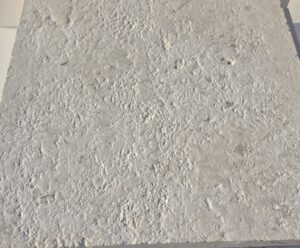
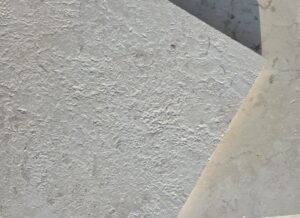
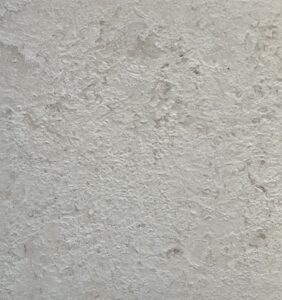
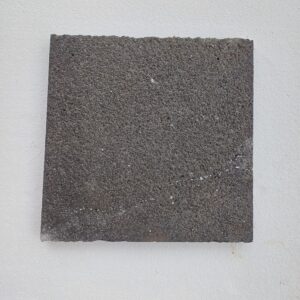
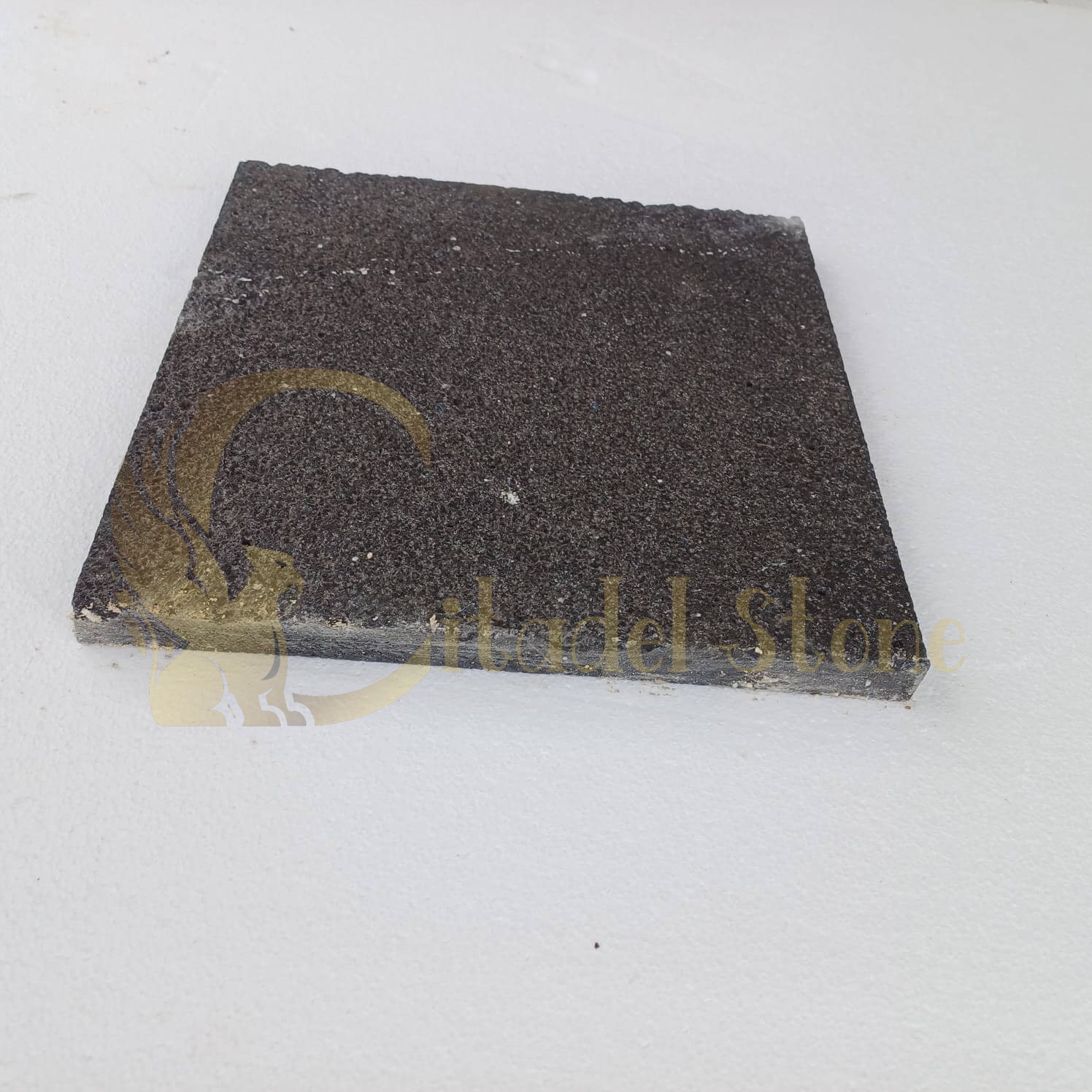
Citadel Stone’s Black Basalt Bush-Hammered 12″ × 12″ is the natural stone hardscape specification of choice for projects across the United States that demand authentic natural material, a bush-hammered surface texture, and the low water absorption of volcanic basalt (0.59–0.69%, certified mill test). The 12-inch square format is the most widely-specified residential paving proportion — sized for straightforward modular installation, suited to garden walkways and paths, residential pool decks and pool surrounds, family patios and courtyards, exterior steps, and other daily-use exterior surfaces. The bush-hammered finish is mechanically produced by impact tooling that strikes the stone surface to remove a controlled amount of material, leaving a deeply textured surface with the dramatic sculptural character that distinguishes basalt from any lighter natural-stone alternative. Quarried from Citadel volcanic deposits in the Middle East and prepared in our own facilities. No sealing required for any application; the dense crystalline structure of volcanic basalt absorbed just 0.59–0.69% water in a certified mill test. The specification that delivers the longest service life with the lowest maintenance commitment available in natural stone.
Price: $2.30 per sq. ft.
Total: $2.30
Your size. Your thickness. Your finish, confirmed for this stone.
We cut this stone to the dimensions and thickness your project calls for. Brushed is our signature finish, from a coarse 16 grit to a fine 80, or finer to order. Most of our limestone and basalt can also be supplied sawn, honed or bush-hammered; polished, tumbled and split-face are made on selected stones. Tell us the size, thickness, finish and use, and we’ll confirm what this stone can be made in. Looking for another color? See the full collection.
Planning a laying pattern? See which of our formats suit herringbone, French pattern, running bond, stack bond, basketweave and fan layouts in our paver laying patterns guide.
Ships by pallet or container to any US state · Lead time quoted per order
Suitability varies with size, thickness, finish, and substrate. Tell us your application when you request a quote and we will confirm the right specification for it.
Bedding: full-bed sand and cement mix or a flexible adhesive appropriate to the substrate.
Joints: from 3 mm for sawn tiles; wider for split-face setts and cobbles.
Sealing: a quality impregnating sealer is recommended for limestone and shellstone; basalt and granite typically need none.
Cutting: wet saw with a diamond blade.
Installation requirements differ by stone and format — a product-specific method note is included with every quote, and our team is available for your installer’s technical questions.
Pricing improves materially with quantity: pallet rates beat per-piece pricing, and full-container rates beat both. Every quote is calculated quarry-direct, with no distributor margin in between.
Distributors, stone yards, and retailers: our Trade & Wholesale Program covers container-load pricing, recurring supply schedules, and private-label production.
Orders ship by pallet or full container to any US state, with kerbside delivery to the nearest safe access point. Lead times depend on stone, finish, and quantity, and are confirmed with your quote. Samples reach any US address within five working days.
Every crate is inspected and photographed before dispatch — if anything is wrong on arrival, contact us and we will make it right.
Black Basalt Bush-Hammered 12″ × 12″ is the most widely-specified format of Citadel Stone’s signature volcanic basalt — the natural stone of choice for residential and light-commercial hardscape projects across the entire United States. The 12-inch square format and the bush-hammered finish combine in a specification that addresses the practical realities of most residential exterior work: the format is straightforward to plan, ship, and install at residential scale; the finish is one of our most textured, our pick for wet steps and slopes; and the underlying volcanic basalt material has low water absorption (just 0.59–0.69% in a certified mill test, under one-seventh of the 5% average that ASTM C936 allows for concrete pavers). From coastal Florida pool decks to Minnesota driveway paving, from California courtyard patios to Massachusetts garden walkways, this format needs no sealing and none of the maintenance commitment that limestone alternatives require.
What makes Citadel basalt the structurally superior natural stone for exterior hardscape is the geological origin of the material. Basalt is volcanic rock — formed from rapidly cooled lava, producing a dense crystalline structure with low water absorption (just 0.59–0.69%, certified mill test) and resistance to acid exposure. Where limestone is sedimentary and porous and requires sealing throughout its service life, basalt is igneous and dense and requires no sealing. Where limestone is acid-sensitive and vulnerable to staining from common environmental contaminants, basalt is acid-resistant and resistant to staining. For the practical demands of family hardscape — kids, pets, pool chemistry, weather, occasional spills, decades of daily use — basalt is the lowest-maintenance natural stone specification available.
Citadel Stone’s basalt is sourced exclusively from Middle Eastern volcanic deposits selected over five decades of trading for density, structural integrity, and colour consistency. The material is a fine-grained crystalline volcanic rock with a deep charcoal-to-black colour and minimal visual variation between pieces — the dark uniformity is part of the design appeal and one of the practical advantages over limestone alternatives, where natural colour variation must be planned around in large installations.
Compressive strength is quoted from the published range for basalt as a rock type (100–300 N/mm²), water absorption measured 0.59–0.69% (certified mill test), hardness is in the published 6–7 Mohs range for basalt as a rock type, and the material resists acids and pool chemistry. For driveway applications under vehicular loading and pool deck applications under chemical exposure, basalt is a dense, low-absorption natural stone choice.
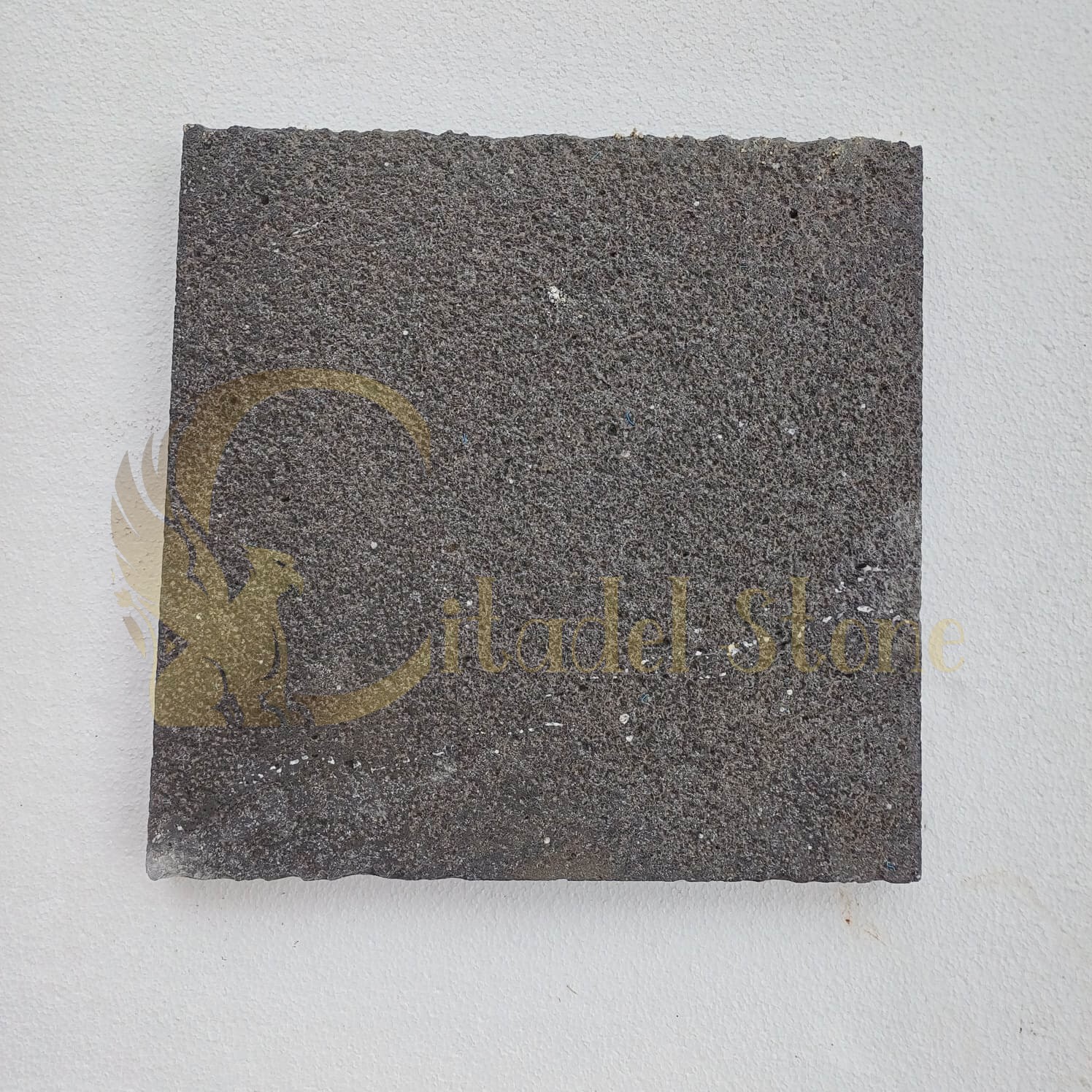
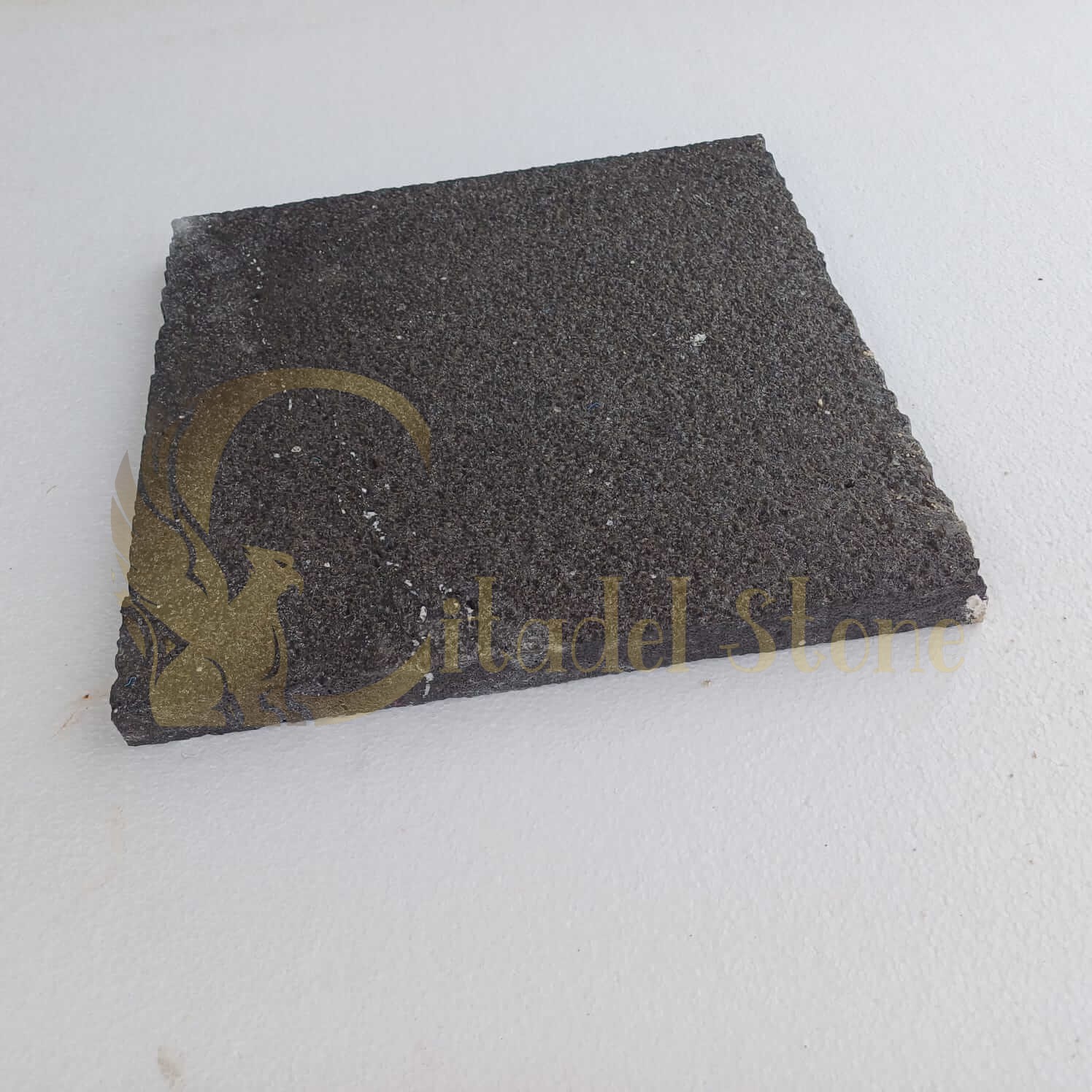
The bush-hammered finish is produced by mechanical impact tooling — a powered hammer with multiple pointed tips strikes the surface of the stone repeatedly under controlled force, removing a uniform thin layer of material and leaving a deeply textured surface. The process is intentional and precise: the depth of texture, the regularity of the pattern, and the consistency of the finish across multiple pieces are controlled by the tooling and the operator skill rather than by the natural character of the stone.
What bush-hammering delivers on basalt specifically is a deeply textured surface, one of our most textured finishes and our pick for wet steps and slopes. The texture runs deeper than the honed, polished or sawn finishes of the same stone, which makes it popular for pool decks, garden walkways in rainy climates, and other exterior surfaces that are often wet. The deeply textured surface also conceals minor wear, scratching, and the abrasive contact patterns of vehicular and pedestrian use, making the finish particularly forgiving over the long service life of a hardscape installation. The visual character is dramatic — strong directional shadow play across the textured surface gives bush-hammered basalt sculptural depth that smoother finishes cannot achieve, and the dark colour of basalt enhances the shadow contrast for a particularly bold visual statement.
The water absorption of Citadel basalt measured just 0.59–0.69% in certified mill tests on two production batches, the lowest of the stones on our certificate. Less water in the stone means less water to freeze inside it, which is why Citadel Basalt is our first choice for cold-climate paving. We do not have a freeze-thaw cycle rating for our stone; we publish its measured absorption instead. The dense crystalline structure resists the thermal expansion stress that summer heat in extreme climates creates. The chemical inertness resists pool chemistry, road salt, and atmospheric pollution that would damage less durable stones.
In practical terms: this specification is appropriate for Florida, the Gulf Coast, Hawaii, and the warm-climate American South without any of the heat-related concerns that affect some manufactured pavers. For Minnesota, Maine, Montana, and the rest of the cold-climate American North, Citadel basalt is the stone in our range we recommend: its water absorption measured 0.59–0.69% in a certified mill test. Ask us about thickness and finish; your installer or engineer designs the base and bedding.
Citadel basalt does not require sealing for any application. This is one of the principal practical advantages of basalt over limestone, marble, sandstone, and the porous natural stone alternatives — the dense crystalline structure of volcanic basalt has low water absorption (0.59–0.69%, certified mill test) and is naturally resistant to staining, weather, and chemical exposure. The initial installation requires no sealer application, and no resealing maintenance is needed across the service life of the installation.
Some installers choose to apply a colour-enhancing sealer to basalt for purely aesthetic reasons — the sealer deepens the dark colour and produces a slight wet-look surface character that some clients prefer. This is a finish preference rather than a maintenance requirement, and it is entirely optional. For clients who prefer the natural matte appearance of bush-hammered basalt as installed, no sealer is required at any point. For clients who prefer the enhanced visual depth of a sealed finish, a colour-enhancing penetrating sealer can be applied at installation and reapplied as the aesthetic effect fades, typically every five to seven years. Neither approach is technically necessary for the stone’s performance; both are valid based on visual preference alone.
The six application sections below address the residential and light-commercial settings where the 12″ × 12″ bush-hammered format performs at its best.
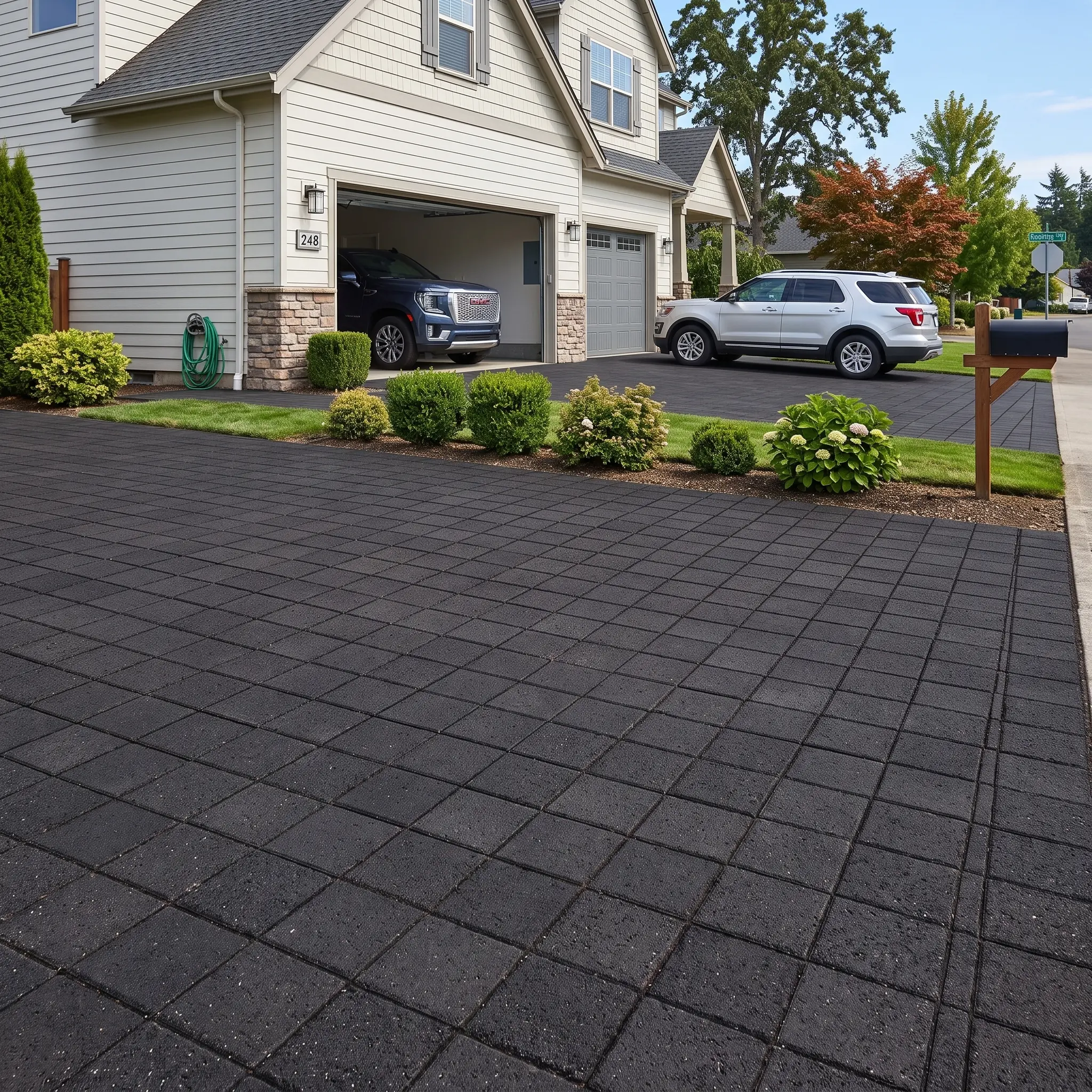
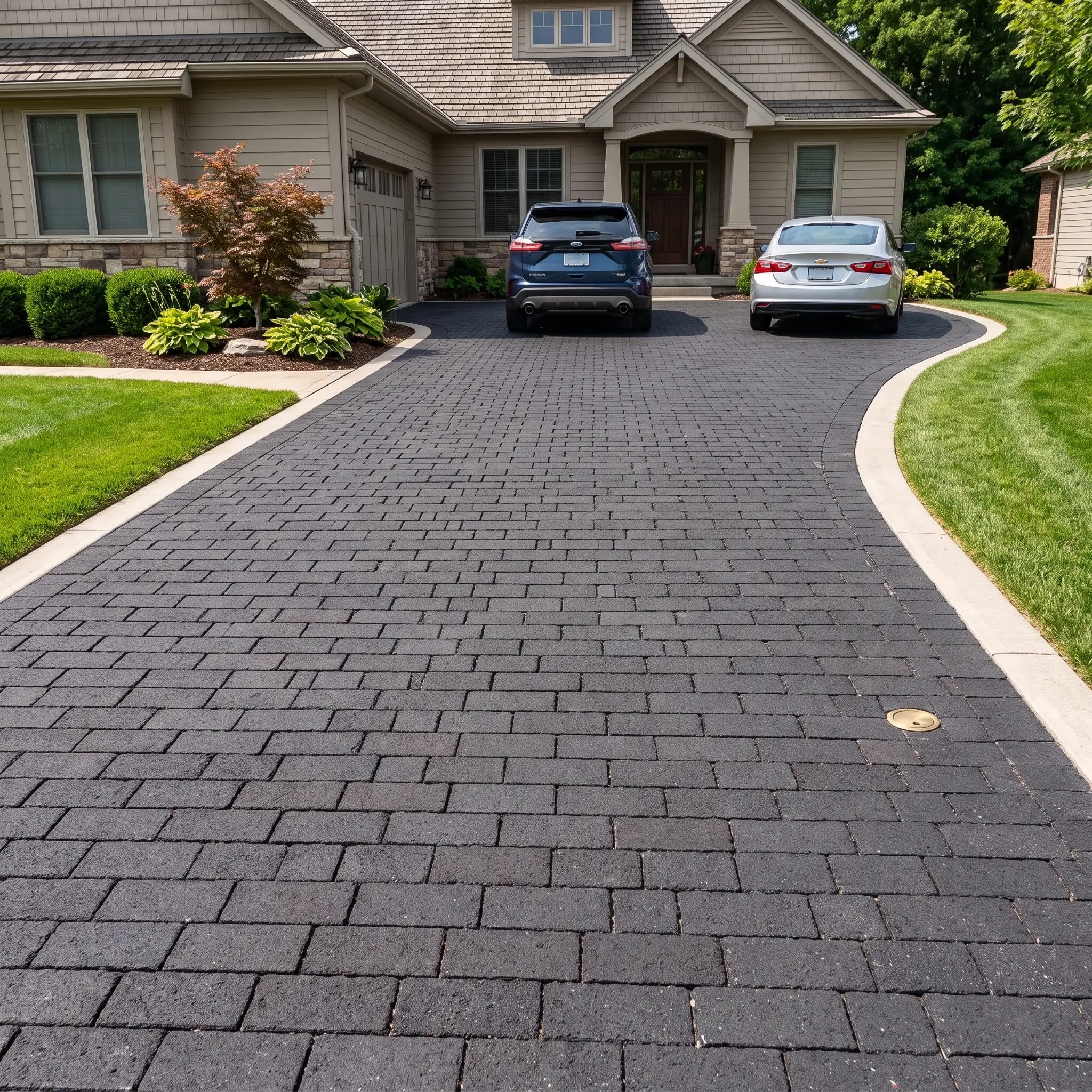
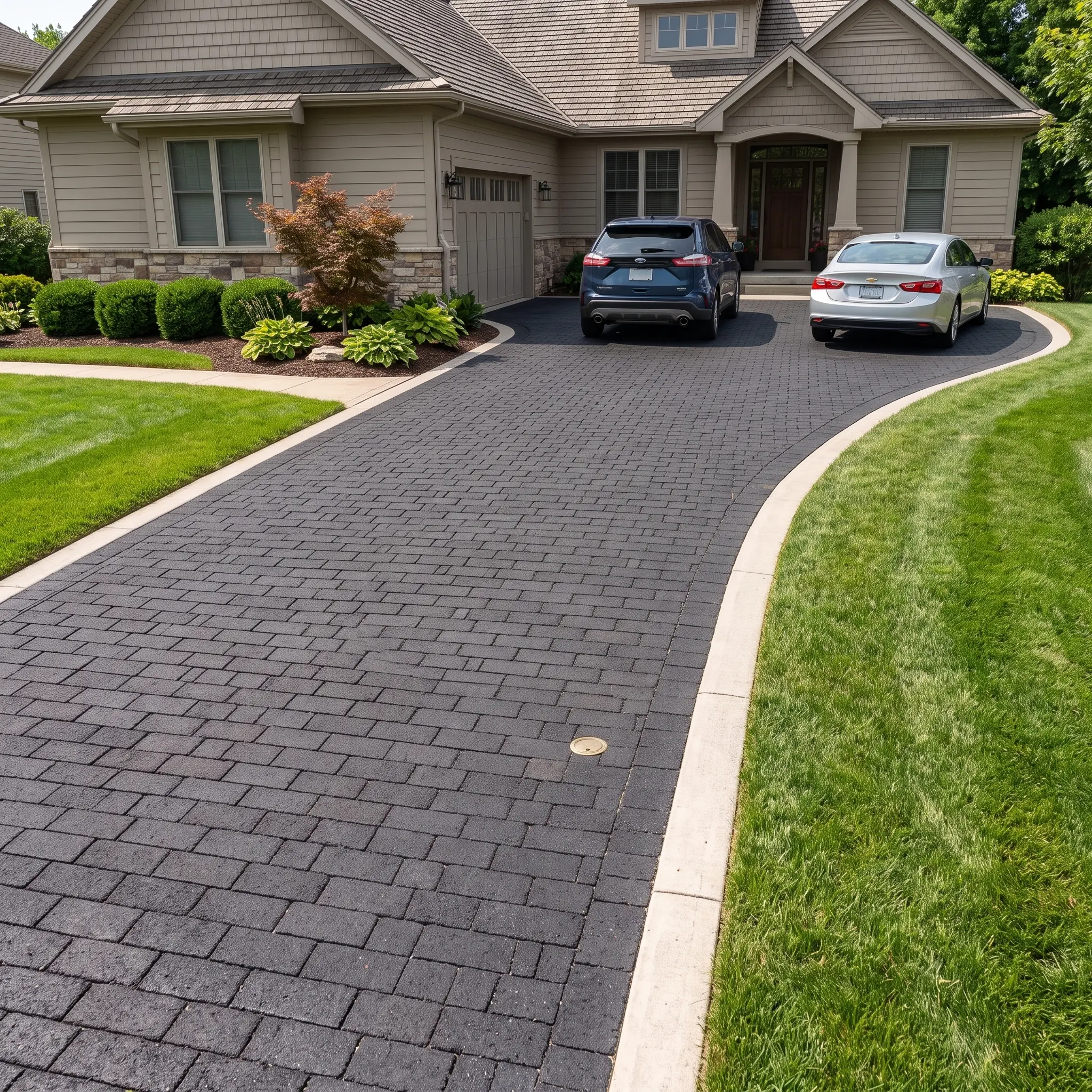
The 12-inch square is a popular residential driveway specification for projects where the visual scale of smaller modular paving complements the residential architecture rather than oversized commercial-format slabs. For driveways, choose Citadel basalt pavers 2 in (5 cm) or thicker mortar-bonded to a reinforced concrete slab, or our basalt setts and cobbles at least 3.5 in (4 in standard) thick on a compacted base; for light trucks and service vehicles, your designer sets the thickness. The bush-hammered finish is textured rather than polished, a common choice for sloped driveways and rainy-climate installations. Any paving can be slippery when wet. Finish, slope, drainage, sealer and footwear all play a part, so ask your designer to confirm local pool-deck and code requirements. Edge restraints are important for any driveway installation, and a properly engineered base — typically 6 to 12 inches of compacted aggregate depending on local soil conditions and frost line — is essential for long-term performance under vehicular loading. The 12-inch format installs in straightforward grid patterns that are quick for experienced installers to lay and easy for clients to maintain.
Pool decks are one of the strongest applications for bush-hammered basalt. The combination of properties is purpose-suited to the environment: the bush-hammered texture is one of our most textured finishes and popular for pool decks, the dense basalt structure resists chlorinated and salt-system pool chemistry that damages limestone surrounds over time, the dark colour does not show pool chemical residue and stays visually consistent over decades of use, and the no-sealing-required protocol eliminates the annual maintenance commitment that limestone pool decks demand. The 12-inch format works well for residential pool decks where the visual scale matches typical residential pool dimensions; for larger commercial and resort pool installations, the same finish in larger formats (16-inch, 18-inch, 24-inch) is appropriate. Pool deck installations require careful drainage planning to move water away from the pool perimeter, and a thicker pieces (1-3/16 inch minimum) is the appropriate specification for the regular weight loading of pool furniture and pedestrian traffic.
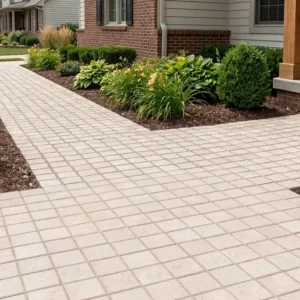
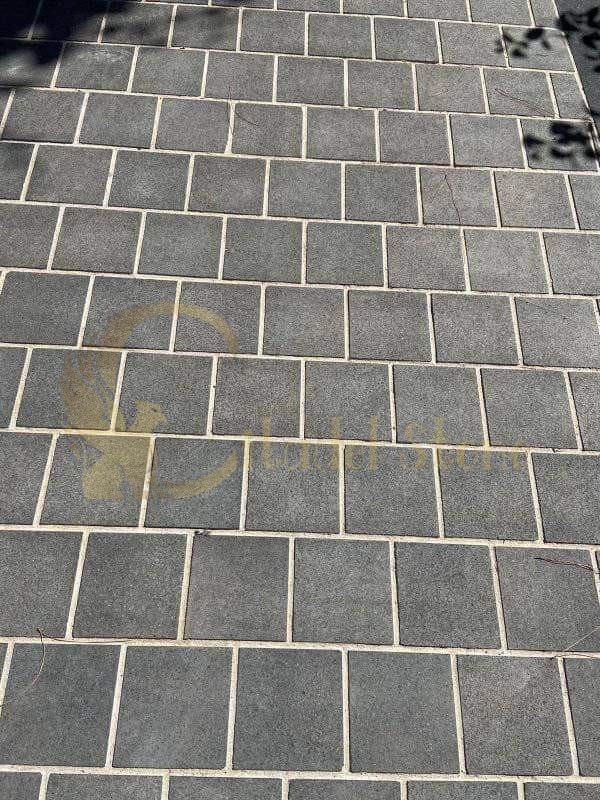
Family patios and outdoor entertaining spaces use this format extensively across both warm and cold climate USA markets. The 12-inch square format installs cleanly in modular grid layouts, and the bush-hammered finish handles the daily wear of furniture movement, foot traffic, and occasional food and beverage spills without showing the marks or absorbing the staining that affects more porous stones. The dark colour of basalt provides visual grounding for outdoor furniture and softens against surrounding landscape planting — a practical and aesthetic advantage in residential patio design where the patio is read in dialogue with the planting beds around it. The deep black surface gives family patios and pool-adjacent terraces a strong, grounded look, and the same basalt carries on through paths, steps and pool surrounds.
Garden walkways and exterior paths through residential landscapes use this format as the workhorse natural-stone hardscape specification. The 12-inch square installs straight or in offset patterns along path runs, accommodates curves and direction changes with modest cutting, and reads as appropriately scaled to garden-path environments. The bush-hammered surface is textured rather than polished (one of our most textured finishes, and our pick for wet steps and slopes), and the no-maintenance protocol means a garden walkway installed in this material delivers decades of service without the annual sealing or treatment cycles that limestone alternatives require. Path widths from 24 inches (narrow garden path) through 48 inches (formal main walkway) are easily accommodated by the 12-inch module in two- to four-piece-wide layouts. Edge treatment can be specified in matching basalt curbing for a unified material vocabulary or in contrasting limestone for deliberate visual contrast.
Enclosed courtyards, side-yard hardscape, and the architectural exterior surfaces that frame residential and light-commercial buildings use this format extensively. The 12-inch grid pattern reads as appropriately formal for courtyard environments without the overscaled appearance of commercial-format slabs. The dark basalt colour provides the visual weight that anchors courtyard architecture and grounds the surrounding building masses. Drainage planning is critical for any courtyard installation, since enclosed spaces collect water that must be managed through deliberate drainage rather than the natural runoff possible on open patios.
Exterior steps and step treads are an important application for bush-hammered basalt, our pick for wet steps and slopes. The bush-hammered finish, one of our most textured finishes, is our pick for wet steps and slopes. The 12-inch square format is suitable for short step runs where the depth of the step matches the format dimension; for deeper step treads, larger formats or custom-cut pieces are typically more appropriate. Step nosing detail can be supplied as either a square cut, a chamfered edge, or a bullnose profile depending on the architectural intent, with bullnose treatments providing the softest edge profile for residential use. Step treads should be installed on a properly engineered structural substrate — typically a reinforced concrete base — with the basalt bonded as a finish surface rather than carrying structural loading.
| Property | Value | Notes |
|---|---|---|
| Stone Classification | Volcanic Basalt | Igneous rock formed from rapidly cooled lava; dense crystalline structure. |
| Origin | Citadel Volcanic Deposits, Middle East | Hand-quarried from Citadel Stone’s exclusive Middle Eastern volcanic source. |
| Surface Treatment | Bush-Hammered | Mechanical impact tooling produces a deeply textured surface. |
| Format | 12″ × 12″ | Standard residential modular format; metric equivalent 30 × 30 cm. |
| Density | 3.01–3.06 g/cm³ (certified mill test) | Certified mill test, two production batches. |
| Water Absorption | 0.59–0.69% (certified mill test) | Water taken up by weight. Lower means less moisture uptake and staining. Less water in the stone also means less water to freeze inside it. |
| Compressive Strength | 100–300 N/mm² (about 14,500–43,500 PSI; published range for basalt as a rock type) | Suited to vehicular loading and structural hardscape; vehicle use is a thickness-and-base decision. |
| Mohs Hardness | 6 – 7 | Significantly harder than limestone, marble, or sandstone. |
| Texture and typical use | Strongly textured; our pick for wet steps and slopes, and popular for pool decks | Bush-hammered surface is deeply textured: our pick for wet steps and slopes. |
| Acid Resistance | Excellent | Resistant to acidic spills, pool chemistry, road salt, atmospheric pollution. |
| Cold-Climate Paving | 0.59–0.69% water absorption (certified mill test) | Ask us about thickness and finish for cold-climate paving. |
| Heat Resistance | Excellent | Dense volcanic stone, formed from lava. |
| Sealing Requirement | Not Required | Optional colour-enhancing sealer for aesthetic preference only. |
| Climate Suitability | Our First Choice for Cold Climates | For freeze-thaw and de-iced paving, ask us about thickness and finish; your installer or engineer designs the base, bedding and joints. |
| Restorability | Excellent | Surface can be re-honed and re-textured by stone restoration specialists. |
The 12″ × 12″ format is supplied in a range of thicknesses appropriate to different application loadings. Heavier thicknesses are specified for driveways and high-traffic commercial use; standard thicknesses serve residential patios, walkways, and pool decks.
| Thickness | Imperial | Recommended Application |
|---|---|---|
| 3/4 inch (2 cm) | 3/4 in | Wall cladding, sheltered light-duty pedestrian surfaces. |
| 1-3/16 inch (3 cm) | 1-3/16 in | Standard residential patios, pool decks, walkways — most widely specified. |
| 1-9/16 inch (4 cm) | 1-9/16 in | High-traffic commercial pedestrian areas and plazas. |
| 2 inch (5 cm) | 2 in | Driveways, mortar-bonded to a reinforced concrete slab; heavier vehicular paving to the designer’s thickness. |
| Custom | On request | Bespoke specification for commercial and architectural projects. |
| Specification | Value |
|---|---|
| Face Dimensions (Imperial) | 12″ × 12″ |
| Face Dimensions (Metric) | 30 × 30 cm |
| Coverage (per piece) | 1.0 sq ft (0.09 sq m) |
| Approximate Weight (1-3/16 inch thickness) | 15 – 17 lbs per piece |
| Pieces per Pallet (typical, 1-3/16 inch) | 80 – 120 pieces |
| Pallet Coverage (typical) | 80 – 120 sq ft |
| Recommended Cutting Waste Allowance | 5 – 10% depending on layout complexity |
| Custom Dimensions | Available on request |
The comparison below positions Black Basalt Bush-Hammered 12″ × 12″ against the four materials most often considered as alternatives for residential exterior hardscape: porcelain pavers, concrete pavers, granite, and bluestone.
| Property | This Stone | Porcelain | Concrete Paver | Granite | Bluestone |
|---|---|---|---|---|---|
| Natural Material | Yes | No (manufactured) | No | Yes | Yes |
| Water Absorption | 0.59–0.69% (certified mill test) | <0.5% | 4 – 7% | 0.1 – 0.5% | 0.5 – 2% |
| Mohs Hardness | 6 – 7 | 7 – 8 | 4 – 5 | 6 – 7 | 5 – 6 |
| Compressive Strength | 100–300 N/mm² (about 14,500–43,500 PSI; published range for basalt as a rock type) | Variable | 30 – 50 N/mm² | 150 – 250 N/mm² | 100 – 150 N/mm² |
| Texture and typical use (textured) | Bush-hammered: strongly textured; our pick for wet steps and slopes, and popular for pool decks | Variable | Good | Variable | Good |
| Sealing Required | No | No | Recommended | Recommended | Recommended |
| Acid Resistance | Excellent | Excellent | Moderate | Good | Good |
| Water Absorption | 0.59–0.69% (certified mill test; lowest of the stones on our certificate) | Excellent | Good | Excellent | Good |
| Heat Tolerance | Excellent | Excellent | Good | Excellent | Good |
| Lifespan | Multi-Generational | 30 – 50 years | 20 – 40 years | Multi-Generational | Multi-Generational |
| Visual Authenticity | True Natural | Engineered Print | Industrial | True Natural | True Natural |
| Restorability | Excellent | None | Limited | Good | Good |
| Maintenance Demand | Lowest | Lowest | Moderate | Low | Low |
Black Basalt Bush-Hammered occupies a distinctive position: it matches porcelain on weather performance and maintenance simplicity while delivering authentic natural-stone identity, true multi-generational lifespan, and restorability. Against concrete pavers, it offers dramatically superior longevity and weather performance. Against other natural stones, it offers the lowest ongoing maintenance commitment, and of the stones we sell it is the one we recommend for freeze-thaw winters. The combination of properties is unique in natural-stone hardscape.
Black Basalt Bush-Hammered 12″ × 12″ is installed using standard modular natural-stone hardscape techniques. Substrate preparation depends on the application: pedestrian-only patios and walkways typically use a compacted aggregate base (4 to 6 inches of crushed stone) with a sand or stone-dust setting layer; pool decks and high-traffic areas typically use a deeper aggregate base (6 to 8 inches) with consideration for drainage; driveways use the driveway formats: pavers 2 in (5 cm) or thicker mortar-bonded to a reinforced concrete slab, or our basalt setts and cobbles at least 3.5 in (4 in standard) thick on a compacted base.
Installation method depends on base type. Sand-bed installations use polymeric jointing sand between pieces to stabilise the layout against weed growth and minor settlement movement; this is the most common residential installation method. Mortar-bed installations on a concrete substrate are used for pool decks, elevated patios, and applications where joint precision and stability are critical; mortar joints are typically 1/8 to 1/4 inch and matched closely to the dark basalt tone using grey or charcoal grout.
Edge restraints are essential for any sand-bed installation to prevent lateral migration of the pieces over time — typically a buried concrete or metal edge restraint along the perimeter of the installation. For mortar-bed installations, properly designed perimeter detailing serves the same function.
Pre-installation sealing is not required — one of the practical advantages of basalt over limestone. Post-installation cleaning is straightforward: a thorough washdown with clean water removes installation residue and reveals the final appearance of the installation.
The maintenance of bush-hammered basalt is the simplest of any natural stone in residential hardscape. Routine care consists of periodic sweeping or low-pressure blowing to remove accumulated grit, leaves, and organic debris. Washing with clean water is performed as needed — typically seasonally — and pressure washing is acceptable at moderate pressure (under 1,500 PSI) with a fan nozzle for more thorough cleaning of accumulated dirt or biological growth.
The bush-hammered surface texture conceals minor wear, scratching, and the cumulative effect of decades of use better than smoother finishes, which means the installation maintains its visual character over time without active intervention. For installations that accumulate biological growth (moss, lichens, algae in shaded or damp settings), a dilute natural-stone cleaner can be applied without concern — basalt’s acid resistance means that even more aggressive cleaning products that would damage limestone are safe to use on basalt.
No sealing or resealing is required at any point in the service life of the installation. Some installations develop a slight surface patina over many years of use, particularly in coastal or industrial environments where atmospheric mineralisation builds gradually on the stone — this is part of the natural character of the material and generally considered an aesthetic enhancement rather than degradation. For installations where the original appearance is preferred, professional cleaning every five to ten years restores the as-installed finish.
In the event of damage to individual pieces — impact damage, deep gouging from heavy equipment, or staining from non-typical exposure — pieces can be lifted and replaced individually in sand-bed installations. The dense crystalline structure of basalt means replacement pieces blend visually with the surrounding installation without the colour-matching concerns that apply to limestone or other variable natural stones.
Both products use the same Citadel basalt and the same bush-hammered finish; the difference is the format dimension and the resulting installation character. The 12″ × 12″ square format reads as more traditional residential hardscape with smaller modular pieces; the 24″ × 12″ rectangle reads as more contemporary and architectural with elongated proportions that draw the eye along the length of a path or patio. The 12″ × 12″ is the appropriate specification for traditional residential settings, smaller-scale projects, and installations where the visual rhythm of a smaller-piece grid is desired. The 24″ × 12″ is the appropriate specification for contemporary architectural settings, larger-scale projects, and installations where directional flow across the surface is desired. Both formats can also be combined in coordinated installations — the most popular pattern is using the larger format for the primary hardscape area and the 12″ × 12″ as a border or detail piece.
Sealing is not needed to limit moisture uptake: Citadel basalt’s water absorption is low, 0.59–0.69% in certified mill tests on two production batches. In freeze-thaw winters the build matters as much as the stone: talk to us about the right thickness and finish, and have your installer design the base and bedding for frost and de-icing salt.
The choice between bush-hammered basalt and porcelain pavers is fundamentally a choice between authentic natural material and engineered alternative. Porcelain pavers offer excellent weather performance, no sealing requirement, and competitive pricing in standardised formats. Black Basalt Bush-Hammered offers all of these advantages plus true natural-stone identity, multi-generational lifespan rather than the 30 to 50 year service life of porcelain, restorability across the lifetime of the installation, and the genuine material value that natural stone adds to a property. For projects where authentic natural material is part of the design intent and long-term property value, basalt is the appropriate choice. For projects where straightforward standardisation and the lowest acquisition cost are the priorities, porcelain may be the practical alternative. Both are legitimate specifications for different project priorities; the bush-hammered basalt is the choice for the longer-term, higher-investment perspective.
Yes — with the appropriate thickness specification. For passenger vehicle driveways, choose pavers 2 in (5 cm) or thicker mortar-bonded to a reinforced concrete slab, or our basalt setts and cobbles at least 3.5 in (4 in standard) thick on a compacted base. For driveways with frequent heavier-vehicle use, your designer sets the thickness and base. The 12-inch format installs cleanly across driveway widths from single-car (typically 10 to 12 feet) through double-width (typically 16 to 20 feet), and the modular grid pattern reads as appropriately formal for residential driveway architecture. Pattern variations including running bond, offset patterns, and incorporated border details using contrasting Citadel limestone are commonly specified for visual interest. The bush-hammered finish is the textured choice for sloped or rainy-climate driveways.
Yes — black basalt makes a striking pool deck in warm climates, where the deep black tone sets off blue water beautifully. For pool decks and surrounds, brushed is a popular choice, and we recommend a coarse grit; for wet steps and slopes, bush-hammered is our pick. Many designs pair the black field with pale coping or border accents for contrast. The same Citadel Basalt then carries on through the surrounding patio and walkways for one continuous material.
Standard 12″ × 12″ bush-hammered format is normally available from stock for delivery to most United States destinations within three to four weeks of order confirmation. Custom thicknesses, custom dimensions, and large commercial orders typically require six to twelve weeks. Minimum order quantities are modest — typically a single pallet (80 to 120 square feet of coverage depending on thickness) is the practical minimum for cost-effective shipping. For trade accounts, commercial projects, and orders above three pallets, dedicated production runs and structured pricing reflecting volume are coordinated through the Citadel Stone trade support team. Physical samples are dispatched ahead of full orders on request to confirm the colour, texture, and surface character before commitment.
Citadel Stone provides a free consultation service for every Black Basalt Bush-Hammered project regardless of scale. The consultation includes review of the project scope, application-suitability assessment, thickness recommendation appropriate to the loading conditions, base preparation guidance, pattern and layout recommendations, coverage and quantity take-off with appropriate waste allowance, and discussion of any project-specific specification considerations. Consultation is available by email, telephone, and video call, and is staffed by experienced natural stone specialists who understand the technical and practical demands of basalt hardscape specification.
For landscape designers, contractors, architects, and developers working on residential and light-commercial projects across the United States, Citadel Stone provides dedicated trade support. This includes priority technical advice during specification development, lead-time guarantees on committed orders, custom thickness and dimension development for project-specific requirements, presentation sample boards for client meetings, and structured pricing for sustained trade volumes. Trade accounts are opened on request and require a single project reference to activate.
Physical samples of Black Basalt Bush-Hammered 12″ × 12″ are dispatched to specifiers and homeowners alike on request. The colour, surface texture, and tactile quality of bush-hammered basalt are most accurately understood in physical form rather than from photography, and the sample allows the surface character, the dark colour saturation, and the texture to be assessed in the actual lighting and use context of the project setting before commitment. To request a sample, a quote, or a project consultation, contact Citadel Stone directly using the form on this page or the email address provided.
Product specifications and pricing are subject to change. Contact Citadel Stone for current stock availability and project-specific recommendations.
Choose Your Finish with Confidence
The finish decides how your stone looks, feels and grips underfoot. Compare every finish we produce — brushed 16, 36 and 80 grit, honed and bush-hammered — photographed up close on the actual stone we supply, so you can judge the texture before you order. Samples of any finish are at your door within 3 working days.
Explore the Stone Finishes GalleryA sample of the exact stone ships before any full order — judge tone, veining, and texture in your own light.