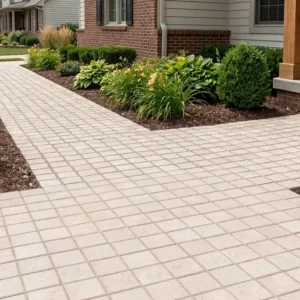
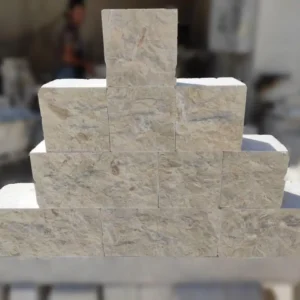
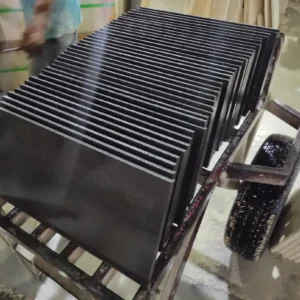
Travertine pavers for driveway applications put the material through one of the harshest load cycles it will ever face — repeated wheel loading, thermal expansion, and oil or fluid contamination from parked vehicles. The question most specifiers ask first is whether travertine is structurally suited to vehicle traffic, and the honest answer is that suitability depends almost entirely on thickness selection, base engineering, and joint design — not on the stone’s general reputation. Get those three variables right, and you can expect decades of service life from a travertine driveway. Miss any one of them, and even the most carefully specified stone will fail at the joints within a few seasons.
Structural Performance Under Vehicle Traffic
Your first specification decision is nominal thickness. Pedestrian pavers and driveway pavers are not interchangeable — the point loads from a vehicle axle compress the setting bed and paver simultaneously, and a paver sized for foot traffic will flex or fracture under that repeated stress. For standard passenger vehicles, a minimum nominal thickness that your structural engineer confirms against the ASTM test method for compressive strength is the right baseline — request the test report from your supplier rather than relying on a verbal assurance. For heavier vehicles, a thicker profile is warranted, and the base depth increases accordingly.
The base itself deserves as much attention as the paver. A well-compacted aggregate sub-base, graded to drain laterally, prevents the hydrostatic pressure build-up that heaves paver fields from below. In clay-heavy soils, the interaction between soil expansion and the rigid paver plane becomes a critical variable — you may need a geotextile separation layer to keep fines from migrating into your aggregate over time. According to Natural Stone Institute driveway paving stone durability and abrasion resistance, the long-term field performance of natural stone paving is closely tied to sub-base engineering rather than to the stone’s surface properties alone.
The travertine driveway load capacity and thickness question resolves differently depending on your soil classification and expected vehicle type. For a single-car residential driveway on well-draining sandy loam, your base specification will differ from what you need under a concrete-heavy delivery access lane. Always work from a site-specific sub-base calculation — generic rules of thumb don’t account for your actual soil bearing capacity.
Understanding Travertine’s Properties in a Driveway Context
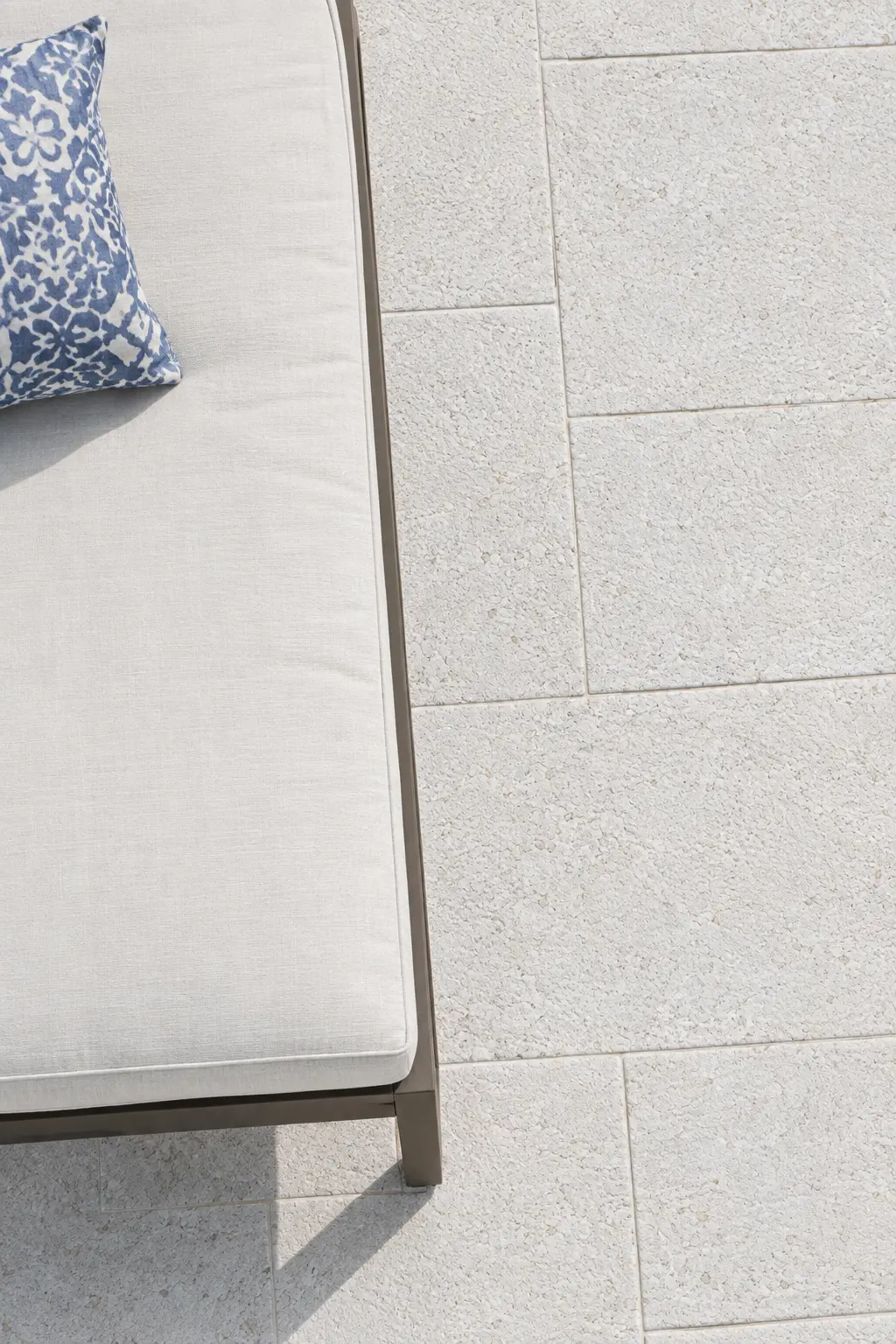
Travertine is a sedimentary limestone formed by mineral-rich spring deposits, and its characteristic open-pore structure is both an aesthetic asset and a practical consideration in vehicle-use areas. That porosity means the stone will absorb motor oil, brake fluid, and road grime faster than a denser igneous material would — not enough to disqualify it from driveway use, but enough to make sealing a non-negotiable part of the specification rather than an optional upgrade.
- The pore structure varies between filled and unfilled travertine — filled pavers have the voids grouted at the factory, which reduces surface absorption and makes them easier to maintain in a driveway setting
- Thermal expansion across a travertine driveway field is real and must be designed into the joint spacing — your movement calculation should drive that spacing, not a default rule
- Surface finish affects both maintenance burden and texture — a honed or brushed finish sits closer to a vehicle’s drip line and shows contamination more visibly than a tumbled finish, which has a more open, matte surface that can partially conceal minor staining between seal cycles
- Abrasion from tyre contact is a long-term factor — travertine performs well under normal passenger vehicle frequency, but high-volume commercial traffic would require testing data to confirm suitability for that specific use case
ASTM C1527 covers the standard specification for travertine dimension stone, and requesting a copy of that test report from your supplier is the most straightforward way to confirm the stone meets the compressive and absorption thresholds your project drawings call for. According to the ASTM C1527 travertine dimension stone standard specifications, physical property requirements are defined by test, and those test results belong in your specification package — not a verbal assurance from the sales side.
Choosing the Right Finish for Driveway Travertine Pavers
Your finish selection for travertine pavers in a driveway context isn’t purely aesthetic — it directly affects how the surface responds to vehicle contact, water pooling, and cleaning cycles. A tumbled finish leaves an open, matte texture with gently rounded edges that sit naturally in a residential landscape context. A honed finish is smoother and more formal in appearance but requires more frequent attention in a driveway setting where contamination events are more common.
Slip resistance on a wet surface is a genuine specification concern for any driveway entry, particularly where the pavers transition from a public footway into the private driveway. The governing standard is ANSI A326.3, which measures wet — finish is the primary variable that determines how any given stone performs under that test protocol, and the test report is available on request. Never rely on a dry-surface assessment to satisfy a wet-surface requirement.
- Tumbled travertine: open, matte surface texture — a common choice for traditional or Mediterranean-style driveways
- Honed travertine: smoother surface, more refined appearance — requires more diligent sealing maintenance in vehicle-use areas
- Brushed travertine: directional texture that adds surface character — sits between tumbled and honed in terms of maintenance frequency
At Citadel Stone, we recommend specifying your finish based on the full maintenance commitment you can realistically sustain over the stone’s service life — not just on the day-one appearance you want to achieve.
Base Preparation and Joint Design That Determines Longevity
The detail that separates a travertine driveway that ages well from one that gets rebuilt early is joint design and maintenance. Polymeric sand, properly installed and compacted into the joints, resists wash-out far better than standard jointing sand — but it still requires inspection after the first wet season, because even correctly installed joints settle slightly as the sub-base beds down. You’ll keep joint integrity only by refilling and re-compacting in those early cycles rather than waiting until visible movement appears.
Expansion joints placed at regular intervals across the driveway field accommodate the thermal movement that travertine undergoes through seasonal temperature cycles. The coefficient of thermal expansion for travertine is available on the supplier’s test report — take that figure, apply it to your longest unbroken paver run, and calculate joint spacing from your own movement arithmetic. Guessing at spacing based on a generic recommendation leaves you exposed to cracked stone if your joint interval is too wide for the temperature range your driveway will actually see.
- Aggregate sub-base: compact in lifts, confirm depth against your soil bearing capacity and expected vehicle load
- Bedding layer: consistent thickness across the entire field — uneven bedding is the most common cause of rocking pavers under vehicle load
- Joint filling: polymeric sand compacted and sealed at installation, inspected and refilled after the first wet season
- Expansion joints: sized and spaced from your movement calculation, not a generic rule
- Edge restraint: rigid restraint at all perimeter edges prevents lateral spreading under repeated vehicle loading
Specifying Travertine Driveway Load Capacity and Thickness
The travertine driveway load capacity and thickness decision comes down to your vehicle profile and your base engineering. For a residential driveway serving standard passenger cars, your structural engineer will confirm the nominal paver thickness against the project’s load assumptions — but the base depth is equally important and must be calculated site-specifically. Thicker pavers are inherently stiffer under point load and give you more confidence in a vehicle-use application, particularly at the entry apron where turning loads concentrate.
Citadel Stone cuts travertine pavers to order at our selected quarries, which means your thickness specification can be matched to the exact nominal dimension your project drawings require rather than rounded to whatever happens to be available. For demanding driveway applications, our thicker travertine paver options give you the structural depth that vehicle-use specifications typically call for. Confirm the nominal thickness with your installer and verify it against the compressive test report before the order is placed.
Here’s what most specifiers miss when reviewing travertine thickness for driveway use: the bedding layer tolerance matters as much as the paver thickness itself. A paver that’s nominally correct but installed over an inconsistent bedding layer will rock under vehicle load — and a rocking paver breaks at the edges before the body of the stone fails. Consistent bedding depth across the entire field is a quality-control checkpoint that should happen at installation, not after the first vehicle crosses the surface.
Cost Factors and Budgeting for a Travertine Driveway Project
The price for travertine pavers varies more than most clients expect, and the variation is driven by a combination of factors that go beyond the per-square-foot material cost. Thickness is the first cost variable — a thicker profile requires more stone per unit, which translates directly into higher material cost before freight is even considered. Finish adds a second variable: tumbled and brushed finishes involve more production steps than a sawn face, and that’s reflected in the quote.
Freight distance plays a significant role in the total delivered cost of natural stone. Travertine is heavy, and the cost of moving a pallet of stone across a long distance adds up quickly — particularly when the delivery point is far from a major port or distribution hub. Your project’s site access constraints may also affect delivery scheduling and the number of drops required to complete an order, which can add logistical cost that isn’t always visible in the per-pallet price. Confirm site access dimensions early — a narrow driveway entry or a restricted street may require a smaller vehicle and a split delivery, both of which carry cost implications.
- Material cost: driven by thickness, finish, and order volume — request an itemised quote that separates material from freight
- Freight cost: influenced by distance from origin, site access, and delivery schedule — get this figure before finalising the budget
- Labour cost: travertine driveway installation requires a skilled installer with experience in natural stone base preparation — labour rates vary by market, and the ratio of material to labour cost shifts depending on region
- Sealing cost: factor in the initial sealer application and the ongoing maintenance interval specified by your sealer manufacturer — this is a recurring cost, not a one-time expense
- Contingency: allow for cuts, waste, and the additional material needed for edge details and pattern changes at the perimeter
Value engineering on a travertine driveway project usually comes from base specification rather than stone specification. Reducing the paver thickness below what the structural calculation supports to save material cost is a false economy — a failed driveway base costs more to rebuild than the savings achieved on the stone. A better approach is to optimise the pattern layout to reduce cut waste and to confirm the order quantity precisely so you’re not over-ordering expensive material.
Travertine Pavers vs. Travertine Porcelain Pavers for Driveway Use
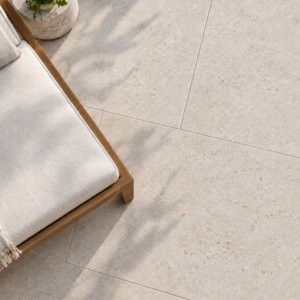
Travertine porcelain pavers represent a genuinely different specification decision, not just a visual alternative. Porcelain manufactured to replicate travertine’s appearance is denser, has near-zero water absorption, and requires no sealing in the same way natural stone does — those are real advantages in a vehicle-use context where oil contamination and freeze-thaw cycling are concerns. The trade-off is that porcelain is harder and less forgiving of base movement — a minor sub-base settling event that natural travertine would accommodate at the joint will crack a large-format porcelain tile, sometimes across the full face.
Natural travertine’s inherent variation in tone and texture is exactly what many homeowners are specifying — the material reads as authentic in a way that manufactured stone alternatives don’t replicate at close range. That authenticity carries a maintenance commitment, but for clients who want genuine natural stone, the commitment is part of the value. The decision between natural travertine and a porcelain alternative should be made with both performance and maintenance expectations clearly stated upfront, not discovered after installation.
- Natural travertine: authentic surface variation, requires sealing and joint maintenance, performs well under normal vehicle loading with correct thickness specification
- Travertine porcelain pavers: consistent appearance, very low absorption, harder and more brittle under base movement, no sealing required for the material itself
- Both options: require correct sub-base engineering and joint design — neither material compensates for a poorly prepared base
According to ASLA driveway paving material guidance and environmental performance, permeable paving systems and material selection decisions should account for both surface performance and the longer-term environmental management of surface water — a relevant consideration when comparing filled natural travertine to a fully dense porcelain alternative in terms of how each material handles runoff at the joint level.
Sealing and Long-Term Maintenance in a Vehicle-Use Setting
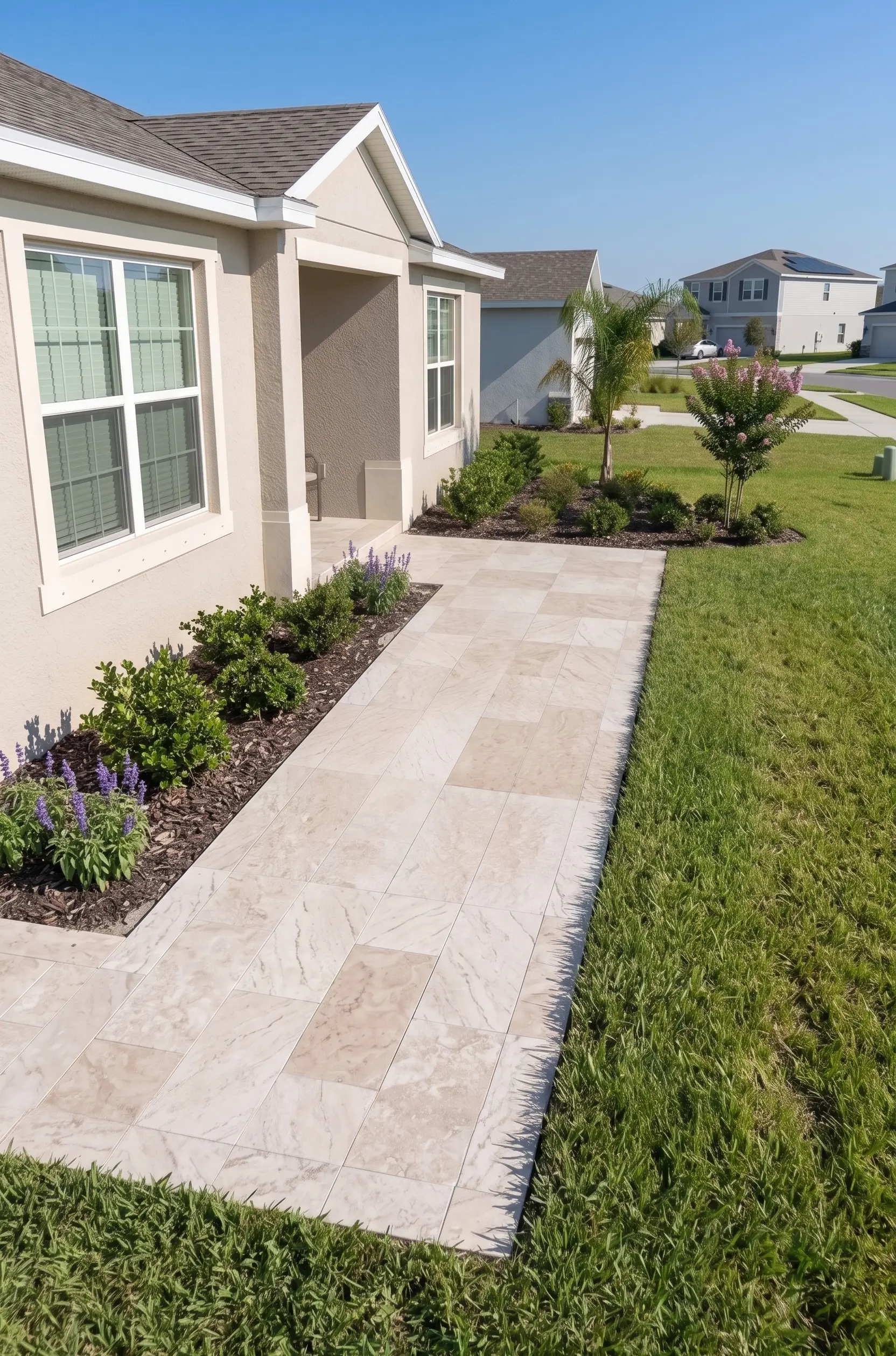
Sealing is where travertine driveway maintenance differs most sharply from travertine in other applications. Vehicle-use areas expose the stone to a different contamination profile — oil drips, brake fluid, and road salt in freeze-thaw regions will penetrate an unsealed or under-sealed travertine surface faster than foot traffic and weather alone would. A penetrating sealer — one that fills the pore structure from within rather than forming a surface film — is the specification most suited to a driveway context because it doesn’t create a surface layer that vehicle contact can abrade away.
Your maintenance interval should come from the sealer manufacturer’s stated recommendation for the exposure conditions, not from a generic annual-resealing rule. Some penetrating sealers perform reliably for several years in a low-traffic residential driveway; others require more frequent attention in high-UV climates or where winter road treatments are used. Test a small area if you’re unsure of the interval before the original application has fully expired — that gives you a real-world read on how the sealer is holding up in your specific conditions rather than relying on the manufacturer’s average.
- Penetrating sealers: preferred for driveway travertine — fills pores without a surface film that vehicle contact degrades
- Topical sealers: generally not recommended for vehicle-use areas — surface film wears under tyre contact and requires more frequent reapplication
- Cleaning before resealing: critical — applying a new sealer over contaminated stone traps the contamination rather than protecting against it
- Joint inspection: combine sealing cycles with a joint inspection — refill any settled or cracked joints before they allow water ingress that affects the sub-base
Getting Travertine Paver Specifications Right
Travertine pavers for driveway projects are a well-established specification — they perform reliably where the sub-base is engineered correctly, the paver thickness is confirmed against a structural load calculation, and the sealing programme is maintained on the interval your sealer manufacturer specifies. The material’s natural character, tonal warmth, and authenticity make it a distinctive choice in a product category where porcelain alternatives are increasingly common. Understanding the maintenance commitment upfront is what separates a travertine driveway that ages gracefully from one that surprises a homeowner five years into ownership.
Pattern layout also plays a role in the long-term appearance and structural performance of the field. Different bond patterns distribute load differently across the joint network, and some patterns suit certain driveway geometries better than others. For a closer look at layout options across Citadel Stone’s travertine range, travertine layout ideas for outdoor spaces covers the pattern decisions worth considering before the installation plan is finalised. A sealed surface is particularly important for driveway travertine, and Citadel Stone highlights penetrating sealers as the preferred option for vehicle-use areas.
Related reading: travertine paver colors guide · cost to install travertine pavers · how to seal travertine pavers.