Pattern selection is where most travertine paver projects either lock in a cohesive design or start to fragment visually — and the decision happens before a single piece hits the ground. Travertine paver pattern ideas range from the simple stacked bond to the complex running French pattern, and each one changes how a space reads in scale, direction, and visual weight. The pattern you choose will also drive your cut count, your waste factor, and how demanding the layout is for whoever is doing the installation. Getting that decision right early means fewer surprises when material arrives and work begins.
The Running Bond: A Reliable Starting Point
The running bond — each row offset by half a paver length — is the workhorse of outdoor travertine layouts. It reads naturally in most landscape settings, works well with both rectangular and square formats, and keeps cut complexity manageable. Long, narrow patios suit this travertine pavers pattern particularly well because the staggered joints draw the eye along the length of the space rather than across it.
- Waste factor stays predictable — border cuts are typically straight, which means less saw time and fewer off-cuts that cannot be reused
- Works with both rectangular and square paver formats without requiring special sizing
- Lower installation complexity makes it a practical choice for projects with tight timelines
- The staggered joint line creates gentle directional movement without the labour overhead of a diagonal layout
For a first travertine installation or a project where schedule is a constraint, the running bond is a visually confident and practically sound choice.
The French Pattern: Four Sizes, One Layout
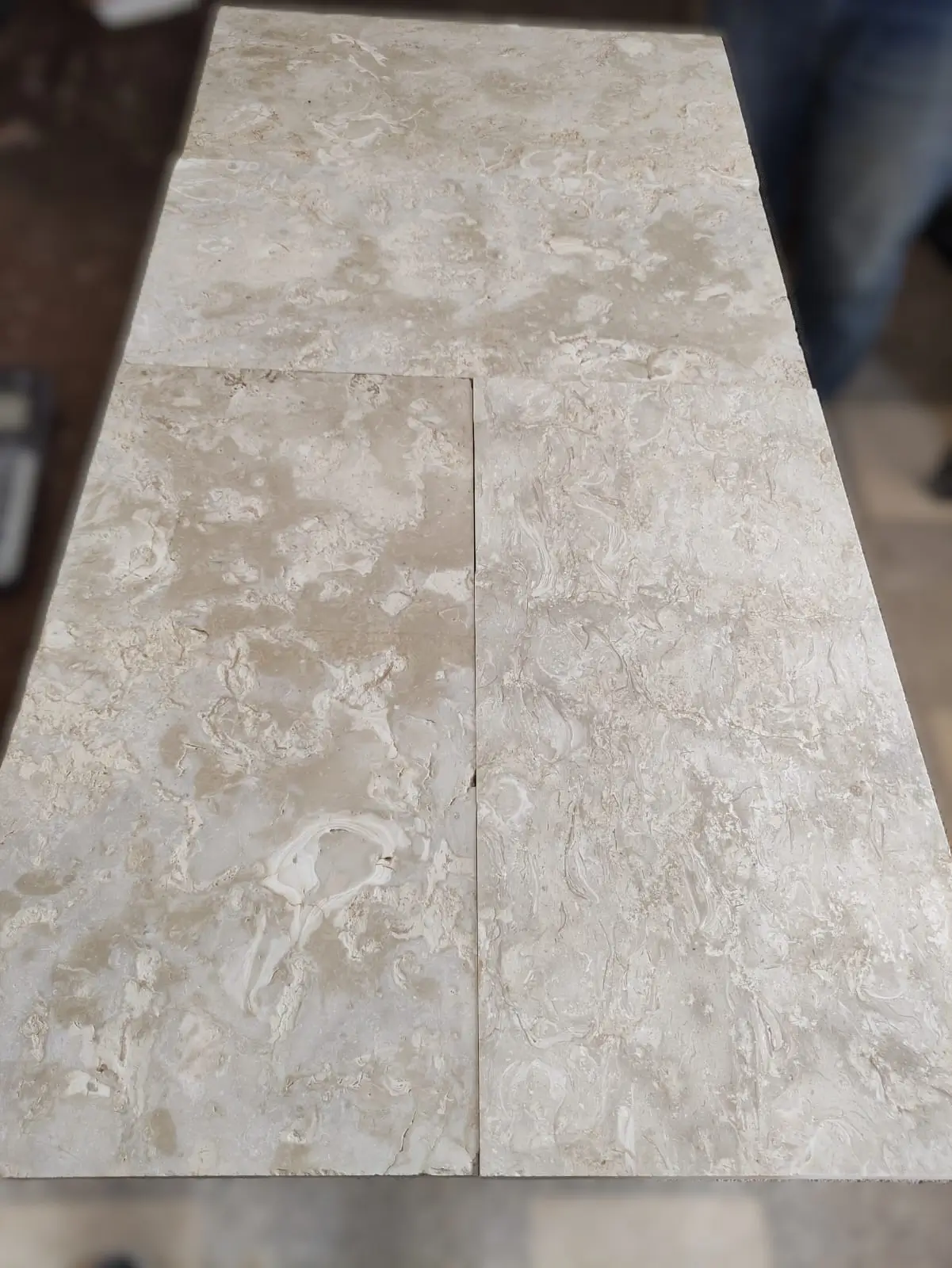
Travertine pavers in a French pattern combine four paver sizes — typically a large square, two rectangles of different proportions, and a smaller square — in a repeating module that tiles across the surface without a visible grid. It is the most widely specified travertine layout for pool surrounds, large residential patios, and estate-scale outdoor rooms. The varied joint lines break up the surface into smaller visual units, which keeps a large expanse from reading as flat or repetitive.
The specification detail that matters here is module coordination. All four sizes in a travertine pavers French pattern must share a common dimension — usually the width of the smallest piece — so joints align without gaps or forcing. When ordering, confirm that all four sizes come from the same quarry run. Shade variation between batches is more visible in a multi-size layout because the eye moves across the surface and registers tonal shifts at size boundaries.
According to Natural Stone Institute travertine properties and outdoor suitability, travertine’s open-pore structure and absorption characteristics are variables that directly influence how consistent a multi-piece layout appears over time — a point worth raising with your supplier when reviewing samples.
Herringbone and Diagonal Layouts
A herringbone pattern in travertine uses rectangular pavers set at 90-degree angles to each other in a zigzag arrangement. It creates strong directional energy and works particularly well in covered outdoor areas, transition zones between inside and outside, and long walkways where the eye needs to move forward. Diagonal layouts — running the bond at 45 degrees to the building line — give a similar sense of movement, widening the visual field of narrow spaces and adding dynamism to modern minimalist settings.
The trade-off with both approaches is a higher border cut count. Every edge parallel to the building line in a diagonal layout requires 45-degree miter cuts, and the waste factor increases accordingly. Budget material quantities to account for that before ordering.
Stacked Bond and Grid Patterns
The stacked bond — all joints aligned both horizontally and vertically — is the most contemporary of the standard travertine pavers patterns. It reads with clean, architectural precision and integrates well with modern minimalist design language. Large-format travertine in a stacked bond, set with minimal joint widths, creates a surface that looks almost monolithic from a distance.
The installation demand is higher than it appears. Perfectly aligned joints across a large field require precise base preparation and careful attention to paver calibration. Any variation in thickness shows immediately because there are no offset joints to absorb small differences. Inspect paver calibration carefully when the delivery arrives — checking across the stack for consistency before laying begins, not after.
How Pattern Choice Connects to Landscape Style
Pattern selection does not happen in isolation — it happens in the context of a broader landscape design language. A French pattern’s irregular joint rhythm reads naturally in traditional colonial gardens, Mediterranean courtyards, and estate landscapes with layered planting. Designers specifying a travertine pavers French pattern in those contexts consistently find that the varied module scale reinforces the organic quality of the surrounding planting rather than competing with it.
A tight-jointed stacked bond in large-format travertine integrates with contemporary low-water plantings, where clean geometry complements sparse, architectural plant selection. For tropical planting schemes, a running bond in a warmer travertine tone provides a neutral surface that lets the planting do the visual work. Think about which element carries the design: if it is the stone, a complex pattern serves the brief; if it is the planting or architecture, a simpler layout is often the stronger call.
Explore Citadel Stone paver pattern options to see how different layouts translate across finish types and travertine tones.
Black Travertine and Pattern Contrast
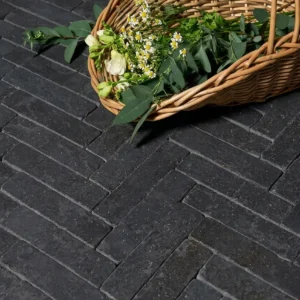
Black travertine pavers open up a different set of design possibilities. The dark tone amplifies pattern geometry — joints become more visible, and directional layouts like herringbone or diagonal running bond read with sharper contrast than they would in an ivory or walnut tone. Specifying black travertine pavers in a stacked bond with tight grout joints creates a surface with real visual authority in modern settings.
- In mixed-material designs, pairing black travertine field pavers with lighter stone borders creates a framing effect that defines the space without additional architectural elements
- Pattern scale matters more with dark stone — smaller module sizes in a dark field can feel busy; larger formats keep the surface readable
- The finish you specify changes how the pattern reads: a honed surface shows joint lines cleanly, while a tumbled finish softens the geometry and gives a more aged, relaxed character
- Under artificial lighting, dark travertine in directional patterns creates strong shadow play that adds depth to evening outdoor spaces
According to ASTM C1527 travertine dimension stone standard specifications, travertine dimensional tolerances and face calibration are defined at the material specification stage — a point that directly affects how cleanly any pattern reads on site, regardless of color.
Waste Factors by Pattern Type
Your material quantity is not just the square footage of the project — it is the square footage plus a pattern-specific waste allowance. Getting this wrong in either direction is a real problem: too little and you are waiting on a supplementary order; too much and budget is tied up in material that cannot be used.
- Running bond: typically requires a modest waste allowance for border cuts and breakage
- French pattern: the multi-size module means cuts at borders must be calculated per size, and the smallest pieces tend to generate the most off-cut waste
- Herringbone: border cuts at the field edges are angled and cannot be reused elsewhere — the waste allowance needs to reflect that
- Diagonal layouts: similar to herringbone; 45-degree border cuts are the primary waste driver
- Stacked bond in large format: lower cut count overall, but breakage risk on larger pieces is a factor to account for in the buffer
Citadel Stone works through material quantities with project specifications before orders are confirmed, which helps arrive at a realistic number rather than a generic percentage added to the square footage. Delivery scheduling and truck access to the site are confirmed at the order stage so logistics do not create delays once work starts.
Finish Selection and How It Interacts with Pattern
The finish you specify changes the character of any pattern — sometimes dramatically. Consider the key distinctions:
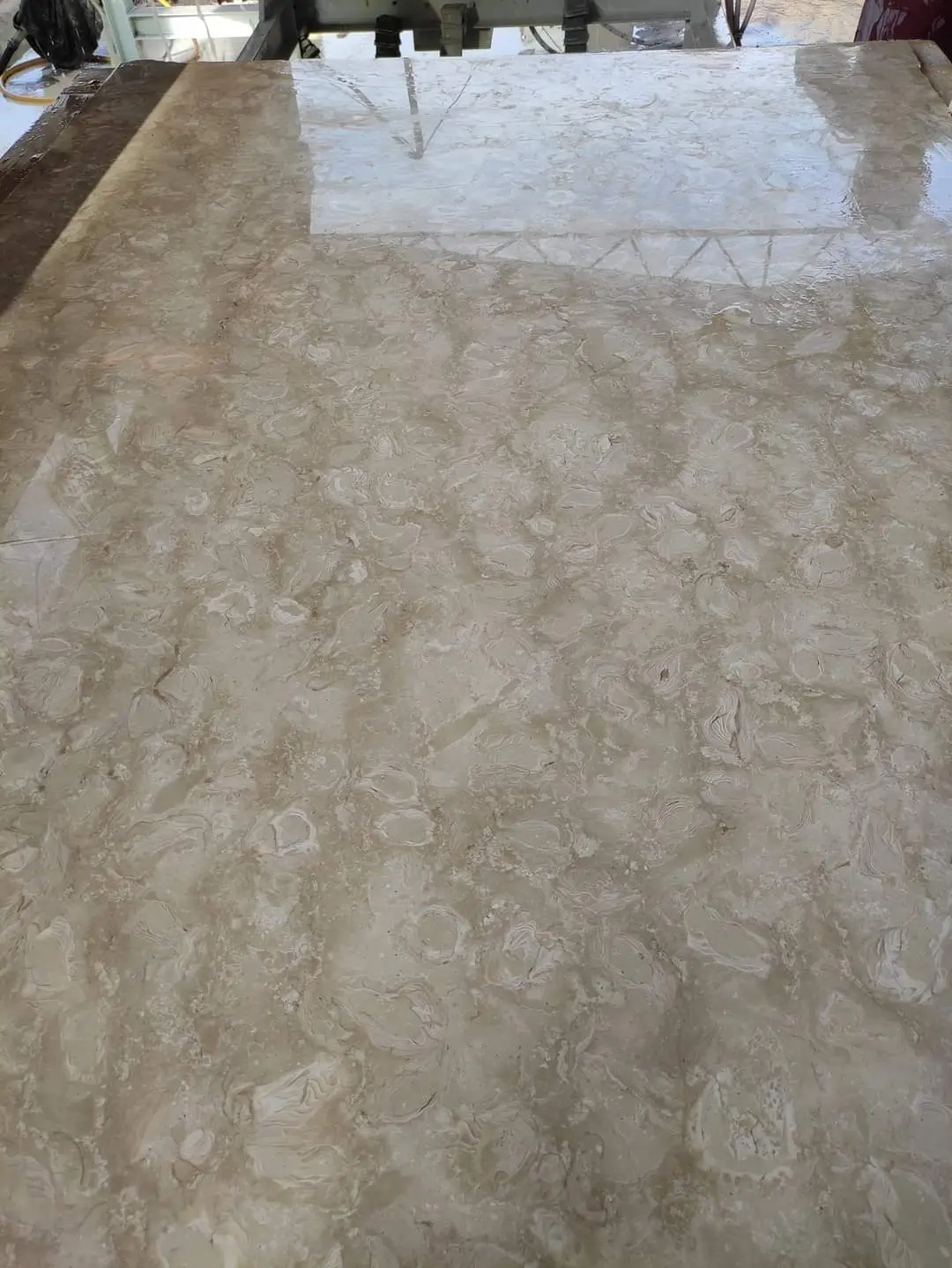
- A honed finish gives travertine a flat, matte surface where joint lines read crisply and the pattern geometry is the dominant visual statement
- A tumbled finish leaves an open, matte texture with softened edges that gives the surface an aged, informal quality — pattern geometry becomes secondary to material character
- A brushed finish sits between the two: it opens the surface texture more than honing while retaining more edge definition than tumbling
For pool surrounds and wet areas, finish choice is a specification decision that involves more than aesthetics. The current standard for assessing surface behavior in wet conditions is ANSI A326.3, measured wet — the finish type is the primary variable affecting how the surface performs, and test reports are available on request for your specification process. A brushed or tumbled finish leaves a more open texture than a polished one, and that difference is measurable under ANSI A326.3 wet testing. Never substitute a dry result for a wet requirement when writing a pool-area specification.
The USGS data on limestone and travertine natural mineral formation provides useful context on why travertine’s pore structure and mineral composition vary between quarry sources — variation that directly influences how consistently a finish behaves across a large installation.
Matching Travertine Paver Pattern Ideas to Your Project
Pattern choice, finish selection, and material quantity planning are the three decisions that define whether a travertine installation achieves what the design intends. Travertine paver pattern ideas only deliver their full effect when the layout is matched to the space’s scale, the landscape design language, and the practical constraints of the site. A French pattern in a small courtyard can feel overworked; a stacked bond in a sprawling pool surround can feel underdeveloped. The most successful specifications match pattern complexity to space scale, and finish character to the surrounding design.
For related specification decisions, your travertine color selection shapes every pattern choice you make — tone, veining, and fill character all shift how a layout reads at distance and up close. Travertine color tones from ivory to gray covers that dimension in detail and is worth reviewing alongside your pattern shortlist. Herringbone layouts in travertine require careful angle cuts at borders — a detail Citadel Stone recommends accounting for when estimating material quantities.
Related reading: how to seal travertine pavers · travertine pavers installation cost.