Thickness is the specification detail that separates a travertine installation that performs for decades from one that cracks under load within a few seasons. How thick are travertine pavers isn’t answered by a single number — it’s answered by the application, the load type, the base condition, and the subgrade beneath. Get the thickness right and the rest of the installation follows logically; get it wrong and no amount of careful jointing or premium sealing will save you from callbacks.
Standard Thickness Ranges for Travertine Pavers
Travertine pavers are cut to a handful of nominal thicknesses that correspond directly to application categories. Understanding where each thickness fits — and why — gives you the specification clarity to match the material to the demand.
- 20 mm (¾ inch nominal): the most common residential thickness, suited to foot-traffic patios, pool surrounds, and covered walkways on well-prepared, stable subgrades
- 30 mm (1¼ inch nominal): the go-to spec for mixed-use outdoor spaces that occasionally see light vehicle crossings, raised decks, or areas where the subgrade has marginal compaction
- 40 mm (1½ inch nominal): the specification threshold for driveways, vehicular courts, and any surface that carries regular car or light truck loading
- 50 mm (2 inch and above): specified for commercial approaches, heavy delivery zones, and environments where the subgrade is known to be problematic — expansive clay, fill material, or poorly draining silts
These nominal ranges reflect the industry’s standard cut-to-order production dimensions. Your supplier should confirm the exact finished thickness — not a nominal label — before the order ships, because travertine’s natural texture means face-to-face dimension can vary slightly even within a matched batch.
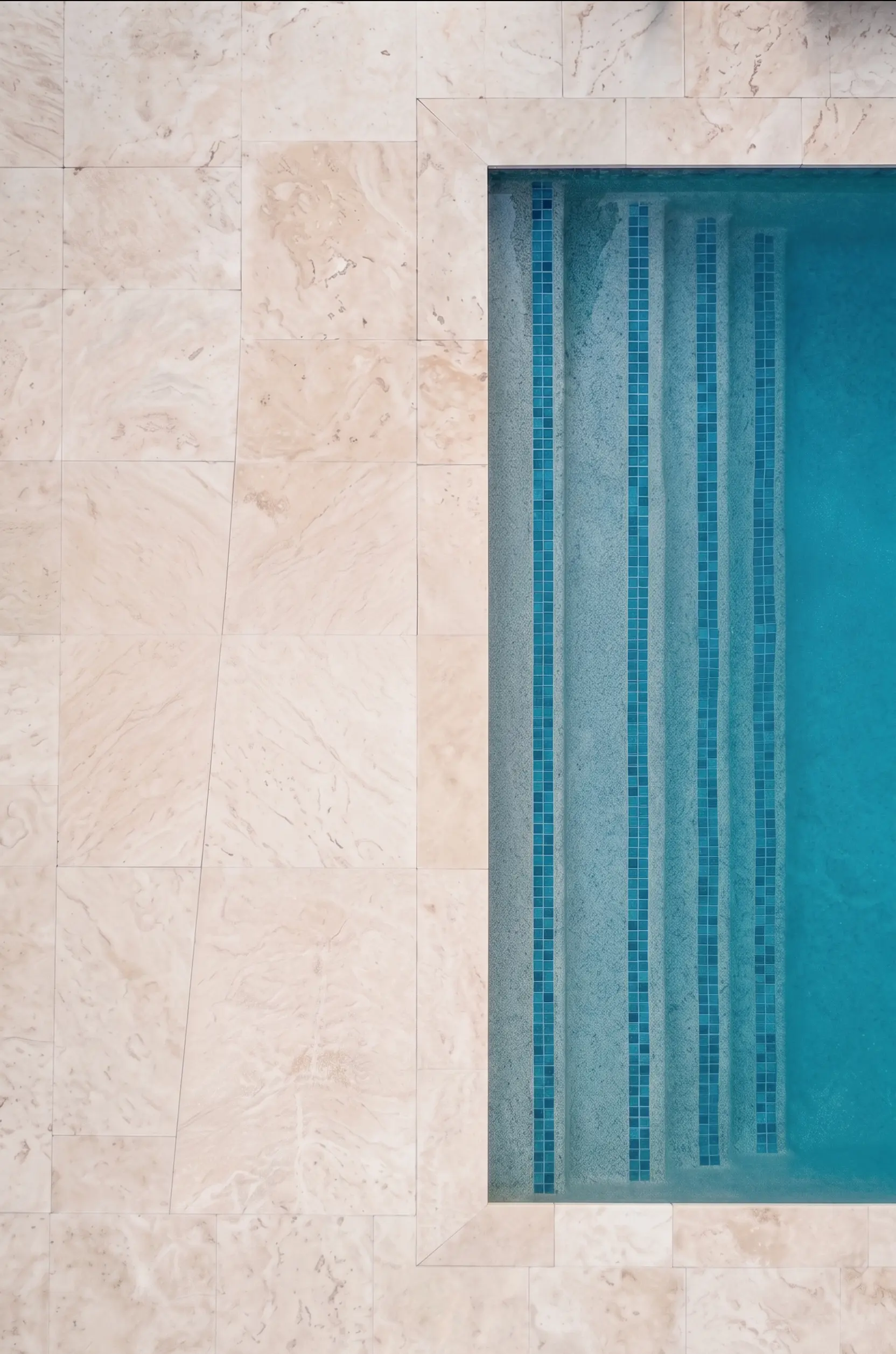
Travertine Paver Thickness by Application
The cleanest way to approach travertine paver thickness is to work backwards from the load scenario. Each application type carries its own load frequency, point-load geometry, and drainage expectation — and thickness is your first line of defence against all three.
Pool Decks and Patios
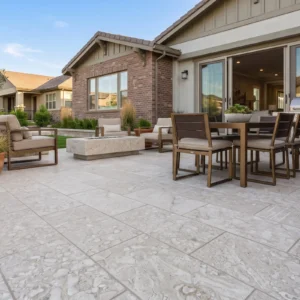
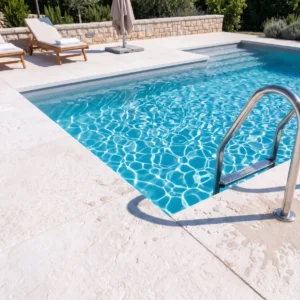
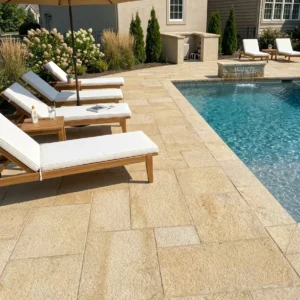
Pool decks and residential patios are foot-traffic-only surfaces. A 20 mm travertine paver on a properly compacted crushed-stone base with a screeded bedding layer performs reliably in this context. The paver’s open-pore structure lets surface water drain through the joints rather than pond, which is exactly what a pool surround demands. You’re specifying for thermal cycling, wet-dry cycles, and occasional furniture legs — not for wheel loads.
That said, 20 mm is a minimum, not a universal default. Stepping up to 30 mm makes sense if your pool deck transitions to a sitting area where heavy planters or outdoor kitchen units will bear down on isolated paver faces. Point loads from concentrated furniture legs are a more relevant failure driver than distributed body weight, and a thicker section absorbs that concentrated stress far better.
Walkways and Pathways
Walkways present an interesting specification case because the load is repetitive and channelled — the same strip of travertine pavers takes foot traffic over and over, rather than spreading it across the full field. For residential walkways, 20–30 mm covers most scenarios. The variable is less about foot load and more about edge stability: a narrow 20 mm paver at a path edge, sitting in sandy or loosely compacted fill, will tip and crack where a 30 mm paver in the same condition holds its geometry through hundreds of edge-loading cycles.
Browse our travertine pavers by thickness to compare the finished dimensions available and match them to your walkway design. Knowing the actual finished thickness before you calculate your build-up height prevents the common field error of undersetting the bedding layer.
Driveway Applications
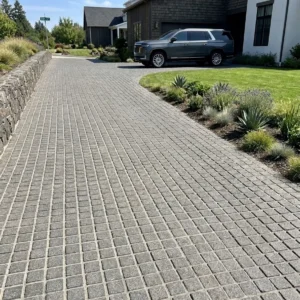
Driveways are where travertine thickness specifications diverge sharply from patio work. A standard passenger car exerts a point load far in excess of anything a residential patio sees, and that load is applied through a small tyre contact patch — concentrated stress, not distributed weight. For a residential driveway, 40 mm is the realistic minimum. Many specifiers go to 50 mm where the driveway also serves as a delivery access point for larger vehicles.
Travertine’s naturally porous structure makes it responsive to load in a way that denser igneous stones are not. Under cyclic vehicle loads, a travertine paver that is undersized for its base conditions will develop hairline fractures at the face that grow with each thermal cycle. The failure builds over one to three winters before it becomes visible. Specifying the right thickness upfront is the only way to avoid that outcome.
Commercial and Heavy-Use Surfaces
Commercial applications — entrance courts, retail forecourts, hospitality terraces with service access — demand a conversation about the full load scenario before thickness is specified. A 50 mm travertine paver on a reinforced concrete base handles light delivery vehicles reliably. For anything heavier, or for surfaces where fork-lift traffic is a possibility, travertine is typically not the right material choice regardless of thickness. Knowing the material’s performance envelope and recommending accordingly is the mark of a genuinely experienced specifier. According to NSI travertine properties and outdoor suitability, travertine’s physical characteristics suit it well for pedestrian and light vehicular environments, but commercial heavy-load specifications require a full review of the stone’s structural properties against the expected demand.
How Subgrade Conditions Affect Travertine Paver Thickness Selection
Here’s what most paver thickness discussions underplay: the subgrade beneath your compacted base is as important as the paver’s cross-section. A 40 mm travertine paver on a stable, well-drained granular subgrade performs very differently from the same paver on expansive clay or poorly compacted fill — even if the visible base preparation looks identical from the surface.
Expansive clay soils — common across broad swaths of the country — swell measurably when wet and contract as they dry. That cyclic movement transmits directly through your compacted aggregate base and into the paver field. You’ll see it as differential settlement first: one paver slightly proud of its neighbour, a joint that won’t stay filled. Left unaddressed, that differential loading cracks the thinner pavers first. The practical fix is to step up one thickness class on expansive subgrades and to install a geotextile separation fabric between the native soil and the aggregate base. That fabric prevents clay fines from migrating up into the drainage aggregate over time — a failure mode that’s slow, invisible, and expensive to correct after the fact.
Caliche subgrades, found in dry regions across the country, present the opposite problem: an extremely rigid, near-impermeable hardpan that prevents downward drainage. Water ponds at the caliche layer, saturates the aggregate base seasonally, and undercuts the bedding. On caliche sites, drainage strategy is as important as paver thickness — you need positive drainage designed into the base, not relying on percolation that won’t happen. A 30 mm or 40 mm travertine paver on a well-drained base over caliche performs far better than a nominally thicker paver on a saturated one.
Sandy or loose subgrades lack the bearing capacity to support even a properly compacted aggregate base under vehicle loads. On sandy soils, a driveway specification in travertine should include a concrete sub-base or at minimum a heavily compacted road-base layer deep enough to bridge the soft material beneath. The USGS limestone and travertine mineral formation data provides context for the stone’s natural pore structure — a characteristic that makes surface drainage management straightforward, but that also means travertine can absorb moisture through its face if the bedding layer becomes saturated from below.
Travertine Pavers Installed Cost and Thickness
Thickness affects travertine pavers installed cost in two ways that most buyers don’t fully account for at the planning stage. The obvious factor is material weight: a 40 mm paver uses roughly twice the stone volume of a 20 mm paver for the same surface area, which drives unit cost and shipping weight. The less obvious factor is the base preparation cost that thickness selection implies.
Specifying 40 mm travertine for a driveway versus 20 mm doesn’t just change the stone cost — it changes the entire build-up height, which affects how much existing grade you need to excavate or raise, how deep your aggregate base needs to be, and whether your finished surface level aligns with adjacent hardscape, drainage channels, and thresholds. A 20 mm paver on a minimal base looks cost-effective on the materials quote; a 40 mm paver with the correct base specification looks more expensive upfront but avoids the remediation cost that an undersized installation always delivers eventually.
- Material cost scales with thickness — request pricing on each thickness class before finalising the specification
- Base depth requirements vary with application: pedestrian areas typically need less aggregate depth than vehicular zones
- Freight weight increases with thickness, which matters when delivery involves access constraints at the site
- Thicker pavers require more precise screeding of the bedding layer — the tolerance for error in the bedding bed is smaller relative to the paver’s mass
Access constraints may affect delivery scheduling — particularly on tight residential sites where a full pallet of 40 mm travertine represents considerable weight on a single delivery drop. Confirm access, offloading space, and pallet storage area with your supplier before the delivery date is set.
How Finish Affects Practical Thickness Choice
The finish on a travertine paver changes its surface texture — and that has a practical bearing on how the paver handles outdoor conditions, even if it doesn’t change the structural thickness requirement.
A tumbled finish leaves an open, matte texture with softened edges and a naturally aged appearance. The edge profile on a tumbled paver is rounded rather than arrised, which means it’s more forgiving of minor height differentials in the bedding layer — a 1–2 mm high spot that would catch a sharp-edged honed paver barely registers with a tumbled one. This is relevant to thickness specification because it gives you a small amount of installation tolerance that honed or polished finishes don’t provide.
A honed or filled-and-honed travertine paver presents a flat, smooth face. The open voids in the natural travertine are filled before honing — which means the surface is denser than an unfilled tumbled equivalent. That filling marginally reduces moisture uptake through the face, though the paver’s base and edges remain permeable. For outdoor applications in freeze-thaw climates, a honed and filled finish is worth specifying for pool surrounds and patios where surface water management matters.
- Tumbled finish: open matte texture, rounded edges, forgiving installation tolerance, suitable for informal outdoor settings
- Honed finish: flat smooth face, tighter jointing requirement, suited to more formal or contemporary designs
- Brushed finish: directional texture from mechanical brushing, matte surface with a slightly open pore — sits between tumbled and honed in texture terms
- Filled and honed: factory-filled voids, smooth face, lower surface absorption than unfilled alternatives
The finish choice doesn’t override the thickness requirement — a pool deck needs the pool-deck thickness regardless of whether you choose tumbled or honed. But it does influence sealing strategy and maintenance interval, which you should confirm with the sealer manufacturer before completing the specification.
Red Travertine Pavers: A Colour and Thickness Note
Red travertine pavers carry the same thickness classifications as ivory, walnut, or silver travertine — the colour variation is geological, not structural. Red and rustic-toned travertines are quarried from deposits where iron oxide concentration in the mineral matrix creates the characteristic warm, terracotta-red colouration. The pore structure, density, and physical behaviour remain in the same family as lighter travertine varieties.
Where red travertine does present a specification nuance is in colour consistency across batches. The iron oxide distribution in red travertine can be less uniform than in ivory varieties, which means batch-to-batch colour variation is more pronounced. This doesn’t affect thickness specification, but it means you should confirm the full order quantity is cut from a matched production run — particularly if your design relies on a consistent warm-red field. Citadel Stone sources this material at our selected quarries and can advise on batch consistency at the point of order.
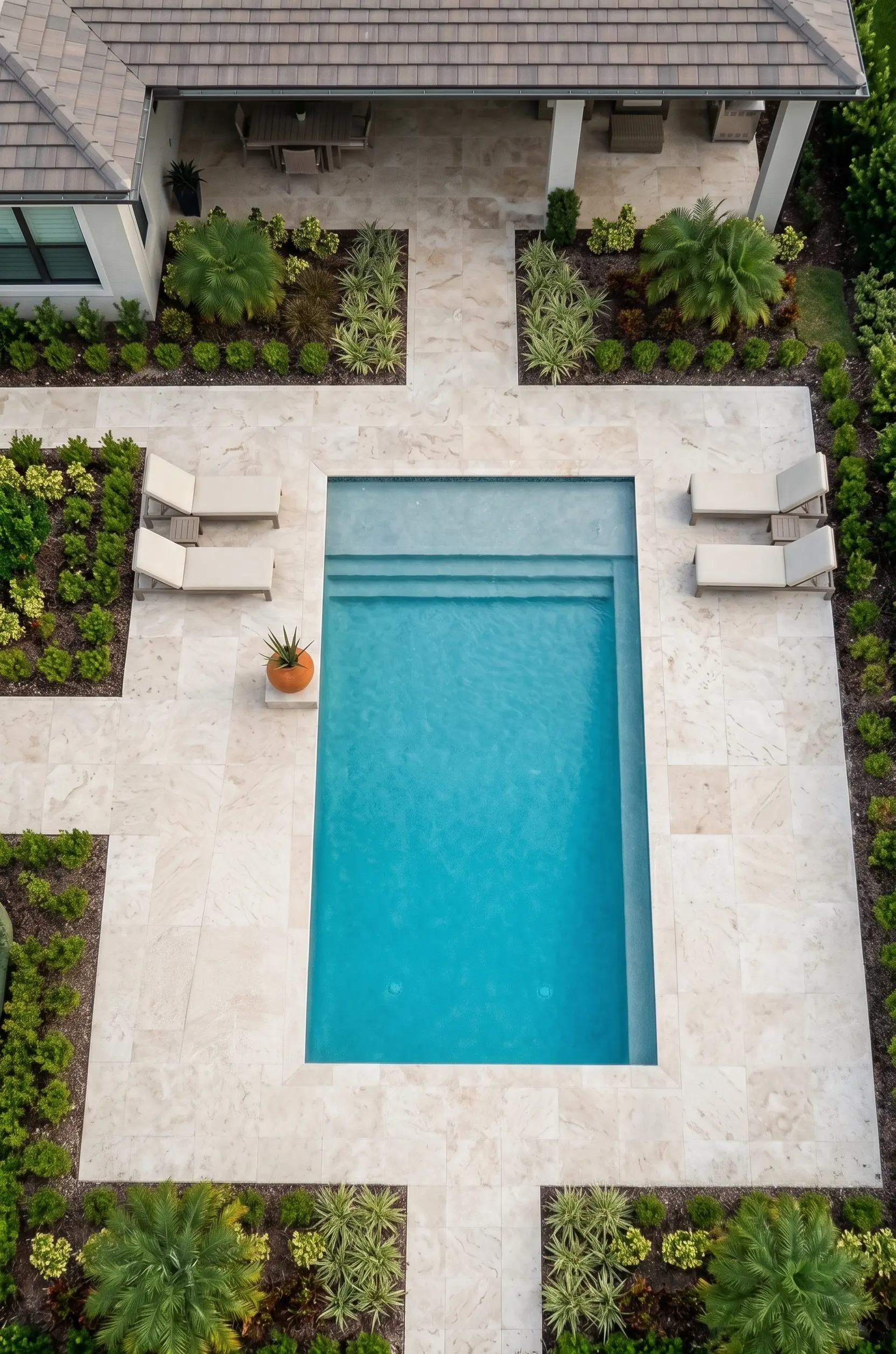
Base Preparation: The Layer That Makes Travertine Paver Thickness Work
Travertine paver thickness is a structural variable, but it only performs as specified when the base beneath it is built correctly. The paver transfers load down through the bedding layer and into the compacted aggregate base — if any layer in that sequence is deficient, the paver carries load it wasn’t designed to handle.
The bedding layer for travertine pavers is typically a screeded sand or fine aggregate bed, set to a consistent depth across the field. For pedestrian applications, this layer is thinner; for vehicular zones, it needs to be firmer and more precisely levelled. What experienced installers know — and what rarely appears in generic installation guides — is that the bedding depth tolerance tightens as paver thickness increases. A 40 mm paver has more mass and less flex than a 20 mm paver; a bedding layer that isn’t perfectly flat creates a three-point loading scenario under the heavier stone that the thinner paver would bridge without incident. You’ll hear it as a hollow knock when you tap a paver that’s sitting on an air pocket in the bedding — that’s the failure mode starting, not already complete.
The compacted aggregate base depth below the bedding layer is determined by the application load and the subgrade bearing capacity — not by the paver thickness. A pedestrian patio base over stable gravel subgrade needs less depth than a driveway base over marginal fill. Your base design should be driven by a soil assessment, however informal, before the excavation starts. The ASTM C1527 travertine dimension stone standard provides the framework for evaluating the stone’s physical characteristics — your base design translates those characteristics into a real-world installation that performs as specified.
- Compact the aggregate base in lifts — not in one deep pass — for consistent density throughout the layer
- Use a plate compactor appropriate to the base depth; hand tamping is insufficient for vehicular base depths
- Install edge restraints before the bedding layer to prevent lateral creep of the aggregate and the pavers
- Check the bedding level with a screed board and spirit level, not by eye — bedding errors compound once the pavers are set
- Leave the geotextile fabric continuous between the native subgrade and the aggregate base where subgrade quality is uncertain
Sealing, Maintenance, and Travertine Paver Thickness Over Time
Travertine’s natural porosity means sealing is a practical requirement for outdoor installations, and the thickness of the paver doesn’t change that requirement. What thickness does affect is how the paver responds to freeze-thaw cycling — a thicker paver has more thermal mass, which means it absorbs heat more slowly and releases it more slowly. In freeze-thaw climates, that mass difference is marginal at the thicknesses used in paving, but it’s worth noting that a properly sealed paver — regardless of thickness — is significantly more resistant to moisture-driven spalling than an unsealed one.
Expect long service from travertine pavers where drainage is working and you reseal on the interval your sealer manufacturer states. That interval varies by product, so confirm it at the time of purchase rather than assuming an annual schedule. Joint material is the other long-term maintenance variable: polymeric sand hardens the joint and resists washout better than plain kiln-dried sand, and it should be re-topped and re-compacted wherever it settles after the first wet season. These are the two maintenance actions that separate installations that age gracefully from those that need early intervention.
Expert Summary: Getting Travertine Paver Thickness Right
How thick are travertine pavers is a decision framework, not a single number. Your application determines the load class, the load class sets the minimum thickness, and the subgrade beneath your base either confirms that minimum or pushes you to the next class up. Pool decks and covered walkways work well at 20–30 mm on stable, well-drained subgrades. Residential driveways start at 40 mm and stay there. Problematic subgrades — expansive clay, loose fill, poorly draining silts — are a signal to step up one thickness class and invest in proper base drainage before the first paver is set. Once you’ve settled your specification, cutting accuracy matters: confirm the finished thickness, not just the nominal label, before the order ships. As your project moves toward installation, understanding how to cut travertine precisely without damaging the face is the natural next step — cutting travertine cleanly in the field covers the tooling and technique choices that protect a well-specified paver during installation. Pool deck and patio applications typically call for thinner travertine than driveways — a distinction Citadel Stone helps buyers navigate during material selection.
Related reading: travertine pavers for driveway · travertine paver cost per square foot · how to seal travertine pavers.