






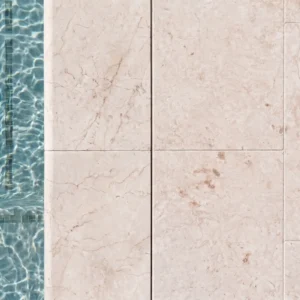
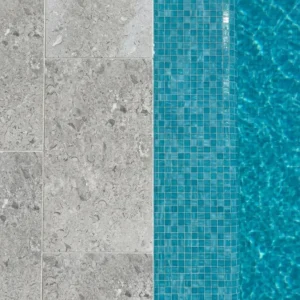
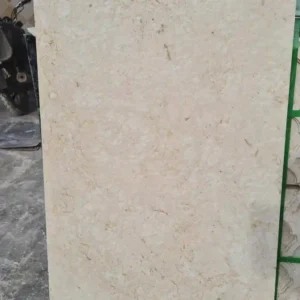
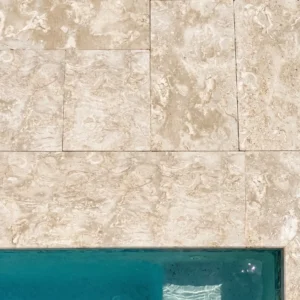
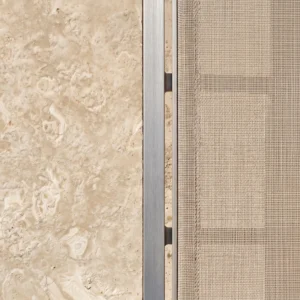
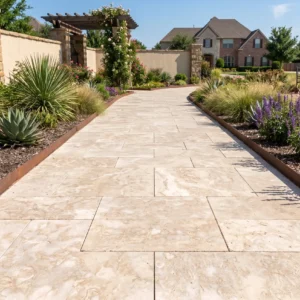
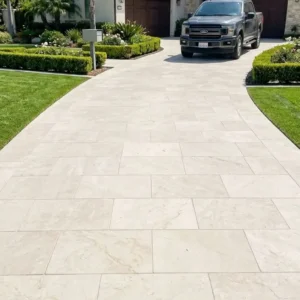
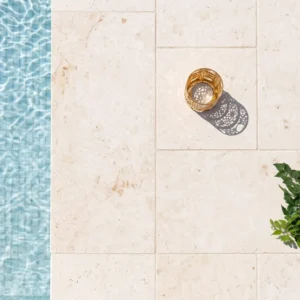


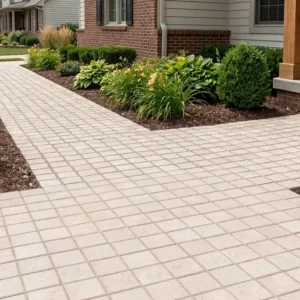
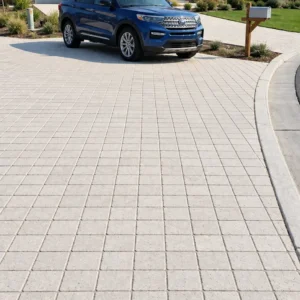
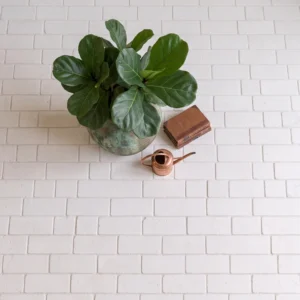
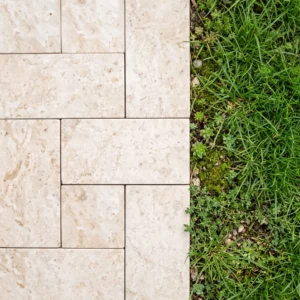
Deflection tolerance decides whether a 24×24 Travertine Tile installation performs for decades or telegraphs hairline cracks within two seasons. Natural stone wants L/720 across the span between supports — twice the stiffness most residential floor systems are actually framed to deliver. That single number causes more large-format stone failures than adhesive brand, grout color, or sealer choice combined. Everything below assumes you’ve verified it before the first pallet lands on site.
What the 24-Inch Format Changes About Travertine Specification
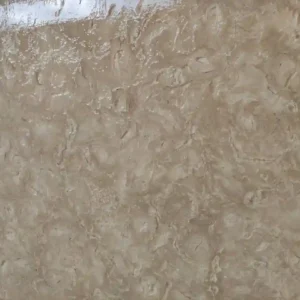
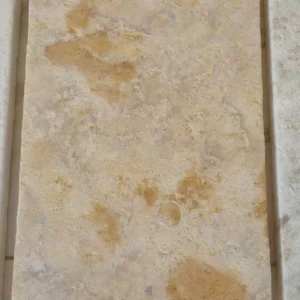
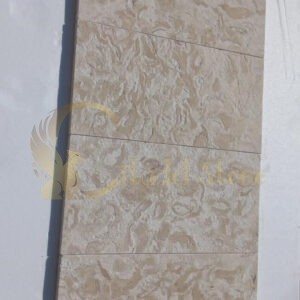
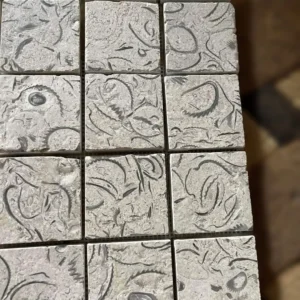
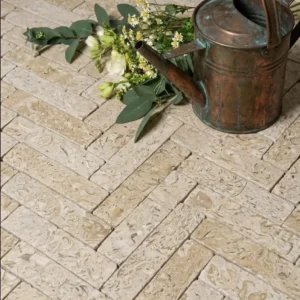
Travertine forms as freshwater limestone precipitates around mineral springs, and the vug structure left behind by escaping gas behaves very differently at 24 inches than it does at 12. A void that reads as harmless character on a small tile can end up sitting directly under a chair leg or an appliance foot on a larger one. That’s the practical reason 24 inch travertine tiles get pulled to tighter fill and consistency standards than smaller cuts taken from the same block.
Absorption is the second variable that shifts with format. Carbonate stone porosity varies widely between quarry beds — a pattern reflected in federal geological data on carbonate stone — and you’ll encounter a wide spread of water absorption across commercially sold material. For a 24×24 travertine floor tile carrying a four-square-foot bond footprint, the upper end of that range means slower moisture release through the body and a longer cure window before sealing.
Here’s what actually changes on site once you step up to the larger format:
- Substrate flatness tolerance tightens to 1/8 inch in 10 feet, versus the 1/4 inch in 10 feet that smaller tile forgives
- Mortar coverage expectations rise to 95 percent for wet and exterior work, 80 percent minimum for dry interior floors, verified by pulling a tile during the first working hour
- Trowel selection moves to a 1/2 by 1/2 inch square notch or a dedicated large-format trowel, not the 1/4 inch notch used for 12-inch tile
- Grout joints should open to 3/16 inch minimum to absorb dimensional variation across the longer edge
- Handling loss climbs measurably — the corner lever arm is longer, so chips happen during carry, not during cutting
You can request full-size samples from current inventory before committing to a 24 x 24 travertine tile order, which tells you far more than a color chip because vein density and fill quality only read honestly at scale. Citadel Stone stocks the format in filled-and-honed, tumbled, and brushed surfaces drawn from established Mediterranean and Middle East quarries.
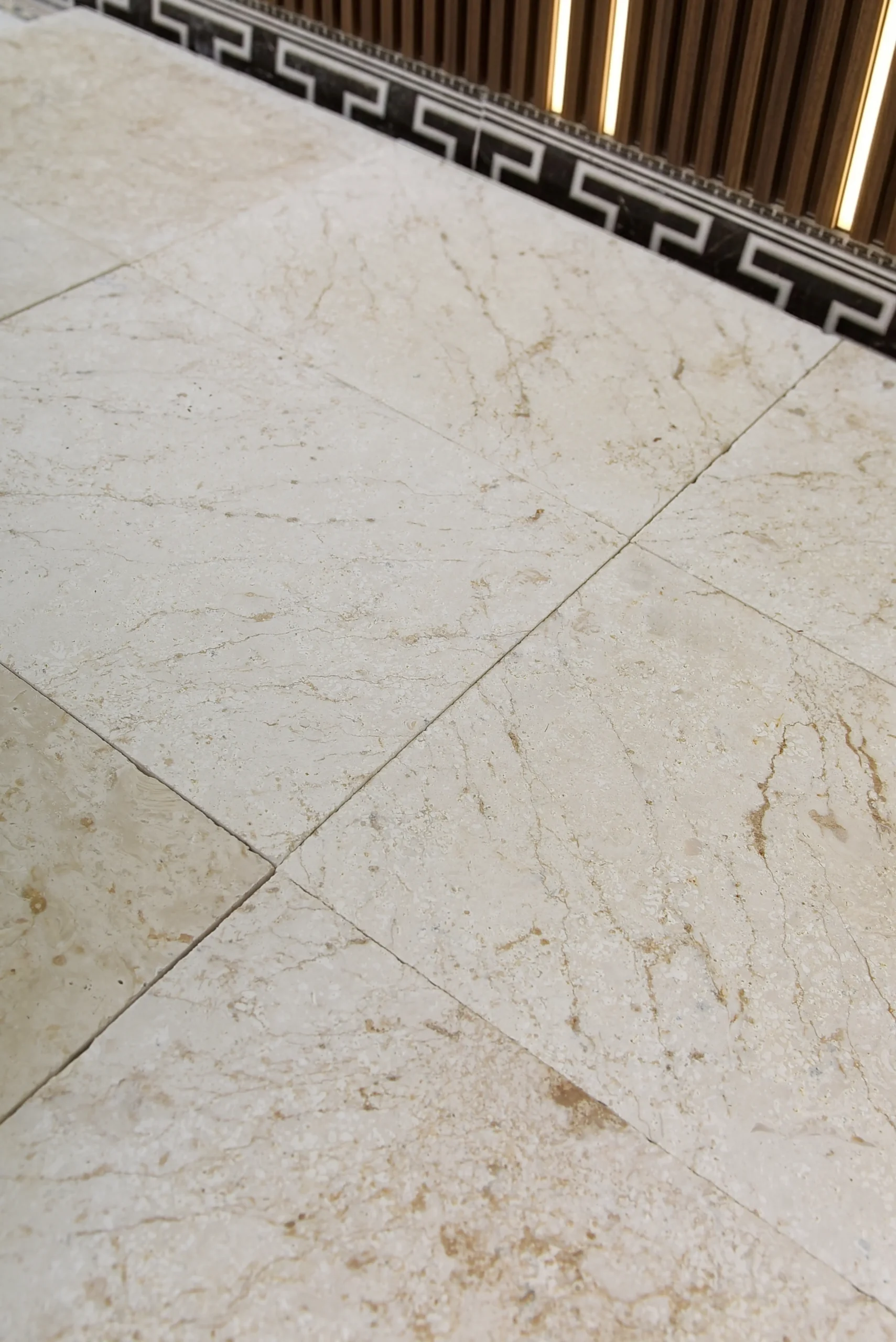
Travertine 600 x 600 and Why Nominal Size Isn’t Actual Size
The metric equivalent printed on most European mill sheets is travertine 600 x 600 millimeters, which converts to 23.62 inches — just under three-eighths of an inch shy of a true 24-inch square. That gap becomes a problem the moment you blend two shipments, run a border against existing tile, or try to hold a modular pattern across a threshold.
Thickness is the other spec people skim past. Most travertine 24×24 stock arrives gauged at either 12mm (roughly 1/2 inch) for interior floors or 20mm (roughly 3/4 inch) for commercial traffic and exterior applications. Gauged material is calibrated on the back face, so your bond coat thickness stays consistent; ungauged or split-face material can vary 3–4mm across a single pallet and will fight you on every lippage check.
Verify these four items against the packing list before the crew opens more than one crate:
- Nominal versus actual dimension, stated in both inches and millimeters
- Gauge tolerance — quality stock holds within plus or minus 1mm across the batch
- Squareness and edge condition: straight-edged rectified, chamfered, or tumbled
- Lot or batch number, so replacement pieces years later can be traced
- Fill material used and whether it’s color-matched resin or cementitious grout
Travertine tiles 600×600 from separate production runs frequently differ slightly in shade and vug density even under the same grade name. At Citadel Stone, our team gauges and squares incoming pallets as part of receiving inspection, and batch consistency notes go to the customer before release rather than after a complaint. Order the full quantity — including cuts and attic stock — from one lot whenever the schedule allows.
Finishes, Fills, and Grade — Reading What You’re Actually Buying
Grade terminology in travertine is not standardized the way it is in granite or marble, which means “premium” from one source can equal “standard” from another. The reliable approach is to ignore the label and evaluate three physical characteristics: vug frequency, fill quality, and shade consistency across a dry-laid mock-up of at least 40 square feet.
Fill quality separates a floor that stays tight from one that opens up in year three. Cementitious fills are cheaper and shrink slightly as they cure, which is why you sometimes see pinholing appear months after installation. Resin fills bond better to the vug walls and resist the moisture cycling that occurs in kitchens and entries. Dimensional and physical requirements for this stone class are set out in the ASTM travertine dimension stone standard, which gives you defensible language for a submittal.
Finish choice drives both appearance and coefficient of friction:
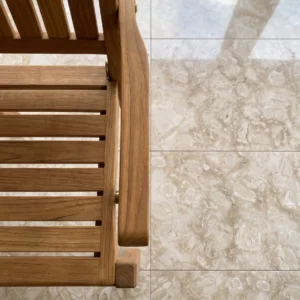
- Filled and honed — smooth, matte, the standard for interior floors and the easiest surface to keep clean
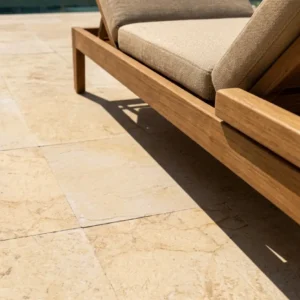
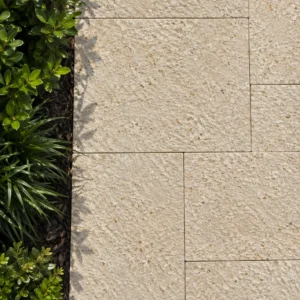
- Tumbled — softened edges and a slightly open surface, more forgiving of traffic and better suited to patios and entries
- Brushed or antiqued — mechanically textured for grip while keeping the vugs filled
- Unfilled and honed — open pores, strong character, but only appropriate where debris collection and cleaning burden are accepted
- Polished — reflective and elegant indoors, but slick when wet and unsuitable for exterior or wet-area use
Every travertine tile 24 x 24 in a large format order should be inspected face-up before setting, not pulled straight from the crate to the mortar. Roughly 3 to 6 percent of any natural stone batch will show a corner chip, an oversized void, or an off-shade face better used as a cut piece against a wall.
Subgrade and Ground Conditions Beneath Large-Format Travertine
Ground behavior underneath the slab is where most large-format stone problems begin, and the failures show up as cracked tile long after the soil report has been filed away. A 24×24 travertine floor tile spans four square feet with no intermediate joint to absorb movement — differential settlement of even 1/16 inch across that span concentrates stress at the corners rather than distributing it through grout lines the way a mosaic or 6-inch tile would.
Expansive Clay, Fill Soils, and Slab Movement
Clay-rich subgrades with high plasticity index can swell and shrink through seasonal moisture cycling, lifting and dropping portions of a slab-on-grade by measurable amounts. Post-tensioned slabs on expansive soil move as a system; the tile assembly has to move with them or debond. That’s the argument for an uncoupling membrane or a crack-isolation membrane under the entire field, not just over visible cracks.
Sandy and granular subgrades bring the opposite risk — poor lateral confinement and washout under downspouts or irrigation lines. Grade preparation for exterior work should deliver a compacted aggregate base at 95 percent modified Proctor density with positive drainage of at least 1/8 inch per foot away from the structure.
Base Detailing for Exterior Installations
- Excavate to a depth that gives 4 to 6 inches of compacted base for pedestrian areas, more where vehicles cross
- Compact in 3-inch lifts rather than one deep pass — single-lift compaction leaves a soft zone in the middle
- Provide a drainage path at the base layer so water never sits against the underside of the setting bed
- Detail perimeter and field movement joints at 20 to 25 feet interior, 12 to 16 feet exterior, and at every change of plane
- Isolate the tile field from columns, curbs, and slab penetrations with soft joints, never rigid grout
Frost depth deserves attention in freeze-thaw regions. Where the base is shallower than the local frost line, seasonal heave will lift sections of the field unevenly, and a large format 24 x 24 travertine tile has no capacity to flex with it.
Setting Method and Layout Details That Prevent Lippage
Lippage tolerance is the metric your client will actually notice, and the industry allowance for large-format tile is 1/32 inch plus the grout joint width. Hitting that number is a substrate problem before it’s a workmanship problem — you cannot trowel your way out of a wavy slab, and back-buttering to fill a hollow simply moves the failure into the bond line.
Use a large-and-heavy-tile mortar rather than a standard modified thinset. The rheology is engineered to hold a non-sag ridge under a 20-pound travertine 24 x 24 piece and to resist slump while the mortar skins. Ambient conditions change your open time more than most crews expect: at 90°F with moving air, a mortar rated for 20 minutes can skin in eight. Test the ridge with a fingertip on every fourth tile and re-comb anything that doesn’t transfer.
Layout method matters as much as materials. Running a one-third offset instead of a 50 percent brick bond reduces the visible lippage created by the natural crown that most large tiles carry along their length; for planning the sequence and leveling system on wide fields, how to install large floor tile covers the layout logic in detail. Snap your control lines from the room’s dominant sightline, not from the longest wall, and dry-lay the first two rows before mixing anything.
- Set leveling clips at every corner and mid-edge on a 24×24 travertine tile field
- Mix mortar to a slightly stiffer consistency than the bag suggests when working over uncoupling membranes
- Beat in with a rubber mallet along the ridge direction, not across it, to avoid trapping air
- Keep foot traffic off the field for a minimum of 24 hours, longer over membranes and in cool conditions
- Grout only after the mortar has released its moisture, typically 24 to 48 hours depending on humidity
Indoor Floors, Patios, and Wet Areas — Where the Format Performs
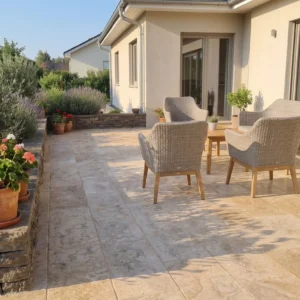
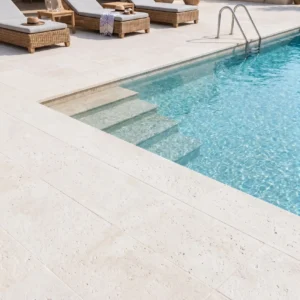
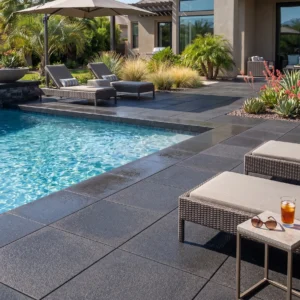
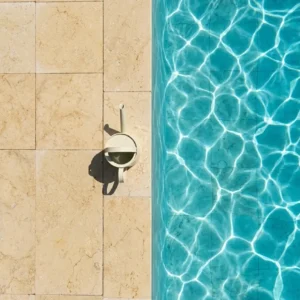
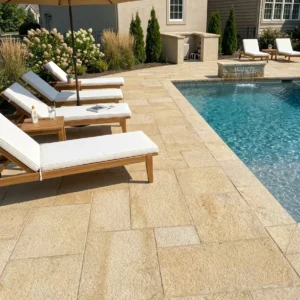
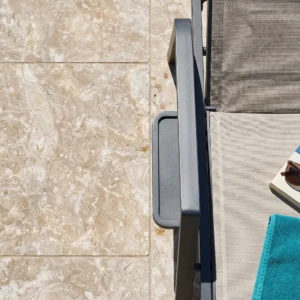
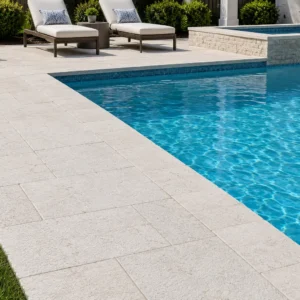
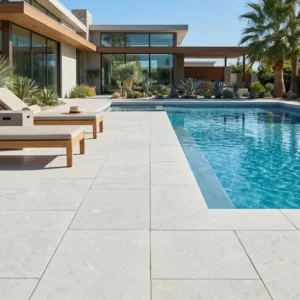
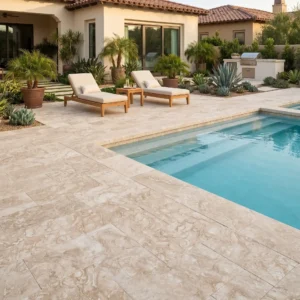
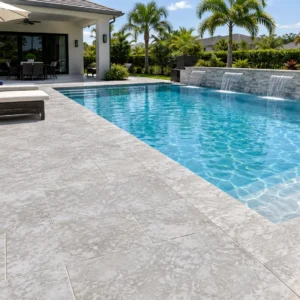
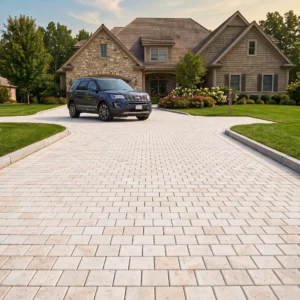
Surface temperature is one of travertine’s quiet advantages outdoors. The pale calcium carbonate body reflects a significant share of incoming solar radiation, and in hot, dry climates that difference is genuinely noticeable underfoot compared with dark porcelain or dense igneous stone. Technical performance characteristics for this stone family are summarized in Natural Stone Institute stone variety data, which is worth attaching to any exterior submittal.
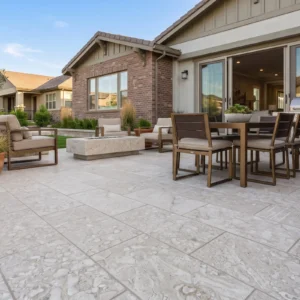
Slip resistance is finish-dependent, not material-dependent. A tumbled or brushed travertine 24×24 tile will hold a wet dynamic coefficient of friction at or above the 0.42 threshold most designers specify for level exterior surfaces; a polished face will not, wet or dry. Specify the finish by performance target and test data, never by appearance alone.
Freeze-thaw performance depends almost entirely on absorption and drainage. Denser, lower-absorption material handles cycling well; higher-absorption stock saturated by standing water will spall at the surface within a few winters. Two practical rules make the difference:
- Never install over a surface that ponds — a dead-flat exterior slab is a failure waiting for the first hard freeze
- Use a breathable penetrating sealer rather than a film-forming topical coating outdoors, so trapped vapor can escape
- Specify 20mm gauge for exterior fields and any area receiving rolling loads
- Keep exterior grout joints at 1/4 inch and use a high-performance cementitious or polymer-modified grout
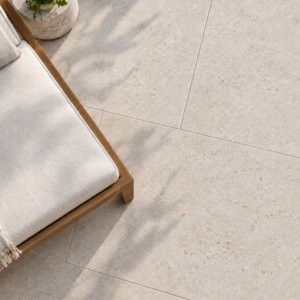
Indoors, travertine tiles 600×600 work particularly well in open-plan spaces because fewer grout lines read as a calmer, larger-feeling floor. Bathrooms are fine with proper waterproofing behind the assembly; steam showers demand a vapor-tight system and a resin-filled surface.
Sealing Schedules and Realistic Maintenance Expectations
Sealing a 24×24 travertine tile floor is about buying reaction time, not creating a barrier. A quality penetrating sealer slows liquid absorption enough that a spilled glass of wine can be wiped up before it stains — it does not make the stone water-resistant to the point of neglect, and no sealer prevents etching from acids. Lemon juice, vinegar, and many bathroom cleaners will dull a honed surface regardless of what’s on it.
Expect this maintenance rhythm from a well-installed floor:
- Initial seal before grouting, then a second application after grout cure — two coats total on day one
- Re-seal interior floors every 2 to 4 years, tested by dropping water and watching for darkening within four minutes
- Re-seal exterior and pool-adjacent surfaces every 12 to 24 months, since UV and runoff strip sealers faster
- Clean with pH-neutral products only; avoid anything marketed as a descaler or lime remover
- Inspect fills annually and re-fill open vugs with color-matched resin before debris packs into them
Honest trade-off: this is a stone that shows life. Traffic patterns soften the finish over time, and in a busy entry you’ll see a subtle patina develop within five to seven years. Many clients want exactly that; some don’t, and it’s better to have that conversation at sample stage than after installation. With sound base conditions, appropriate finish selection, and consistent resealing, decades of service life is a reasonable expectation for interior travertine 24 x 24 floors.
Ordering Quantities, Waste Factors, and Delivery Planning
Waste factor calculation on a 24×24 travertine tile order trips up more budgets than material price does. For a straight-set field in a rectangular room, 10 percent covers cuts and breakage. Diagonal layouts, rooms with multiple angles, or fields interrupted by islands and hearths push that to 15 percent. Add attic stock on top — a minimum of one crate held back, because matching a lot two years later is difficult and sometimes impossible.
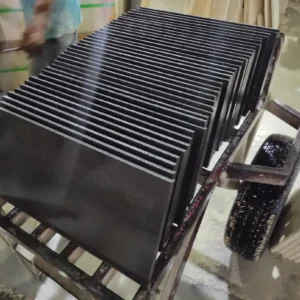
Weight planning deserves a line in your schedule. A 20mm gauged 24 inch travertine tile runs roughly 27 to 30 pounds per piece, so a 400-square-foot order is close to 3,000 pounds of stone. Confirm that the delivery truck can reach a staging point within reasonable carry distance, that any elevator has the capacity, and that the slab or deck you’re stacking on can handle a concentrated pallet load.
- Confirm warehouse stock and lot availability before you lock a start date with the client
- Ask whether liftgate service is included, since most residential sites have no forklift
- Stage pallets under cover — saturated stone must dry before setting, which can cost you days
- Order cut pieces, thresholds, and stair treads with the main shipment to keep the lot consistent
- Budget for a dry-lay mock-up in the actual space and lighting before full installation begins
Citadel Stone holds warehouse inventory for national distribution, which typically compresses lead times to one or two weeks against the six-to-eight-week cycle a direct import order requires. Truck routing, palletizing, and any special handling for oversized crates can be reviewed with our team during quoting rather than discovered on delivery day. For projects needing custom cuts, non-standard thickness, or travertine 600 x 600 metric matching to existing work, plan an additional two to three weeks in the schedule.
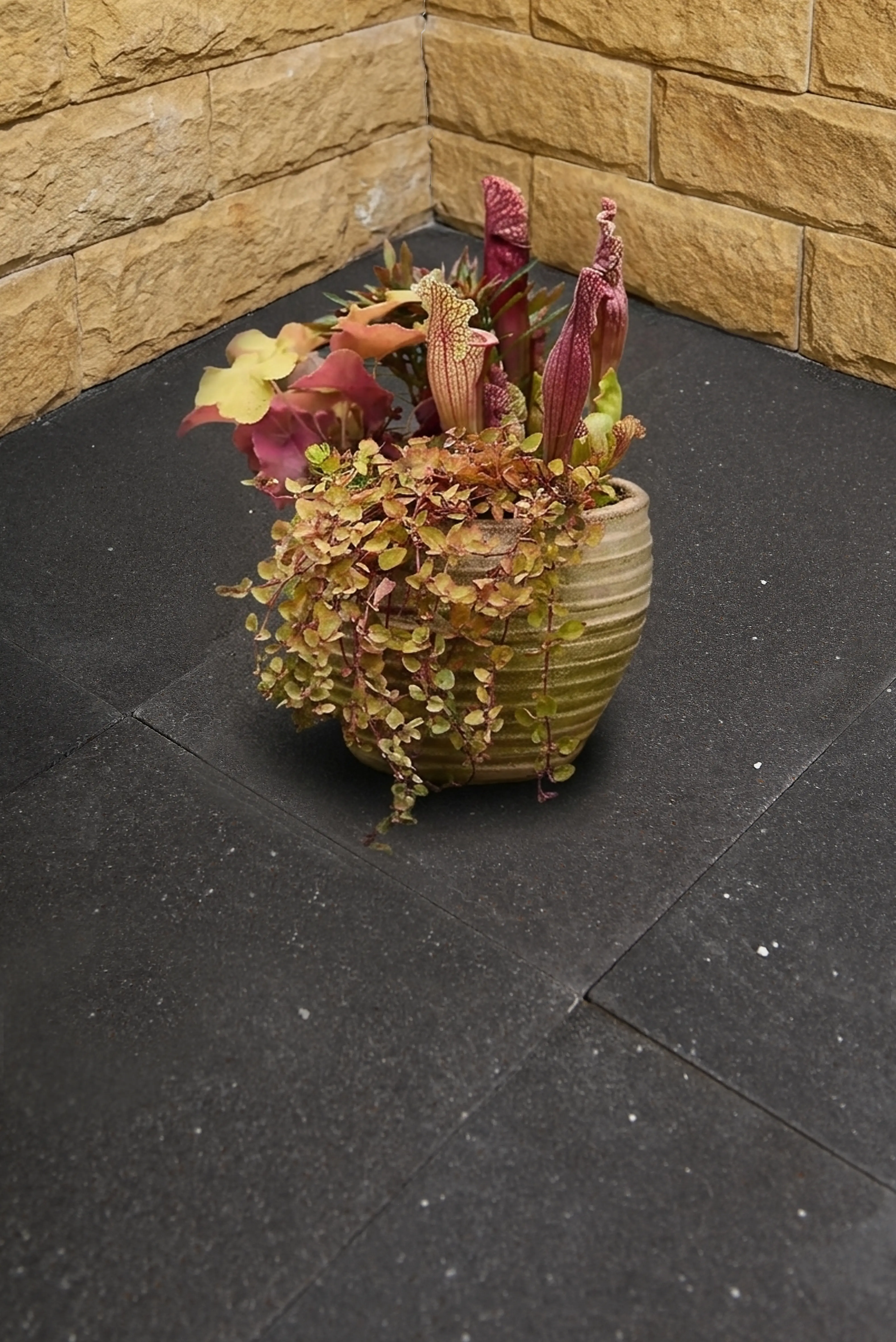
Order 24×24 Travertine Tile from Citadel Stone
Citadel Stone supplies 24×24 travertine tile in 12mm and 20mm gauges across filled-and-honed, tumbled, brushed, and unfilled finishes, with matching thresholds, bullnose, and stair treads available from the same production lots. You can request full-size samples, gauge and absorption data, or a batch consistency report before issuing a purchase order — sample requests ship from warehouse stock rather than waiting on an import cycle.
Trade and wholesale inquiries are handled directly: send square footage, layout type, gauge, and required delivery window, and you’ll receive quantity pricing with a realistic waste allowance built in. Standard orders ship nationwide, with palletized truck freight and liftgate service quoted upfront so site logistics are settled before the material moves. Buyers comparing cheap import stock against graded travertine tile 24 x 24 material can request a side-by-side sample pair to judge fill quality honestly.
Stone selection rarely happens in isolation — many projects pair a large field format with a smaller module in bathrooms, landings, or borders, and reviewing how 18×18 travertine formats compare will help you plan those transitions before ordering. Contractors specify 24×24 Travertine Tile from Citadel Stone, a limestone with a distinctive naturally banded texture, for residential and commercial sites.
See also: large format floor tile patterns.
Related guides: porcelain floor tile · How to Choose Marble Floor Tile 24×24 Wisely · stone kitchen floor tile ideas · Natural Stone Floor Tile Cost: A Full Breakdown · large tile lippage problems · bathroom floor tile ideas.