Porcelain floor tile clocks in at water absorption rates below 0.5% — a figure that sounds impressive until you sit down with a travertine specification sheet and realize you’re comparing manufactured consistency against geological character, and the decision is rarely as straightforward as absorption data alone suggests. What actually separates a well-chosen porcelain floor tile installation from a travertine one isn’t the material’s raw performance ceiling; it’s how each material behaves at the margin — at grout joints under hydrostatic load, at surface transitions where foot traffic concentrates, and over decades of thermal cycling that no showroom demonstration can replicate. This guide walks you through a genuine side-by-side comparison across the performance categories that matter most for your specification decision.
Material Fundamentals: How Each Floor Tile Is Made
Porcelain floor tile is produced by firing dense clay bodies at temperatures exceeding 2,200°F, which vitrifies the clay matrix into a near-glass state. That manufacturing process is the origin of its defining properties — low porosity, consistent dimensions, and predictable surface hardness across every unit in a batch. Your specification benefits from that uniformity: every tile ships from the factory within tight dimensional tolerances, which simplifies layout and reduces lippage risk on large-format runs.
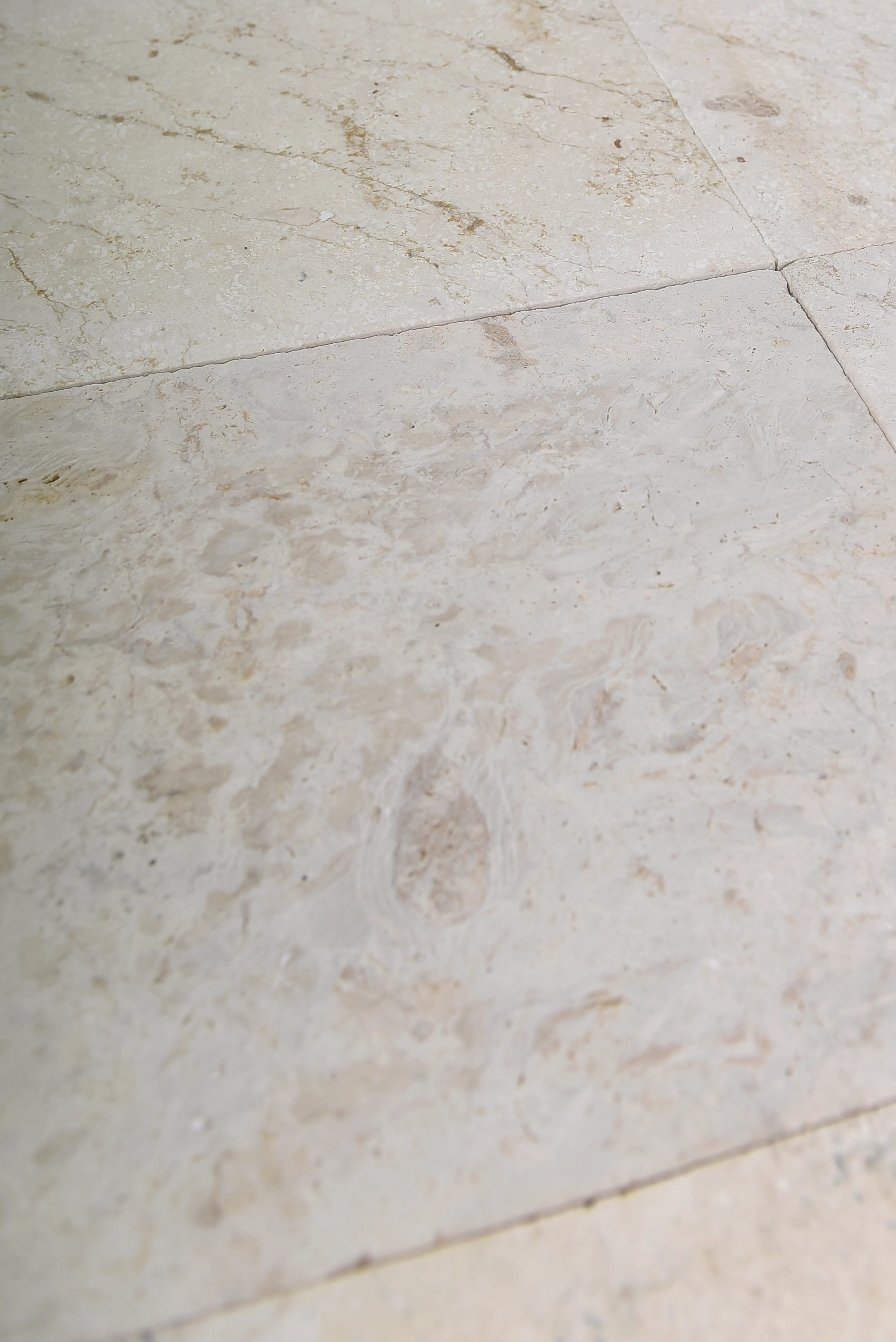
Travertine forms differently — it’s a sedimentary limestone precipitated from calcium-rich groundwater, typically near hot springs or limestone cave systems. The voids and fissures you see in a cross-section are original gas escape channels from the formation process, later filled with grout, resin, or left open depending on the finish specification. That geological origin gives travertine its warmth and visual depth, but it also means no two slabs are identical, and your material selection process needs to account for natural variation in tone, veining, and void density.
- Porcelain vitrification produces compressive strengths typically ranging from 12,000 to 19,000 PSI, depending on body formulation
- Travertine compressive strength ranges from roughly 3,500 to 8,000 PSI — lower than porcelain but well within structural requirements for residential and light commercial floor applications
- Porcelain dimensional consistency runs within ±0.3% per ASTM C485 warpage standards; travertine thickness variation requires calibration or back-grinding for tight-tolerance installations
- Travertine’s open pore structure before filling creates a natural surface texture that affects slip resistance, sealing schedules, and long-term maintenance requirements
- Porcelain tile offers full-body color through the thickness in some product lines, which matters when edges chip — the damage is less visible than on a surface-printed glazed tile
Floor Tiles Texture: What Each Finish Delivers Underfoot
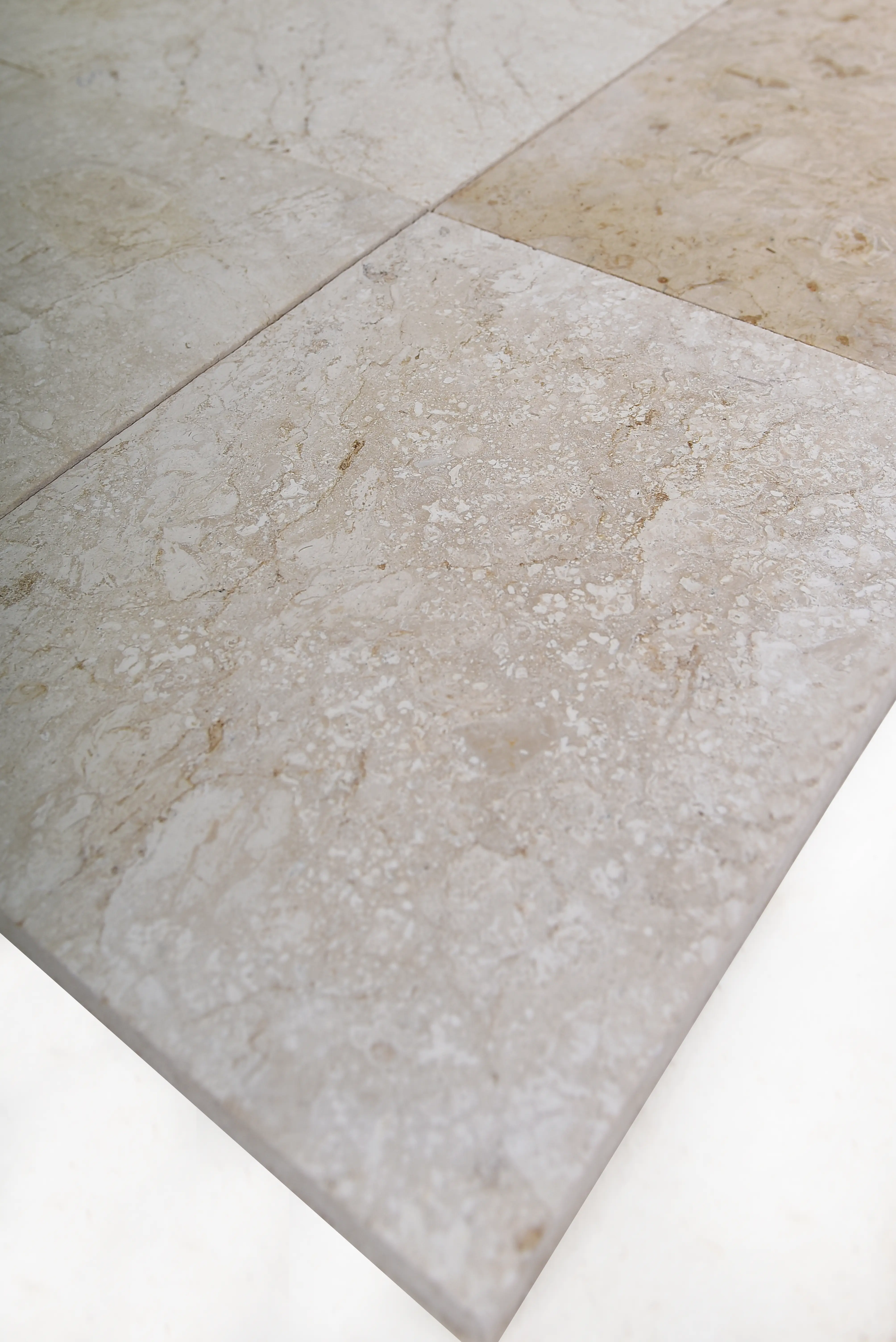
Floor tiles texture is one of the most underweighted specification variables in buyer-facing guides, and it’s the category where porcelain and travertine diverge most sharply in real-world performance. Porcelain achieves its texture mechanically — through die embossing during pressing or through surface etching after firing — and that texture is consistent across every unit. Travertine’s texture emerges from the stone’s natural grain, void structure, and surface finish applied during processing: honed, polished, brushed, or tumbled each produce a measurably different coefficient of friction.
For indoor floor applications, honed travertine with filled voids should be verified for wet DCOF against the 0.42 minimum of ANSI A326.3. Polished travertine retains very little wet texture — serviceable for low-traffic residential rooms but marginal for commercial corridors or households with young children. Porcelain floor tile with a structured or matte finish carries dependable texture, and that consistency holds across the full production run because it’s engineered rather than geological. According to TCNA installation standards, wet-area floor specifications should target a minimum DCOF of 0.42, which both materials can achieve — but porcelain reaches that threshold more reliably across varied finish options.
Water Management: How Each Material Responds to Moisture Load
Your drainage design influences material selection as much as any aesthetic preference, and this is the dimension of the porcelain-versus-travertine decision that most comparison guides handle superficially. Porcelain floor tile’s sub-0.5% absorption rate means moisture doesn’t penetrate the tile body — water stays at the surface and moves toward drains as designed. That behavior is valuable in wet-zone interiors, in climates with heavy rain seasons, and in any installation where the subfloor has limited vapor barrier capacity.
Travertine’s absorption rate varies by density grade but commonly falls between 3% and 8% on unfilled, unsealed specimens. After proper filling and sealing, effective surface absorption drops substantially — but the key word is “after.” Your installation and maintenance schedule must stay current with resealing cycles, typically every 12 to 24 months depending on traffic and cleaning chemistry, or moisture penetration resumes at rates the base system wasn’t designed to handle. In freeze-thaw regions, that absorbed moisture expands as it freezes, creating internal stress that can fracture travertine tile bodies over multiple seasons if drainage slopes are inadequate or if the base allows standing water.
- Porcelain floor tile in wet-zone applications requires no sealing — grout joint sealing is still recommended, but the tile body itself is moisture-resistant without any treatment
- Travertine installed in areas with monsoon-season moisture loading or seasonal flooding risk requires aggressive drainage slopes — minimum 1/8 inch per foot toward drains — and premium penetrating sealers reapplied on a documented schedule
- Both materials perform well in dry climates with reliable drainage, but drought-then-deluge precipitation cycles create subfloor heave risks that affect travertine’s filled voids more than porcelain’s dense body
- In humid environments, travertine can develop efflorescence at grout joints if moisture migrates upward through the slab — a phenomenon rarely seen with porcelain installations over similar substrates
- Base preparation requirements diverge: travertine benefits from a thicker mortar bed (a minimum 3/4-inch medium-bed mortar) to accommodate natural thickness variation, while porcelain’s dimensional consistency allows thinner-set applications without lippage risk
Thermal Behavior and Long-Term Dimensional Stability
Porcelain’s thermal expansion coefficient runs approximately 3–4 × 10⁻⁶ per °F, which is low by flooring standards and one reason large-format porcelain installations hold tight over time in climate-controlled interiors. The challenge appears at unconditioned thresholds — covered patios, sunrooms, and mudrooms that swing between outdoor ambient and conditioned interior temperatures seasonally. Your expansion joint schedule needs to account for those transitions explicitly: joints every 20–25 feet in conditioned space tighten to every 8–12 feet at climate boundaries.
Travertine’s thermal expansion is comparable — roughly 4–5 × 10⁻⁶ per °F — but the material’s heterogeneous structure means expansion doesn’t distribute uniformly across the tile body. Voids and filled areas respond differently to temperature change, which is why tight grouting of travertine without soft joints at perimeter conditions leads to spalling at void edges over time in hot, dry climates with significant day-to-night temperature swings. The Natural Stone Institute ASTM specifications provide clear guidance on soft joint placement for natural stone tile installations — a reference worth pulling before you finalize your expansion joint layout regardless of which material you’re specifying.
Installation Complexity and Field Variables
Here’s a variable that comes up constantly in the field and rarely in published comparisons: your installation timeline and subcontractor familiarity with the material matter as much as the material’s published performance data. Porcelain floor tile is more forgiving of installer variability — its dimensional consistency means layout lines hold, lippage is predictable, and setting bed thickness can be standardized across the entire floor. An experienced tile setter working with a new porcelain product can calibrate within a few tiles.
Travertine demands more from the installer. Thickness variation across natural stone requires back-buttering technique adjustments tile by tile, and the filled voids can telegraph stress if the mortar bed isn’t fully supported beneath them. Verify that your tile setter has documented travertine experience before committing to a large-format installation — the difference between a 24×24 travertine floor installed by someone who knows the material and one installed by someone learning it on your project is visible within the first heating season. For travertine tile options in 24-inch formats, the Citadel Stone stone tile selection includes calibrated material with documented thickness tolerances that simplify the installer’s task significantly.
- Large-format porcelain (24×24 and above) requires back-buttering and a flat subfloor — any deflection exceeding L/360 will cause lippage regardless of installer skill
- Travertine grout joint width should be specified at a minimum 1/8 inch to accommodate natural dimension variation — tighter joints increase the risk of cracked edges at void locations
- Porcelain tile cutting requires diamond wet saws with appropriate blade speed; travertine cuts more cleanly but voids at cut edges need immediate sealing to prevent grout migration into the stone body
- Setting material selection differs: large-format porcelain benefits from a large-and-heavy tile (LHT) mortar meeting ANSI A118.15 for improved bond strength; travertine performs best with a medium-bed mortar that can be feathered beneath thickness variations
- Both materials require a minimum 24-hour cure before grouting and 72 hours before heavy foot traffic — but travertine’s first sealer application should follow grouting within 48 hours to prevent grout haze from penetrating open fill areas
Maintenance Requirements Over the Service Life
The maintenance conversation is where porcelain’s manufacturing advantages become most apparent to homeowners who didn’t fully work through long-term ownership costs at the specification stage. Porcelain floor tile in a matte or structured finish requires nothing beyond regular cleaning — no sealing, no resealing, no specialty stone cleaners. Mop it with pH-neutral detergent, and the surface chemistry doesn’t change over time because the glaze or full-body color is vitrified into permanence.
Travertine’s service life and appearance over decades depend directly on your maintenance discipline. Unsealed or under-maintained travertine in kitchens will absorb cooking oils and acidic liquids — wine, citrus, vinegar-based cleaners — into the stone body, creating stains that require professional poulticing to remove. The calcium carbonate base is also reactive to acid, meaning common household cleaners cause visible etching if left in contact with the surface. That said, travertine installed correctly and maintained attentively delivers decades of service life with a character that porcelain’s printed surface pattern can approximate but not replicate. According to ASTM natural stone tile testing standards, absorption and chemical resistance characteristics of natural stone tile should be verified per ASTM C97 and C650 before specifying in chemically demanding environments.
- Travertine resealing schedule: every 12 months in high-traffic or wet applications; every 24 months in low-traffic, dry residential rooms
- Porcelain floor tile cleaning: pH-neutral mopping weekly; grout resealing every 2–3 years in wet areas only
- Travertine void re-grouting: inspect annually and regrout settled or cracked fill areas before moisture migration begins
- Both materials are highly resistant to UV discoloration in covered interior applications — color stability over decades is strong for each
- Porcelain surface glaze can scratch under sharp-edged dragging loads; travertine honed surfaces develop a natural patina over time that many clients find more appealing than new
Cost, Supply Lead Times, and Project Logistics
Material cost comparison between porcelain floor tile and travertine is heavily format- and quality-dependent, which makes headline price comparisons misleading. Entry-level porcelain runs lower per square foot than mid-grade travertine, but premium large-format porcelain with through-body digital print and structured texture can exceed the cost of well-graded travertine sourced from Middle East quarries. Your total installed cost calculation needs to include mortar bed, grout, sealer (travertine only), setting labor adjusted for material difficulty, and any subfloor remediation required to hit flatness tolerances.
Lead times deserve attention in your project schedule. Porcelain is produced domestically and internationally with broad warehouse inventory available for most popular formats and finishes — you can often pull from in-stock inventory within a week. Travertine sourced from select quarries in the Middle East and Mediterranean carries longer import cycles when warehouse stock is depleted, typically 6–10 weeks from order to delivery. Citadel Stone maintains ready warehouse inventory of core travertine formats that reduces that lead time significantly for common specifications — confirm stock levels before finalizing your project schedule, especially for large-quantity orders that may require staged truck delivery across multiple loads.
- Porcelain floor tile installation waste factor: 10–12% for straight lay; 15% for diagonal or complex pattern layouts due to cut waste
- Travertine waste factor: 12–15% due to natural variation rejection and void-edge cut losses — budget conservatively
- Freight planning: both materials ship by truck as heavy freight; 24×24 travertine pallets run approximately 3,000–4,000 lbs per pallet — verify your site’s truck access before scheduling delivery
- Porcelain tile comparison shopping is easier because dimensional and finish specifications are standardized — you can substitute between manufacturers without significant field adjustment
- Travertine lot consistency matters: order enough material to complete the full floor from a single quarry lot, or accept natural variation between lots as part of the design intent
Aesthetic Fit: Which Material Works for Your Design
Design fit is ultimately a subjective call, but there are objective parameters that push a project toward one material over the other. Porcelain floor tile excels in contemporary, high-contrast, and minimalist interiors where dimensional consistency and geometric precision reinforce the design language. Large-format porcelain in a concrete or stone-look finish creates seamless visual planes that natural stone can’t match because natural stone’s inherent variation breaks the continuity. Your architect or interior designer will likely specify porcelain in these contexts because the end result is more controllable.
Travertine fits differently — it works best in designs that embrace material character rather than control it. Mediterranean, transitional, and organic-modern interiors benefit from travertine’s tonal warmth and the subtle depth of its vein structure. The porcelain floor tile comparison ultimately comes down to whether your project’s design intent values manufactured precision or natural authenticity — both are legitimate goals, and neither material is universally superior. What matters is aligning the material’s inherent character with the design’s requirements before you order.
- Porcelain: ideal for large open-plan floors where visual continuity and grout-line minimization are priorities
- Travertine: ideal for rooms where the material is meant to be the focal element — entry halls, master baths, feature walls transitioning to floors
- Mixed applications: porcelain field tile with travertine borders or feature insets is a practical compromise that delivers each material’s strengths where they fit
- Travertine in honed or brushed finish reads warmer and more tactile than most porcelain surface textures — a distinction that photographs poorly but feels significant to occupants daily
- Porcelain’s print technology has advanced to the point where stone-look products are genuinely convincing at a distance; the difference becomes apparent in hand samples and under raking light
Porcelain Floor Tile vs. Travertine: Making the Final Specification Call
The decision between porcelain floor tile and travertine resolves quickly once you’ve locked in three variables: your drainage and moisture environment, your maintenance commitment over the installation’s service life, and your design intent. Porcelain wins on dimensional consistency, maintenance simplicity, and moisture resistance — it’s the pragmatic choice for wet zones, heavily used commercial floors, and projects where long-term ownership cost needs to stay predictable. Travertine wins on material authenticity, thermal character, and the kind of visual depth that only geological time produces — it’s the right choice when the design calls for something a manufacturing process can’t replicate, and when the owner understands the maintenance relationship that comes with natural stone.
At Citadel Stone, we work through these specification decisions with clients regularly — reviewing quarry sourcing, warehouse stock positions, and delivery logistics before a single tile is ordered, because the material that looks right on a sample board needs to perform right in the field for decades. As you extend your planning to related spaces, bathroom floor tile ideas covers how these materials translate into wet-room specifications with additional finish and layout guidance. Travertine from Citadel Stone comes in 24-inch tiles measured for uniform thickness, sourced from select natural stone quarries worldwide.
Related reading: large tile lippage problems · floor tile · how to install large floor tile.