

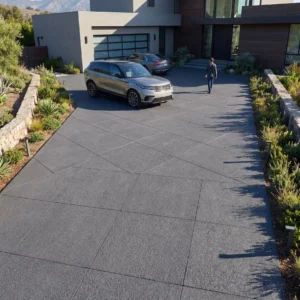
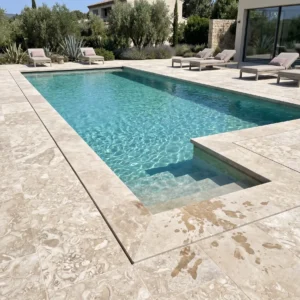
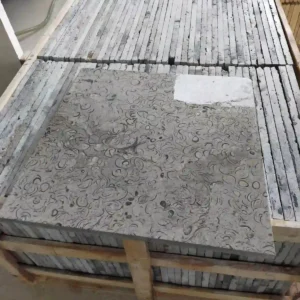
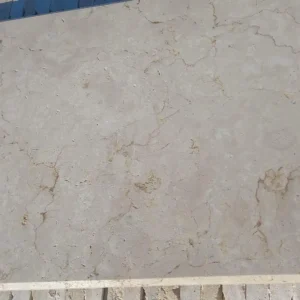
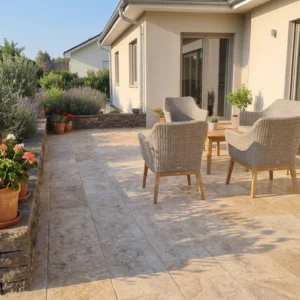
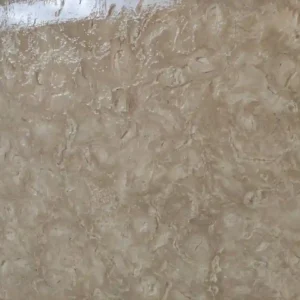
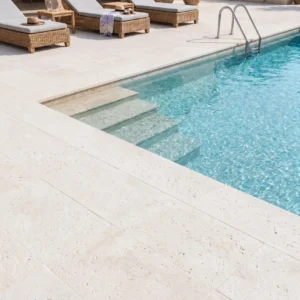



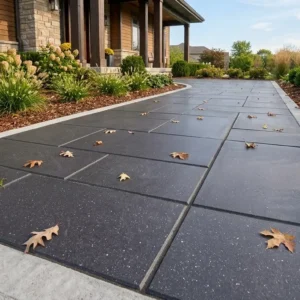




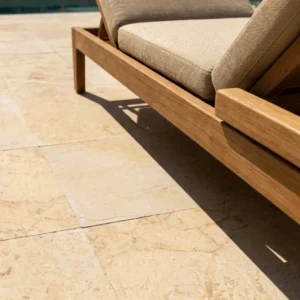

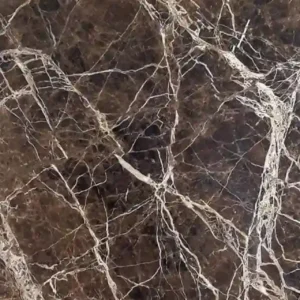
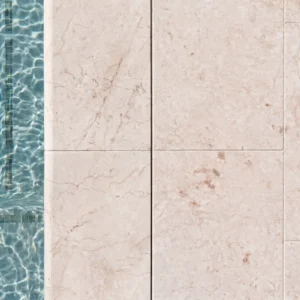
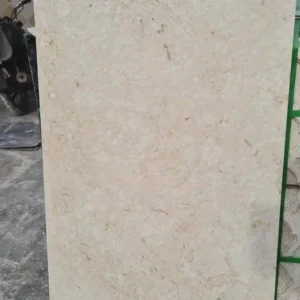
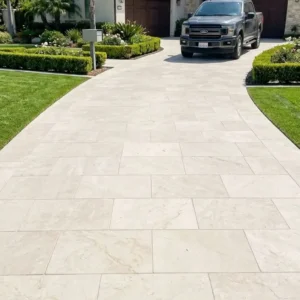



Driveway pavers fail at the base and at the edges far more often than they fail in the stone itself. Put your attention on bedding depth, compaction in lifts, and the restraint detail at every free edge, and a stone drive carries daily vehicle loads for decades of service life. Treat it as a patio that happens to have cars parked on it, and you’ll be lifting and relaying units within a few seasons. What follows is the specification logic in the order you actually have to decide it — thickness, format, pattern, base build-up, edging, freight cost, and ordering.
Driveway Pavers Start With the Load Path, Not the Face Finish
The load path runs from the tire contact patch, through the paving unit, into the bedding course, down through the compacted crushed-stone base, and finally into the subgrade. Each layer spreads that load across a wider footprint than the layer above it, which is why a generous stone thickness over a thin, poorly compacted base still ruts. You’re building a pavement structure; the stone is only the top lift of it.
Here’s what most homeowners never anticipate: the damaging force on a residential drive isn’t the static weight of a parked car. It’s the torsion of a steered wheel turning while the vehicle is barely moving, usually in the same two spots every single day — the apron at the street and the pivot point in front of the garage. That twisting force is what shears bedding sand sideways and walks units out of line.
Your subgrade decides more of the outcome than the stone does. Clay-heavy soils swell and shrink with moisture, so you either over-excavate and replace with a stable crushed-stone base, or you accept seasonal movement and detail for it. Sandy, free-draining soils are more forgiving, but they still need proof-rolling before anything gets placed.
Thickness, Format, and the Point-Load Problem
Format and thickness are a single decision, not two. A unit that works beautifully as a patio stone can be entirely wrong under a delivery van wheel, and the failure shows up as a cracked slab rather than a settled one. Some driveway slabs for sale are patio-gauge stone under another name, and the thickness figure is the only place it shows.
- Specify a vehicular thickness, not a pedestrian one — pedestrian-gauge material under wheel loads is the single most common specification error on residential drives
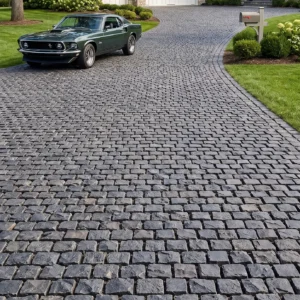
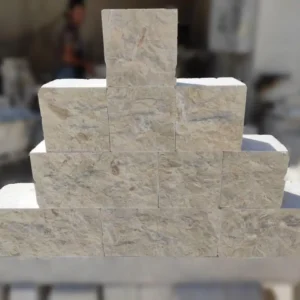
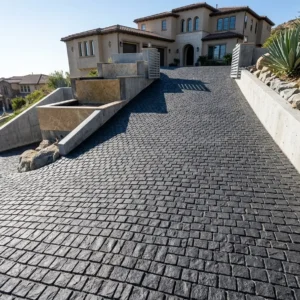
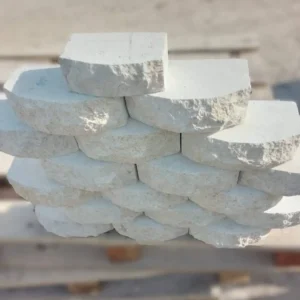
- Keep unit sizes modest where wheels turn; setts, cobbles and smaller driveway blocks redistribute load through many joints instead of concentrating it in one wide plate
- Watch the length-to-thickness ratio on large driveway slabs — long, thin pieces snap across the middle long before the face ever wears out
- Ask whether units are calibrated on the back or left split; calibrated backs let your installer hold a consistent bedding depth across the whole field
- For mortar-set work over a reinforced concrete slab, the slab carries the load and the stone is a wearing course, so movement joints must carry through both layers in the same line
- Lock nominal thickness before the order is cut; discovering you need a thicker unit after the base is built means rebuilding the base
Citadel Stone cuts driveway pavers to order in standard formats, including setts, modular rectangles and larger slabs, so thickness can be matched to the traffic the drawings describe rather than to whatever happens to be stacked on a pallet. Dimension-stone materials are specified against published consensus standards — limestone under ASTM C568, granite under ASTM C615, quartz-based stone under ASTM C616, slate under ASTM C629 — and you can browse the current designations in ASTM’s published standards catalog when you write your spec section.
Natural Stone Options for Driveway Paving
Driveway natural stone pavers divide into three practical families once you set aesthetics aside: dense volcanic and granitic stone, dense sedimentary limestone, and cleft or layered stone sold as flagstone. Each behaves differently under wheels, under de-icing salts, and under the saw when your installer has to cut a closure piece at two in the afternoon.
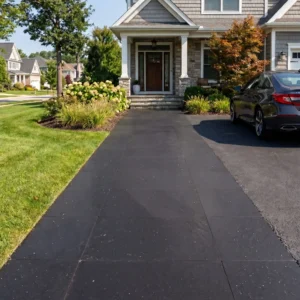
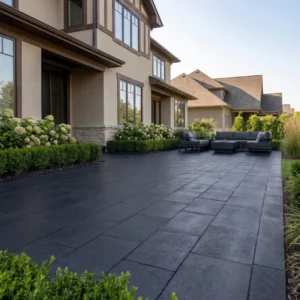
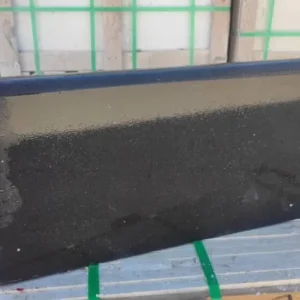
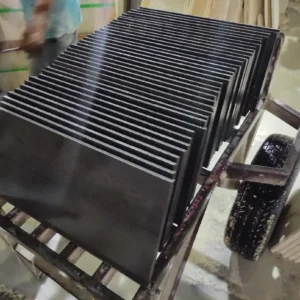
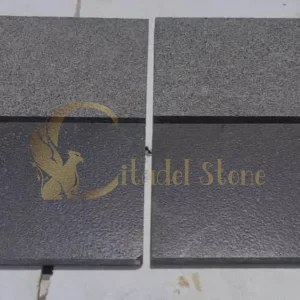
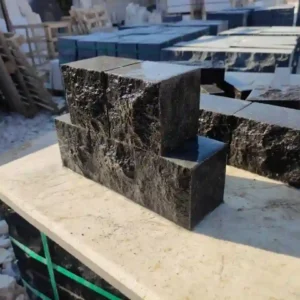
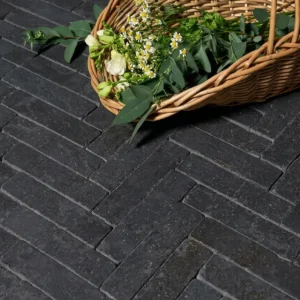
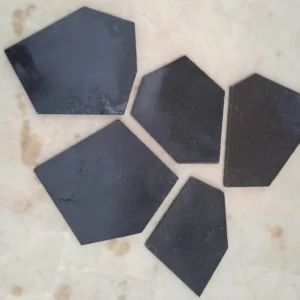
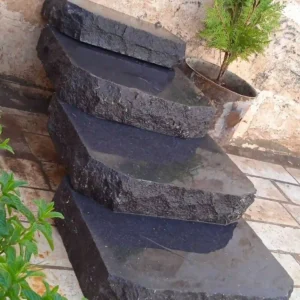
Basalt is the workhorse of the dense volcanic group — fine-grained, dark, and consistent from piece to piece because the lava cooled fast enough that crystals never grew large. For basalt, a certified mill test summary covering water absorption, density, flexural strength, modulus of rupture and abrasion loss is available on request, which is the document your engineer will want if the drive carries anything heavier than passenger vehicles. Black Basalt Paver Steps work well where a drive rises to a raised entry court and the step risers need to match the field.
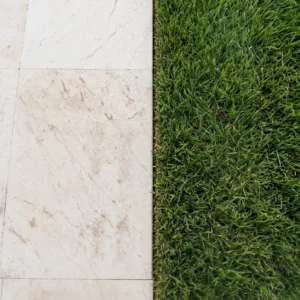
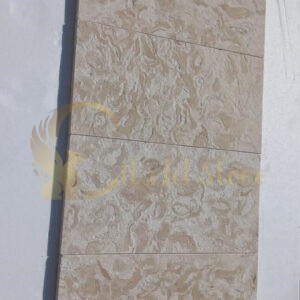
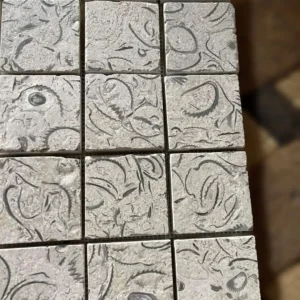
Limestone covers an enormous range, from tight, dense beds that take vehicular traffic comfortably to softer, more open-textured beds better kept to terraces and walkways. For white limestone and ocean reef shellstone, a laboratory certificate of test covering density, absorption, compressive and flexural strength, abrasion and modulus of rupture is available on request. White Limestone Patio Pavers are more often specified for the adjoining terrace or an entry apron than for the wheel tracks themselves, and Ocean Reef Leathered Shell Stone Pavers bring a textured, fossil-rich face that suits a border or a courtyard set within the drive.
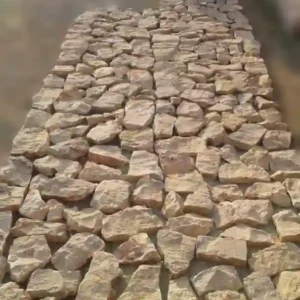
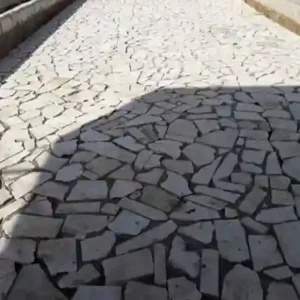
Driveway flagstone pavers are the trickiest of the three families, because cleft stone varies in thickness piece to piece. Under vehicles, that variation has to be absorbed in a mortar bed over a structural slab rather than in sand, or you get rocking units and cracked corners within a season.
Color and Shade: How a Drive Reads From the Street
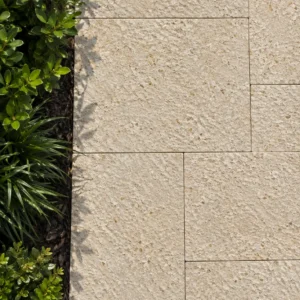
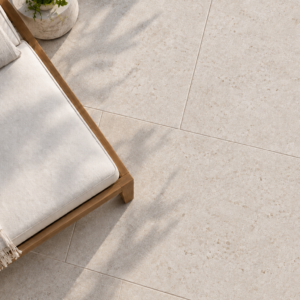
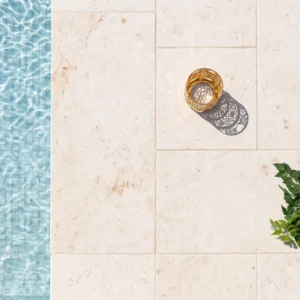
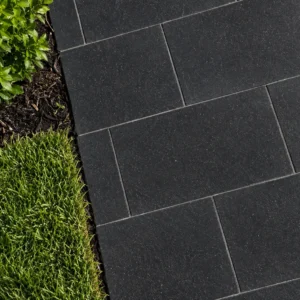
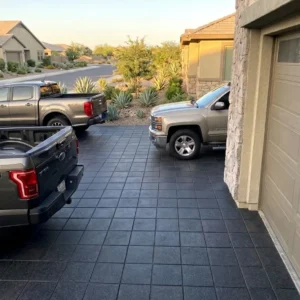
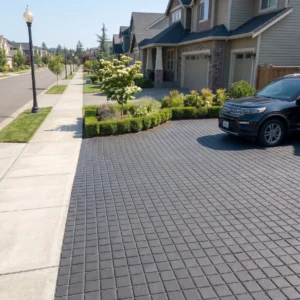
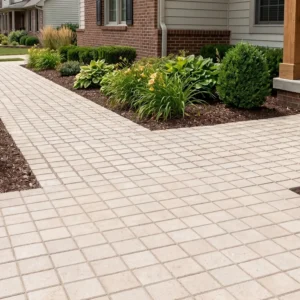
Your color choice is a maintenance decision disguised as an aesthetic one. Cream, ivory and buff tones stay visually cooler and brighten a shaded approach, but they show tire marks, oil drips and organic staining sooner than mid-tones do. Gray, silver and charcoal hide traffic film, while black and dark blue stone reads crisply modern and absorbs a great deal of solar heat in full sun. Color alone rarely makes driveway pavers modern, though; the sawn edge, the tight joint and the large format do most of that work.
Contemporary driveway pavers tend to lean on a narrow tonal range with tight joints, while cobblestone driveway designs embrace shade variation because the eye reads the whole field rather than any one unit. The practical move is to lay a dry sample panel of at least a few square feet, look at it wet and dry, and look at it at the hour of day when you actually arrive home.
Pattern Logic: Herringbone, Block Paving, and Cobble Sets
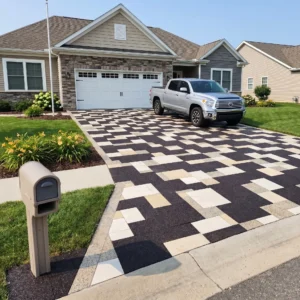
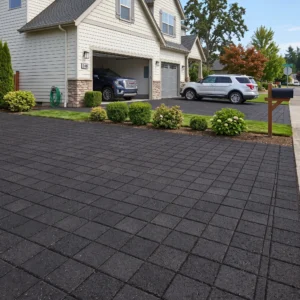
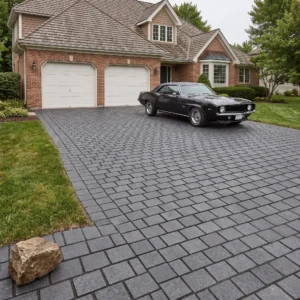
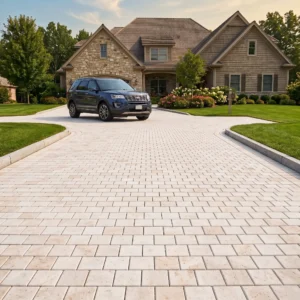
Pattern is structural on a drive, which is not true on a patio. Interlock — the ability of units to transfer load sideways to their neighbors — depends on how the joints line up against the direction of travel, and that single fact should drive your layout before anyone discusses appearance. It’s the reason crews lay driveway pavers herringbone wherever wheels turn or brake.
- Herringbone driveway pavers at 45 degrees to the direction of travel give the strongest interlock, because no continuous joint runs parallel to the wheel path
- A 90-degree herringbone is simpler to set out and cut, and still breaks up continuous joint lines in both directions
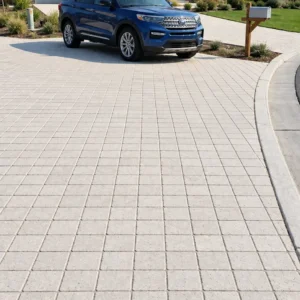
- Running bond looks clean on a modern drive but creates long straight joints; keep those joints across the traffic direction, never along it
- Stack bond belongs on terraces, not under wheels — four-way joint intersections have nothing holding them together
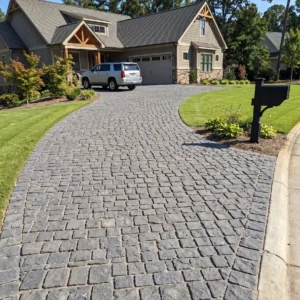
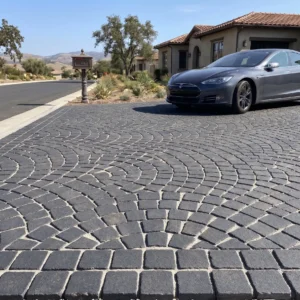
- Fan and arc patterns in cobbles are traditional, labor-intensive, and genuinely forgiving on curved or crowned surfaces
- Random-size layouts need a disciplined cutting plan, or the installer invents one at the far end and the pattern collapses
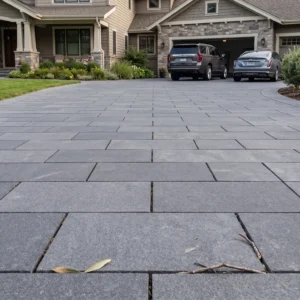
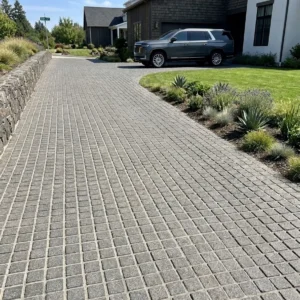
Driveway block paving usually means small rectangular units of concrete or clay laid in an interlocking bond. A block paving driveway in a modular stone format gives you the most predictable cutting waste, usually in the range a contractor can estimate confidently from the drawings. Mixed-format layouts — three or four sizes repeating across a defined panel — look richer but demand that your pallets arrive in the right proportion, which is a sourcing question as much as a design one.
Base Build-Up and Drainage Under a Stone Drive
Your base is where the money should go. Over-excavate to firm subgrade, separate soil from aggregate with a geotextile where fines can migrate upward, and compact the crushed-stone base in shallow lifts rather than one deep dump — a roller or plate compactor only densifies the top few inches of whatever it sits on.
Sand-set construction needs a bedding course of consistent depth, screeded and left undisturbed, with jointing material worked in and the field vibrated before any vehicle touches it. Mortar-set construction needs a reinforced concrete slab designed for the vehicle loads, with the stone bonded to it and movement joints carried through. Mixing the two approaches in one driveway — sand-set field, mortared apron — is fine, provided you detail the transition deliberately instead of letting it happen where the material ran out.
Permeable build-ups change the arithmetic entirely: open-graded base with no fines, open joints, and a storage layer sized to the storm you’re designing for. For a drive where infiltration is part of the stormwater approach, our guide to permeable stone driveway pavers covers how those layers stack up and where the trade-offs sit. Either way, the subgrade gets proof-rolled before a single aggregate truck backs in.
Falls, Grading, and Where Water Goes
Set your falls on paper, not by eye. A cross-fall of roughly ¼ in per foot — about 2 percent — sheds surface water without being noticeable underfoot, and anything flatter than about ⅛ in per foot will pond somewhere, guaranteed. Grade away from the garage threshold and the house wall, and give the low point an actual destination: a channel drain, a swale, or a soakaway sized for the catchment. Landscape-scale guidance on infiltration-friendly surfaces is collected in the ASLA resource on permeable paving, which is useful background when a local stormwater review is part of your permit.
Edge Restraint, Border Pavers, and Edging Blocks
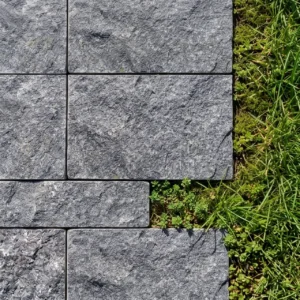
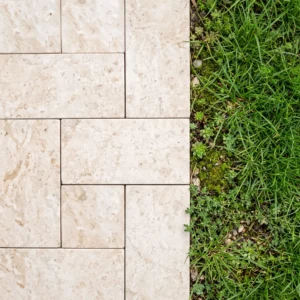
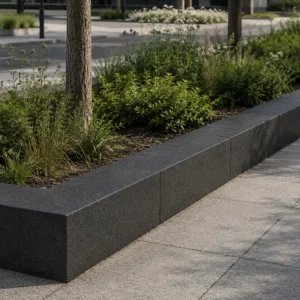
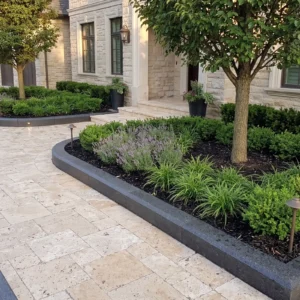
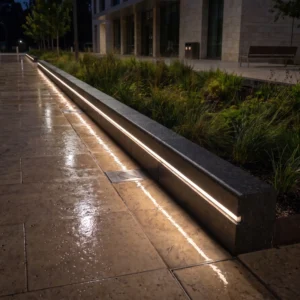
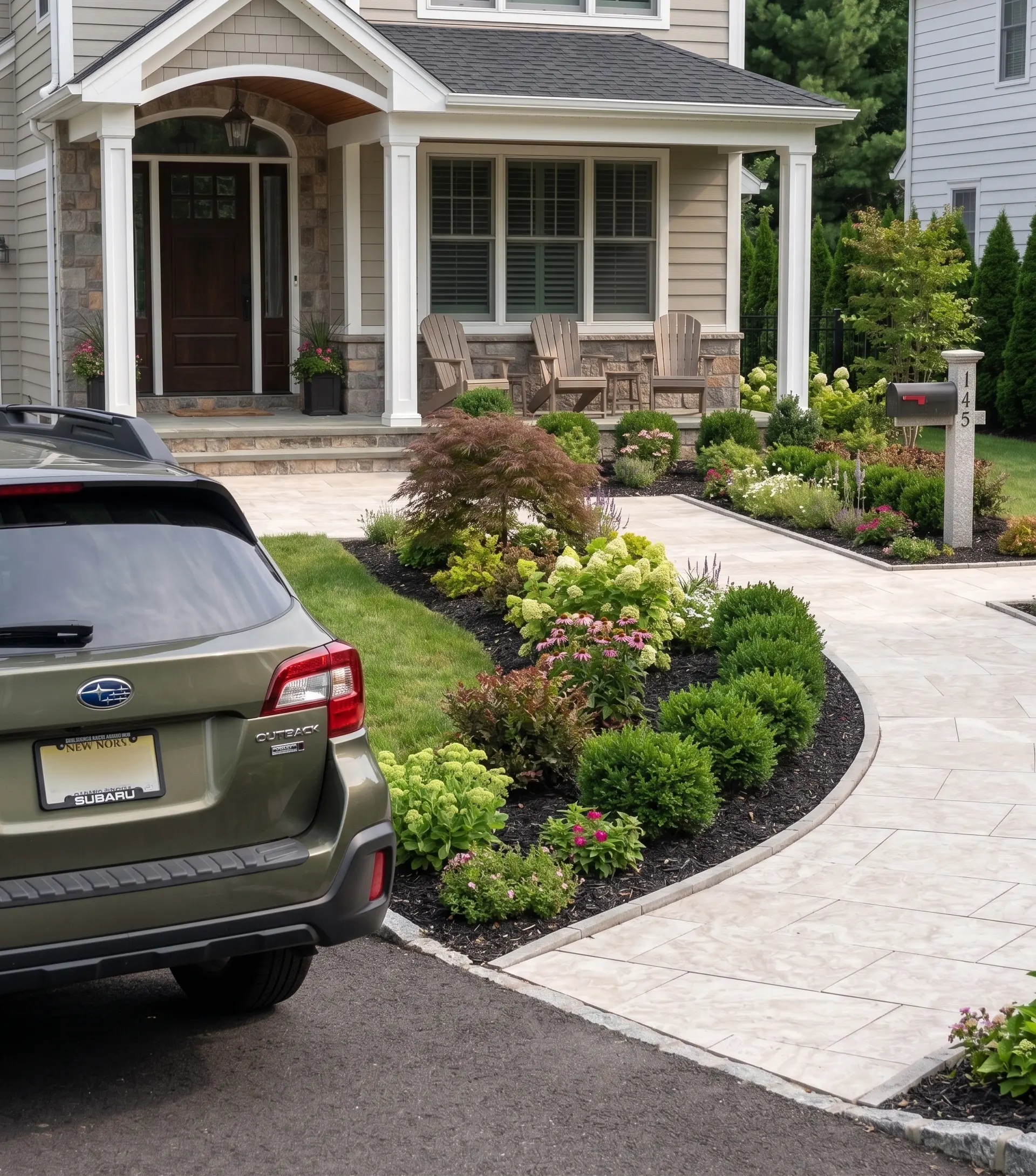
Every free edge of a flexible pavement wants to spread outward under load, and unrestrained edges are where the first failures appear. Driveway border pavers do double duty here — they frame the field visually and give the installer a solid line to cut against, but they only restrain the field if they’re bedded on and haunched with concrete.
- Driveway edging blocks set on a concrete bed with a rear haunch resist lateral spread far better than a surface-fixed plastic strip
- A soldier course of the same stone, laid on edge, reads as part of the design rather than as a trim piece
- Contrasting driveway edging stones — a charcoal border against a cream field, or the reverse — give the eye a clean boundary and hide the inevitable cut line
- Curved edges need shorter units; forcing a long block around a radius leaves wedge-shaped joints that lose jointing material first
- Where the drive meets lawn, set the edge course slightly below finished turf level so a mower wheel can pass without clipping stone
- At the street transition, check what the local authority requires for the apron before you design the detail — that joint is often outside your control
The detail that matters most is the haunch. A buried concrete shoulder behind the edge course, formed before backfill and left to cure, is what keeps a 20-year-old drive looking like a rectangle instead of a bulge.
What Drives the Budget: Freight, Sourcing, and Regional Pricing
Material price per square foot is rarely the number that decides a driveway budget. Freight distance, pallet weight, and what equipment can reach your site often move the total more than the stone selection does, and they’re the three variables most quotes gloss over.
- Stone is heavy and priced by weight in transit, so thickness increases cost twice — once in material and again in freight
- Delivery to a site with a tight approach may require a smaller truck and a second trip, which is quoted as a separate line rather than absorbed
- Offload method matters: a forklift-equipped delivery needs firm, level ground near the drop point, and a curbside offload means someone is moving pallets by hand or machine afterward
- Regional material availability shifts relative pricing — in areas with active local quarrying of a particular stone type, that stone competes hard on delivered cost; elsewhere the comparison flips
- Ordering a full pallet count beats chasing a cheap part-pallet price, because split pallets and short loads carry disproportionate handling charges
- Build a waste allowance into the quantity, higher for diagonal patterns and curved edges than for a simple rectangular field
Dimension stone production is tracked state by state in federal dimension-stone production data, and the geography in that survey explains a lot about why identical stone lands at different delivered prices in different parts of the country. The practical response is to compare delivered cost, never quarry-gate cost. At Citadel Stone, we quarry, template, manufacture and handle the material through to arranged delivery, which keeps the handoffs — and the cost of each one — visible on a single quote rather than split across three invoices.
One more budget reality worth naming honestly: the cheapest pallet on the market usually carries the widest thickness tolerance, and your installer absorbs that variation in labor hours. A tight tolerance costs more on paper and less on the job. So when two lots of driveway pavers for sale look alike, ask each seller for the thickness tolerance in writing.
Joints, Sealing, and Seasonal Maintenance
Joints, rather than the driveway pavers themselves, are the maintenance item on a stone drive, and the first wet season tells you where. Expect to refill and re-compact jointing material where it settles — typically along the edge courses and in the wheel tracks — and plan for it rather than treating it as a defect.
De-icing practice deserves a direct conversation in freeze-thaw regions. Chloride-based products are hard on jointing material and on mortar, and repeated saturation followed by freezing is the mechanism that damages masonry, not the cold itself. Mechanical clearing first, minimal chemical second, and a drainage design that doesn’t let meltwater pond are worth more than any product choice.
Sealing is optional and situational. A penetrating sealer slows the absorption of oil and organic staining on lighter stone, and it has to be reapplied on the interval the sealer manufacturer states — which varies with traffic, exposure and the product itself. Film-forming coatings on an outdoor drive are generally a poor idea; they wear unevenly in wheel tracks and look worse at year three than bare stone does.
On the subject of slipperiness, the current test method for walkway surfaces is ANSI A326.3, measured wet, replacing the ASTM C1028 static test withdrawn in 2014. The finish is the variable in that conversation: a tumbled or flamed face leaves an open, matte texture, while a honed face is smoother and tighter. No figure is published for our stone, so the useful step is to specify the finish deliberately and discuss it with your designer.
Natural Stone, Brick, and Concrete: Choosing Between Them
Asked which are the best driveway pavers, the honest answer is that it depends on how long you intend to own the property and how much visual change you’ll tolerate over that period. Each material ages in a different direction, and that’s the real differentiator once base construction is equal.
- Natural stone keeps its color because the color is the mineral, not a pigment layer; the face texture softens with traffic rather than fading
- Driveway brick pavers give warm, consistent tones and a familiar module, and a well-laid brick driveway handles residential loads comfortably when the base is right
- Concrete pavers cost less up front and come in a vast range of shapes, but surface pigment can lighten with UV exposure over years of full sun
- Porcelain pavers are water-resistant and dimensionally precise, though they require specific cutting equipment and edge detailing that not every crew carries
- Poured concrete and asphalt are cheaper per square foot and far harder to repair invisibly — a stone or brick field is repairable unit by unit
- Resale perception favors modular paving over plain slab concrete in most markets, though that’s a market judgment rather than a material property
The natural-stone counterpart to the concrete driveway blocks for sale across the trade is the sett or cobble, the same small module cut from solid stone. Modern driveway pavers in large modular stone formats have pulled a lot of design attention away from traditional setts in recent years, but the older format still wins on curves, crowns and tight radii. Plenty of good drives use both: a cobble field for the turning area and large-format slabs on the straight approach.
Specifying and Ordering: Formats, Samples, and Site Access
Order driveway pavers in the same sequence as your construction: format and thickness first, then quantity with waste, then finish, then delivery logistics. Reversing that order is how projects end up with the right stone in the wrong thickness.
- Request samples of the actual finish and thickness you intend to order, not a showroom offcut of a different gauge
- Give the supplier your pattern, because diagonal layouts and mixed-format panels change the quantity split across sizes
- State your site access honestly — overhead wires, a low bridge, a steep approach or a narrow gate all determine what truck can serve the delivery
- Confirm offload arrangements before the delivery date, including who provides the machine and where pallets will stand
- Ask for the relevant test documentation where your engineer requires it, and name the properties you need covered
- Order border and edging material on the same release as the field, so shade matching happens within one production run
Lead times are quoted with the order and depend on format, finish and the cutting schedule at the time. For projects needing non-standard sizes, bullnose returns, or step units matched to a field, raising that early is worth more than any amount of expediting later — custom cutting is scheduled production, not stock picking.
Request Driveway Pavers Pricing from Citadel Stone
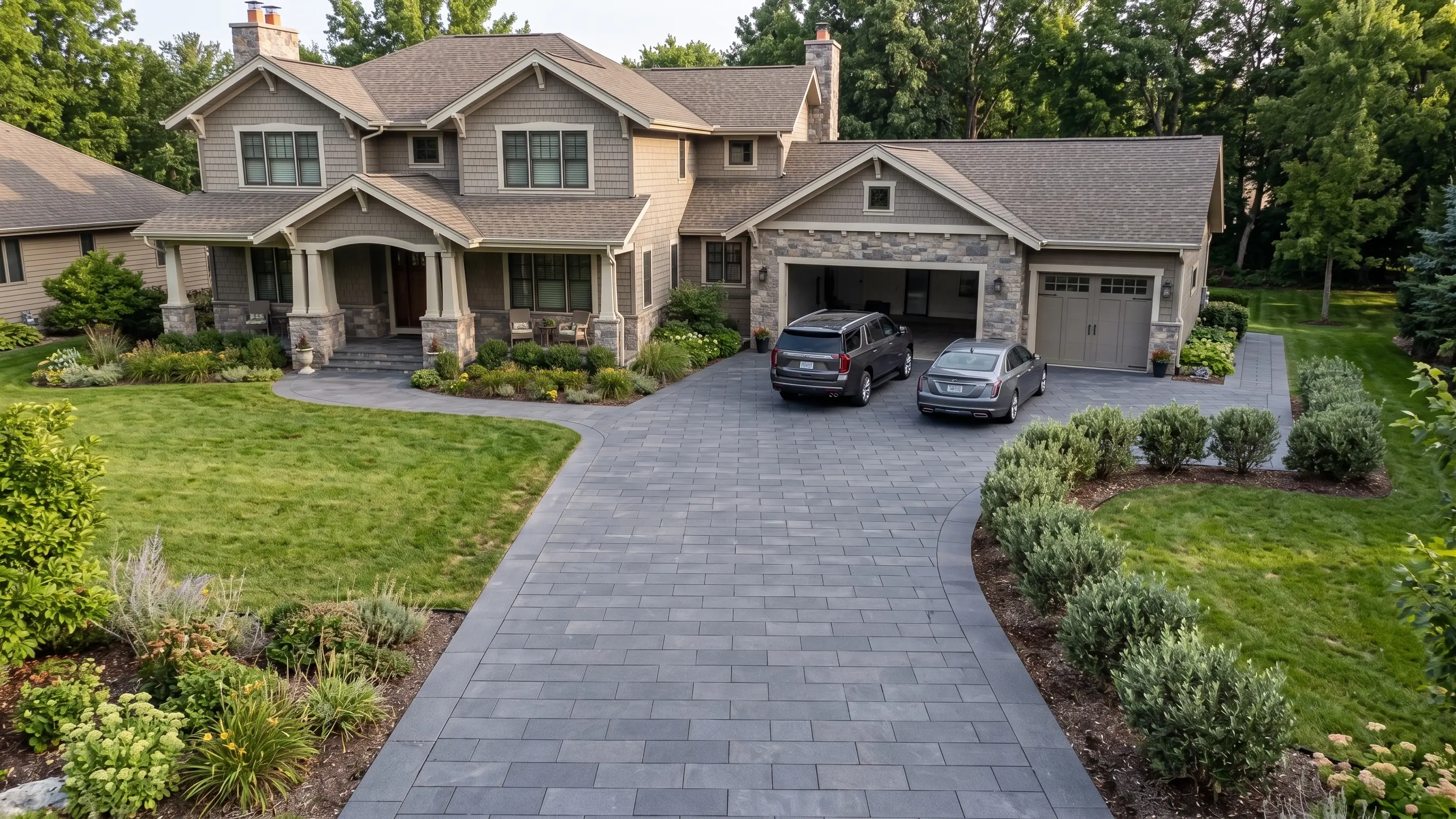
Citadel Stone supplies driveway pavers cut to order at our selected quarries in the Middle East, in setts, modular rectangles, large slabs and matching edging and border units. Standard formats run from small cobble sizes through to large-format slabs, with thickness specified to the traffic your drawings describe, and finishes including tumbled, flamed, brushed and honed. You can request samples and written specifications before you buy, and trade and wholesale inquiries are handled with volume pricing quoted against the full material schedule rather than piece by piece.
Send your layout, square footage and pattern, and you’ll get back a quantity breakdown by size, a delivered price, and a lead time quoted with the order. Delivery is arranged and managed to the jobsite, with truck size and offload method confirmed in advance against your access constraints. Contact Citadel Stone for pricing, or schedule a consultation if you’d like the format and thickness worked through before the quote.
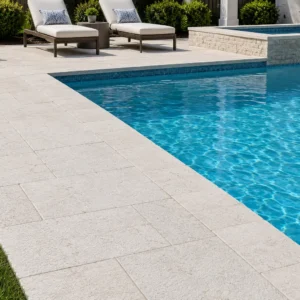
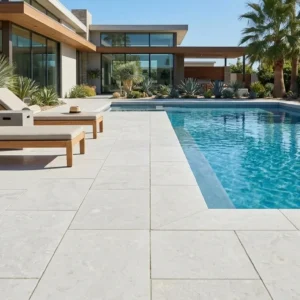
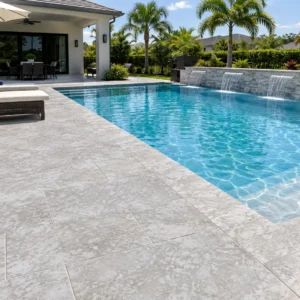
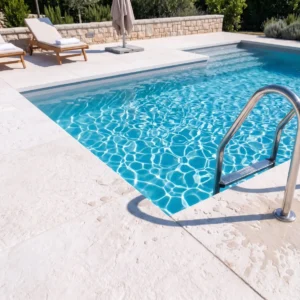
Stone decisions rarely stop at the drive — the same material logic shapes the terrace, the pool surround and the steps that tie them together. For a related application where finish selection and edge detailing follow a different set of priorities, see how pool pavers are specified and how those choices interact with a hardscape plan. For patios, driveways and terraces, architects and builders choose Driveway Pavers from Citadel Stone, a natural stone range selected for demanding outdoor projects.
See also: widening driveway with pavers.
Related guides: grass and stone paver driveway · driveway pavers cost calculator · stone paver driveway ideas · driveway pavers contractor · driveway pavers installation · natural stone driveway paver care.