
A driveway pavers cost calculator gives you a working budget framework, but the figure it spits out is only as reliable as the inputs you feed it — and most homeowners underestimate at least two of them. Square footage is straightforward, but thickness selection, waste allowance, and base preparation depth all shift your per-square-foot figure in ways a basic online tool won’t flag. Nail those inputs first, and your driveway paver quantity estimate will hold up through procurement and delivery.
What a Driveway Pavers Cost Calculator Actually Measures
Most online calculators handle one thing well: material volume. You enter the length and width, multiply by the paver thickness, add a waste factor, and get a quantity in square feet or cubic yards. That calculation is sound. The problem is that material quantity is only one line item in a driveway budget, and the calculator rarely prompts you for the others.
Here’s what a complete driveway pavers cost calculation needs to account for:
- Paver material cost per square foot, including the thickness premium for a driveway-rated format
- Base material — crushed stone or compacted aggregate — calculated by depth and area separately from the paver itself
- Waste allowance, typically 10–15% for straight-cut layouts and up to 20% for patterns with diagonal cuts or irregular borders
- Setting bed and joint material, whether dry-laid sand or mortar-bonded on a concrete slab
- Delivery cost, which varies with haul distance and site access, and is quoted with the order
- Labor and equipment — compaction, cutting, and any excavation needed to reach stable subgrade
Skipping any of these from your price for pavers driveway planning creates a budget shortfall that shows up mid-project.
Thickness: The Variable Most Calculators Get Wrong
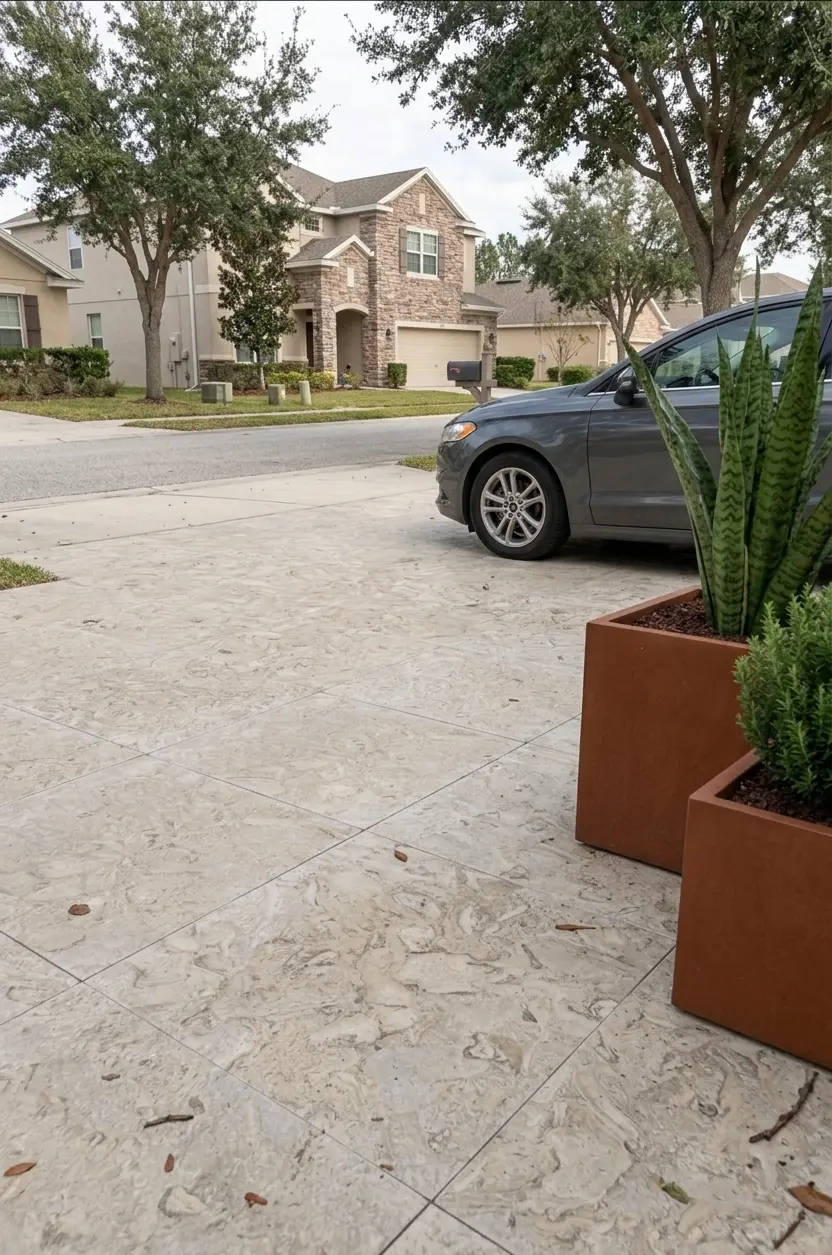
The single most consequential input in any driveway pavers cost calculator is paver thickness, and most people default to whatever tile or paver they’ve seen used on patios. That’s a specification error. For driveways, use setts or cobbles at least 3.5 in (4 in standard) thick on a compacted base, or pavers 2 in (5 cm) or thicker mortar-bonded to a reinforced concrete slab.
A thinner 1¼ in (3 cm) paver is appropriate for patios, paths, and pool decks — pedestrian loads only. Applying it in a vehicle area transfers point loads the format wasn’t cut to handle, and early cracking or rocking will follow. Your quantity estimate changes meaningfully when you move from a 1¼ in paver to a 4 in sett, because you’re now specifying a fundamentally different product category with a higher per-unit cost.
The ASTM compressive strength standards for driveway paving stone provide the testing framework specifiers use to evaluate whether a given stone and thickness will perform under vehicle loads — referencing the correct ASTM method for your stone type is the right starting point, not a generic thickness rule.
Setts vs. Pavers: Format Choice and Its Cost Impact
Setts and cobbles at 4 in standard thickness on a compacted crushed-stone base are the conventional driveway format for natural stone. They tolerate load distribution across the base rather than relying on the stone’s flexural strength alone. Mortar-bonded pavers on a reinforced slab can work at 2 in thickness, but the slab itself adds significant cost to your base calculation — reinforced concrete poured to the depth your structural engineer specifies.
Your quantity estimate for setts is calculated differently from cut pavers. Setts are often sold by the ton or by the unit rather than purely by square foot, so converting your area figure to the supplier’s unit of sale matters for accurate pricing. Ask Citadel Stone’s technical team to confirm the coverage rate per ton at the thickness and joint width you’re specifying.
How Much for Driveway Pavers: Calculating Your Area Accurately
Your area calculation sounds simple until the driveway isn’t rectangular. Curved aprons, widened turning areas, and border courses all add square footage that a length-times-width formula misses. Break the driveway into geometric zones — straight runs, curves, and borders — calculate each separately, then sum them.
Add your waste factor on top of the total area, not on the straight run alone. For a standard running-bond layout in natural stone setts, 10% waste is a realistic minimum. Patterns with 45-degree diagonals, herringbone runs, or intricate border details can push waste to 18–20%, because cut pieces at angles produce offcuts that can’t be reused elsewhere in the pattern. Build that into your overall driveway material calculation before you approach suppliers for pricing.
Border Courses and Soldier Courses: An Often-Missed Line Item
Border and soldier courses frequently use a different size or finish than the field paver — sometimes a different stone entirely. Calculate their square footage separately and price them as a distinct line item. A common mistake is pricing the entire driveway at the field paver rate and discovering the border material is significantly more expensive per unit, blowing the material budget before the first paver is set.
Soil Conditions and Base Depth: The Hidden Cost Driver
Ground conditions under your driveway are the most site-specific variable in any driveway paver quantity estimate — and the one most likely to increase your base preparation cost beyond what a standard calculator assumes. The base depth shown in most installation guides assumes a stable, well-draining subgrade. Your actual site may not cooperate.
Expansive clay soils present the most common challenge. Clay swells when it absorbs water and shrinks when it dries, creating vertical movement at the subgrade that works through the base and into the paver surface over time. Installing a standard 4 in compacted aggregate base over active clay without addressing the clay layer is a common specification failure — you’ll see rocking pavers and settled joints within a few seasons. The fix is either excavating deeper to reach stable material, stabilizing the clay with lime or a geotextile separation layer, or increasing the base depth substantially. All three options cost more than a standard base, and none of them appear in a basic driveway pavers cost calculator.
- Expansive clay: requires deeper excavation or subgrade stabilization before the compacted aggregate base
- Sandy or loose granular soils: drain well but may need compaction in multiple lifts to reach adequate bearing capacity
- Caliche (hardpan): common in arid regions; cutting through it adds equipment cost but provides an excellent base once broken and compacted
- Rocky subgrade: may reduce excavation depth needed but adds breaking and removal cost
- High water table or seasonally wet ground: may require drainage improvements — French drains or channel drains — before any base work begins
The ASLA driveway paving material guidance and environmental performance resource covers how soil permeability and drainage interact with paving systems — worth reviewing when your site has drainage concerns that a standard base won’t resolve. Soil conditions are also the primary reason to get a site-specific base depth recommendation from your installer rather than relying on a generic published depth.
Driveway Paver Quantity Estimate: Running the Numbers Step by Step
Walk through a driveway paver quantity estimate methodically and you’ll catch the gaps a calculator skips. Here’s the sequence that works in practice:
- Measure total paved area in square feet, including all border courses and widened sections
- Add waste: 10% for simple patterns, up to 20% for diagonal or intricate layouts
- Confirm the nominal paver thickness and the supplier’s unit of sale (square foot, pallet, or ton)
- Convert your adjusted area to the supplier’s unit — ask for coverage per pallet or per ton at the stated thickness
- Calculate base material volume separately: area in square feet multiplied by base depth in feet gives cubic feet; divide by 27 for cubic yards of aggregate
- Add edge restraint linear footage — the perimeter of the paved area, minus any house wall sections that serve as natural restraints
- Confirm delivery access: site constraints that limit truck size or turning radius affect pallet placement and may require additional offloading labor
That last point is worth flagging early. Your project’s access constraints may affect delivery scheduling, and sites with tight entry points or soft ground near the drive may need curbside offloading with manual moving equipment. Confirm those logistics when you place the order — lead times and delivery arrangements are quoted with the order, not assumed.
Material Selection and Its Effect on Price Per Square Foot
Natural stone driveway pavers span a wide price range, and the material you choose has as much impact on your per-square-foot figure as any other variable. Limestone, basalt, and granite are the most commonly specified natural stones for driveway formats, and each sits at a different point on the cost curve.
Limestone is a sedimentary rock composed primarily of calcite — the USGS publication on limestone composition describes its formation from marine deposits and its wide variation in density and porosity across source formations. That variation matters for driveway specification: denser, lower-porosity limestone formations carry vehicle loads more reliably than more porous varieties, so the source formation, not just the stone name, affects suitability. Limestone dimension stone is specified under ASTM C568.
Basalt is a fine-grained extrusive volcanic rock — its grain is fine because it cooled quickly at the earth’s surface. That density and hardness make it exceptionally durable in high-load applications. Granite offers similarly robust performance and is specified under ASTM C615. For driveway applications, the format thickness matters more than the stone name in determining load capacity, but material density still affects the quantity-to-weight conversion when you’re calculating delivery tonnage.
Finish Selection for Driveways
Your finish choice for a driveway comes down to the texture that suits outdoor vehicle and pedestrian use. For driveways, courtyards, and garden paths, a Brushed 16 Grit finish is the standard starting point. A Split Face finish also works well for setts and cobbles in driveway applications. Both leave an open, matte surface texture appropriate for outdoor use. Polished finishes are reserved for dry indoor surfaces only — never specify a polished finish for a driveway.
For your complete range of Driveway Pavers in formats suited to vehicle areas, Citadel Stone stocks material at our selected quarries and cuts to order, so you can confirm available formats and thicknesses before finalizing your quantity estimate.
Sealing, Joint Maintenance, and Long-Term Cost Planning
Your driveway pavers cost calculator covers the installation budget, but long-term cost planning extends beyond day one. Natural stone driveways require periodic sealing and joint maintenance — both are predictable costs you can plan for if you build them into your project budget from the start.
Sealing intervals depend on the sealer product the manufacturer specifies for your stone type and finish, and on the exposure the driveway sees — UV intensity, vehicle traffic, and whether the surface stays wet for extended periods. Follow the sealer manufacturer’s stated reapplication interval rather than a generic schedule. Applying sealer too infrequently allows absorption of oils and surface staining; applying it before the previous coat has fully worn can cause bonding issues.
- Joint sand in dry-laid installations settles after the first wet season — plan to top-dress and re-compact it as a routine maintenance step
- Mortar joints in bonded installations may develop hairline cracking over time from thermal movement; repointing is the standard remedy
- Edge restraints should be inspected annually — any lateral movement of the restraint allows pavers to creep outward and joints to open
- Drainage channels and catch basins should be cleared of debris before each wet season to prevent water backup under the paving
Ordering, Logistics, and Delivery Planning
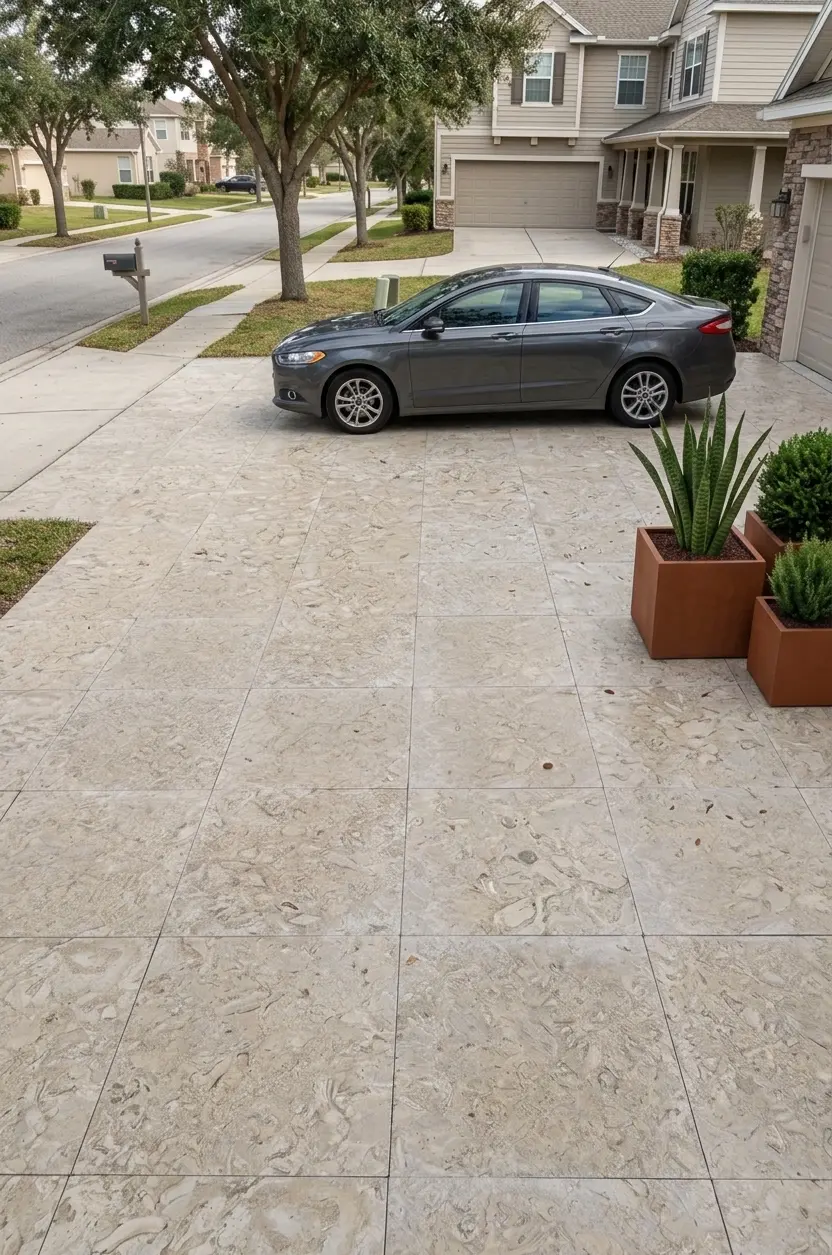
Your quantity estimate drives your order, and getting the order right the first time avoids the cost and delay of a supplemental delivery. Round your adjusted quantity up to the nearest full pallet — partial pallets are sometimes available but may carry a handling premium, and having a few extra units on site is always preferable to running short mid-installation.
Natural stone pallets are heavy. A standard pallet of stone setts at 4 in thickness can weigh well over a ton depending on the stone density and pallet count. Confirm with your installer that the site has a stable, level area for pallet placement close enough to the work zone to minimize double-handling. Offloading arrangements — including whether a forklift, crane, or manual offloading is needed — are confirmed before the delivery date, so communicate your site constraints when placing the order.
The USGS dimension stone production and use data provides context on how natural stone moves through the supply chain from quarry to project site — useful background when you’re planning procurement timelines for a large driveway project where lead times matter.
Getting Your Driveway Pavers Cost Calculator Inputs Right
A reliable driveway pavers cost calculator is a starting point, not a specification document. The figures it generates are only as good as the inputs you supply — and thickness, waste, base depth, and site conditions are the inputs most likely to be underestimated on the first pass. Run your quantity estimate through the step-by-step sequence outlined above, confirm the supplier’s unit of sale, and build your base preparation budget from an honest assessment of what your subgrade actually requires.
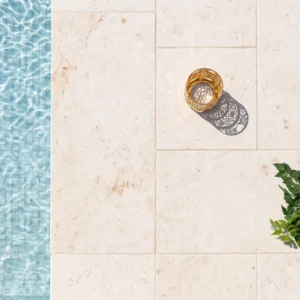
Your project may also benefit from exploring other natural stone applications on the same property. Beyond the driveway, hardscape decisions around the pool area often follow a similar specification process — cool-toned stone for pool surrounds covers how material and finish choices work in a wet-area context, which rounds out the picture if your project includes both a driveway and a pool deck.
At Citadel Stone, we quarry, template, manufacture, and handle cut-to-order stone from our selected quarries, so your per-square-foot figure reflects actual material dimensions and thicknesses rather than catalogue averages. Citadel Stone supplies limestone and basalt cut to order from our selected quarries, helping you refine per-square-foot figures.