
Permeable stone driveway pavers fail most often not from the stone itself but from a base that wasn’t designed to move water fast enough to keep pace with the rainfall intensity your site actually sees. The stone sits at the top of a drainage system, and every specification decision — thickness, joint width, aggregate gradation — either supports or undermines that system’s function. Getting those decisions right before the first paver goes down is what separates a surface that handles heavy rain season after season from one that heaves and puddles after the first wet winter.
How Permeability Works in a Stone Driveway
Natural stone pavers are not porous in the way an open-graded aggregate is — the permeability in a permeable stone driveway comes primarily from the joints between pavers, not through the stone faces themselves. Your layout and joint specification carry most of the hydraulic load. A tighter joint filled with fine sand sheds water laterally; a wider joint packed with washed pea gravel or crushed stone allows water to infiltrate vertically into the base. That distinction matters enormously when you’re sizing the sub-base reservoir for your site’s peak rainfall rate.
The ASLA guidance on permeable surfaces treats the paving layer and the aggregate sub-base as an integrated drainage system — a useful frame when you’re writing the specification. Your pavers define the surface; the base defines the capacity. Mismatch those two and you’ll see ponding on the surface even though the system was labelled permeable on the drawing.
Limestone conforms to ASTM C568 (Limestone Dimension Stone), basalt to ASTM C615 (Standard Specification for Granite Dimension Stone as the closest applicable specification for dense volcanic stone used as dimension stone), and sandstone or quartzite to ASTM C616 (Quartz-Based Dimension Stone). Specifying the right standard for the stone type you’re ordering is the first line of quality assurance before any discussion of base design.
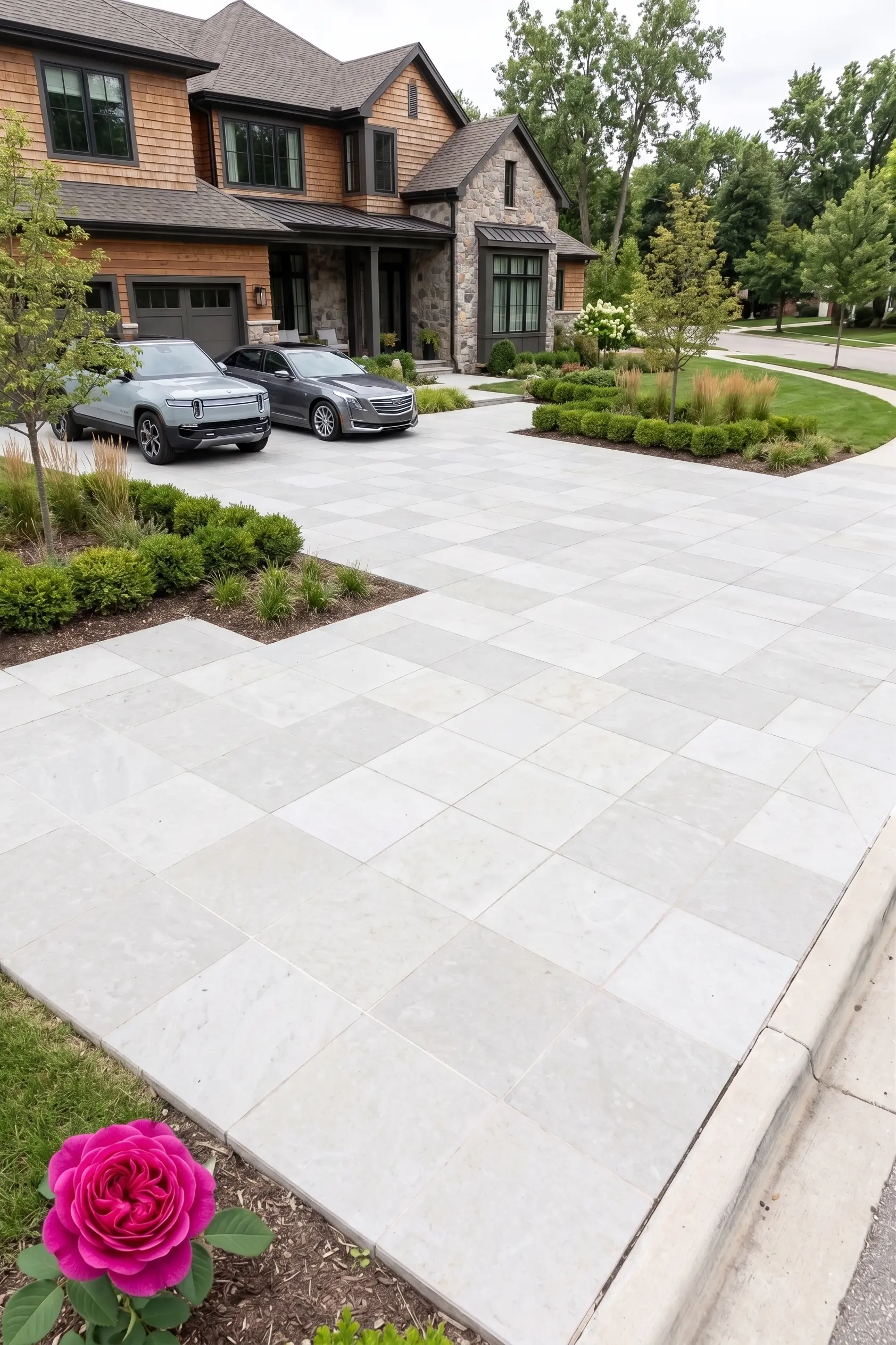
Choosing the Right Stone for a Permeable Driveway
Dense, low-absorption stone performs best in permeable stone driveway applications because water is passing around it, not through it — and the freeze-thaw cycle will exploit any weak seams. Basalt and granite consistently rank among the most appropriate choices here: both are fine-grained, highly resistant to water penetration through the stone body, and exceptionally durable under repeated load. Limestone is a sound choice in climates without hard freeze-thaw exposure, particularly where the design calls for a warmer visual character.
- Basalt: extremely dense grain, low absorption through the stone body, well-suited to heavy foot and vehicle loads in permeable driveway layouts
- Granite: comparable density to basalt, wide color range, long service life in freeze-thaw-exposed climates
- Limestone: moderate absorption — suitable in mild climates when sealed on a schedule; specify absorption class by ASTM C568
- Quartzite and sandstone: performance varies widely by origin — specify the ASTM C616 test method for absorption and compressive strength before committing
Citadel Stone stocks basalt and limestone at our selected quarries and cuts to the nominal thicknesses your project drawings require, so you’re ordering to spec rather than fitting the design around available stock dimensions.
For the driveway format specifically, use setts or cobbles at least 3.5 in (4 in standard) thick on a compacted base, or pavers 2 in (5 cm) or thicker mortar-bonded to a reinforced concrete slab. That thickness rule isn’t arbitrary — it reflects the point-load distribution geometry of a vehicle tire on a stone unit, and thinner stone simply doesn’t have the section depth to spread that load without risk of fracture at the joint edges.
Base Design: The Specification That Actually Controls Performance
Your aggregate base in a permeable system does two jobs simultaneously: it provides structural support and it stores and transmits infiltrated water. Those two demands pull in opposite directions. A dense, well-graded aggregate gives you compaction strength but low void ratio and limited storage. An open-graded aggregate gives you high void ratio and good drainage but requires more careful attention to stone thickness and load distribution above it.
- Open-graded crushed stone (typically ¾ in clean crushed angular aggregate) provides the void space that makes the system actually permeable
- Depth of the reservoir layer is calculated from your site’s design storm intensity and the sub-soil’s percolation rate — there’s no universal number; get a soils report
- Geotextile separation layers between the reservoir aggregate and the sub-soil prevent fines migration without blocking infiltration — specify a non-woven fabric with an appropriate apparent opening size for your sub-soil classification
- Edge restraints are structural in a permeable base — without confinement, the open-graded aggregate migrates outward under load, destabilising the paver layer
The ASTM standards library includes test methods for aggregate gradation, compaction and permeability that your geotechnical engineer will reference when specifying the base layers. Never let a contractor substitute a dense-graded base for an open-graded one and still call the system permeable — the distinction is fundamental, not cosmetic.
Thickness and Joint Specification for Permeable Stone Driveways
Permeable stone driveway pavers need enough section depth to bridge the open-graded aggregate below them without cracking under point loads. For vehicle areas, the sett or cobble minimum of 3.5 in (about 90 mm) is set by that structural requirement, not by aesthetic preference. For pavers mortar-bonded to a reinforced concrete slab, 2 in (5 cm) is the minimum — the slab carries the structural load, the stone carries the surface wear and aesthetic.
Joint specification is where you tune the hydraulic performance. Wider joints filled with clean, single-size washed aggregate — typically 3/8 in pea gravel or crushed angular stone of equivalent size — allow vertical infiltration. Narrow sand-filled joints tighten the surface and shift drainage to sheet-flow toward planned outlets. For a fully permeable system, joints of at least ⅜ in (10 mm) filled with washed aggregate are a reasonable design starting point, though your civil engineer should confirm this against the site’s rainfall data.
To explore the full range of formats and nominal thicknesses Citadel Stone offers for vehicle-area applications, the Driveway Pavers page covers the stone options available in sett and cobble formats.
How Storm Events Affect Permeable Driveway Pavers
Heavy storm events test permeable driveway systems in ways that steady drizzle never reveals. Wind-driven rain arrives at high velocity and high volume almost simultaneously — your surface needs to begin infiltrating before the base reservoir is overwhelmed, which means joint hydraulic conductivity and aggregate void ratio need to be sized to the peak intensity, not the average annual rate. Undersizing is the most common design error, and it shows up as surface flooding during the first significant storm after installation.
- Wind-driven rain forces water into joints at an angle, increasing the hydraulic pressure on joint infill material — ensure the joint aggregate is angular and well-locked, not round and free-rolling
- Edge restraint integrity under storm conditions is non-negotiable: deep-set steel or concrete restraints prevent the outward migration of open-graded base aggregate when saturation reduces inter-particle friction
- Hail impact on dense basalt or granite is not a structural concern for properly specified thicknesses, but softer limestones can show surface marking from repeated large hail events — factor this in for open-country sites with frequent severe weather
- Post-storm joint inspection is part of a permeable system’s maintenance cycle: re-topping joint aggregate that has been displaced or compacted by storm flow keeps infiltration rates from declining over time
Joint integrity under wind-driven rain is also a sealer specification question. If you seal a permeable stone driveway to protect the stone surface, use a penetrating sealer that doesn’t film over the joint openings — a surface-bridging sealer on the joint aggregate will reduce hydraulic conductivity substantially and partially defeat the permeable design intent.
Sealing and Maintenance Considerations
Sealing permeable stone driveway pavers is a trade-off, and it’s one worth spelling out for your client before the project closes. A penetrating impregnating sealer applied to the stone faces protects the stone from staining and reduces absorption through the stone body, without closing the joints. Apply it on the schedule your sealer manufacturer states — there’s no universal interval, and it varies by product, climate and traffic intensity.
What you should never do is specify a topical film-forming sealer for a permeable installation. Film sealers cross the joint edges and reduce infiltration capacity — sometimes dramatically. The USGS dimension stone production data doesn’t address sealer chemistry, but it does underscore how widely stone properties vary by source, which is exactly why sealer choice should follow the stone’s specific absorption characteristics rather than a generic recommendation.
Maintenance of a permeable system also means periodic vacuuming or pressure-washing of the joints to clear sediment that accumulates and reduces void space. In practice, joints in vehicle-traffic areas load up with fine sediment faster than pedestrian areas — plan for annual inspection and spot re-topping of joint aggregate where needed.
Finish Selection for Permeable Driveway Pavers
Your finish choice on a permeable stone driveway paver affects texture, long-term wear character and how the surface reads visually under wet conditions. For vehicle-area setts and cobbles, a split face or bush-hammered finish is the standard recommendation — both leave an open, matte texture that develops character with age and weathering. A brushed finish in a coarser grit (Brushed 16 Grit) is well-suited to driveways, courtyards and garden paths where you want a more refined surface than split face but still need an open texture.
- Split face: natural cleaved texture, high surface variation, well-suited to setts and cobbles in driveway and courtyard layouts
- Bush-hammered: mechanically textured open surface, consistent across the paver face, appropriate for high-traffic vehicle areas and ramps
- Brushed 16 Grit: coarsest standard brushed grit, used for driveways, courtyards and garden paths — available as a standard finish
- Honed finishes: appropriate for covered outdoor areas and interiors, not recommended for open vehicle-traffic driveways where surface character matters for long-term wear
- Polished finishes: for dry indoor surfaces only — never specify polished for a driveway or any outdoor application
Finish availability depends on the stone and the format — Citadel Stone can confirm which finishes are available in the nominal size and thickness your specification requires when you’re ready to order.
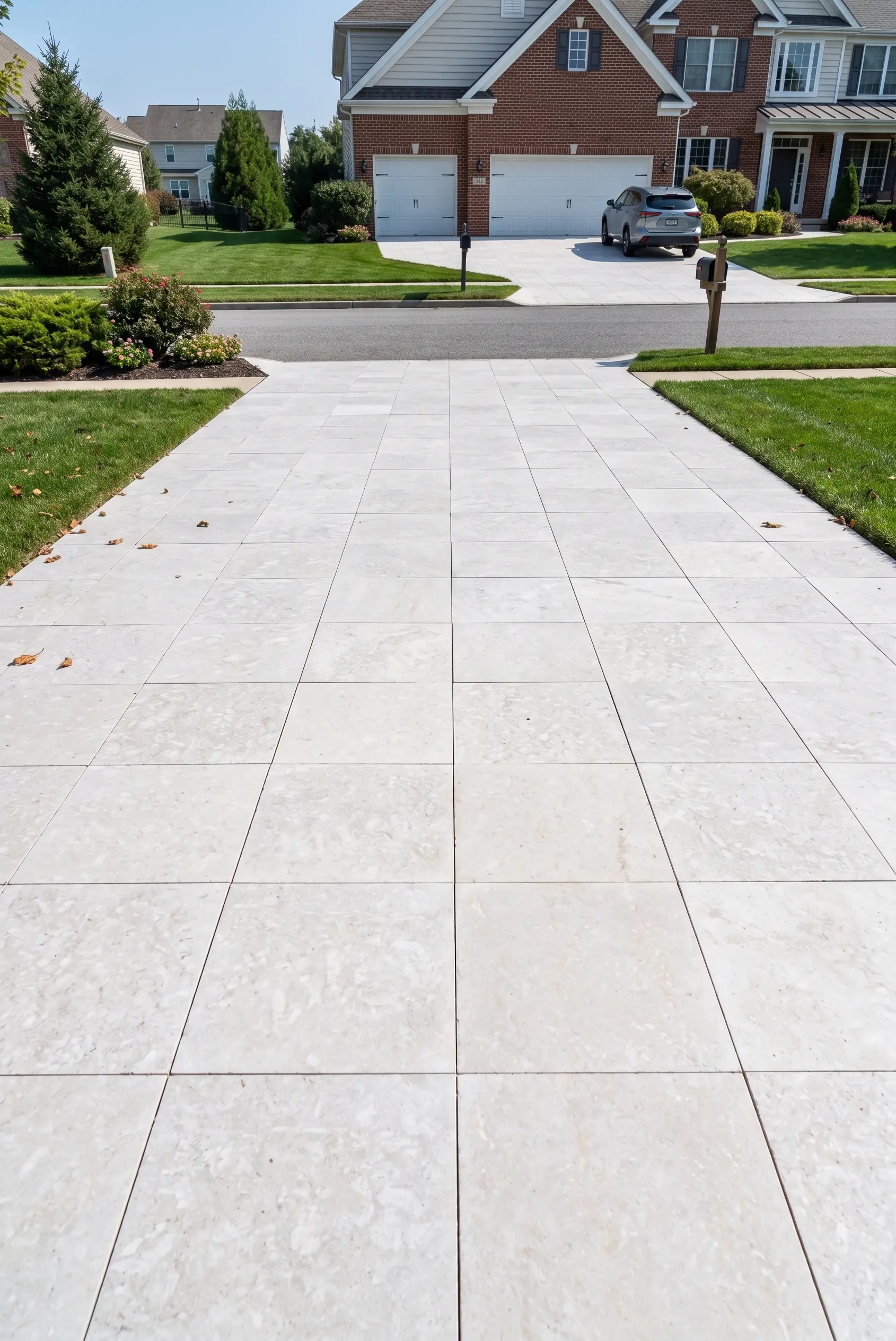
Wet Surface Considerations for Permeable Stone Driveways
Slip resistance in a permeable driveway application is governed by finish texture, not stone species — and it’s evaluated under the current standard ANSI A326.3, which measures wet. The finish is the variable you control at specification stage; a bush-hammered or split-face surface leaves an open, matte texture, while a honed surface leaves a smoother face. For wet steps and slopes, choose a bush-hammered finish. For other outdoor paths, bush-hammered or Brushed 36 Grit or coarser both work — check a sample against your project’s specific conditions before specifying at scale.
What the standard replaced matters for specifications that reference older documents: ANSI A326.3 is the current wet-measured standard, replacing the ASTM C1028 static test withdrawn in 2014. If you encounter project specs that still cite ASTM C1028, flag it for the design team — a dry static test does not satisfy a wet measurement requirement under the current standard.
Slipperiness on a permeable surface also changes as the joint aggregate settles over the first season. Joints that were slightly proud at installation compact under traffic load, lowering joint infill slightly below the stone face — a normal condition that doesn’t affect the stone surface texture you specified.
Delivery and Project Logistics for Stone Driveway Orders
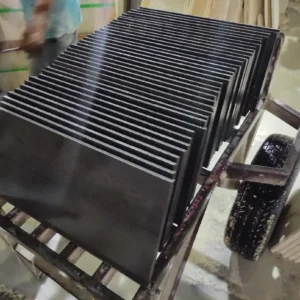
Permeable stone driveway pavers arrive on pallets, and your site access needs to be confirmed before the delivery date. Setts and cobbles at the thicknesses specified for vehicle areas are heavy — pallet weights for dense basalt or granite in sett format are substantial, and the delivery vehicle will need a stable surface and adequate clearance to offload safely. Lead times are quoted with the order and vary by stone type, finish and quantity; confirm access constraints and offloading arrangements when you place the order so delivery scheduling can account for them.
For large projects, it’s worth requesting that stone be delivered in the sequence your installation crew will lay it — section by section rather than all at once — to avoid storing heavy pallets on the prepared base or on adjacent finished paving. Citadel Stone cuts permeable stone driveway pavers to order at our selected quarries, which means the order is fulfilled to your confirmed dimensions and finish, not pulled from a fixed pre-cut inventory.
Spec Wrap-Up: Getting Permeable Stone Driveway Pavers Right
The specification decisions for a permeable stone driveway concentrate in four places: stone type and thickness for the structural load, base aggregate gradation and depth for the hydraulic capacity, joint width and infill for surface infiltration, and finish for long-term texture character. Get those four right, and the stone surface performs well through wet seasons and storm events for decades. Miss one — particularly the base reservoir depth or the joint infill type — and no amount of quality stone at the surface recovers the installation.
Your project may also involve natural stone in water-adjacent settings beyond the driveway itself. For planning those elements, stone pavers in pool surrounds covers jointing, sealing and finish considerations for another demanding wet environment. For driveways in heavy-rain or freeze-thaw regions, Citadel Stone’s natural stone pavers cut to order at our selected quarries give designers a durable surface that works with a permeable aggregate base.
Related reading: driveway pavers cost calculator · widening driveway with pavers.