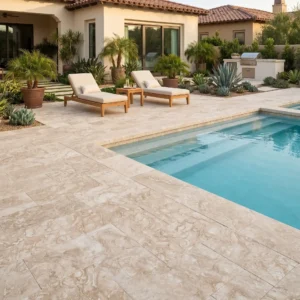

Grout width, joint spacing, and sealer selection govern whether stone pavers around pool installations hold up over decades or begin failing at the edges within a few seasons. Most specifiers focus entirely on stone choice and finish — both important — but the jointing and sealing decisions are where long-term performance is actually won or lost. Get those right, and well-chosen stone pavers around a pool stay tight, drain cleanly, and age with character rather than crumbling at the perimeter.
Why Joint Width Matters Around Water
Your joint width does two jobs simultaneously around a pool: it accommodates thermal movement in the stone and substrate, and it channels water away from the slab edge where saturation causes the most damage. A joint that is too tight traps moisture and limits drainage; one that is too wide collects debris, holds standing water, and allows the fill material to wash out progressively. The right width depends on the stone type, the slab dimensions, and the substrate below — there is no single figure that fits every installation.
For large-format pavers — 24 × 24 in (600 × 600 mm) or bigger — you typically need a wider joint than you would for 12 × 12 in (300 × 300 mm) tiles. That is because the absolute thermal movement of a larger piece is proportionally greater, and the joint must absorb it without locking the stone. For pool surrounds specifically, consider that the joint also sees chemical water, splashing, and regular wetting cycles. Those conditions accelerate the breakdown of organic-based joint fillers, so your material choice matters as much as the width itself.
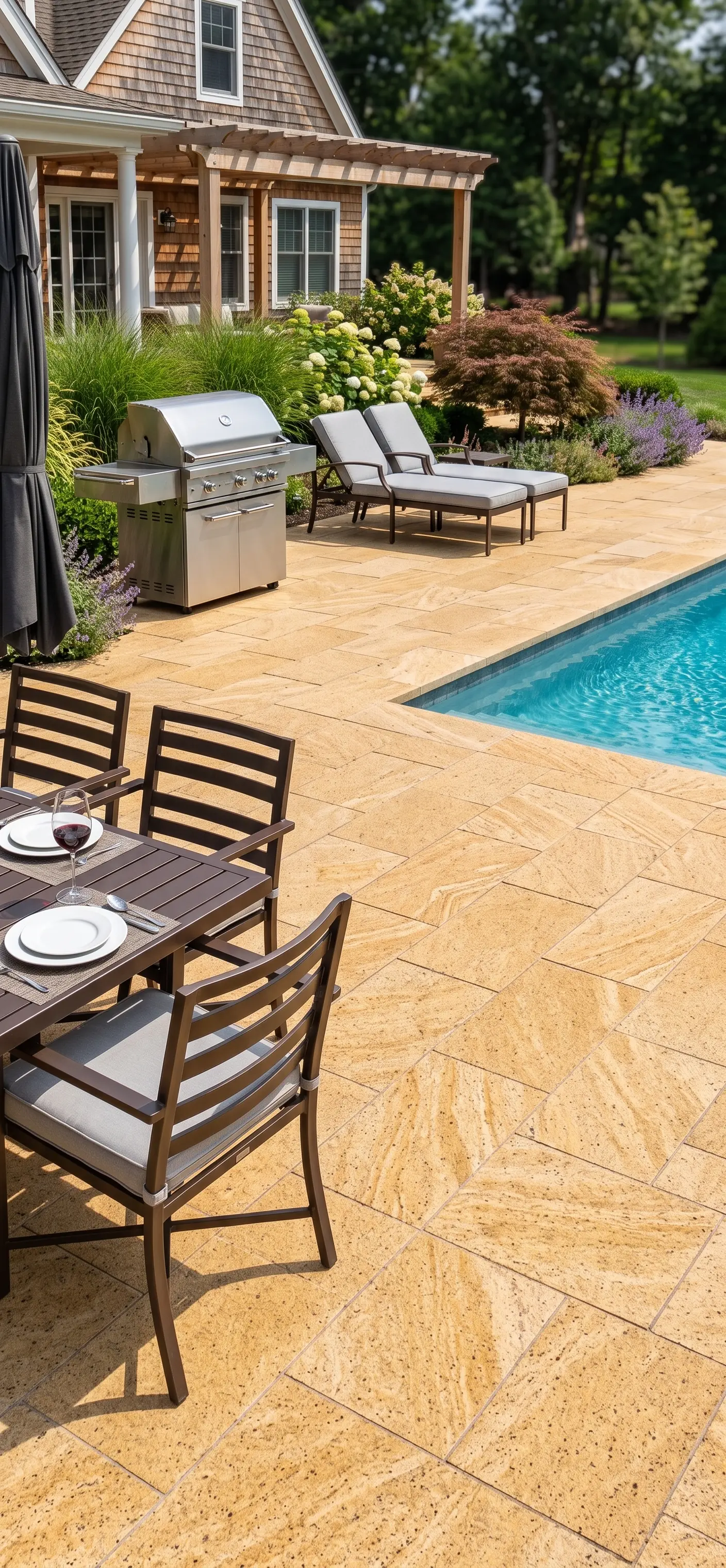
Grout and Joint Filler Options Compared
Standard sanded or unsanded cement grout works in covered or low-exposure settings, but around a pool it absorbs pool chemistry quickly and stains in a single season. Epoxy grout resists chemical attack and handles the wet environment well, but it is unforgiving to install — you have a narrow working window, and any smear left on the stone face needs aggressive cleaning before it cures. For large outdoor joints, a polymeric sand designed for wide gaps is the most common field choice, but verify it is rated for submerged or wet-edge applications before you specify it.
- Cement-based grout: straightforward to apply, but porous and vulnerable to pool chemistry over time — seal it immediately and reseal on your sealer manufacturer’s stated schedule
- Epoxy grout: highly resistant to chemical exposure, low absorption, long service life — but requires careful installation technique and an experienced crew
- Polymeric joint sand: good for wider joints and irregular formats, allows minor movement, drains well — confirm it suits a wet-edge pool environment before specifying
- Mortar joints: appropriate for coping set on a bond beam — use a pool-compatible mortar and leave consistent expansion gaps at corners
The PHTA pool deck stone standards address joint and coping requirements in pool surround construction, and your local code may reference those standards directly — check before you finalise the spec.
Expansion Joints: The Detail Most Specs Miss
Expansion joints around pool decks are non-negotiable, and their placement is calculated from the slab movement, not guessed from a generic rule. You need them at every change of plane — where the coping meets the deck, where the deck meets a wall or column base, and at regular intervals across a large continuous field. Around a pool, the joint must also be filled with a material that stays flexible under repeated wetting and chemical exposure: a silicone or polyurethane sealant rated for pool surround use, never rigid mortar.
What often gets overlooked is the interaction between the expansion joint location and the substrate below. On expansive clay soils — common across a wide swath of the country — the subgrade moves independently of the pool shell as moisture content shifts seasonally. That movement telegraphs directly to the stone pavers around a pool surface, and if your expansion joints are not positioned to relieve it, you will see cracking at predictable intervals regardless of the stone’s inherent strength. A geotechnical assessment of the subgrade before you pour the slab is worth far more than specifying a thicker stone after the fact.
Subgrade and Soil Conditions Under Pool Decks
Soil conditions are the hidden variable in pool surround longevity. Sandy soils drain freely and compress predictably, making them relatively forgiving under a stone-paved deck. Expansive clay is the opposite — it swells when wet and contracts when it dries, and the differential movement under a pool deck (where one side stays consistently saturated from pool shell moisture while the other dries out) creates heaving that breaks grout joints and can crack even well-set pavers. If your site sits on expansive clay, the structural slab and its reinforcement detail matter more than any finish product specification.
- Sandy or well-draining soils: compact thoroughly to the specified density, verify moisture content before pour — relatively low risk of differential settlement
- Expansive clay: require a geotechnical report, design the slab to span rather than sit on the clay, include expansion joints on a tighter spacing than you would on stable ground
- Caliche or rocky subgrades: excavation costs rise, but the substrate itself is stable — drainage design becomes the primary concern because water cannot percolate through
- Fill soils: highest risk category — verify compaction depth and density, consider extending the slab reinforcement, and plan for longer settling-in periods before specifying tight grout joints
Delivery scheduling can also be affected by site conditions — if the pool surround is accessible only over soft or unstable ground, truck access constraints are confirmed before the delivery date so the stone arrives without damaging a subgrade that has just been prepared.
Sealing Stone Pavers Around Pool Surrounds
Sealing decisions for stone pavers around pool areas are driven by stone porosity and the specific chemical environment — not by generic sealing schedules. A dense, fine-grained stone like a honed basalt tile needs a different sealer type and application interval than a more open-textured limestone. For pool surrounds, the sealer must also be rated for chlorine and saline exposure if the pool uses either; a sealer that breaks down under pool chemistry will blush, peel, or allow chemical ingress within months.
Penetrating sealers (impregnators) are generally the right specification for pool surround pavers. They sit below the surface, do not alter the finish texture meaningfully, and allow the stone to breathe while reducing absorption of water and pool chemistry. Film-forming sealers create a surface layer that can delaminate under UV exposure and repeated wet-dry cycling — particularly problematic on a south-facing pool deck in a high-sun climate. For Citadel Stone pool area stone, the sealer choice is matched to the stone’s porosity and the finish, so specifying them together avoids a mismatch that shows up in the first season.
The Natural Stone Institute limestone specifications describe the porosity characteristics that inform sealer selection for calcareous stones — relevant reading if your pool surround uses a fossil limestone or shellstone format.
Stone Selection for Pool Surrounds
Your stone choice sets the ceiling on what sealing and jointing can achieve — no maintenance program compensates for a stone that absorbs pool chemistry at a rate the material cannot sustain. For pool surround pavers for pool patio areas, the key properties to specify are absorption rate (tested to the relevant ASTM dimension stone standard for the material), surface texture, and color stability under UV. Dense stones with low absorption rates perform well over a long service life in wet environments; softer or more porous stones require more frequent maintenance and careful sealer management.
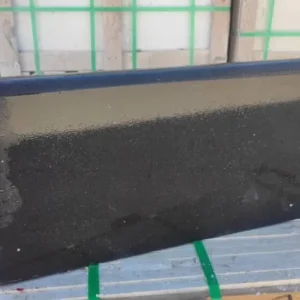
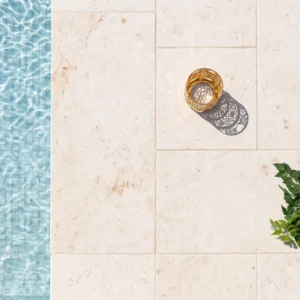
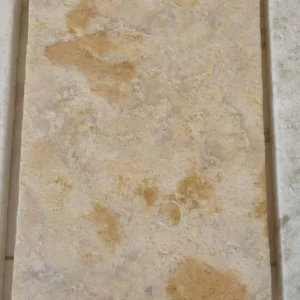
Three materials illustrate the range well. White Limestone Patio Pavers bring a clean, pale aesthetic to pool surround areas and suit a wide range of deck styles — their calcareous nature means sealing on schedule is essential to manage absorption of pool chemistry; limestone dimension stone is covered under ASTM C568 (Limestone Dimension Stone). Ocean Reef Leathered Shell Stone Pavers are a fossiliferous limestone with a naturally textured surface from the leathered finish — an open, matte texture that suits outdoor environments and complements a naturalistic pool design. Black Basalt Paver Steps, while specified here as step elements, can be used throughout a pool surround where a darker, dense, fine-grained stone is preferred — basalt is a volcanic rock formed by fast cooling of lava at the surface, and the USGS overview of igneous rocks explains how that rapid cooling produces the tight grain structure that makes honed basalt so uniform in appearance; confirm the applicable dimension stone standard with your specifier for the exact project context.
- White Limestone Patio Pavers: pale, elegant look — seal promptly and reseal on schedule; suited to covered or shaded pool surround areas as well as full sun
- Ocean Reef Leathered Shell Stone Pavers: fossiliferous texture, open matte finish from the leathered surface — a visually distinctive option for naturalistic pool surrounds; a laboratory certificate of test covering density, absorption, compressive and flexural strength, abrasion and modulus of rupture is available on request
- Black Basalt Paver Steps: dense, fine-grained, uniform dark face — works well as a step or border element in a pool surround where contrast with the lighter deck surface is part of the design intent; a certified mill test summary covering water absorption, density, flexural strength, modulus of rupture and abrasion loss is available on request
Finish Selection for Wet Pool Environments
Finish is the variable that most directly affects the surface texture your pool users encounter — and it is a decision that cannot be reversed without regrinding or replacing the stone. For pool decks and wet steps, choose a bush-hammered finish. For other outdoor paths, bush-hammered or brushed in the coarsest grit both work; check a sample. The current standard for evaluating wet surface performance is ANSI A326.3, measured wet — the finish is the key variable, and no specific rating figure is published here.
A polished finish is specified only for dry indoor surfaces — countertops, vanity tops, indoor floors, and similar environments. Never specify a polished finish for pool surrounds, wet steps, or any exterior surface that gets wet. A bush-hammered finish leaves a mechanically fractured, open texture that is appropriate for pool decks and ramps. A brushed finish at a coarser grit leaves a directional, matte surface that suits covered terraces and pool houses. Understanding how each finish affects the surface texture — not just the aesthetics — is the specification decision that pool surround projects hinge on.
Drainage, Slope, and Layout Planning
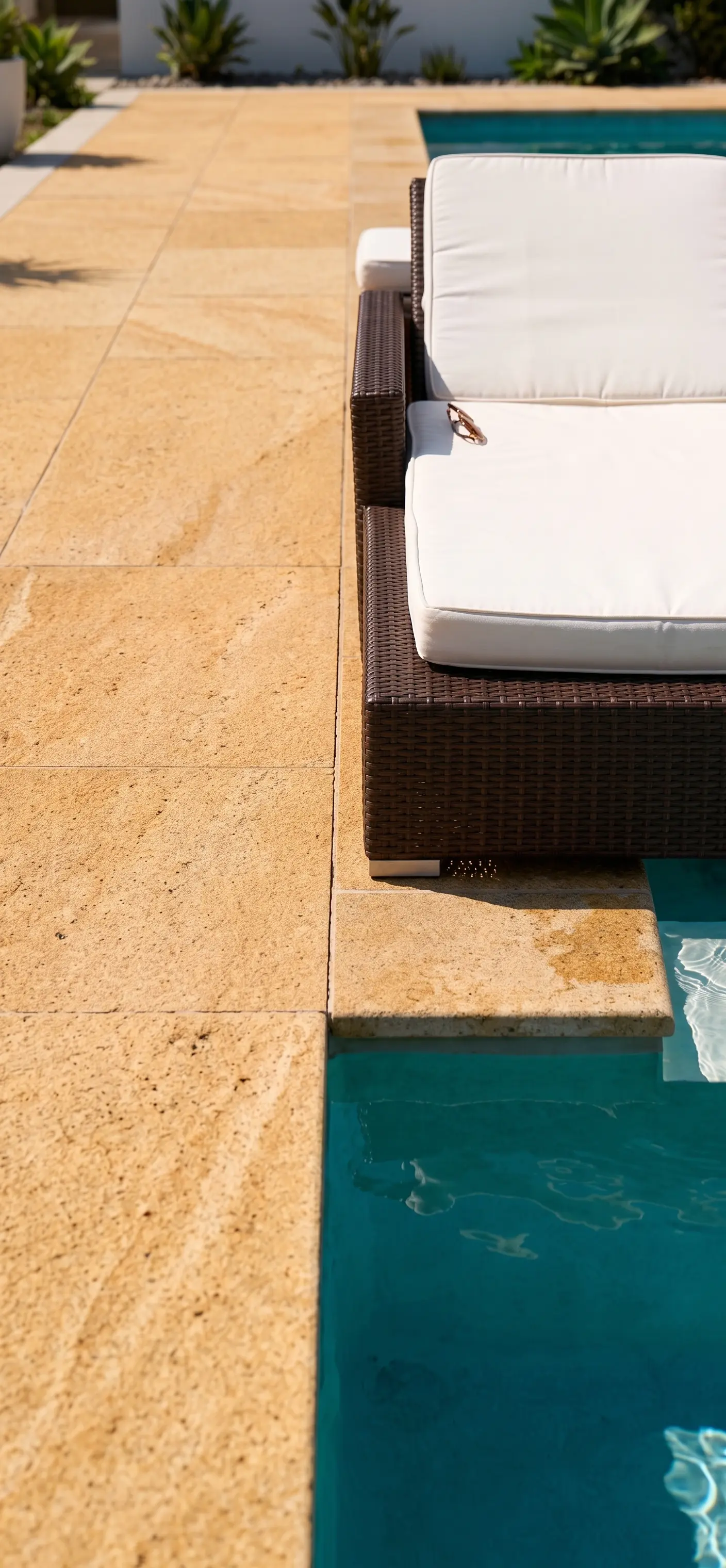
Your pool surround needs a consistent slope away from the pool edge and toward drains or planted areas — a minimum of about ¼ in per foot (2%) across the paved field. That slope has to be built into the substrate and slab, not attempted by varying the bedding mortar depth. Trying to create drainage slope through mortar depth variation leads to uneven bedding, inconsistent joint widths, and pavers that rock under foot traffic as the mortar cures unevenly.
- Set the slope in the structural slab or base — not in the setting bed
- Align drain locations with the stone layout grid so joints fall over drains rather than across them
- Allow for the coping overhang when calculating the deck slope — water running off the coping adds to the load on the first row of pavers
- At pool shell penetrations (steps, inlets, light housings), plan the stone layout so cuts are consistent and joints land at logical intervals
Slope planning also interacts with soil conditions: on sites with expansive clay or fill soils, the slab may move slightly as the subgrade adjusts over the first year or two, and a slope that was perfect at installation can flatten or reverse at a low spot. Building in slightly more slope than the minimum gives you a buffer against that early settling.
Decision Points
Getting stone pavers around pool installations right means making the structural and specification decisions before the stone is ever ordered — not resolving them on site. Your subgrade assessment, slab design, expansion joint placement, finish selection, and sealer specification are all upstream decisions that determine what the installation looks like in year ten. The stone choice is real and consequential, but it cannot compensate for a slab that moves on an unstable subgrade or a sealer that breaks down in pool chemistry within two seasons.
Citadel Stone cuts pool surround stone to order at our selected quarries, so formats, thicknesses, and finishes are confirmed at the specification stage rather than adapted to whatever standard stock happens to be available. Lead times and delivery arrangements are quoted with the order, and your project’s truck access constraints can be discussed before the delivery date is set. As you plan the broader hardscape around your pool, related stone applications may also factor into your design — above-ground pool stone surrounds covers how Citadel Stone materials are specified for a different pool surround context worth reviewing alongside this guidance. Stone for nationwide projects keeps stone pavers around a pool easy to reseal, cut to order at our selected quarries.
Related reading: best pavers for pool deck · gray pool pavers · Pavers Around Pool: How Much Does Stone Cost?.