
Base preparation is the variable most above-ground pool surrounds get wrong — and it shows up fast. Pavers for above ground pool surrounds carry foot traffic, absorb splash water, and sit directly against a structure that expands and contracts with temperature changes, yet many installations start on a base that would struggle to support a garden path. Getting the base right means understanding the load path, the drainage geometry, and how the paver material itself responds to continuous moisture at its edges.
What the Structure Demands from a Pool Surround
An above-ground pool imposes a constraint that an in-ground installation does not: the pool wall is a fixed vertical boundary, and your surround must meet it cleanly without transferring lateral pressure back into the structure. The paving plane sits at the same elevation as the pool rim or slightly below it, which means water flows away from the pool wall rather than toward it. That drainage slope — typically around ¼ in per foot away from the pool — is not optional. Install it flat and you trap water under the pavers, accelerate joint erosion, and risk frost heave in regions with below-freezing winters.
Pavers for above ground pool areas also face a narrower working zone than most patios. You are often laying stone in a ring that is as little as 3 to 4 ft wide, which makes compacting the aggregate base more difficult and makes the choice of paver format more important. Large-format slabs become hard to maneuver in a tight ring; smaller, modular formats give you more joint flexibility and easier cutting at the pool wall interface.
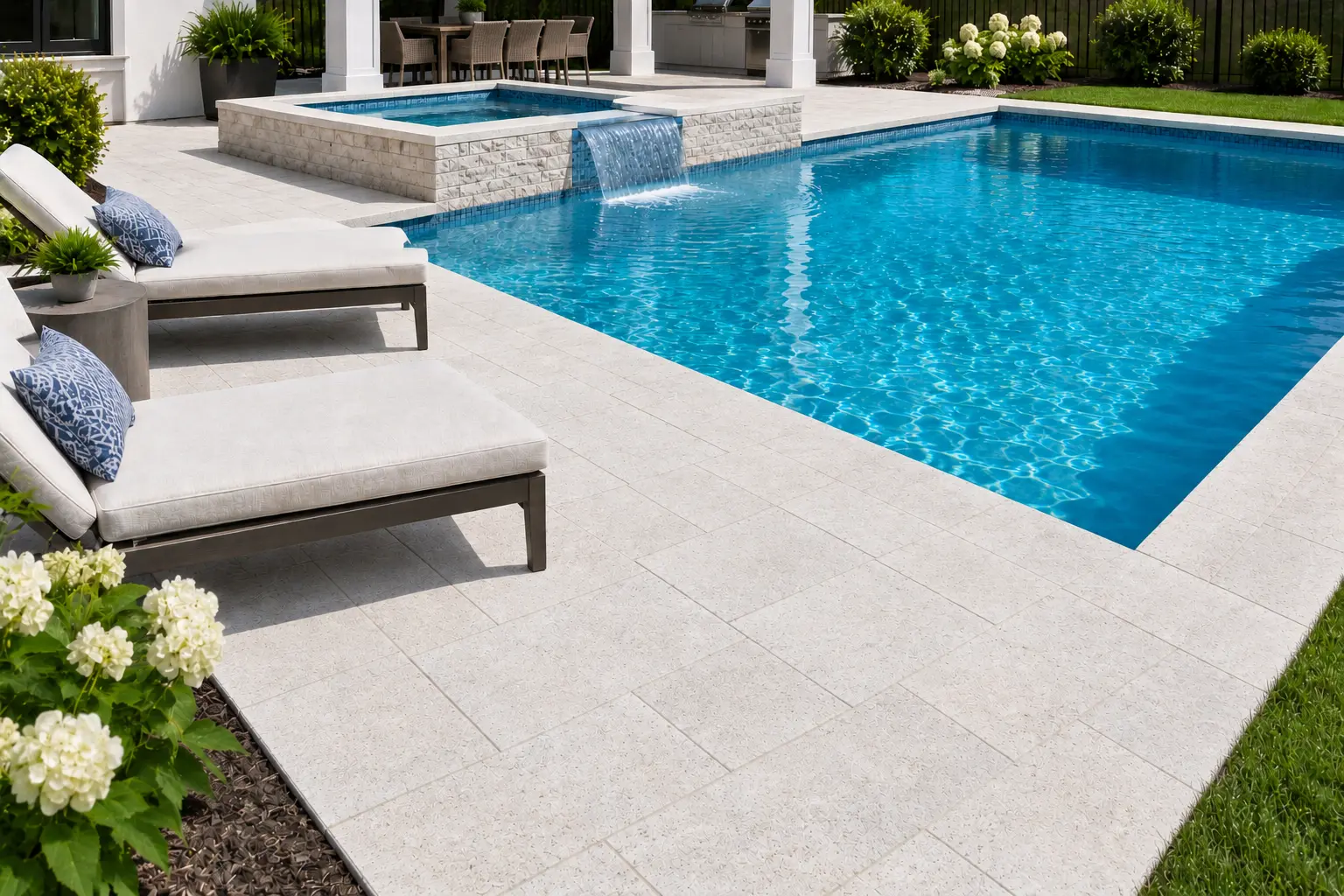
Base and Drainage Specification for Above-Ground Pool Surrounds
Your base layer does the structural work. For pedestrian pool surrounds, a compacted crushed-stone base of at least 4 in depth is a reasonable starting point in stable, well-draining soils — but increase that depth in clay-heavy soils that expand seasonally, because the clay movement will telegraph through a thin base and open your joints within a season or two. Confirm the finished surface slope by pulling a string line before you lay your setting bed: getting this wrong at the base stage is straightforward to fix; getting it wrong after the stone is down is expensive.
- Slope the finished surface a minimum of ¼ in per foot away from the pool wall, directing runoff to a gravel channel or lawn edge
- Use a compacted crushed-stone base — a minimum of 4 in in stable soils, more in expansive clay subgrades
- Set pavers on a 1-in screeded sand or fine aggregate bed to allow minor grade adjustment
- Leave a narrow gap at the pool wall interface — caulk it with a flexible, water-resistant joint compound rather than rigid mortar, so the pool structure can move independently of the surround
- Consider a perimeter gravel drain channel at the outer edge of the surround to handle concentrated splash runoff
The PHTA pool deck and coping safety standards provide industry guidance on drainage geometry and surface conditions around pool structures — worth reviewing before finalizing your grade specifications.
Stone Selection for Wet Surround Areas
Material choice for pavers for above ground pool surrounds narrows quickly once you apply two practical filters: finish texture and water absorption. A polished finish is appropriate for dry indoor surfaces only — it has no place in a pool surround environment. For pool decks, wet steps, and slopes, choose a bush-hammered finish. For other outdoor paths, bush-hammered or brushed in the coarsest grit both work; check a sample. That is not a generic recommendation — it reflects what actually happens when consistently wet stone is walked on barefoot or in pool shoes.
Water absorption is the second filter. Stones with higher absorption rates take in pool water, chlorine, and mineral deposits at the pore level, which can stain, spall, or effloresce over time if the stone is left unsealed. Specifying by ASTM C568 for limestone or ASTM C615 for granite gives your specifier a basis for absorption and density requirements — without those test method references, the conversation stays at the level of marketing language rather than verifiable performance data. The Natural Stone Institute limestone overview covers how porosity and absorption vary across limestone varieties, which is directly relevant when choosing between denser and more open-structured options for wet areas.
- Specify finish before material — finish determines texture more directly than stone type does in a wet zone
- Request absorption data under the relevant ASTM dimension-stone standard for your chosen material
- Seal all natural stone pool surrounds on the interval your sealer manufacturer states — not a fixed calendar schedule
- Avoid any polished finish in the surround, even on the pool wall-facing edge
Black Basalt: Performance Characteristics in Wet Zones
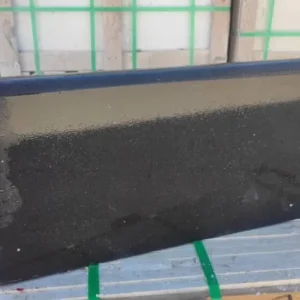
Black Basalt Paver Steps are one of the registry products that performs well in a surround role — the density and tight grain structure of basalt mean lower absorption compared to many sedimentary stones, and the material holds its dark, uniform face well under UV exposure and repeated wetting. Basalt is an extrusive volcanic rock — the USGS overview of igneous rocks explains how rapid cooling at the surface produces the fine grain that gives basalt its characteristic hardness and low porosity. That fine grain is also what allows a bush-hammered finish on basalt to hold its open texture over seasons of wet foot traffic without breaking down to a smooth surface.
For the pool surround application, specify Black Basalt Paver Steps in a bush-hammered finish for the deck plane, and consider them in a split-face format for a vertical feature wall behind the pool structure. The color contrast between the dark stone and pool water reads particularly well in modern minimalist and desert xeriscaping landscapes — both design traditions favor the controlled palette that black basalt naturally provides.
White Limestone and Shell Stone: Cooler-Toned Surround Options
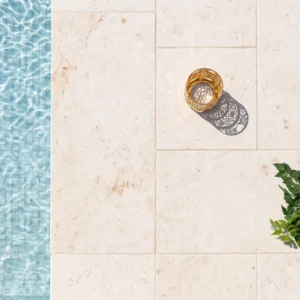
White Limestone Patio Pavers bring a lighter, warmer aesthetic to a surround — they stay notably cooler underfoot in direct sun than darker-toned stone, which matters in a bare-foot pool environment during peak summer heat. Limestone is specified under ASTM C568 (Limestone Dimension Stone), and a laboratory certificate of test covering density, absorption, compressive and flexural strength, abrasion and modulus of rupture is available on request for white limestone. For a pool surround, specify white limestone in a brushed or bush-hammered finish, and confirm the absorption class before ordering — a limestone with a higher absorption rate will require more frequent sealing when it sits in a chlorine splash zone.
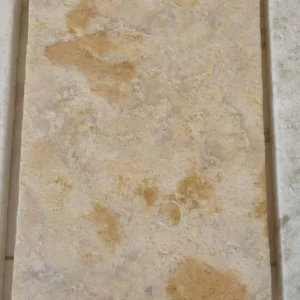
Ocean Reef Leathered Shell Stone Pavers offer a different texture register. The leathered finish leaves an open, matte surface with a subtle dimensional quality that reads as natural and organic in tropical planting landscapes or coastal-style designs. Shell stone is a fossilized marine limestone, and the coral and shell inclusions that give it its characteristic face also create an inherently varied surface texture at the pore scale. A laboratory certificate of test covering density, absorption, compressive and flexural strength, abrasion and modulus of rupture is available on request for Ocean Reef Leathered Shell Stone Pavers — confirm absorption figures in that certificate before specifying for a heavy-use pool surround, as shell stone absorption can vary between quarry zones. For pool decks and wet areas, the leathered finish is appropriate; avoid any polished variant in this application.
- White limestone stays cooler underfoot than dark stone in direct sun — a material-behavior fact worth communicating to the homeowner or designer
- Shell stone’s varied face complements tropical and coastal planting schemes; pair it with low-maintenance succulents or ornamental grasses for a cohesive surround landscape
- Both limestone and shell stone benefit from sealing before first use in a pool environment, and re-sealing at the interval your sealer supplier specifies
- Request the available certificate of test for absorption data before finalizing either material for a chlorinated pool environment
Integrating Pool Surround Stone with Landscape Style
The design context around an above-ground pool often gets less attention than the pool itself, but the surround is what ties the structure into the broader yard. A pool sitting on plain grass reads as temporary equipment; a pool with pavers around it and planted borders reads as a designed outdoor room. The stone you choose sets the palette for everything else — planting selections, fence materials, furniture finishes, and even the color of the pool liner all respond to the dominant tone of the surround surface.
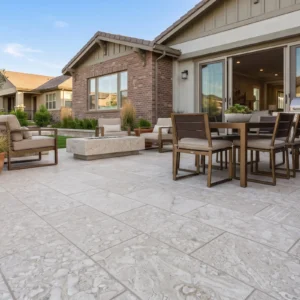
For pools in modern minimalist settings, black basalt or a consistent gray limestone in a bush-hammered finish gives you clean geometry and a neutral backdrop. For traditional colonial or farmhouse landscapes, a tumbled limestone or a shell stone with its varied face reads as more relaxed and organic. Desert xeriscaping environments benefit from stone that complements warm, sandy soil tones — white limestone or a buff-toned shell stone works here, surrounded by gravel mulch and drought-tolerant planting that extends the paved area visually. Tropical planting schemes pair naturally with the textured face of shell stone, where the organic variation in the stone echoes the layered foliage behind it.
For a broad look at how natural stone works across landscape design contexts, Citadel Stone above-ground surround stone covers material options matched to surround geometry and design style. The selection decision is not just material performance — it is how the stone reads from the pool, from the yard, and from inside the house looking out.
Thickness, Format, and Joint Spacing for Pool Surrounds
Pavers for above ground pool surrounds are pedestrian-only surfaces, so thickness specification follows pedestrian-load guidance — 1¼ in (approximately 32 mm) is the standard pedestrian paver thickness for a mortar-bonded installation on a concrete slab, or the same thickness on a screeded sand bed over a compacted crushed-stone base. Do not underspecify thickness thinking the pool surround carries lower loads — pool surrounds get concentrated point loads from furniture legs, ladders, and people stepping off pool entry stairs onto a single paver.
- Standard pedestrian pavers: 1¼ in thick on a compacted base or mortar-bonded to a concrete slab
- Format: 12 × 12 in (300 × 300 mm) or 16 × 16 in (400 × 400 mm) works well in tight surround rings; larger formats are hard to cut cleanly at the pool wall curve
- Joint width: a minimum ⅜ in joint filled with polymeric sand prevents joint washout from pool splash; wider joints in bush-hammered or textured stone allow the fill to seat properly
- Allow for thermal expansion at all fixed boundaries — the pool wall, any step structure, and the outer edge of the surround — using a flexible caulked joint rather than a rigid mortar joint
Sealing and Ongoing Maintenance in a Pool Environment
Pool surrounds are chemically active environments. Chlorine, algae inhibitors, and mineral-rich splash water all interact with natural stone at the pore level, and sealing is not optional here — it is part of the initial specification. Apply a penetrating sealer rated for exterior wet zones before the pool is filled and before foot traffic begins. Your sealer manufacturer’s stated re-application interval governs the maintenance schedule — that interval is not a calendar rule, it is a product specification, and it varies with stone density, pore structure, and local UV intensity.
Citadel Stone cuts pool surround stone to order at our selected quarries, so your order can include pieces pre-specified for the surround ring dimensions, minimizing site cutting and waste. Delivery lead times are confirmed with the order and depend on your project’s site access and offloading setup — arrange that detail early in the project schedule, particularly for tight residential access.
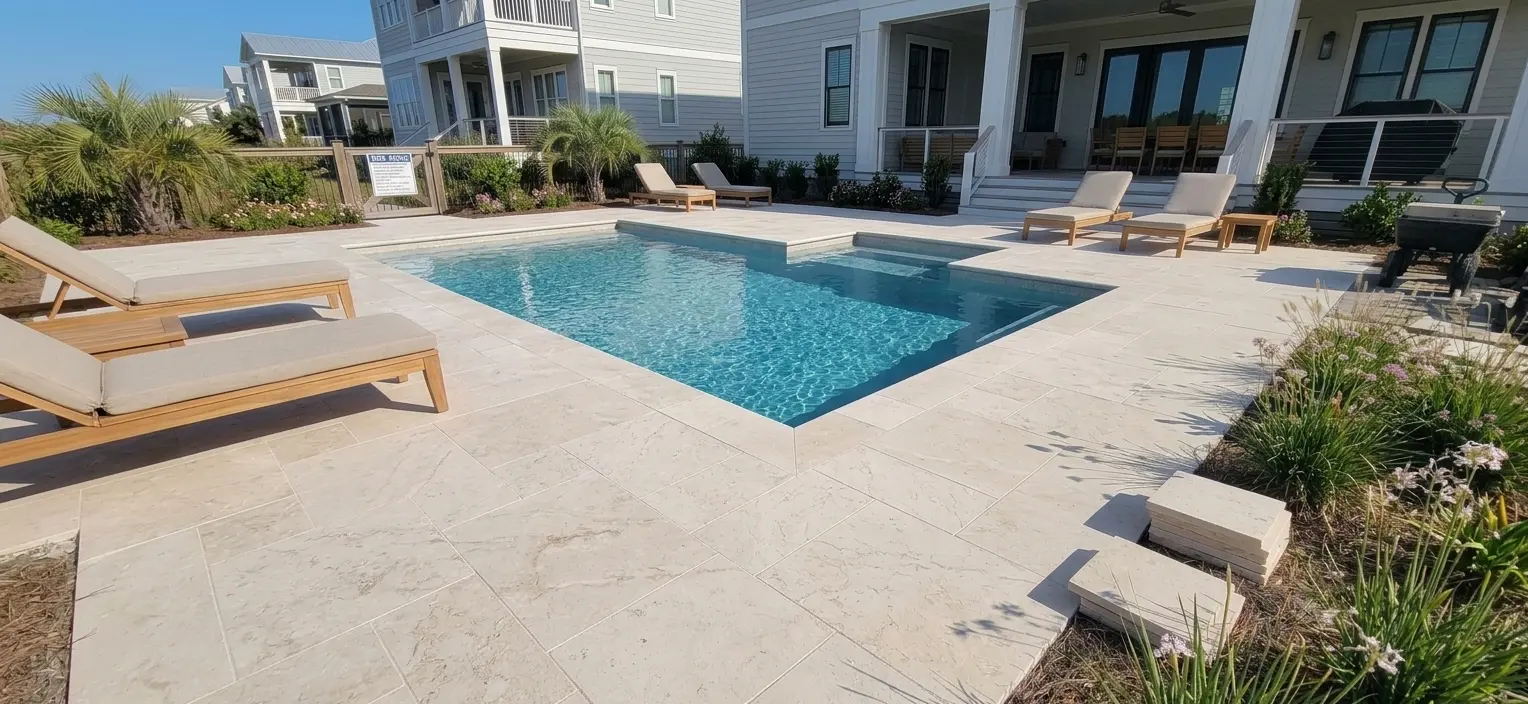
Slip Resistance and Finish Selection Around Pool Areas
Finish is the variable that most directly affects slipperiness in a wet pool surround, and it deserves a dedicated specification decision — not an afterthought. The current standard for evaluating wet surface performance is ANSI A326.3, which measures dynamic coefficient of friction under wet conditions; it replaced the ASTM C1028 static test withdrawn in 2014. What matters for your surround specification is understanding that finish texture is the lever — a bush-hammered finish leaves an open, matte, macrotextured surface; a brushed finish leaves directional grooves; a polished finish closes the surface and is not appropriate for pool surround use at all.
For pool decks, wet steps, and slopes, choose a bush-hammered finish. For other outdoor paths, bush-hammered or brushed in the coarsest grit both work; check a sample against your project conditions. These are texture descriptions — your project’s slip risk in wet conditions depends on finish, substrate condition, joint width, and how the surface drains, all of which are within your control at the specification stage.
- Bush-hammered finish: open, macrotextured surface — appropriate for pool decks, wet steps, and slopes
- Brushed 36 Grit or Brushed 80 Grit: appropriate for patios and pool surrounds where foot traffic is primarily barefoot or in pool shoes
- Polished finish: appropriate for dry indoor surfaces only — not suitable for any pool or wet area application
- Honed finish: suitable for covered outdoor zones where drainage is controlled, but verify texture against a sample before specifying in a fully exposed wet pool surround
Professional Summary
The specification decisions that determine long-term performance of pavers for above ground pool surrounds are made at the base and drainage stage, not at the surface. Get the slope, the base depth, and the expansion joints right, and your stone will serve the project for decades with routine sealer maintenance. Choose the wrong finish — particularly any polished surface — and no amount of good stone quality will compensate. Material selection among black basalt, white limestone, and shell stone is a function of design intent, absorption behavior, and the landscape context around the pool: each material offers a distinct aesthetic register and each is specified under its relevant ASTM dimension-stone standard. As you finalize your material and thickness specifications, the detail-level guidance in our pool paver installation guide covers setting bed preparation, joint filling, and sealing sequence in a step-by-step format worth reviewing before mobilizing. Citadel Stone gives above-ground pools a natural stone paver surround cut to order at our selected quarries.
Related reading: best pavers for pool deck · gray pool pavers · pavers around pool.