
Thickness and base design govern whether the best pavers for pool deck installations stay flat across decades or begin to rock at the joints within the first two wet seasons. Most specifiers research stone variety and finish first — but the performance split between a pool deck that holds up and one that needs early remediation almost always traces back to those two structural decisions. Material choice matters, but it operates downstream of substrate engineering.
Related guide: Choosing the Best Pool Deck Tile: A Practical Guide.
Why Stone Type Drives Pool Deck Performance
Natural stone brings a combination of thermal mass, dimensional stability, and visual quality that concrete pavers and porcelain tile rarely replicate across the same surface area. For pool surrounds, the relevant performance variables are water absorption, surface texture, thermal behaviour underfoot, and resistance to the repeated wetting and drying cycle that a pool deck endures season after season. Each stone type handles those variables differently, and the differences are significant enough to affect your material specification from the first conversation with your supplier.
Stone absorbs water to varying degrees depending on its mineralogy and pore structure. Denser stones with tightly interlocked crystalline grains — granite and basalt, for example — tend toward lower absorption, while sedimentary stones like limestone and shellstone carry more interconnected pore networks. That distinction matters for pool deck environments, where standing water is a given and the surface is never truly dry during the season. Specifying to ASTM C568 for limestone, ASTM C615 for granite, or the appropriate dimension stone standard for your chosen material ensures you’re working from a defined performance baseline, not a sales claim.
The Natural Stone Institute limestone overview gives useful context on how absorption characteristics are categorised for dimension stone in paving applications. Understanding where your chosen stone falls within that classification helps you set appropriate sealing intervals and maintenance expectations for the pool environment.
Stone by Stone: How Each Material Performs Around Pools
Your selection decision sharpens considerably once you compare stones not by name but by the specific conditions a pool deck creates. The surface endures UV exposure, chlorinated water contact, barefoot traffic, and the repeated thermal cycling of wet stone warming through the afternoon. Here is how the primary natural stone options stack up across those conditions.
Limestone Around the Pool
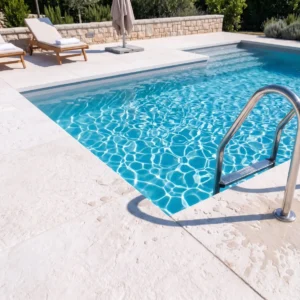
Limestone remains one of the most widely specified stones for pool surrounds because it combines a naturally lighter tone — which keeps the surface from becoming uncomfortably warm underfoot in direct sun — with a surface texture that responds well to brushed and bush-hammered finishing. Its sedimentary origin means the stone is available in a wide range of regional colour expressions, from creamy buff tones to the cooler grey-blue range. Blue fossil limestone, in particular, provides a dense, tightly grained surface that performs durably in the wet-dry cycle of pool environments.
- Specify brushed or bush-hammered finish for all pool deck surfaces — polished finishes are for dry indoor surfaces only
- Light-toned limestone stays markedly cooler underfoot than darker stone varieties in full afternoon sun
- Absorption varies by limestone type — denser blue fossil limestone behaves differently from more porous buff limestone, and both require sealing on the schedule your sealer manufacturer states
- ASTM C568 governs limestone dimension stone and sets the classification framework for absorption, density and compressive strength — specify those properties by test method, not by verbal assurance
Basalt: Density and Thermal Considerations
Basalt is an extrusive volcanic rock — lava that cooled quickly at the earth’s surface, leaving a very fine grain structure with minimal visible crystal development. The USGS overview of igneous rocks explains how the rate of cooling controls grain size, which is why basalt’s surface looks and feels so uniform compared with coarser-grained stone. That fine, dense grain translates to low absorption and high dimensional stability in wet environments, making basalt a technically sound choice for pool surrounds.
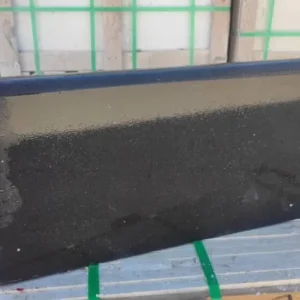
The trade-off is thermal behaviour. Darker stone absorbs more radiant energy through the day, which means a honed or brushed black basalt pool deck will be noticeably warmer underfoot by mid-afternoon than a buff limestone or cream shellstone surface in the same orientation. That’s not a defect — it’s a physical reality of thermal mass in darker material, and it’s one your client needs to understand at the specification stage rather than discover in July. For barefoot pool use, specify a brushed finish in 80 grit or bush-hammered, both of which create an open matte texture suited to pool surrounds. A certified mill test summary covering water absorption, density, flexural strength, modulus of rupture and abrasion loss is available on request for basalt.
Shellstone and Its Pore Structure
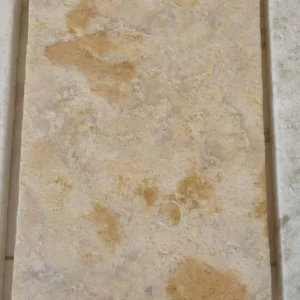
Shellstone — sometimes called ocean reef shellstone — is a shell-packed limestone formed from compacted marine organisms. Its surface carries a naturally varied texture from the fossilised shells embedded in the matrix, which creates an open, matte face without any mechanical finishing. That characteristic texture makes it popular for pool surrounds where a more organic, resort-style aesthetic suits the project. A laboratory certificate of test covering density, absorption, compressive and flexural strength, abrasion and modulus of rupture is available on request for shellstone.
- Shellstone’s pore structure is more open than denser limestone varieties — sealing is essential and the interval should follow your sealer manufacturer’s stated schedule, not a generalised rule of thumb
- The naturally varied surface texture creates visual interest that suits contemporary and tropical resort-style pool designs
- Specify 1¼ in (3 cm) nominal thickness for pedestrian pool deck areas on a properly prepared base
- Avoid machine-polished finishes entirely — the natural face of shellstone is part of what makes it suitable for wet pool environments
Granite for High-Traffic Pool Surrounds
Granite’s crystalline structure — feldspar, quartz and mica interlocked at the grain level — gives it a dimensional stability that makes it one of the more forgiving stones in demanding pool environments. It resists the wet-dry cycling that causes softer sedimentary stones to degrade at their edges over time, and its consistent colour through the body of the stone means chips and edge wear are less visually prominent. ASTM C615 governs granite dimension stone specification.
For pool deck applications, specify a bush-hammered finish for any surface that will be wet or used for pool entry. Brushed finishes in 36 or 80 grit are appropriate for surrounding terrace areas. Polished granite is for dry indoor surfaces only and should never appear in a pool surround specification.
Finish Selection: The Variable That Changes Everything
The finish you specify on your pool pavers for pool areas changes the character of the surface more fundamentally than most buyers anticipate. Two pavers cut from the same limestone block behave and look entirely differently once one receives a polished finish and the other receives a bush-hammered treatment. For pool environments, finish selection is governed by a simple operational rule: the more water the surface will carry, the more open and textured the finish needs to be.
For pool decks, wet steps and slopes, choose a bush-hammered finish. For other outdoor paths, bush-hammered or brushed in the coarsest grit both work — check a sample in wet conditions before you commit to a large order. The specific finishes relevant to pool deck environments from our range are:
- Bush-Hammered — the recommended finish for pool decks, ramps, wet areas and pool entry steps; the mechanical hammering leaves an open, matte, deliberately broken surface
- Brushed 80 Grit — suited to barefoot pool decks and terraces where a slightly smoother surface than bush-hammered is preferred; still leaves an open, matte texture
- Brushed 36 Grit — appropriate for pool surrounds and patios; coarser than 80 grit
- Double-Brushed 60 — suited to pool house interiors, covered terraces and spa areas where foot traffic is less aggressive
- Honed 60 Grit — acceptable for covered pool house floors and interior areas that remain predominantly dry; not for exposed pool decks
Regarding slip resistance: the relevant test standard for wet surfaces is ANSI A326.3, measured wet. The finish is the primary variable — a bush-hammered or coarser brushed finish creates an open, matte surface texture, while a polished or fine-honed finish leaves the surface smooth. Specify the finish by name; never assume finish and safety outcome are the same thing, and never rely on a dry test result to satisfy a wet surface requirement.
For a full overview of material options and thickness specifications for pool surrounds, the Pool Pavers section of our catalogue covers the natural stone formats we cut to order, including pavers, coping and steps.
Thickness and Base Requirements for Pool Deck Pavers
The paver itself is only half of a pool deck specification — the base beneath it determines whether the surface stays flat and stable across years of thermal cycling, seasonal ground movement, and the loading that comes from pool equipment, furniture and foot traffic. Getting the base wrong while specifying a premium natural stone is one of the most consistent field failures in residential and commercial pool surround installations.
Paver Thickness for Pool Areas
For pedestrian pool deck areas, 1¼ in (3 cm) pavers on a correctly prepared base represent the standard working thickness. Thinner material risks flexural failure under point loads — outdoor furniture legs in particular concentrate load over a small footprint, and the combination of a saturated base and a thin paver is where edge cracking typically originates. At Citadel Stone, we cut pool deck pavers to order from our selected quarries, so thickness is confirmed at the specification stage rather than adjusted on site.
- 1¼ in (3 cm) is the standard pedestrian pool deck thickness — specify this explicitly in the project documents
- Coping and edge pieces that project over the pool bond beam may require increased thickness — coordinate with the pool structure engineer
- Steps and entry treads should be specified at greater thickness than deck pavers, with the tread depth and riser height confirmed against local code requirements
- Never specify a thinner paver by assuming the stone’s physical properties compensate for reduced cross-section — they do not
Base Preparation and Code Compliance
Local building codes and the structural requirements of the pool surround dictate base depth more than material preference does. In freeze-thaw regions, the frost line depth controls how deep your compacted crushed-stone base must extend — installing a pool deck over an uninsulated base above the frost line is a reliable path to heave and joint failure within the first two winters. Your local authority having jurisdiction (AHJ) sets the frost depth requirement, and the base specification must reference it explicitly.
The PHTA publishes pool deck and coping standards that address structural requirements for pool surrounds, including drainage slope, bond beam integration, and deck surface expectations. Checking those standards early in the design process keeps the pool deck specification aligned with the pool structure rather than treating the two as independent systems. Seismic zones add another layer — in areas with significant seismic design categories, flexible joint systems and base isolation details may affect how you specify the mortar bed or setting material beneath the pavers.
- Confirm frost line depth with your AHJ before finalising base specification — it varies significantly across climate zones
- Pool deck drainage slope should be directed away from the pool; a slope of about ¼ in per foot (2%) toward perimeter drains is a common working figure, confirmed against the pool engineer’s drawings
- In seismic design zones, coordinate with the structural engineer on joint system flexibility and base construction requirements
- Edge restraint at the pool deck perimeter prevents lateral creep — the coping itself often functions as the primary edge restraint, but confirm this against the pool bond beam detail
Joint Width and Movement Accommodation
Thermal movement is a real factor on any outdoor hard surface, and pool decks intensify it — the surface runs from cold and wet in the morning to hot and dry in the afternoon across a full summer season. Natural stone expands and contracts with temperature, and joints that are specified too tightly will close and cause edge chipping or surface displacement as the material moves. Joints that are too wide catch debris and become maintenance liabilities.
Joint width and the frequency of movement joints should both come from a thermal movement calculation based on the paver’s coefficient of thermal expansion and the anticipated temperature differential at your site, not from a generic rule of thumb. Different stone types have different coefficients of thermal expansion, and a pool deck exposed to direct sun in a hot climate will experience a larger temperature differential than a shaded terrace in a moderate climate. Calculate it for your project, or ask your engineer to do so, rather than borrowing a figure from a previous job with different conditions.
- Keep joints filled and compacted — joint sand settles after the first wet season and needs refilling to maintain surface stability
- Movement joints at the pool bond beam and at any changes in direction allow the deck to move independently of the pool structure
- Mortar-bedded pool decks require saw-cut movement joints at intervals the setting material manufacturer specifies — follow their technical data sheet, not a general rule
- Joint sand type should match the base system — polymeric joint sand is typically specified for pedestrian pool decks to reduce washout and weed pressure
Sealing Pool Deck Pavers: What the Environment Demands
Chlorinated water, sunscreen residue and pool chemicals are a demanding combination for any natural stone surface, and the sealing specification for a pool deck needs to account for all three. A penetrating sealer — one that enters the pore structure rather than building a film on the surface — is generally the more appropriate choice for pool surrounds because it does not alter the finish texture the way a topical film sealer does. Film sealers on pool decks can also trap moisture beneath the surface in climates where the stone is saturated before it dries, which leads to delamination of the sealer layer rather than protection of the stone.
Apply sealer to a clean, dry surface — pool deck stone that has been wet all week needs full drying time before sealing is productive. The sealer manufacturer’s technical data sheet specifies the required surface moisture content and ambient temperature window for application; working outside those parameters typically produces adhesion failure. Set your maintenance calendar by the sealer manufacturer’s stated reapplication interval for pool environments, which is usually more frequent than for interior applications because UV exposure and chemical contact degrade sealer performance faster.
Color and Format Decisions for Pool Surrounds
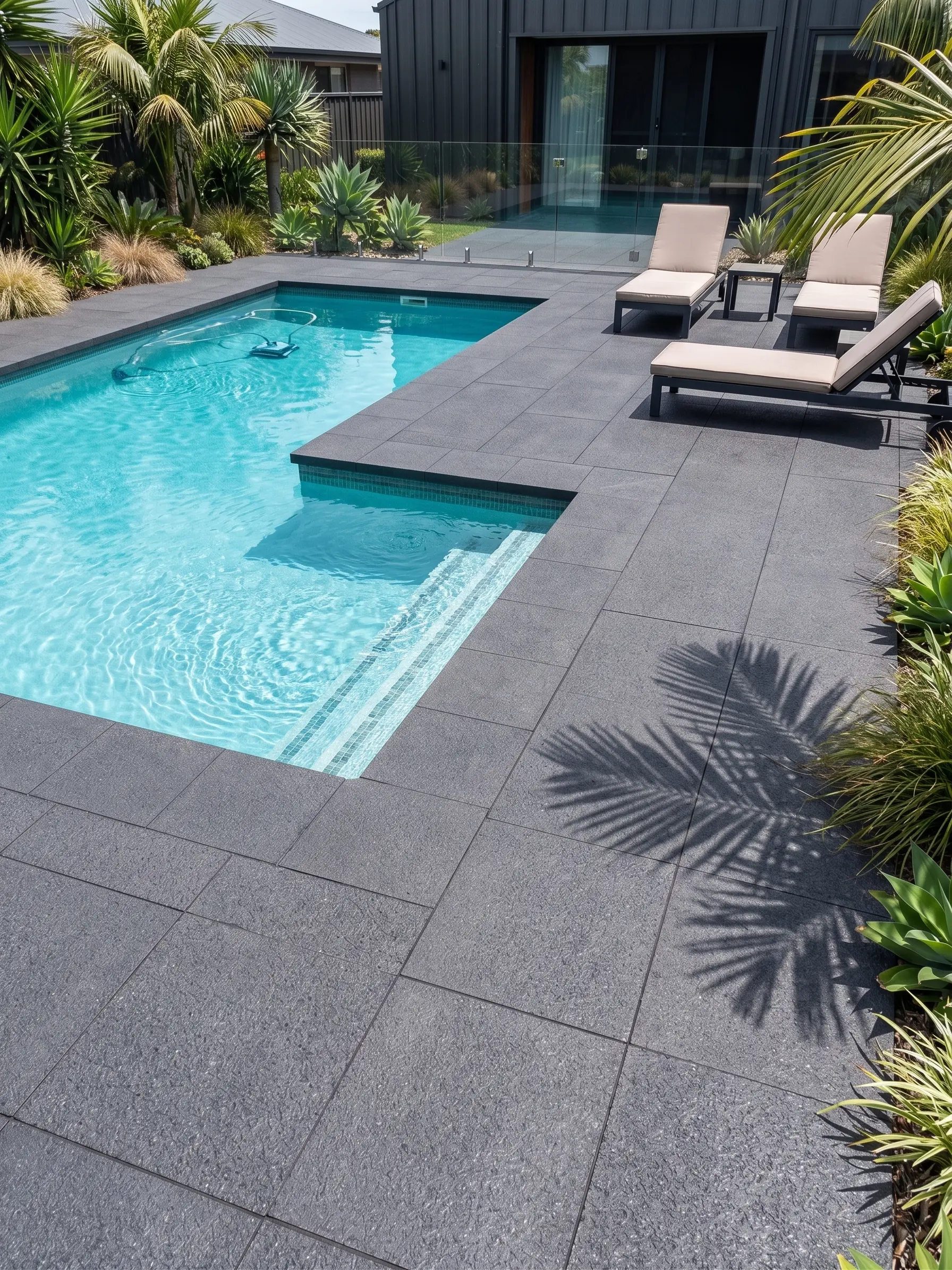
Stone color choice for a pool deck affects the thermal environment around the pool more directly than most clients anticipate. Lighter stone tones — cream limestone, buff shellstone, light grey granite — reflect a greater proportion of solar radiation and stay markedly cooler underfoot during afternoon peak sun than darker stones in the same orientation. The difference is perceptible to bare feet and can be significant enough to affect how usable the deck is during the hottest part of summer days.
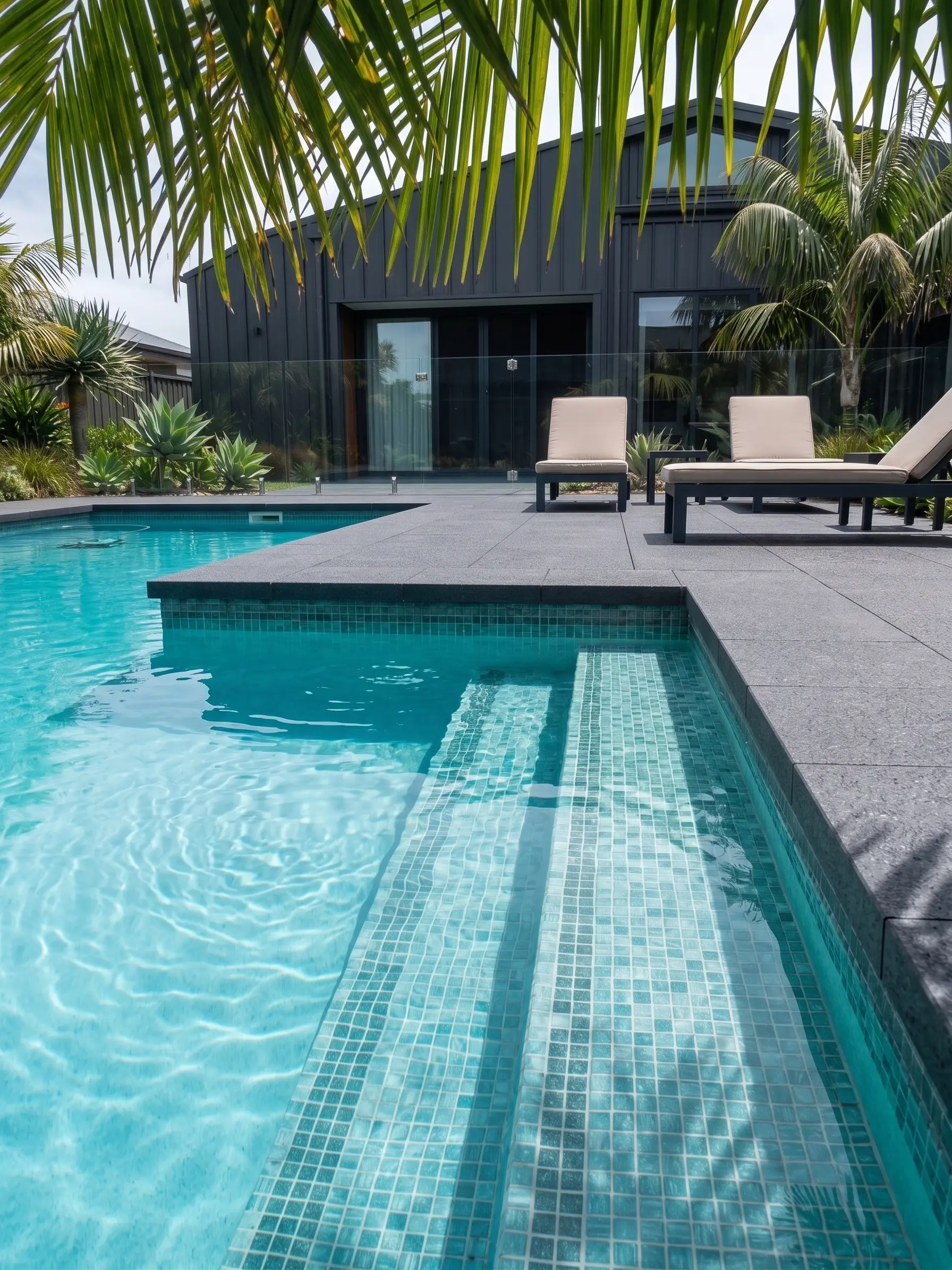
Darker stones — black basalt, dark grey granite — absorb more solar energy through the day, and while they typically release it as the sun drops, mid-afternoon surface temperatures on exposed dark pool decks can be considerably higher than on equivalent lighter surfaces. Neither is wrong as a specification — both stone types perform durably in pool environments — but the client needs to understand the thermal trade-off before the order is placed rather than after installation. A sample of the actual stone in the intended finish, assessed on a sunny day at the site, remains the most reliable test.
- Format: 24 × 24 in (600 × 600 mm) pavers are common for open pool deck areas; 12 × 24 in (300 × 600 mm) and 16 × 16 in (400 × 400 mm) provide more joint lines, which can be a visual or structural consideration depending on the design
- Large-format pavers — those wider than 24 in (600 mm) — require very flat base preparation to avoid rocking; the tolerance tightens with the paver size
- Irregular flagstone formats can work on pool decks but complicate drainage slope management and require greater care in base levelling
- Coping profile — square edge, bull-nose, or drop-face — is determined by the pool bond beam detail and local pool code requirements, not just by aesthetic preference
Delivery and Project Planning for Pool Surrounds
Natural stone pool deck projects have tighter scheduling constraints than most residential hardscape work because the pool shell is typically complete and backfilled before the deck is installed, which limits access to the working area. Access conditions — driveway width, gate height, turning radius, surface load capacity — all affect how the delivery is arranged and how the stone is staged around the pool perimeter. Offloading arrangements are confirmed before the delivery date to avoid on-site improvisation that adds cost and delays the installation crew.
Lead times are quoted with the order, and the right sequence is to confirm your stone specification and order quantity before the pool deck structural work reaches the coping installation stage, not after. Citadel Stone cuts pool pavers to order from our selected quarries, which means the specification you send — stone type, finish, nominal thickness, format dimensions and quantity — is what gets cut. There is no inventory adjustment available once the order is in production, so accuracy at the specification stage is the most important delivery management tool you have.
Getting Pool Deck Paver Specifications Right
The best pavers for pool deck installations are the ones specified with full knowledge of the structural requirements beneath them, the thermal behaviour above them, and the finish characteristics that make them appropriate for wet, barefoot environments. Stone type, finish, thickness, base depth, joint system, and sealing protocol are each individual decisions — and each one affects how the others perform over the service life of the installation. Shortcutting any one of them typically shows up in the others within a few seasons. Your material choice is the visible part of the specification, but the base, the joints, and the maintenance schedule determine whether that material performs across the decades. For a complementary look at another dimension of natural stone hardscape planning, basalt cobble weight and handling covers the practical logistics of working with dense volcanic stone formats on site. Specifying the right stone for wet traction and surface temperature starts with Citadel Stone’s range, cut to order at our selected quarries.