

Basalt cobblestone weight is the spec variable that catches project managers off guard more often than almost any other material decision. You can get the stone selection right, nail the finish, confirm the joint pattern — and then discover on delivery day that your site access, your crew size, and your lifting equipment were all sized for a lighter stone. Understanding the actual mass of basalt cobbles before the order is placed is what separates a smooth installation from a scramble.
Why Basalt Is Heavier Than It Looks
Basalt is a fine-grained volcanic rock that cooled rapidly at or near the earth’s surface. That fast cooling left almost no room for large crystals or internal voids, which is what the USGS overview of igneous rocks describes when it explains how lava cooling rate determines grain size. The result is a stone that is denser and more tightly packed than many sedimentary alternatives like limestone or concrete pavers of equivalent dimensions. When you pick up a single basalt cobble and compare it to a concrete block of similar size, the difference in hand weight is immediately noticeable — basalt feels heavier for its volume because it genuinely is.
That density matters when you translate it into pallet loads, delivery payloads, and manual handling decisions. A material that feels manageable as a single piece becomes a serious logistical and ergonomic challenge when you are moving two hundred pieces off a flatbed and positioning them by hand on a sloped site.
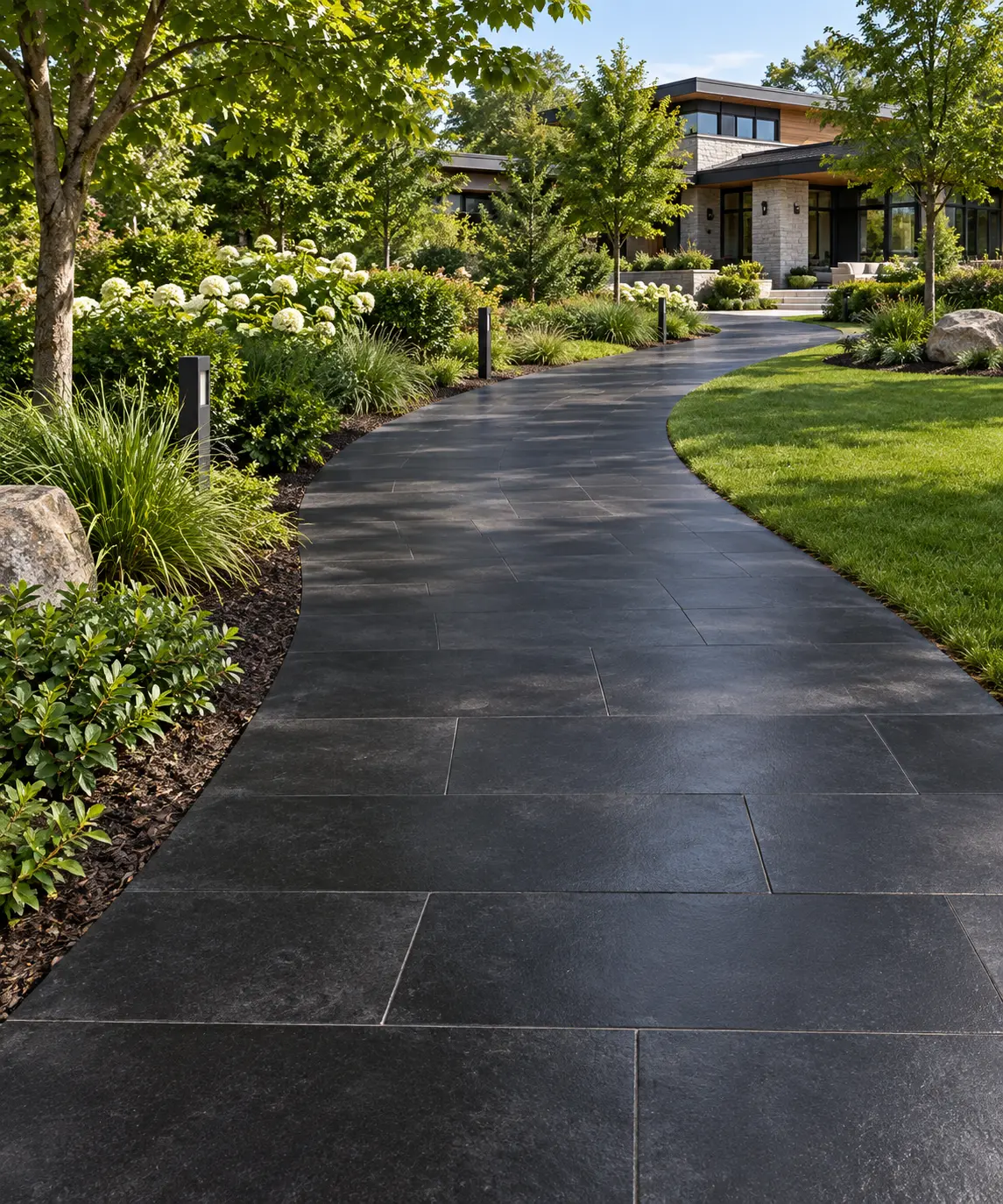
Typical Weight Range for Basalt Cobbles
Basalt cobblestone weight varies with size, but the relationship is straightforward once you know the density range of the stone. Basalt typically falls in a density range that places it among the heavier natural stones in common use; a certified mill test summary covering water absorption, density, flexural strength, modulus of rupture and abrasion loss is available on request. What that means practically is that even a modest cobble format adds up fast on a pallet.
- A small cobble roughly 4 × 4 × 4 in (100 × 100 × 100 mm) will weigh in the range of 10–12 lb per piece — confirm against the quarry test report for your specific source
- A medium cobble at 4 × 6 × 4 in (100 × 150 × 100 mm) steps up proportionally — expect the weight to scale with volume, not with the largest dimension alone
- A large cobble format at 6 × 8 × 5 in (150 × 200 × 125 mm) can reach 25–30 lb per piece, which puts it firmly in two-person handling territory on flat ground and requires mechanical assistance on a slope
- A full pallet of basalt cobbles — typically 1.5 to 2 tons depending on packing configuration — is not a hand-unload job; confirm your pallet weight with the order
These are working estimates for planning purposes. The actual density of your stone depends on the specific quarry geology, and you should request the quarry test report when you place your order. At Citadel Stone, we cut cobbles to order at our selected quarries and can provide specification documentation alongside the order confirmation.
How Weight Affects Delivery and Site Access
Your delivery planning has to account for the full loaded weight of stone, not just the square footage. A typical basalt cobble order for a mid-size pathway or courtyard project can land at five to ten tons of material — and getting that volume from the delivery point to the installation zone is where weight becomes an active design constraint.
Delivery is arranged and managed by Citadel Stone; offloading arrangements and lead times are confirmed with each order. Your responsibility on site is to have the access route, the offloading zone, and any mechanical lifting equipment ready before the delivery date. Here is what commonly creates problems in the field:
- Narrow gates, tight bends, or low-clearance entries can prevent a fully loaded vehicle from reaching the drop point — measure your access width and overhead clearance before finalising the delivery address
- Soft ground, uncompacted fill, or recently laid turf can give way under loaded pallet weight — place a temporary hardstanding of plywood or steel plates if your drop zone is not on solid pavement
- Basement-level or below-grade sites require a crane or conveyor plan for cobbles at this weight; hand-carrying down a stairwell is a serious injury risk above a few pieces
- Distance from drop point to lay zone matters — even a 100 ft carry adds meaningful time and fatigue at 12–30 lb per piece over hundreds of pieces
Handling Basalt Cobbles on Sloped and Elevated Sites
Terrain is where basalt cobblestone weight shifts from a logistics question to a safety and engineering question. On a flat courtyard, you can roll a wheelbarrow loaded with half a dozen cobbles without much drama. On a hillside installation or a site with significant grade change, the same load becomes a controlled-movement problem that requires a different plan.
Elevation changes affect handling at every stage. Bringing material up a slope under load puts mechanical stress on your equipment and physical strain on your crew. Bringing it down a slope introduces the additional risk of a runaway load if a barrow tips or a worker loses footing. The standard approach on sites with more than a 5% grade is to establish a mechanical-assist system — a motorised barrow, a site hoist, or a crane — before the stone arrives, not after.
- For slopes steeper than roughly ¼ in per foot (about 2%), consider staging the stone at an intermediate level rather than carrying full loads from the base to the top of the slope in one move
- On switchback or terraced sites, each level change adds a lift-and-lower cycle to every piece — factor that into your crew hours, not just your material cost
- Drainage design on sloped cobble installations also responds to weight: a heavier stone needs a more firmly locked base to resist creep on grade, which means your compacted sub-base depth and bedding layer thickness both need to account for the slope angle, not just the anticipated foot traffic
- Low-lying sites with poor drainage present the opposite challenge: saturated ground reduces the bearing capacity of the sub-base, and at basalt’s density, the point loads from individual cobbles on soft ground are higher than with a lighter stone
Grade management and base preparation are interdependent decisions on any site that is not dead flat. If you are working on a hillside or a site with drainage requirements, your base engineer needs the stone’s density — not its compressive strength — to size the sub-base correctly. Request the quarry test report and pass the density figure to your structural or civil consultant.
Manual Handling, Ergonomics, and Crew Planning
There is a weight threshold above which a stone piece reliably requires two people to move safely, and basalt cobbles at larger formats clear that threshold. The practical rule used on most well-run natural stone installations is a one-person lift limit of around 50 lb — anything above that requires either a second person or a mechanical assist. Larger basalt cobbles sit close to or above that line depending on format.
Your crew planning should reflect the actual piece weights, not a generic “heavy stone” assumption. Here is how to build a realistic handling plan:
- Calculate the number of pieces your project requires, then divide by the expected lay rate per person-hour — for cobbles at larger formats, that rate drops compared to smaller pieces because of the additional handling time
- Identify which pieces in your layout will require two-person placement — corners, edge cuts, and any piece above a drain or a level change tend to take longer and require more care
- Plan your on-site storage location to minimise double-handling — stone that is dropped at one end of the site and then carried the length of the project costs you real labor hours
- Confirm your PPE and lifting equipment requirements before the material arrives — back braces, grip gloves, and knee pads matter at this weight class over a full installation day
You can browse our basalt stone selection to review available cobble formats and confirm dimensions before you build your handling plan. Knowing the exact piece size — not an approximation — is what lets you calculate accurate weights and logistics for your specific project.
Calculating Total Project Weight from Coverage Area
Converting your coverage area into a tonnage figure is the practical step that bridges material selection and logistics planning. The calculation depends on three inputs: the area to be covered, the cobble format (dimensions), and the stone’s measured density. Without the density figure from a test report, any tonnage calculation is an estimate — but it is a good-enough estimate for load planning and access logistics.
A working approach that project managers use in the field:
- Establish the total square footage of the installation area
- Determine the cobble thickness (depth), which for a standard cobble format runs 3–5 in (75–125 mm) — confirm the actual depth of the format you are ordering
- Multiply area by thickness to get the volume of stone, then multiply by the density figure from the test report to get mass; your supplier’s technical team can walk you through this if needed
- Add 10–15% for waste, cuts, and breakage — natural stone projects consistently run over on material when cuts are involved
- Divide the total mass by the typical pallet capacity your supplier quotes to estimate pallet count and delivery load requirements
The Natural Stone Institute’s guide to natural stone varieties provides useful context on how different stone types compare in terms of physical characteristics — a helpful reference when you are comparing basalt cobblestone weight against other cobble formats for the same project. The calculation itself belongs in your project planning documents, reviewed alongside your sub-base specification and your site access plan.

Basalt Cobblestone Weight and Sub-Base Design
The weight of the stone sitting on your sub-base is not the primary load the base needs to carry — foot traffic and occasional point loads from equipment or furniture matter more for a pedestrian installation. But the stone’s own mass does influence sub-base design in one specific way: a heavier stone placed on an inadequately compacted base will settle differently from a lighter one, and that differential settlement shows up as rocking, lippage, and joint gaps over time.
Basalt cobble installations on compacted crushed-stone base with a sand bedding layer perform well when the base is correctly engineered for the site conditions. Here is what the sub-base specification needs to respond to:
- Soil type — clay soils with high shrink-swell potential need a deeper base with geotextile separation to prevent the native soil from contaminating the aggregate over time
- Drainage — basalt cobblestone weight and density mean the stone itself does not flex; if water has nowhere to go under the installation, hydrostatic pressure can lift or shift the bedding, especially at changes in grade
- Frost depth — in freeze-thaw regions, your base needs to extend below the local frost depth to prevent heave; the stone’s mass makes it more resistant to minor surface movement but does not compensate for an under-depth base
- Edge restraints — at the perimeter of any cobble installation, the combined weight of the stone and the lateral forces from foot traffic mean edge restraints need to be mechanically fixed into a solid substrate, not just laid in the bedding sand
According to the Britannica entry on basalt, the rock’s characteristically fine grain and high density are products of its volcanic origin — properties that translate directly into the sub-base load characteristics you are designing for. Your structural or civil engineer should have the stone’s density figure from the test report before they sign off on the base depth.
Sealing and Long-Term Maintenance at Weight Scale
Maintenance planning for basalt cobble installations is simpler than for many other natural stones, but the weight of the installation creates one practical constraint that often gets overlooked at the specification stage: if you need to lift and relay individual cobbles to address drainage issues, repair a sub-base failure, or reroute a service, you are handling the same 10–30 lb pieces again — at a time when the project crew is long gone and the site owner is managing repairs with a smaller team or a single contractor.
Designing for maintainability means a few specific decisions at the installation stage:
- Keep a small quantity of matching cobbles in storage after the project — color match and texture match on basalt are consistent from a single quarry run but can shift between production batches
- Document the joint compound and bedding sand specifications so a future repair contractor can replicate the original installation without guesswork
- Seal the installation on the interval your sealer manufacturer specifies for this stone type and your local climate conditions — basalt’s low porosity means sealer intervals are typically longer than for limestone or granite, but the correct interval comes from the sealer product data sheet, not a generic rule
- For any installation on a slope, inspect drainage outlets annually — a blocked outlet on a sloped cobble installation can push water under the bedding layer, which is the most common cause of cobble displacement on graded sites
Spec Wrap-Up: Getting Basalt Cobblestone Weight Right
Getting basalt cobblestone weight right in your project documents is a front-end decision that pays off at every downstream stage — delivery planning, crew sizing, sub-base design, and long-term maintenance all trace back to the density figure on the quarry test report. Request that report early, size your logistics to the actual tonnage, and build your sub-base specification to match the site conditions rather than a generic depth rule.
For projects on sloped or elevated sites, the terrain amplifies every weight-related challenge: handling becomes a safety question, drainage design becomes more critical, and the base depth calculation needs to account for grade as well as load. Address those variables at the design stage, not during installation. If you are planning a cobble installation for a path or access area, basalt cobble installation covers the base and laying sequence in detail worth reviewing alongside this weight guide.
Citadel Stone quarries, templates, manufactures, and handles basalt cobbles cut to order at our selected quarries — which means the specification documentation, including density data on request, travels with the stone. Talk to our technical team before you finalise your delivery and handling plan, and build the weight figures into your project schedule from day one. Sourced from our selected Middle East quarries, basalt from Citadel Stone is prized for its fine, uniform grain structure.
Related reading: basalt retaining wall · uneven basalt cobbles fix · basalt cobbles design ideas.