

Basalt cobbles design ideas reward specifiers who think beyond the surface — the real creative range opens up when you understand how the stone’s natural geometry, finish options, and jointing choices interact to produce very different aesthetic outcomes from the same raw material. Most designers treat cobbles as a single visual note when they’re actually a system: the cobble size, the laying pattern, the joint width, and the finish each contribute independently, and the combinations multiply quickly. Your design decisions at each of those layers will define whether the finished patio reads as crisp and contemporary, richly textured and traditional, or somewhere in between.
Related guide: Basalt Mosaic Tile Ideas for Showers and Backsplashes.
Idea 1 — The Classic Fan Pattern for Curved Patio Edges
The fan, or sett fan, is one of the oldest cobble arrangements still specified on high-value residential projects, and for good reason. You set each cobble on a radius so the joints radiate outward from a focal point — a planter base, a fire pit surround, or a patio centrepiece. The visual pull draws the eye inward, anchoring the space with a sense of intentional geometry that flat-cut paving rarely achieves.
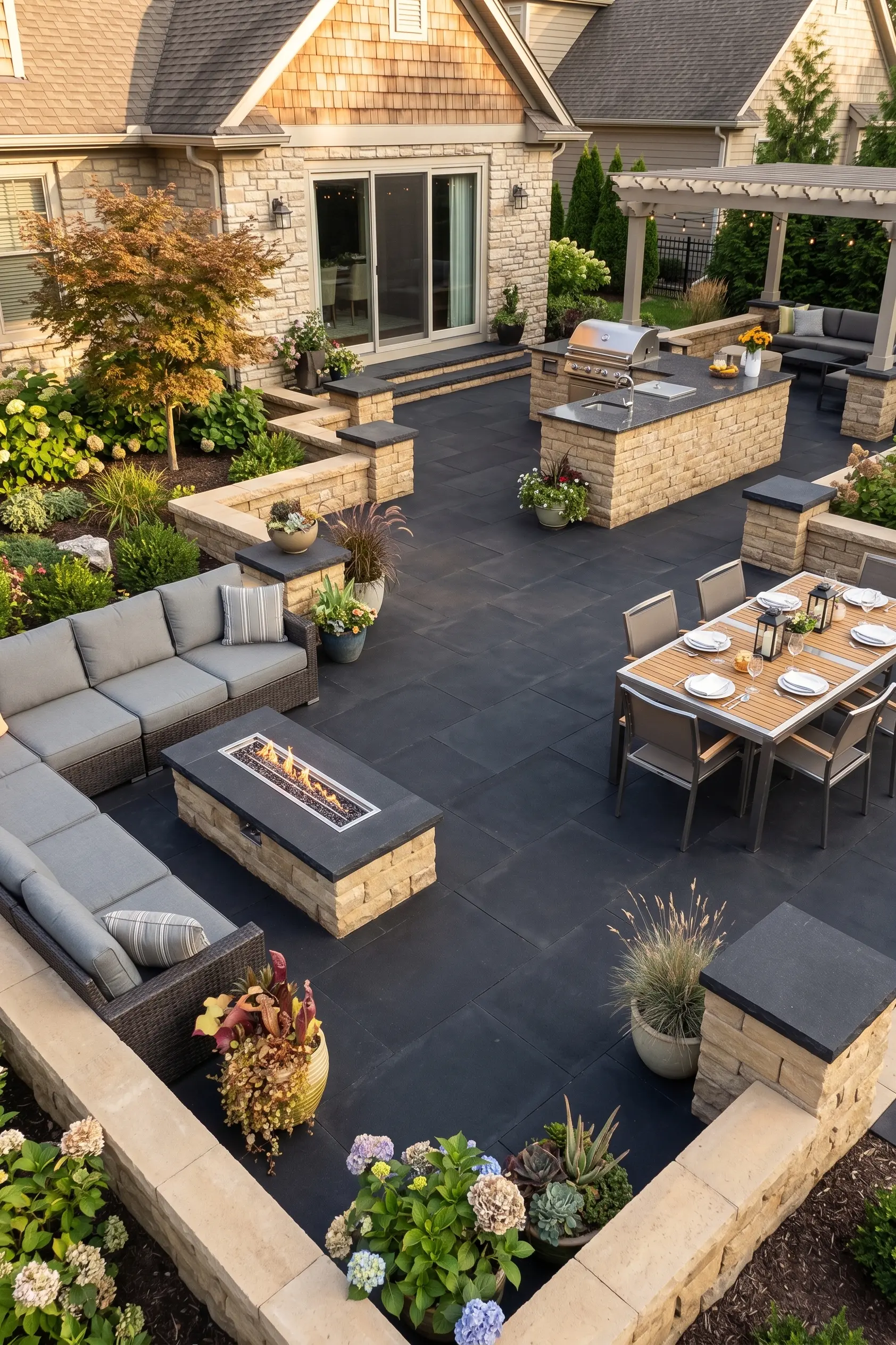
- Choose a consistent cobble face size — uniform lengths keep the radiating joints tight and clean
- Set the fan origin point before you lay a single cobble; string lines from the origin govern every row
- Use a tighter jointing sand in the centre of the fan where joint angles converge, and compact in stages
- Basalt’s dark, close-grained face makes the radiating lines read sharply — lighter jointing sand creates a high-contrast grid
The fan pattern is most effective on patios where at least one dimension is generous enough to complete two or three full arcs. On a tight terrace, even a half-fan from a single edge delivers the same centring effect without demanding extra cutting at the boundary.
Idea 2 — Straight and Diagonal Herringbone for High-Traffic Areas
Herringbone is the structural workhorse of cobble patterns — the interlocking geometry distributes point loads laterally across the field so no single cobble carries the full impact. Your specifier notes should reflect whether you want the herringbone running at 45 degrees to the patio edge (diamond herringbone) or parallel to it. The 45-degree version reads as more dynamic; the parallel version settles into the background and lets planting or furniture become the visual focus.
According to Natural Stone Institute igneous stone paving technical standards, igneous stones like basalt perform well in high-traffic paving applications due to their dense, crystalline structure. Herringbone magnifies this benefit by maximising the contact edges between cobbles, reducing differential movement under load. You’ll keep joints tight only by refilling and re-compacting the sand where it settles after the first wet season — budget that maintenance into the project handover notes so the client understands it as normal stone behaviour, not a defect.
Idea 3 — Mixed-Size Field Laying for an Organic, Informal Look
Combining two cobble face sizes — say a larger format and a smaller format — in a random field pattern produces the kind of organic texture that formal geometric arrangements simply cannot replicate. The trick is in the ratio: too many large cobbles and the small ones read as filler; too many small ones and the surface becomes visually restless. A roughly two-to-one ratio of large to small by surface area tends to settle into a balanced, readable composition.
Layout decisions also affect drainage. Mixed-size fields naturally produce irregular joint widths, and wider joints in a random field allow water to percolate more readily between cobbles — a performance benefit on patios that sit over free-draining aggregate bases. Citadel Stone cuts cobbles to order from selected slab stock, so you can specify face size and thickness consistently across the whole project batch rather than sorting through a mixed pallet on site.
Browse our patio cobble range to see the face sizes and finishes currently available for mixed-field project orders.
Idea 4 — Contrasting Border Courses to Frame the Patio
A single-course or double-course border running the perimeter of your patio — laid perpendicular to the field pattern inside — creates a visual frame that lifts the whole composition. The border serves a structural purpose too: it locks the field cobbles against lateral migration at the edges, reducing the need for hidden edge restraints in certain base configurations.
- Running the border cobbles with their long axis perpendicular to the patio edge creates a soldier-course effect that reads as a deliberate frame
- A contrasting joint — wider in the border than in the field — further separates the two zones visually
- On patios with a step down to a lawn level, the border course at the drop edge also acts as a visual warning of the level change
- Basalt’s consistent dark tone means you can achieve contrast through finish rather than colour — a brushed border against a honed field, for example
The detail that matters most at the border-to-field junction is the joint alignment. If the first row of field cobbles runs parallel to the border course, the two elements read as intentional layers. If the field pattern cuts across the border at an odd angle, the composition looks unresolved. Set out the border first, then work the field pattern inward from it.
Idea 5 — Linear Band Patterns to Define Zones
Alternating bands of cobbles — either in different orientations or at slightly different scales — let you divide a patio into functional zones without a physical edge or a change of material. A dining zone and a lounge zone on the same continuous patio surface can be delineated cleanly by rotating the cobble orientation 90 degrees between bands, or by inserting two or three rows of a smaller-face cobble as a transition strip.
The USGS notes that basalt is among the denser volcanic stones used in construction paving, and that density translates to a consistent face surface across a large band layout — the colour reads uniformly from one end of the patio to the other without the tonal variation you sometimes see in sedimentary stones. That consistency is what makes band patterns work at scale: the geometry carries the design, and the material stays quiet behind it.
For the linear band approach, your base preparation needs to be flat to a tighter tolerance than for a random-field layout. Any deviation in the sub-base will telegraph through the straight joint lines of a band pattern in a way that an organic mixed-size field would absorb and hide. Spec your base compaction accordingly before the cobbles go down.
Idea 6 — Designing Joints for Temperature Cycling
Here’s what most specifiers miss on patio cobble projects: the jointing system is doing thermal work, not just gap-filling. Basalt — like all dense stone — expands and contracts with temperature. In climates with significant day-to-night swings, or in regions where seasonal temperature ranges run from sub-freezing winters to hot summers, that cumulative cycling stresses the joint material repeatedly over the life of the patio. A jointing sand that’s too rigid will crack and powder; one that’s too loose will wash out at the first heavy rain.
- For patios in freeze-thaw regions, specify a flexible, polymer-modified jointing compound rather than a rigid cement-based grout
- Joint width affects how much movement accommodation is built into the system — tighter joints leave less room for thermal expansion, which transfers more stress to the cobble faces themselves
- When designing for a climate with large day-night swings, discuss joint width with your installer before finalising the pattern — some patterns, like tight herringbone, produce narrower joints that limit movement capacity
- Water that enters a joint and freezes expands; drainage slope of the patio surface is your first line of defence against that loading cycle
According to USGS basalt volcanic rock properties, basalt is a dense igneous rock with a characteristically low absorption rate — a property relevant to freeze-thaw performance, since water uptake into the stone body is the primary mechanism by which freeze-thaw damage occurs in porous materials. Requesting the absorption test report from your stone supplier before specifying for a freeze-thaw region is standard due diligence. At Citadel Stone, we recommend requesting the test report for any project where seasonal temperature cycling is a design consideration.
Idea 7 — Combining Finishes Across Zones
Your patio doesn’t have to carry a single finish throughout. A deliberate finish transition — from a bush-hammered surface in the main traffic zone to a brushed finish in a sheltered seating area — creates tactile and visual variety without changing the stone. Both zones read as the same material because the colour and scale are identical; the texture shift signals the zone change instead.
For pool decks, wet steps and slopes, choose a bush-hammered finish. For other outdoor paths, bush-hammered or brushed in our coarsest grit both work; check a sample. On covered terraces or a patio area with a pergola overhead, a Double-Brushed 60 or Honed 60 Grit finish works well — the reduced exposure to standing water makes a finer surface appropriate, and the smoother face reads well under artificial lighting in an evening-use space.
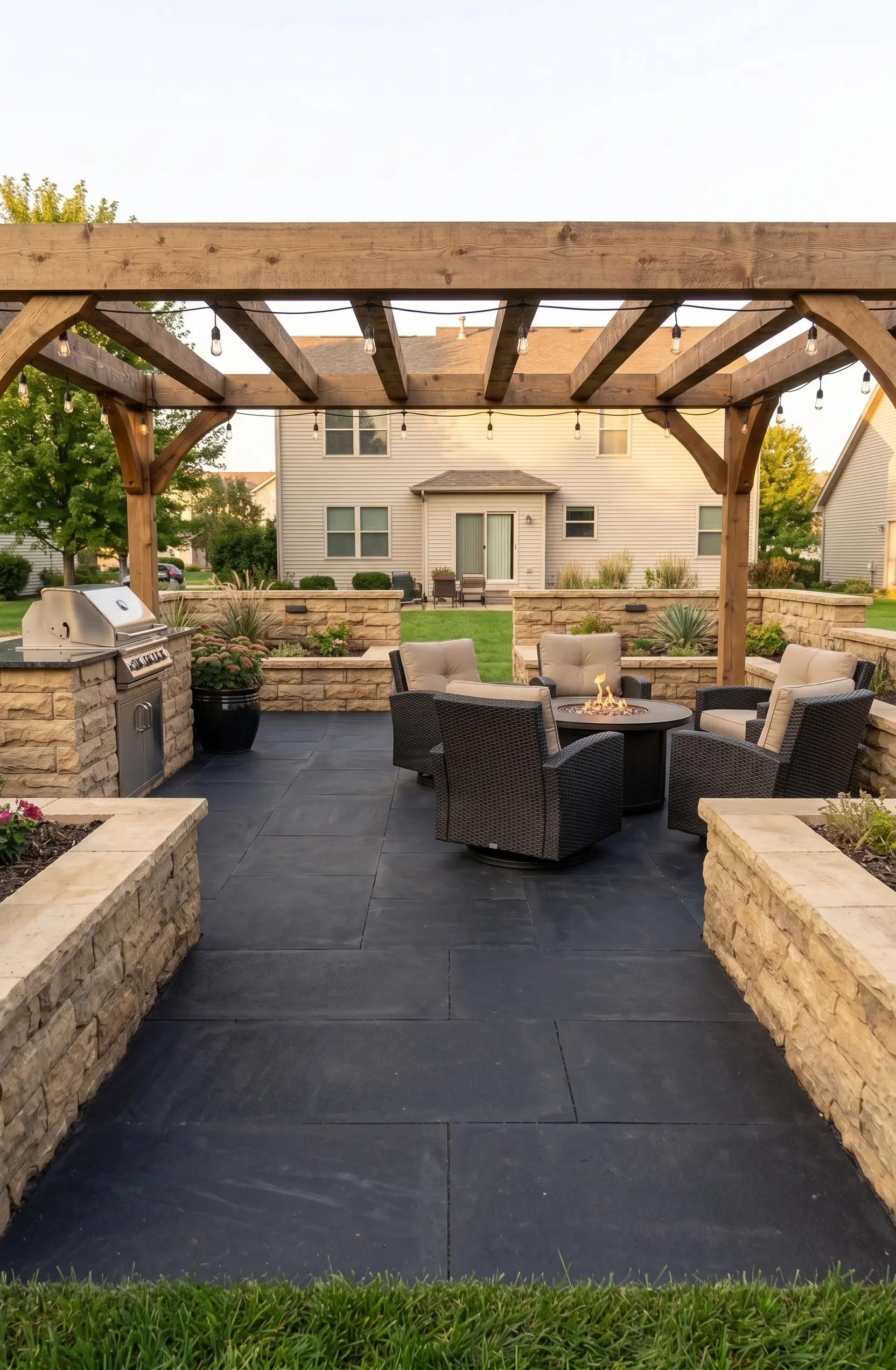
The Brushed 36 Grit finish suits patios and pool surrounds that aren’t in a direct wet-zone. The Brushed 80 Grit gives a finer, more refined texture suited to barefoot terraces. Never specify a polished finish for any outdoor or uncovered surface — it is appropriate for dry indoor floors, countertops, and wall cladding only.
Idea 8 — Integrating Basalt Cobbles with Stepping Stone Paths
One of the more versatile basalt cobbles design ideas is using a cobbled patio as the origin point for a stepping-stone path through a garden. The cobbled surface terminates at a grass or planting edge, and larger basalt slabs — cut to size from slab stock — continue as individual stepping stones. The material relationship is immediate and coherent: same stone, different form factor, different function.
The junction detail where the cobbled field meets the stepping-stone path needs thought. You want the stepping stones to sit at the same finished surface level as the cobbles, which means their base depth will differ from the cobble bed depth because the slab thickness is greater. Setting out both elements from the same datum level before any excavation begins keeps this manageable. The Britannica entry on basalt formation and construction properties confirms basalt’s crystalline, fine-grained structure — that structural consistency is what makes it possible to cut cleanly in both small cobble faces and large slab formats from the same quarry block, maintaining colour and texture coherence across both elements.
Idea 9 — Planning Your Order, Base Prep, and Site Access
The practical dimension of basalt cobbles design ideas is often where projects slow down. Cobbles are heavy, and delivery scheduling needs to account for site access constraints. Your project’s access constraints — turning radius, surface load limits on an existing driveway, gate width — all affect how the pallet delivery can be managed. Confirm offloading arrangements before you set a delivery date; repositioning a pallet of stone because the delivery could not reach the drop zone adds cost and delays the installation sequence.
- Order a full project quantity in one batch — matching face size and finish across separate orders from different cut dates is harder than it sounds
- Citadel Stone stocks basalt at our selected quarries and cuts to order, so lead times are confirmed when you place the order — factor that into your programme
- Stack pallets on firm, level ground close to the installation zone; cobbles shifted by hand across soft ground add unnecessary labour time
- For mixed-size field designs, separate the two face sizes on arrival — working from two clearly labelled stacks speeds laying significantly
For driveways, use setts or cobbles at least 3.5 in (4 in standard) thick on a compacted base, or pavers 2 in (5 cm) or thicker mortar-bonded to a reinforced concrete slab. For pedestrian patio applications, 3 cm cobbles on a well-prepared compacted aggregate base perform well across a broad range of conditions — the base preparation quality is the variable that most directly governs long-term performance. Shallow or poorly compacted bases produce differential settlement that no surface stone can compensate for.
Getting Your Basalt Cobbles Design Right From the Ground Up
Getting basalt cobbles design ideas off a mood board and into a finished patio comes down to decisions made early: pattern before laying begins, joint system before the stone arrives, finish combination confirmed against a physical sample in your actual site lighting. The stone itself is forgiving of a great many site conditions, but it cannot compensate for a base that wasn’t compacted properly or a joint compound that wasn’t suited to the climate’s temperature range. Build the specification from the ground up — literally — and the surface decisions become much more straightforward.
As you finalise your specification, related installation challenges are worth reviewing before the project starts. If settlement or level variation becomes an issue during or after installation, fixing uneven cobbles after installation covers how to address that without lifting the whole field. Basalt from our selected quarries in the Middle East carries deep charcoal tones that pair well with light jointing sand for contrast.
Related reading: basalt raised garden beds · Basalt Cobblestone Sizes: Choosing the Right Format · basalt cobble drainage channel.