

Basalt cobblestone sizes determine far more than visual scale — they set the structural logic of your entire surface. The face dimension controls how jointing distributes load, how the pattern reads from distance, and whether your bedding layer can accommodate the tolerances that natural stone always carries. Specifiers who treat size as a purely aesthetic variable tend to encounter problems at installation that a better-informed spec would have prevented.
What Size Actually Means for Basalt Cobblestones
Your first decision isn’t which size looks best — it’s which size functions correctly for the application. Basalt cobblestone sizes are described by face dimensions (length × width) and by depth, and these three numbers carry different structural implications. Face dimensions affect pattern scale and joint spacing; depth governs load-bearing capacity and bedding behaviour. Confusing decorative scale with structural adequacy is where most specification errors begin.
The natural variation within basalt as an igneous rock also means you need to understand what “nominal” size actually means in practice. As USGS basalt volcanic rock properties confirm, basalt forms through rapid volcanic cooling, producing a fine-grained, dense matrix with low water absorption — properties that make it well-suited to heavy-use paving. However, that same formation process means natural colour and textural variation are inherent, and you should always review samples before committing to a specification.

Standard Face Dimensions Explained
Basalt cobblestone sizes across the industry tend to cluster around a few common face formats, each suited to a different type of surface. Understanding these clusters helps you match the format to the project before you start detailing the base specification.
- Small-format cobbles (roughly 4 × 4 in face) read as dense, fine-grained paving — they suit tight curved layouts, garden paths and decorative edging where the jointing pattern is part of the visual design
- Standard cobbles (approximately 4 × 6 in or 4 × 8 in face) are the workhorse format — versatile enough for courtyards, driveways, plazas and mixed hardscape schemes
- Large-format cobbles (6 × 8 in and above) suit wide-open paving fields where you want strong horizontal lines and fewer visible joints, common in commercial plazas and formal entry drives
- Irregular or tumbled cobbles follow traditional European sizing, typically ranging from 3 to 6 in in the longest face dimension, and are generally specified for naturalistic garden and heritage-style layouts
None of these formats is superior in an absolute sense. Your choice turns on the scale of the space, the pattern you intend to lay, and the structural depth the application demands.
Depth, Thickness and Structural Requirements
Face size gets most of the attention, but depth is the specification that carries structural weight — literally. For pedestrian-only paths and residential courtyards, a cobble depth of around 2.5 to 3 in is workable on a well-prepared compacted aggregate base. For driveways carrying standard vehicles, you need setts or cobbles at least 3.5 in (4 in standard) thick on a compacted base, or pavers 2 in (5 cm) or thicker mortar-bonded to a reinforced concrete slab.
Depth also affects how the cobble behaves during bedding. Deeper units have a lower centre-of-gravity-to-face-area ratio, which means they resist rocking on an uneven bedding layer more effectively than shallow units with the same face. On large commercial installations where you’re laying hundreds of square feet, this stability difference becomes visible as a smoother, more consistent finished plane — especially in the first seasons of settlement.
- Shallow depths (under 2.5 in) suit purely decorative wall caps and non-trafficked garden features
- Standard depths (2.5 to 3.5 in) serve pedestrian plazas, residential paths and pool surrounds on prepared bases
- Heavy-duty depths (4 in and above) are specified for driveways, commercial entries and areas subject to frequent delivery or emergency-vehicle access
- Depth tolerances from natural stone suppliers vary — always confirm the stated tolerance before you design your bedding thickness, not after the material arrives on site
How Finish Interacts with Size Selection
The size you specify and the finish you specify are not independent decisions — they interact. A large-format cobble in a split-face finish will read very differently from the same face dimension in a bush-hammered finish, and the application context should drive both choices simultaneously rather than sequentially.
For pool decks, ramps, wet steps and any slope, choose a bush-hammered finish. For other outdoor paths, a bush-hammered or brushed finish in our coarsest grit both work — check a sample. For formal courtyard layouts and covered terraces where the surface stays predominantly dry, a honed finish works well in larger face formats because the clean, flat surface emphasises the geometric precision of the pattern. For driveways and courtyards in heavier-use settings, a Brushed 16 Grit finish is the right starting point. The key is to evaluate the finish against a physical sample of the actual size you’re specifying — the textural effect reads very differently across face formats.
- Bush-hammered finish: open, textured surface — pool decks, ramps, wet-area surrounds and public plaza paving
- Split face: raw, fractured surface texture — feature walls, driveway setts and retaining-wall block faces
- Brushed 16 Grit: coarse brushed texture — driveways, courtyards and garden paths
- Brushed 36 Grit: medium brushed texture — patios and pool surrounds in pedestrian applications
- Honed finish: smooth, matte surface — interior floors, wall cladding and covered exterior features in dry conditions
Slip performance under the current standard is governed by ANSI A326.3, measured wet. The finish is the primary variable that affects how a surface performs under that test. If a tested value exists for a specific finish and size combination, the test report is available on request — we do not publish figures in our product descriptions.
Pattern Layout and How Size Drives It
Your chosen basalt cobblestone size constrains the patterns available to you more than most specifiers realise at the design stage. Small-format cobbles allow fan patterns, radiating arcs and tight curved borders — their joint density gives you geometric flexibility. Large-format cobbles in a running or stacked bond read as bold, linear paving that suits contemporary landscapes with strong geometry.
Mixing sizes — for example, a field of standard cobbles with a contrasting border of smaller units — is a legitimate design move, but it creates a more complex installation. You need to detail the transition between sizes carefully so that the joint pattern doesn’t interrupt structural continuity. Natural Stone Institute paving standards consistently emphasise that mixed-size natural stone layouts require additional setting-out time and should be specified with pattern drawings, not left to the installer to work out on site.
Explore our basalt cobble range to see the available face formats and discuss which depth suits your structural brief before you commit to a pattern layout.
Base Preparation Varies by Cobble Size
Larger, heavier cobbles place different demands on the base than lighter small-format units, and the base specification should reflect that. A small-format cobble on a pedestrian path can perform well over a compacted crushed aggregate base with a sand bedding layer, provided drainage is correctly managed. A large-format cobble on a driveway application requires the reinforced concrete slab and mortar-bed configuration described above — the point loads from vehicle tyres are concentrated differently across a large face than across a small one.
The bedding layer depth also needs to account for the depth tolerance of natural stone. Basalt cobbles are cut to nominal dimensions, but natural variation in the material means individual units may run slightly proud or slightly low. A consistent sand bedding layer gives you the ability to fine-tune each unit’s seating during installation. Rigid mortar bedding, by contrast, offers less tolerance for adjustment once the unit is placed — which is why experienced installers working with natural stone prefer to dry-set and check alignment across multiple units before any fixing compound is used.
- Pedestrian paths: compacted aggregate base with sand bedding, adequate for standard cobble depths in residential settings
- Driveways: mortar-bonded to a reinforced concrete slab — no exceptions for vehicle-trafficked areas
- Pool surrounds: compacted base with drainage fall designed in from the outset — bedding must not trap water beneath the surface
- Commercial plazas: consult your structural engineer for base specification, especially where emergency vehicle access is required
Ordering, Lead Times and Seasonal Installation Windows
Basalt cobblestone sizes that fall outside the standard range — oversized face formats, non-standard depths or custom calibrated tolerances — are cut to order, which means lead time planning matters. Factor your delivery window into the project programme before you finalise the specification, not after. Lead times are quoted with the order, and delivery is arranged and confirmed with the project once the cut spec is agreed.
Seasonal timing also affects installation in ways that the specification document rarely captures. Setting materials — both sand and mortar compounds — have stated working-temperature windows, and scheduling installation around those windows is practical project management, not optional. In periods of low overnight temperature, mortar-bedded installations need protection from early curing failure; the setting material’s stated minimum temperature governs whether morning or afternoon placement is appropriate for that day’s conditions. In extended dry periods, sand-bedded cobble installations benefit from compaction and joint filling before wind or foot traffic redistributes the fine aggregate. Scheduling your installation crew around the setting material’s requirements — not just around the weather forecast — is the detail that separates installations that bed uniformly from those that develop differential settlement in the first season.
Site access should be confirmed before the delivery date is scheduled — delivery arrangements, offloading points and pallet positioning all need to be resolved in advance, particularly on constrained residential sites where access may be limited to specific times of day.
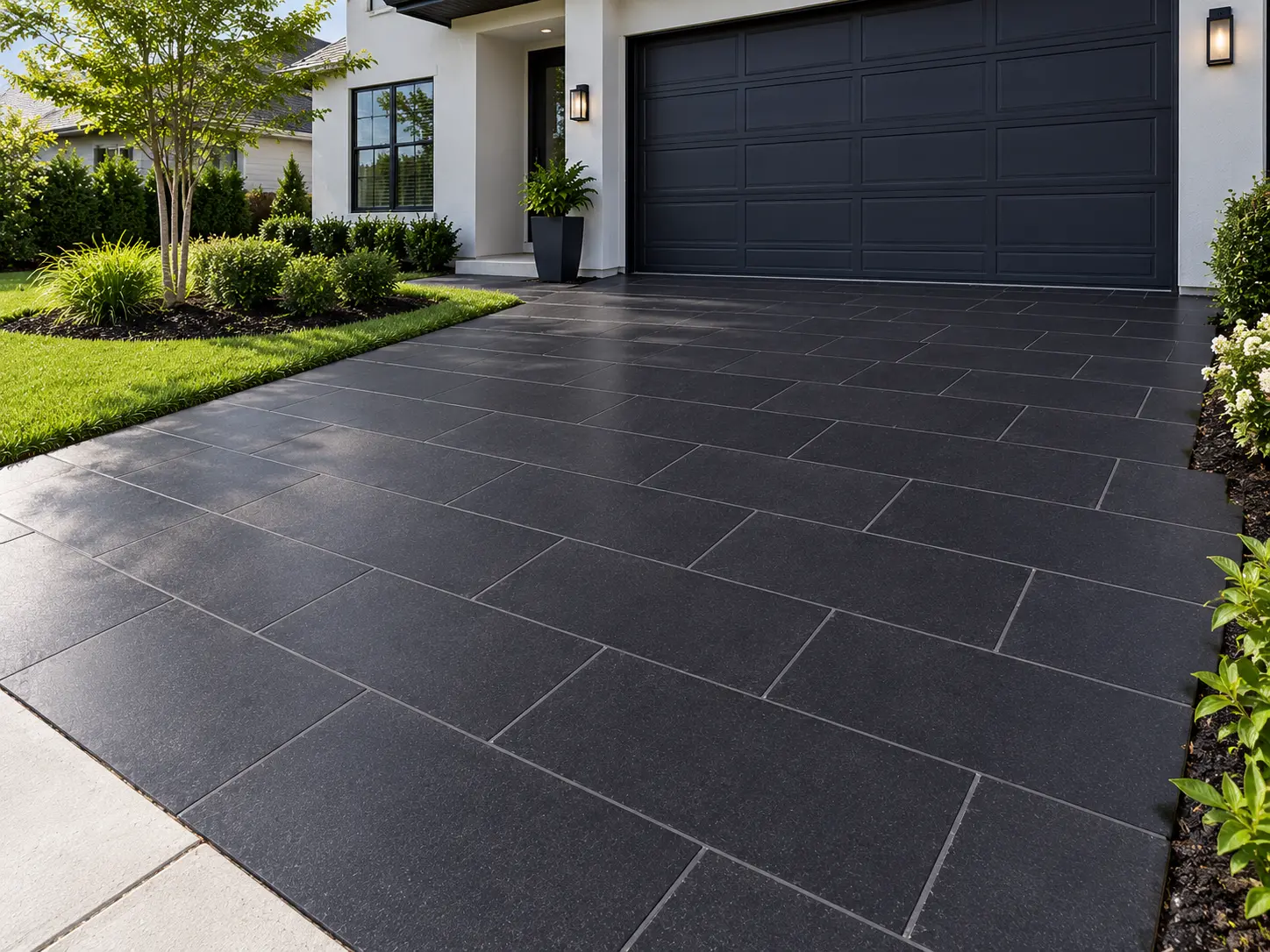
Basalt Cobblestone Size Options in Commercial Applications
Commercial specifications for basalt cobblestone size options differ from residential ones primarily in scale and load requirements, but also in the precision demanded of the setting-out. A residential courtyard can absorb minor pattern irregularities that a formal commercial plaza cannot. Commercial project managers typically specify a control drawing showing the exact face format, joint width and pattern repeat, then hold the installation against that drawing using string lines and a surveyor’s level.
The USGS dimension stone production data documents basalt’s consistent use in commercial and civic paving applications nationally, reflecting the material’s well-established performance over decades of service in high-traffic public environments. Its dense, fine-grained structure makes it highly resistant to abrasion under heavy foot traffic — a property that translates directly into reduced maintenance frequency over a long service life.
- Control drawings should specify nominal face size, depth, joint width and tolerance range before ordering begins
- Setting-out grids should be established before any material is bedded — adjusting a pattern mid-installation costs significantly more than getting it right from the first course
- Commercial projects with phased installation areas benefit from consistent batch ordering to minimise colour variation across phases
- Public plaza specifications often require a third-party test report — request this from your supplier at the specification stage, not at practical completion
Maintenance and Long-Term Performance by Size Format
Basalt’s low absorption rate means it doesn’t take on moisture the way more porous stone does — a property that simplifies maintenance considerably over a long service life. That said, joint material is the point where most cobbled surfaces develop maintenance requirements over time. Sand-bedded installations will need periodic joint refilling after the first wet season as the fine aggregate settles; this is normal and expected, not a sign of installation failure. Mortar-jointed installations are more stable but require inspection for crack propagation, particularly at section changes or where point loading is concentrated.
Sealing is not mandatory for basalt cobblestones, but it can extend the service life of the joint material and simplify routine cleaning. Where you do seal, follow the interval your sealer manufacturer states — not a generic industry rule of thumb. The sealer’s performance depends on the product chemistry and the specific finish you’ve specified, so manufacturer guidance takes precedence over generic advice.
- Sand-bedded surfaces: expect to refill joints once after the first season, then periodically as needed depending on traffic intensity
- Mortar-jointed surfaces: inspect joint faces annually and repoint any failed sections before water ingress causes bedding disturbance
- Sealing: apply to the sealer manufacturer’s schedule, not a calendar-year assumption — check the product data sheet
- Cleaning: avoid high-pressure washing over sand-bedded joints, which displaces the bedding material and creates settlement voids beneath individual units
Getting Basalt Cobblestone Sizes Right
Specifying basalt cobblestone sizes correctly is an exercise that runs from the base up — face dimensions, depth, finish and pattern are all interdependent, and the base preparation has to be designed for the depth and application, not generalised from a similar project. The material itself is highly resistant to the wear, moisture and weathering that compromise lighter stone, but it performs that way only when the structural specification beneath it matches the demands of the use. Work through depth requirements, pattern constraints and finish selection together before finalising your order, and confirm your installation timing around the setting material’s temperature window, not just around a construction schedule.
As you plan complementary elements of your outdoor space, basalt works beyond paving surfaces too — basalt raised garden bed construction explores how the same material performs in a structural garden context. Citadel Stone basalt cobbles are cut to order at our selected quarries in the Middle East, to the face size and depth your layout calls for.
Related reading: stony basalt · smooth stone blocks.