

Smooth basalt stone blocks reward specifiers who read past the surface description. The honed or sawn face that defines this material is a function of how the stone is cut, not just how it’s finished — and the cut direction relative to basalt’s columnar structure affects both visual uniformity and long-term dimensional stability. You’ll get the most out of your specification when you understand the relationship between finish, structure, and the conditions the blocks will actually face on site.
What Makes Basalt Different From Other Paving Stone
Basalt is a fine-grained volcanic rock formed from rapidly cooled lava. That quick cooling history produces a dense, low-absorption matrix that sets it apart from sedimentary alternatives like limestone or sandstone. According to USGS basalt volcanic rock properties and composition, basalt’s mineralogy — dominated by pyroxene and plagioclase feldspar — contributes to its consistently high density and tight pore structure. In practice, that means the material is highly resistant to water ingress and performs well in wet or exposed environments where more porous stones would need more aggressive sealing regimes.
The dark, near-black coloration of most commercial basalt is another functional characteristic, not merely an aesthetic one. Thermal mass builds quickly in full sun on dark paving, which is worth factoring into your design when smooth stone blocks are specified for seating areas or pedestrian surfaces at low to mid elevations. On hillside or elevated installations, where wind exposure moderates surface temperature, this becomes less of a concern — but on flat, sheltered sites the heat load matters for comfort.
You’ll also notice that basalt tends to cleave cleanly. That characteristic makes it well-suited to precise machine cutting, which is exactly how smooth basalt stone blocks achieve their crisp, refined faces without surface pitting or edge chipping that can occur in more crystalline stone types.
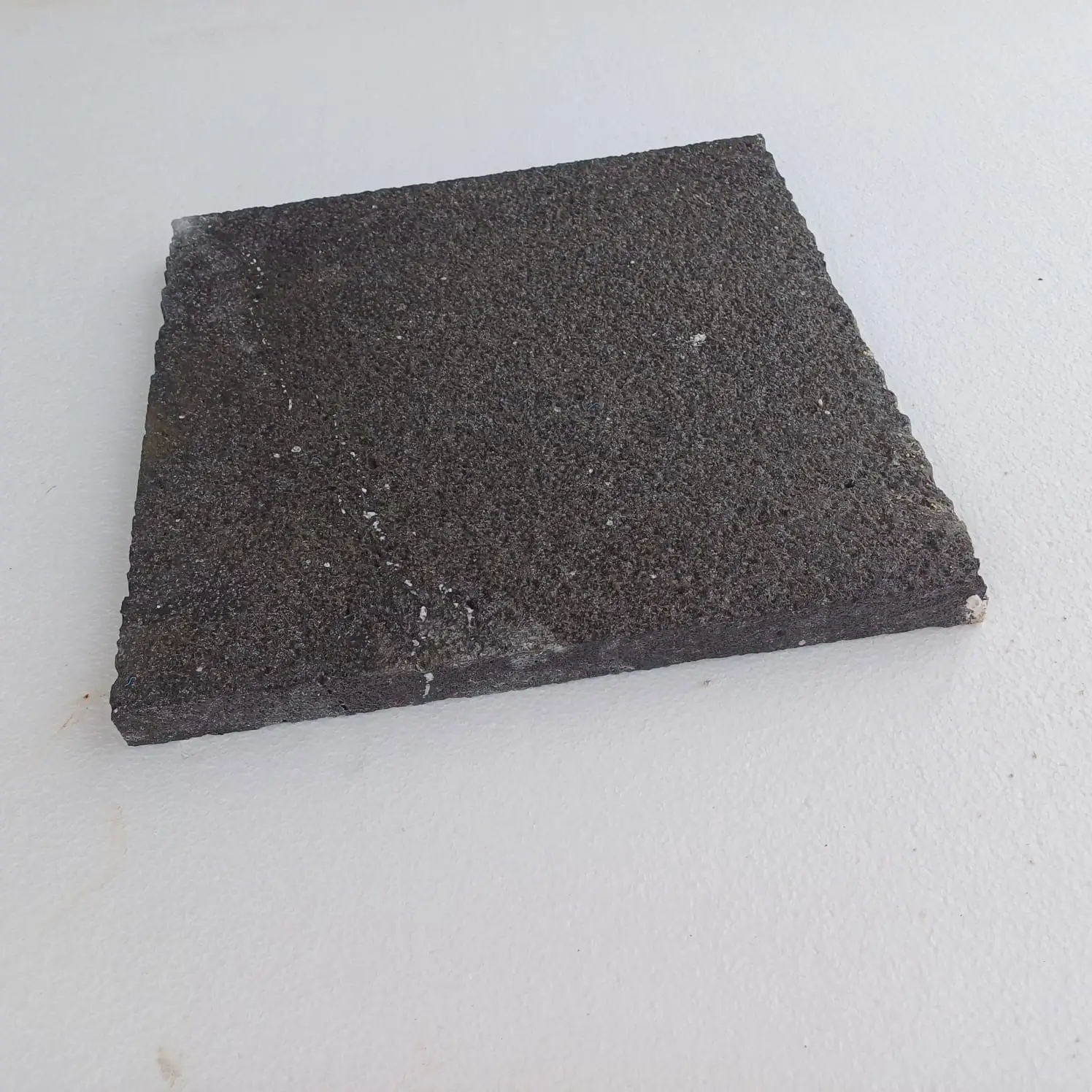
Finish Types and What They Mean in Specification
The term “smooth” in smooth basalt stone blocks covers a range of manufactured finishes, and your specification needs to name the right one for your application. Honed, sawn, and machine-polished are the three finishes you’ll encounter most often — and they differ in both texture and maintenance demand.
- A sawn finish is the baseline: flat, matte, and produced directly by the saw blade. The surface is smooth to the touch but retains a fine directional tooling line that gives it a subtle texture under raking light.
- A honed finish goes one step further — the surface is ground to a consistent matte flatness without the directional lines. This is the most common specification for interior flooring and exterior feature paving.
- A polished finish brings up the reflective quality of the basalt’s mineral content. It requires more maintenance in exterior use and is best reserved for interior applications or protected covered surfaces.
Slip resistance is a material performance property you should evaluate carefully for any smooth finish on a wet or exposed surface. The relevant test standard is ANSI A326.3, measured wet — the finish is the primary variable that affects the outcome, and test reports are available on request. Never rely on a dry measurement to assess a surface that will be wet in service; it is a fundamentally different result.
Smooth stone blocks in exterior contexts generally call for either sawn or honed surface preparation. Polished finishes suit internal corridors, lobbies, and covered terraces where the visual payoff justifies the additional sealing and cleaning discipline.
Block Dimensions and Thickness Selection
Thickness selection for smooth basalt stone blocks is driven by point load, span, and substrate type — not by aesthetic preference. A nominal dimension in the specification drawings should be confirmed against the intended bedding method and the application’s load demands before ordering.
- Pedestrian paving on a compacted aggregate base: thinner nominal profiles are workable, provided the base is correctly prepared to the full depth the material requires.
- Vehicular or semi-vehicular surfaces: a heavier nominal thickness is standard practice. Request the relevant load-bearing data from the test report.
- Cladding, edging, and vertical applications: thinner formats are appropriate, and the adhesive or mortar system specification takes over as the primary structural element.
- Stepped treads or raised platforms: thickness and cantilever geometry interact — the structural engineer’s specification governs, not the stone supplier’s nominal range.
You should also consider the quarry’s cut-to-order capability when specifying non-standard dimensions. Citadel Stone cuts basalt blocks to order at our selected quarries, which means your project dimensions don’t have to conform to a fixed stock size. That flexibility matters on bespoke installations where standard modular formats create awkward cuts at perimeter conditions.
Base Preparation for Different Site Conditions
Here’s what most specifiers underestimate: the base preparation for smooth basalt stone blocks is where most field failures originate. The stone itself is rarely the problem. A well-prepared base holds the installation together through soil movement, freeze-thaw cycling, and drainage stress — a poorly prepared one leads to differential settlement, joint widening, and cracked blocks well before the stone itself shows any wear.
For level or near-level sites, a compacted granular sub-base with a consistent depth profile is the standard approach. The depth depends on soil type and anticipated loads — clay-heavy soils require deeper treatment than free-draining sandy profiles because clay’s volume change under saturation and drying cycles exerts significant upward and lateral pressure on your paving slab layer.
Terrain and elevation introduce additional engineering demands. On sloped or hillside sites, drainage design is the dominant concern — not just for surface runoff, but for subsurface water management. Retained water behind a paved slope, or water tracking along the underside of a slab layer on a gradient, generates hydrostatic pressure that destabilises the base over time. You’ll need to specify permeable sub-base layers, drainage channels, or both, depending on the site’s hydrology. Grade management on these installations requires a site-specific drainage plan, and the base preparation depth and material specification should be confirmed by a structural or civil engineer familiar with the soil conditions on that specific plot.
Flat, low-lying sites present a different version of the same problem. Without positive drainage away from the installation, standing water undermines the base by saturating the sub-grade. Specifying a slight fall — even a shallow one — into a collection point or drainage channel resolves this, but it has to be built into the finished surface geometry from the start, not corrected afterward.
Sourcing and What to Confirm Before Ordering
Smooth basalt stone blocks vary in quality by quarry. The consistency of the volcanic deposit determines how uniform the colour, density, and surface finish will be across a full project order. A block set from a consistent basalt flow presents a uniform, near-black appearance across the installation. Material from a mixed or transitional deposit may show variation in tone — occasional lighter or greener-tinted blocks — that becomes visible once the project is laid.
At Citadel Stone, we source from selected quarries in the Middle East where the basalt flows deliver consistent colour and density. That sourcing specificity is what allows us to match large project orders without noticeable batch variation — something worth asking any supplier about before you commit to a volume order for a feature installation. As Britannica’s basalt volcanic rock formation reference notes, the mineralogy of basalt varies by eruption source, which is why quarry selection — not just stone type — determines the finished appearance on site.
For related block formats in basalt, including rougher-textured alternatives that suit different surface and drainage requirements, Basalt Cobbles offer a useful comparison point — particularly where a more textured surface profile is specified alongside smooth stone blocks in the same project.
Sealing and Maintenance Protocols
Basalt’s low absorption rate is a genuine performance advantage — but it doesn’t eliminate the need for sealing in most exterior applications. Surface contamination, particularly from iron-rich water, organic matter, or efflorescence migrating from mortar joints, can stain a smooth honed surface and is significantly harder to remove once it penetrates the pore structure, however tight that structure is.
- Apply a penetrating impregnating sealer rated for dense igneous stone — not a surface-film product, which will peel and discolour under UV and thermal cycling.
- Follow the sealer manufacturer’s stated reapplication interval. At Citadel Stone, our technical guidance is to check the sealer’s performance annually on exterior applications and reseal on the interval the sealer manufacturer states.
- Joint maintenance matters as much as surface sealing. Mortar or resin joints should be inspected after the first full seasonal cycle and any shrinkage or cracking treated before water tracks into the sub-base.
- For polished interior basalt, a maintenance program using pH-neutral cleaners prevents the micro-etching that dulls the finish over time — standard acidic cleaning products will damage the surface.
The Natural Stone Institute provides guidance on igneous stone paving maintenance; their natural stone variety selection and maintenance data is worth reviewing when finalising your sealing specification for smooth basalt applications.
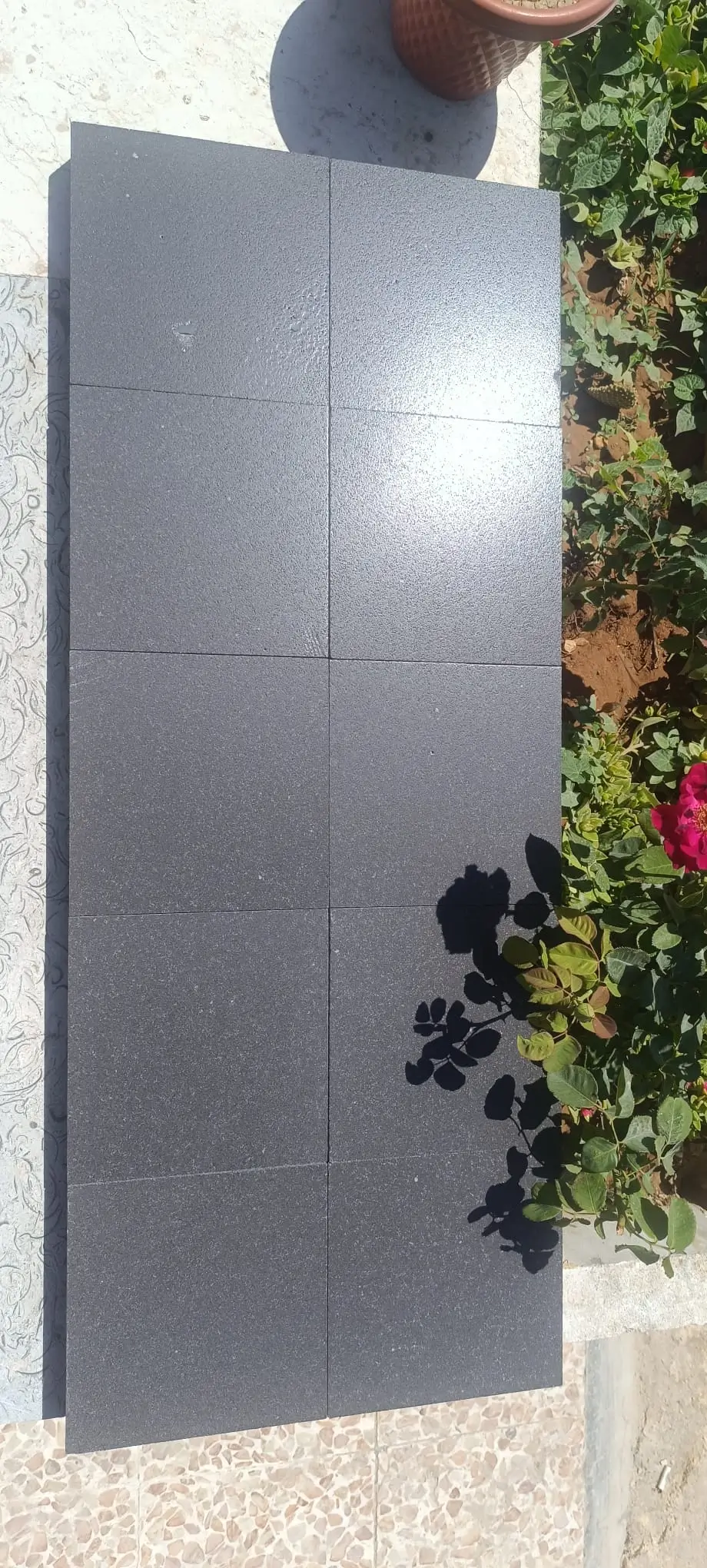
Applications Where Smooth Basalt Blocks Perform Well
Your material selection is only as good as the match between finish and application. Smooth basalt stone blocks suit a specific set of project types particularly well — and being clear about those boundaries saves you from a specification that looks right on paper but underperforms in service.
- Feature paving in covered or semi-covered outdoor spaces: the smooth face reads well visually, thermal build-up is moderated by shade, and the controlled environment reduces the maintenance demand compared to a fully exposed installation.
- Interior flooring in commercial and residential applications: the honed finish handles foot traffic well, and basalt’s density makes it highly resistant to surface abrasion in high-use corridors and lobbies.
- Seating walls and raised planters: smooth-faced block units at vertical or angled faces present a clean, contemporary finish that complements landscaping without competing with planting.
- Pool surrounds and water features, specified with appropriate finish and sealing: the material’s low porosity makes it a practical choice for wet environments, with slip resistance evaluated through ANSI A326.3 wet testing — request the test report before finalising your pool deck specification.
- Edging and border applications: smooth blocks as a banding element alongside rougher-textured field paving is a common and effective design move, giving visual definition without a material change.
The smooth basalt stone blocks format is also well-suited to coping applications on raised structures — the clean top face and controlled edge geometry read as precise and intentional in architectural detail drawings, and they hold up well when the coping is exposed to weather at the top of a retaining structure or raised terrace.
Ordering, Logistics, and Lead-Time Planning
Lead times for cut-to-order smooth basalt stone blocks are quoted with the order — never assumed. Your project programme should build in the quarry production time plus the shipping window, and your site team should plan for confirmation of access and offloading arrangements well before the delivery date is set.
Delivery of basalt block orders typically involves palletised loads on flatbed transport. Your site access conditions — gate widths, overhead clearance, turning radius, and proximity to the working area — affect how the offloading is managed. Flagging a tight or restricted access route at the order stage avoids delays when the delivery arrives. On hillside or elevated sites with restricted access roads, this planning step is particularly important: a delivery scheduled to a site where vehicle turning is impossible creates a genuine programme problem that’s easy to avoid with early communication.
For phased projects or staged installations, confirm at the order stage whether the quarry can hold stock to match your programme. Material from a single production run ensures colour batch consistency across phases — something that matters significantly on a smooth, honed surface where tonal variation between phases is immediately visible.
Getting Your Smooth Basalt Stone Block Specification Right
Your smooth basalt stone block specification comes together from four converging decisions: the right finish for the application’s wet and dry exposure conditions; a thickness and dimension appropriate to the loads and substrate; a base preparation and drainage design matched to the site’s actual terrain and hydrology; and a sealing and maintenance protocol you can realistically sustain through the installation’s service life. Getting any one of these wrong puts pressure on the others — but when all four are aligned, basalt is a material that delivers decades of service life with consistent appearance and minimal remedial work.
For projects that benefit from texture contrast or where a rougher surface profile is specified alongside smooth block sections, exploring how different basalt textures behave in practice is a worthwhile step before you finalise the design. The stony basalt texture and finish comparison covers how surface profile choices affect both aesthetics and performance across basalt applications. Smooth-faced basalt from Citadel Stone suits edging, seating walls, and low-traffic surfaces where a refined finish matters more than the grip of a rough-split sett.