

Basalt mosaic tile ideas tend to look straightforward on a mood board, but the real specification work begins when you reconcile format, finish, and substrate in a single coherent design. The material itself — a dense, fine-grained volcanic rock — gives you a surface that holds detail well at small scale, which is exactly what mosaic formats demand. Understanding how basalt’s mineralogy shapes its behavior in wet areas will sharpen every decision you make from here.
Why Basalt Works in Mosaic Format
Basalt’s crystalline structure is remarkably uniform at small tile sizes. Where a large-format slab can reveal veining inconsistencies across its face, a mosaic sheet keeps each individual piece compact enough that the stone reads as a coherent field of color and texture rather than a series of individual tiles. The result is a surface with a quiet, almost monolithic visual weight — something that’s genuinely difficult to replicate with manufactured porcelain at the same price point.
According to USGS basalt volcanic rock properties, basalt forms from rapidly cooling lava, which produces its characteristically tight grain and low porosity relative to sedimentary alternatives. That density is what makes basalt mosaic tiles perform consistently across the face of a mosaic sheet — you’re not fighting variable absorption from piece to piece, which simplifies sealing and maintenance significantly.
Shower Applications for Basalt Mosaic Tile
Basalt mosaic tile ideas for shower floors consistently outperform large-format alternatives in one critical respect: the grout joint network. More joints per square foot means more mechanical interruption across the walking surface — a practical consideration in wet-area design that goes beyond aesthetics. Pair that with a honed or brushed finish rather than polished, and you’re selecting a surface texture that remains functional through prolonged exposure to water.
Your waterproofing membrane selection matters here as much as the tile itself. Small-format mosaic sheets introduce more grout joints, and any movement in the substrate telegraphs directly into those joints. Specify a membrane that accommodates the deflection your floor system will see — a crack-isolation membrane rated for the substrate type is the minimum standard. The tile choice and the substrate system must be specified together, not independently.
- Honed basalt mosaic on shower floors presents an open, matte texture that differs visibly from a polished face — factor finish into your specification before ordering
- Brushed finishes on basalt leave a slightly directional surface feel, which many designers prefer for wall applications alongside a honed floor
- Epoxy grout performs better than standard cement grout in shower niches where standing water contact is prolonged
- Sheet-mounted mosaics simplify installation alignment but require careful back-buttering to avoid voids beneath individual tesserae
Backsplash Design Ideas with Basalt Mosaic Tiles
The contrast game is where basalt mosaic tiles earn their place in kitchen and bathroom backsplash design. The stone’s naturally dark tones — ranging from deep charcoal to warm grey, and occasionally carrying a cool undertone that reads close to a purple floor tile in certain lighting conditions — sit against white cabinetry and light countertops with an authority that painted subway tile simply can’t match. You’re working with a material that has genuine geological character, not a manufactured approximation of it.
Consider the joint pattern as a design variable, not just a technical detail. A stacked horizontal layout on a backsplash reads very differently from a herringbone or offset pattern. The same basalt mosaic tile specification can shift from a calm, linear background to an active surface depending on how the sheets are oriented during installation. Spend time with paper mock-ups before the tile goes on the wall.
- Stacked patterns emphasize the horizontal field and work well behind open shelving where visual continuity matters
- Herringbone orientation adds movement to a backsplash and draws attention to the format — appropriate where the tile is a focal element
- Linear penny-round sheets in basalt create a softer edge profile than rectangular formats and suit more transitional interiors
- Mixing basalt mosaic tile with a larger field tile of the same material creates depth without introducing a second stone species
Outdoor and Pool Area Applications
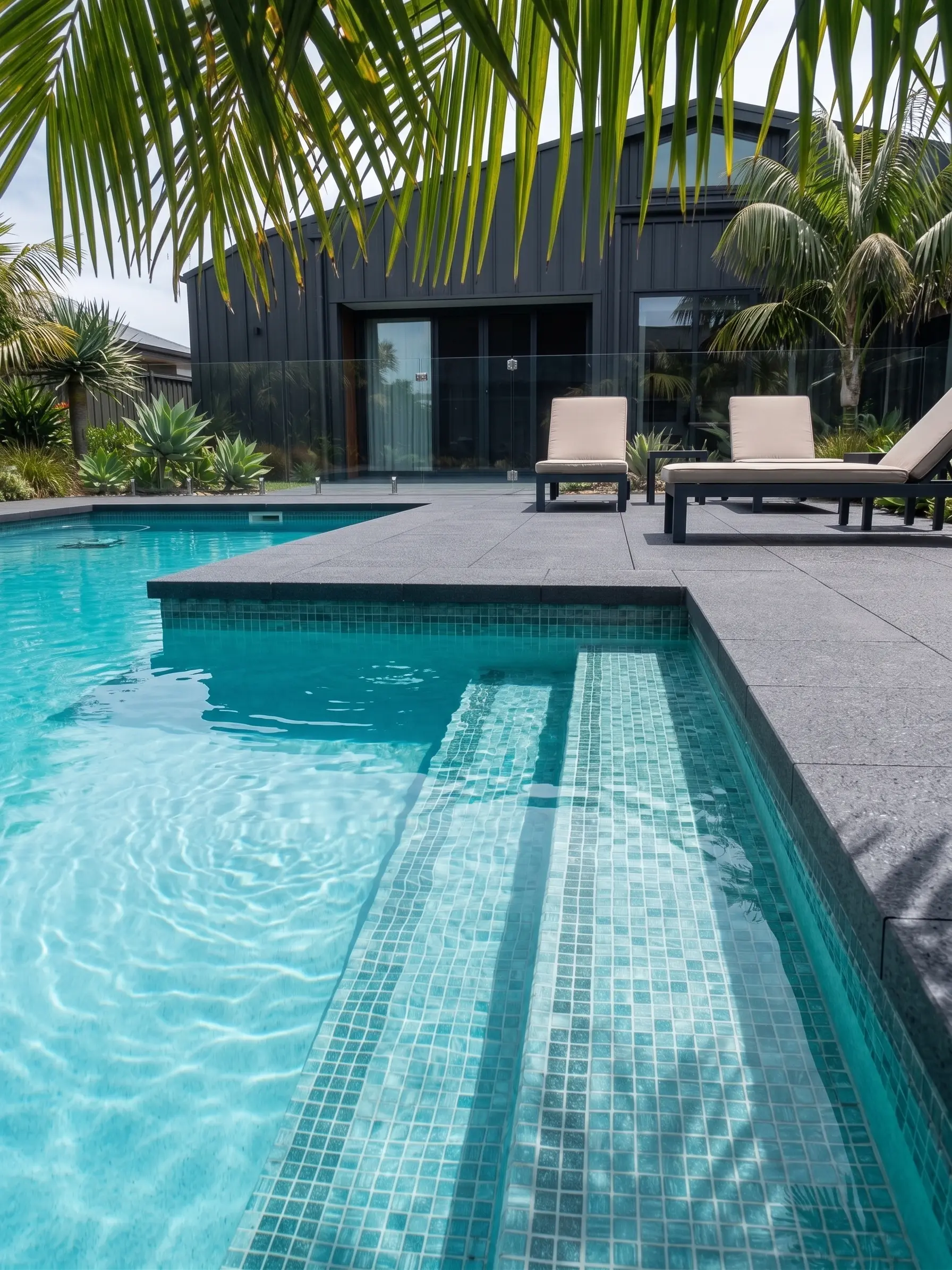
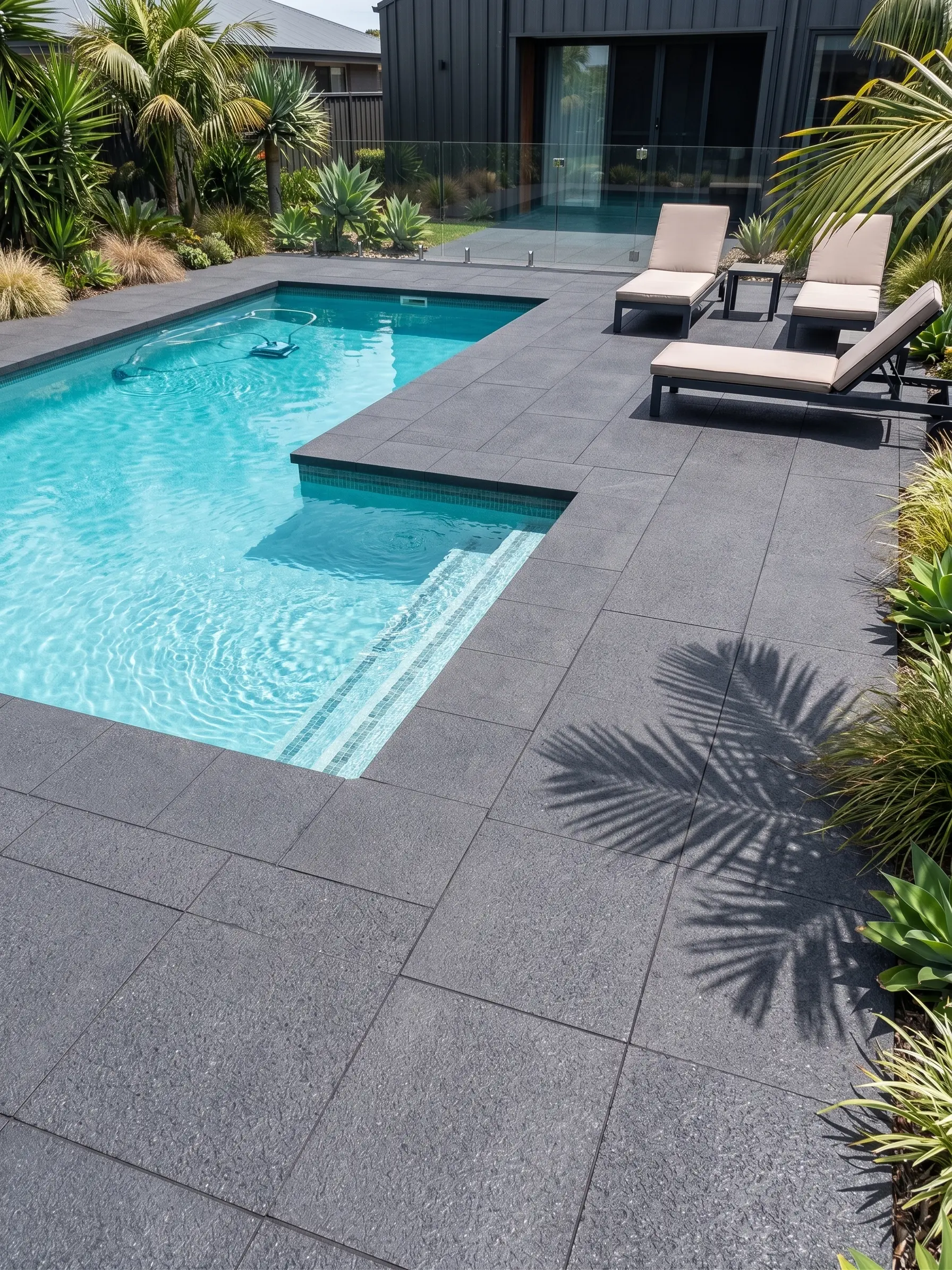
Basalt mosaic tile ideas extend naturally to outdoor wet areas — pool surrounds, outdoor showers, and feature walls adjacent to water features. The material’s volcanic origin gives it a thermal stability that suits environments where temperature swings between day and night are significant. The elemental basalt composition — high in calcium, magnesium, and iron silicates — is what underpins these performance characteristics and distinguishes it from sedimentary alternatives in exposed conditions.
For pool surrounds specifically, you’ll need to confirm the tile’s freeze-thaw behavior with a test report from your supplier if the installation is in a region where ground temperatures cycle below freezing. Basalt’s density works in its favor here, but the grout specification and drainage design are equally important variables. Water that cannot escape a mosaic sheet assembly will expand on freezing and work the joints apart over successive winters.
Explore our basalt wall tile collection to see how different finishes and sheet formats translate across both indoor and outdoor applications — the range covers the formats most commonly specified in wet-area projects.
Finish Selection and What It Means in Practice
The finish you select for basalt mosaic tiles affects texture, light reflectance, and maintenance interval in equal measure. A polished finish amplifies the stone’s dark color and gives the surface a mirror quality that reads as dramatic in low-light settings. It’s a legitimate choice for dry wall applications, but it demands more frequent cleaning in kitchen backsplash contexts where grease and steam are present.
A honed finish strikes the practical middle ground for most wet-area applications. The surface is smooth without being reflective, which keeps the installation looking intentional rather than tired as it accumulates the minor marks that come with use. Brushed or tumbled finishes open the surface texture further, which affects both the visual feel and the sealing interval — a more open texture requires more frequent resealing to maintain the stone’s original appearance. Where designers are element basalt co-ordinating across a larger project palette, the honed finish offers the most neutral baseline for pairing with complementary materials.
- Polished basalt: highest visual impact, best suited to dry walls and feature panels
- Honed basalt: versatile, widely specified for shower walls and kitchen backsplashes
- Brushed basalt: directional surface texture, popular for exterior feature walls and pool surrounds
- Tumbled basalt: aged appearance with an irregular edge profile, used where a softer aesthetic is the goal
Budgeting for Basalt Mosaic Tile Projects
Project cost for basalt mosaic tiles is shaped by more variables than the tile price alone. Freight distance from the point of supply is a meaningful factor — natural stone is heavy, and the cost per pallet increases proportionally with delivery distance. Ordering in a single consolidated shipment rather than in stages reduces the per-unit freight burden and also reduces the risk of dye-lot variation between batches.
Labor-to-material cost ratios shift significantly with mosaic formats. Setting a small-format mosaic sheet takes more time per square foot than installing a large-format tile, and the grout labor compounds that. In markets where skilled tile setter rates are elevated, the labor component of a basalt mosaic installation can exceed the material cost. Factor that ratio into your budget before committing to a format, especially on large-scale projects where a modest increase in setting time per sheet accumulates to a significant schedule and cost impact.
- Consolidate your full order — basalt mosaic tiles cut to order at our selected quarries are confirmed and dispatched as a single shipment where possible
- Delivery lead times and freight costs are quoted with the order — confirm these before finalizing your project schedule
- Tile setter labor for mosaic formats runs higher per square foot than for large-format work — price both before selecting the format
- Grout and setting material quantities increase with smaller tile formats — include these in your materials budget
Installation Details That Determine Long-Term Performance
The tile selection is only part of the specification — what sits beneath the mosaic sheet determines whether the installation holds up across years of thermal movement and use. A fully supported mortar bed with no voids beneath individual pieces is the baseline requirement. Back-butter each sheet in addition to applying adhesive to the substrate, particularly in wet-area applications where any hollow behind a tile becomes a point of water ingress.
The TCNA natural stone tile installation standards provide the reference framework for setting material selection, coverage requirements, and joint sizing for natural stone mosaics. These standards exist precisely because natural stone behaves differently from ceramic and porcelain — the setting system must account for the stone’s specific absorption characteristics and thermal expansion behavior.
- Full mortar bed contact is non-negotiable for shower floor mosaics — any void becomes a failure point under foot traffic
- Allow the setting material to reach full cure before grouting — rushing this step is the most common cause of early grout failure in basalt mosaic work
- Joint width should be consistent across the sheet — use properly sized spacers if the mesh backing doesn’t hold the spacing under the weight of the adhesive
- Seal basalt mosaic tiles before grouting to prevent grout haze from penetrating the stone face — this step is easy to skip and costly to correct after the fact
Sealing and Ongoing Maintenance
Sealing basalt mosaic tiles is a non-optional step, not a finishing touch. The stone’s absorption characteristics — while lower than most sedimentary alternatives — still allow surface staining from grease, soap scum, and minerals in hard water if the surface is left unsealed. Apply a penetrating impregnator sealer before grouting to protect the face, then reseal on the interval your sealer manufacturer specifies for the finish and exposure level of your installation.
Your maintenance routine should account for the grout joints as much as the tile face. In shower applications, grout is often the first element to show wear — mineral deposits from hard water accumulate in the joints and are easier to prevent than to remove. A pH-neutral cleaner used consistently is far less damaging than periodic aggressive cleaning with acid-based products, which can affect the sealer and, over time, the stone face itself. At Citadel Stone, we recommend confirming the sealer compatibility with your specific basalt finish before the first application, as brushed and tumbled faces absorb sealers differently than honed surfaces.
Specifying Basalt Mosaic Tiles with Confidence
Getting basalt mosaic tile ideas off the mood board and into a finished specification comes down to treating finish, format, substrate, and setting system as a single integrated decision rather than four separate ones. The material rewards careful specification — its density and tonal consistency deliver a result that holds its character across years of use in demanding wet-area environments. The Natural Stone Institute’s igneous stone technical guidance is worth reviewing alongside your supplier’s test documentation to confirm the specific product’s performance parameters before the project goes to tender.
When coordinating across a broader material palette, designers sometimes compare basalt against options like a purple floor tile or other dark-toned stones — basalt’s consistent mineralogy and tight grain make it a reliable anchor in those comparisons. As you refine your specification, understanding how basalt’s internal structure influences surface behavior at a tile level is genuinely useful background — how basalt rock types affect tile performance covers the structural variables that distinguish one basalt source from another. The additional grout lines in small-format layouts are a practical slip-resistance advantage that Citadel Stone’s basalt mosaic tile range is well suited to exploit in wet-area applications.
Related reading: choosing grey basalt tile · cast basalt tiles.