

Cast basalt vs natural basalt tiles is a comparison that trips up even experienced specifiers — not because the materials look different, but because they achieve their performance through entirely different mechanisms. Natural basalt is a volcanic igneous rock cut directly from quarried stone, while cast basalt is produced by melting basalt aggregate and casting it into molds, then annealing it slowly to relieve internal stress. That distinction shapes everything downstream: how the material wears, how it behaves under point loads, how it responds to moisture cycles, and where each belongs in a serious specification.
What Sets Cast Basalt Apart from Natural Basalt Tiles
Natural basalt tiles originate as extruded volcanic rock — rapid surface cooling creates an extremely fine-grained, dense matrix that geologists describe as aphanitic. The mineralogy is dominated by plagioclase feldspar, pyroxene, and olivine, with minimal visible crystal structure. That tight matrix is what gives natural basalt its characteristic density and low absorption rate, both of which you should confirm from the supplier’s test report before finalizing any specification.
Cast basalt takes a different route. Raw basalt is melted at temperatures exceeding 1,200 °C, poured into purpose-built molds, then passed through a carefully controlled annealing oven. The slow cooling cycle allows a crystalline structure — primarily pyroxene — to develop throughout the material. This is the step that most distinguishes cast from natural: the recrystallization produces a material with an internal structure engineered specifically for abrasion resistance, which is why you find it lining chutes, hoppers, and industrial channels rather than residential terraces.
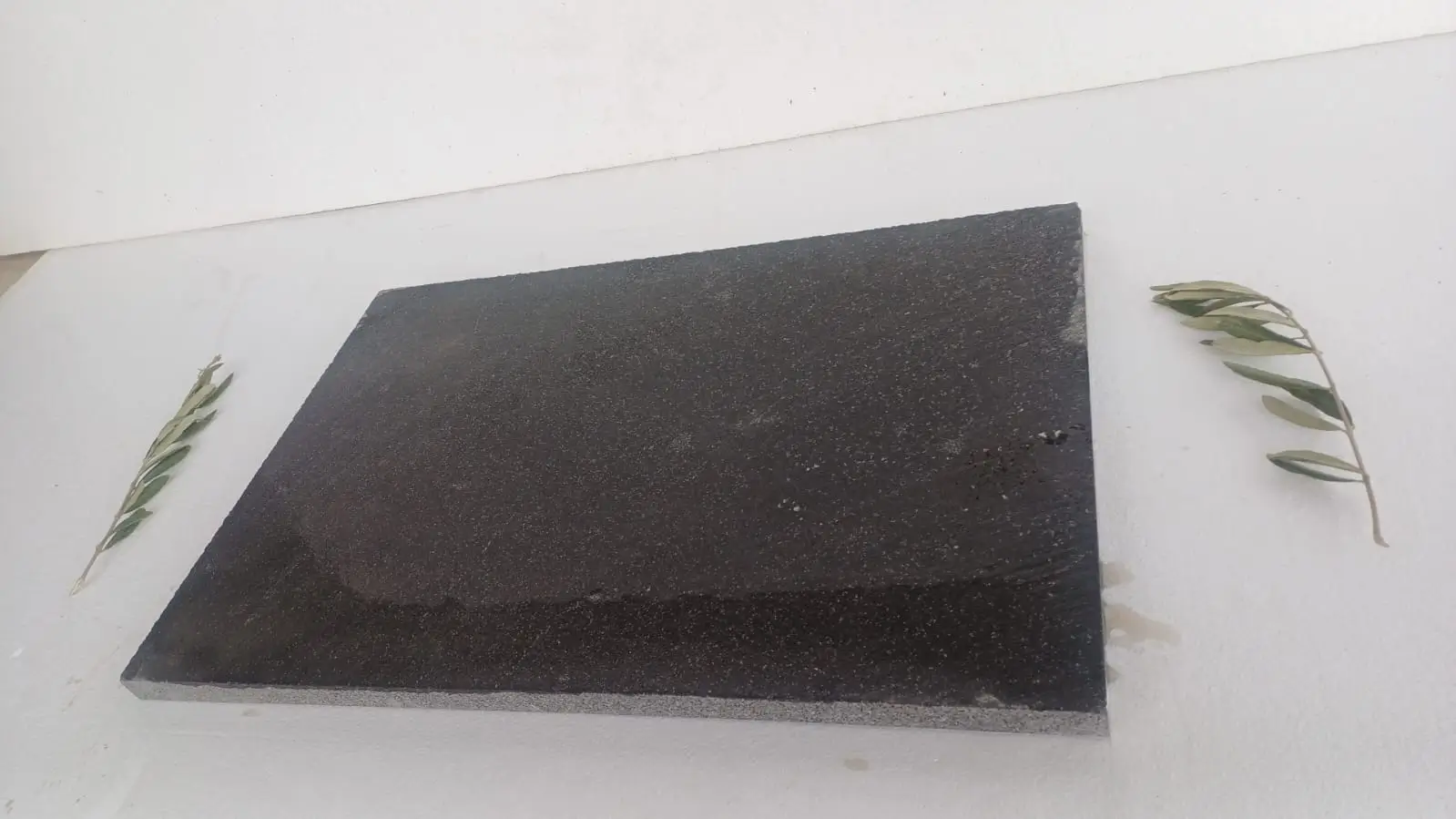
Surface Finish, Texture, and What That Means for Your Project
Your choice of finish is rarely trivial with basalt — it changes the material’s visual character, maintenance demands, and how water interacts with the surface. For cast basalt vs natural basalt tiles, the finish options diverge considerably between the two types.
- Natural basalt tiles are available in honed, sawn, brushed, flamed, and tumbled finishes — each leaving a different surface texture and open-pore profile that affects how quickly the material dries after rain
- Cast basalt products typically leave the mold with a smooth, near-glassy face that reflects the internal crystalline structure; the finish is a product of the casting process itself rather than post-production machining
- A honed natural basalt leaves an open, matte texture that responds differently to wet conditions than the denser, smoother cast surface
- A flamed finish on natural basalt thermally opens the surface grain, creating a coarser texture that reads and behaves very differently from any cast equivalent
- Brushed natural basalt tiles develop a textured but consistent surface that channels standing water more readily than a polished face
The surface finish question connects directly to the relevant slip standard — ANSI A326.3, which is measured wet. The finish is the primary variable that determines how the surface performs in wet conditions, and the test report from that standard is available on request through your supplier. Never substitute a dry result for a wet-condition requirement: the two do not correlate reliably for stone surfaces.
Abrasion and Wear Performance: Where Each Basalt Type Belongs
The abrasion resistance of cast basalt is the main reason it dominates industrial applications. During the annealing process, the recrystallized microstructure develops a hardness profile that natural basalt — even dense, fine-grained natural basalt — cannot match by its geology alone. This is why you find cast basalt in cement plant chutes, mining transfer points, and chemical processing channels: environments where loose particulate abrasion would destroy most other materials quickly.
According to USGS data on basalt volcanic rock properties, natural basalt is itself a dense and durable igneous rock — but its abrasion characteristics reflect its natural formation rather than any engineered post-processing. For architectural paving, flooring, and cladding, that natural performance profile is entirely appropriate. The abrasion demands on a commercial floor tile or an outdoor paving surface are categorically different from those in a bulk-material handling facility.
Your specification should match the wear mechanism to the correct material. Cast basalt for sliding particulate abrasion; natural basalt tiles for pedestrian and vehicle traffic in architectural applications.
Dimensional Precision and Format: Cast vs Cut Stone
Cast basalt and natural basalt tiles diverge sharply in how they are produced to size — and that divergence has real consequences for installation planning.
- Cast basalt is produced to net shape in the mold; dimensional tolerances are determined by the mold tooling and the casting process, not by sawing or grinding
- Natural basalt tiles are cut and calibrated from quarried slabs, allowing a wider range of formats, thicknesses, and edge profiles than casting allows
- Cast basalt shapes are largely standardized around industrial pipe liners, blocks, and channel sections — irregular formats are expensive to tool
- Natural basalt tiles can be cut to order for specific project formats, including large-format slabs, custom stair treads, and coping profiles
- The color consistency of cast basalt tends to be uniform within a production batch; natural basalt carries natural tonal variation between slabs that experienced specifiers often regard as a design asset
At Citadel Stone, we stock natural basalt at our selected quarries and cut to the formats your project specifies — which is worth confirming early in the design process, since format directly affects setting-bed layout and joint widths.
Water Management, Drainage, and How Each Material Responds to Moisture
For outdoor paving applications, the way a material handles water is as important as how it handles foot traffic. Cast basalt vs natural basalt tiles behave differently in this respect, and your base design needs to account for whichever you specify.
Natural basalt has low porosity — lower than most sedimentary stones — but it does not fully resist moisture movement. In climates that experience heavy seasonal rainfall, freeze-thaw cycling, or extended saturation periods, the base preparation under natural basalt paving is the variable that separates long-service installations from premature failure. A compacted aggregate base with properly designed cross-falls and perimeter drainage allows surface water to escape quickly, which matters particularly in regions with monsoon-pattern rainfall where volume and intensity exceed what a flat substrate can shed without pooling.
- Natural basalt’s absorption rate is low relative to limestone or sandstone, but you should confirm the figure from an ASTM C97 test report before specifying it in areas subject to frequent saturation
- In freeze-thaw regions, base drainage controls heave risk more effectively than material porosity alone — even low-absorption stone will lift if hydrostatic pressure builds beneath it through freeze cycles
- Cast basalt’s near-zero porosity makes it particularly relevant in chemical processing environments where liquid containment matters, but this property is largely irrelevant for outdoor paving base design
- Drainage fall across outdoor natural basalt paving should be designed into the substrate and confirmed before setting — relying on joint gaps alone is insufficient in high-precipitation climates
- In drought-cycle regions where soils shrink and expand seasonally, movement joints in natural basalt paving need to be sized and spaced to your structural engineer’s calculation, not from a generic rule of thumb
The distinction matters most when a project site sits in a flood-risk zone or where storm drainage infrastructure is undersized. The material choice is secondary to the drainage design; both cast and natural basalt will perform well where water management is correctly engineered into the base.
Chemical Resistance and Thermal Behavior
Cast basalt’s industrial dominance traces largely to its chemical resistance. The recrystallized pyroxene matrix is highly resistant to weak acids, alkalis, and most industrial solvents — a property confirmed by the applications it serves in chemical plant flooring and liquid containment channels. This is a genuine performance advantage in industrial environments where chemical spillage is a routine hazard.
Natural basalt tiles, as the Britannica entry on basalt volcanic rock formation notes, share the same mineral base — but without the post-cast annealing that optimizes the microstructure for chemical contact. For architectural applications — commercial lobbies, retail floors, outdoor terraces — natural basalt’s inherent mineral density provides excellent service life without requiring the specialized treatment that industrial-grade cast material commands in price and availability. Specifiers evaluating elements basalt compositions will find that the underlying mineralogy of plagioclase and pyroxene is consistent across both cast and natural forms; what differs is how processing shapes those elements into a finished material.
Thermal expansion is a specification consideration for both basalt types. Natural basalt’s coefficient of thermal expansion is well-characterized by stone type, and you should request the ASTM C531 test report from your supplier to use the correct figure in your joint-spacing calculation. Designing expansion joints from the material’s actual test data — rather than from a printed rule — is the difference between joints that accommodate seasonal movement and joints that cause cracking within the first summer cycle.
Installation Differences Your Contractor Needs to Know
The installation requirements for cast basalt and natural basalt diverge significantly, and a contractor experienced with one type may need specific guidance before working with the other. Here is what the field experience behind both materials reveals.
- Cast basalt blocks and liner sections are heavy — the density that defines the material creates logistical challenges that must be planned into the delivery and handling schedule well before units reach the site
- Natural basalt tiles in standard paving formats are handled similarly to other dense stone tiles, but the material’s hardness means cutting tools wear faster than with softer stones — blade specification matters
- The adhesive or mortar system for natural basalt must be selected against the specific absorption characteristics confirmed in the test report; a mortar designed for high-absorption travertine will behave differently behind dense basalt
- Cast basalt joints in industrial linings are typically filled with chemical-resistant grout or cast epoxy — architectural tile grout systems are not the right specification here
- Natural basalt tiles respond to movement differently than cast sections: the tile format means movement is distributed across many joints, while large cast liner blocks concentrate movement at fewer points
- Setting-time management in hot climates matters: the open time of your adhesive narrows in high ambient temperatures, so you work to the adhesive manufacturer’s temperature window rather than to an assumed schedule
Cost, Availability, and Lead Time Considerations
The supply chain for cast basalt and natural basalt tiles operates through entirely different channels, and your project timeline needs to account for that from the outset.
Cast basalt is manufactured to order for industrial applications. Lead times reflect the production cycle of a specialist manufacturer, and standard architectural tile formats are not typically available from industrial cast basalt producers. The cost reflects the energy-intensive melting and annealing process, the mold tooling, and the specialized distribution channel it travels through to reach a construction site.
Natural basalt tiles move through the natural stone supply chain — quarried, cut to order, quality-checked, and arranged for export. For projects specifying Basalt Tiles for architectural or commercial applications, lead times are quoted with the order and confirmed before production begins. The Natural Stone Institute’s technical stone specifications provide a useful framework for confirming which test reports to request from your supplier as part of the procurement process.
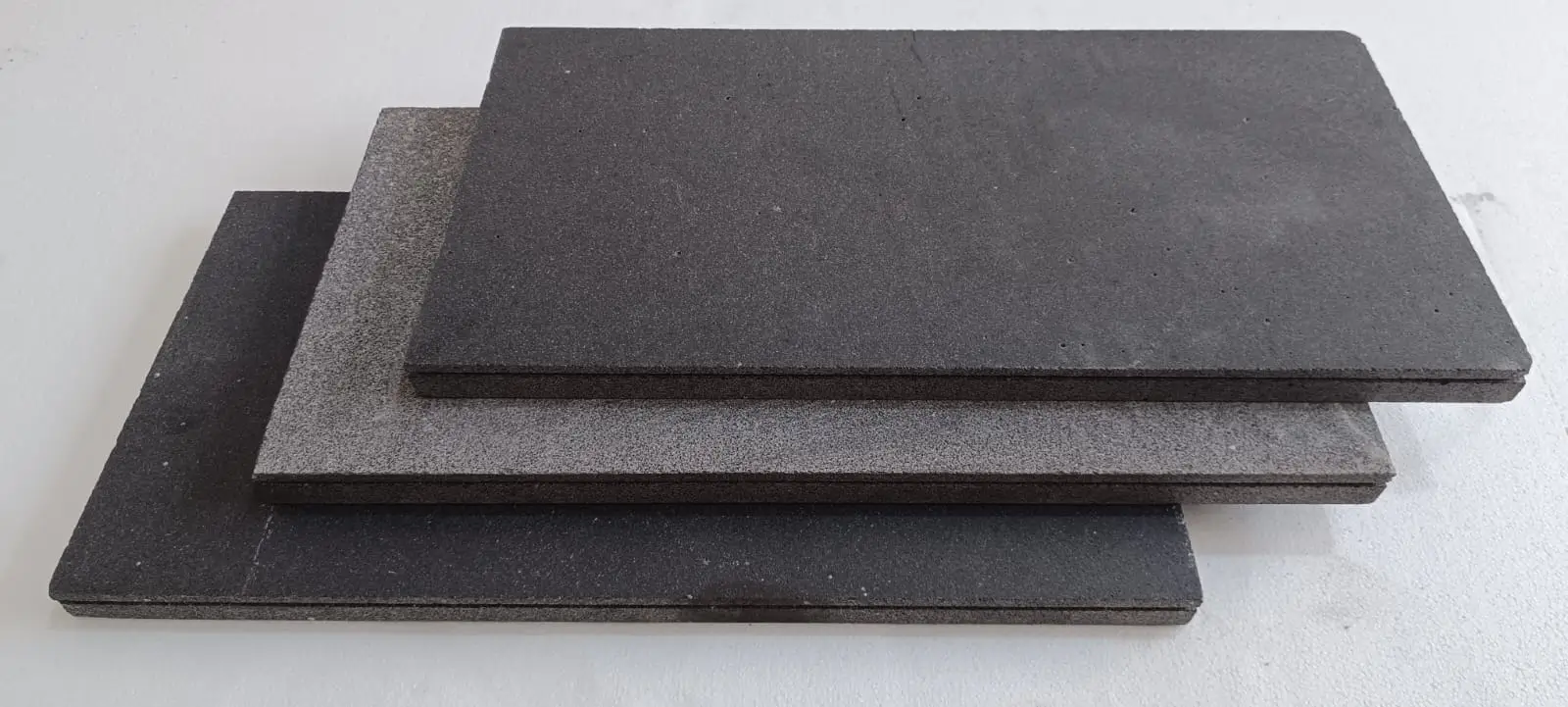
Specification Checklist: Matching the Right Basalt to Your Project
Before committing to either material, run your project through these decision points. The answers direct you to the correct specification without ambiguity.
- Is the application industrial — bulk material handling, chemical containment, high-abrasion machinery surrounds? Cast basalt is the category to evaluate
- Is the application architectural — commercial flooring, exterior paving, cladding, pool surrounds, stair treads? Natural basalt tiles are the appropriate specification path
- Do you need cut-to-order formats, custom dimensions, or a specific edge profile? Natural basalt cut-to-order production accommodates this; standard cast basalt does not
- Is chemical resistance to aggressive industrial compounds a primary performance requirement? Request the chemical resistance data for cast basalt from the manufacturer’s test report
- Is water management and drainage design part of your site specification? Apply base preparation discipline regardless of basalt types — the base, not the stone, controls moisture behavior in outdoor applications
- Has your project confirmed the test reports for absorption (ASTM C97), modulus of rupture, and thermal expansion from the supplier? These should be in the specification package before installation begins
- Does your contractor have experience with the specific basalt type you are specifying? Briefing on the differences in cutting, fixing, and jointing is worth doing before the project starts; understanding elements basalt compositions and how processing affects final properties will also inform material selection conversations with your supplier
Cast Basalt vs Natural Basalt Tiles: Making the Right Specification Decision
Cast basalt vs natural basalt tiles resolves cleanly once you identify the wear mechanism and application environment your project actually involves. Cast basalt is a purpose-engineered industrial material — its recrystallized microstructure is optimized for sliding abrasion, chemical contact, and bulk handling environments where most other materials would fail within months. Natural basalt tiles are quarried, cut-to-order stone that brings the volcanic rock’s inherent density, low porosity, and long service life to architectural floors, exterior paving, and cladding applications. Confusing the two categories — or assuming either material performs well outside its design envelope — is where specifications go wrong. Your project drainage design, base preparation, test-report review, and finish selection each matter independently of which basalt type you specify; doing those steps correctly is what determines how long the installation performs. As you plan your stone project, other natural stone applications can inform your material decisions — bright white stone paving options explores how Citadel Stone materials perform in a contrasting but complementary specification context. Architects specifying industrial floors often ask Citadel Stone to clarify basalt types, since cast and natural material differ significantly in how abrasion resistance is achieved.