What Separates a Good Pool Deck Tile from a Great One
The best pool deck tile decisions don’t start with aesthetics — they start with surface temperature, slip resistance wet coefficient, and how the material behaves when your subgrade shifts. Most specifiers get the product right and lose the installation to a detail they didn’t anticipate: thermal cycling at the bond line, or a sandy subgrade that allows micro-movement the tile simply can’t tolerate over a decade of seasonal loading. Understanding these variables upfront is what separates a 12-year deck from a 25-year one.
Pool deck tile operates in one of the harshest environments a stone surface faces — constant UV exposure, chlorinated water contact, thermal swings between wet and dry surface states, and foot traffic from barefoot users who expect zero slip tolerance. The material you choose needs to satisfy all of those demands simultaneously, and not every tile that looks appropriate in a showroom performs appropriately at poolside.
Material Options Compared: Natural Stone vs. Porcelain
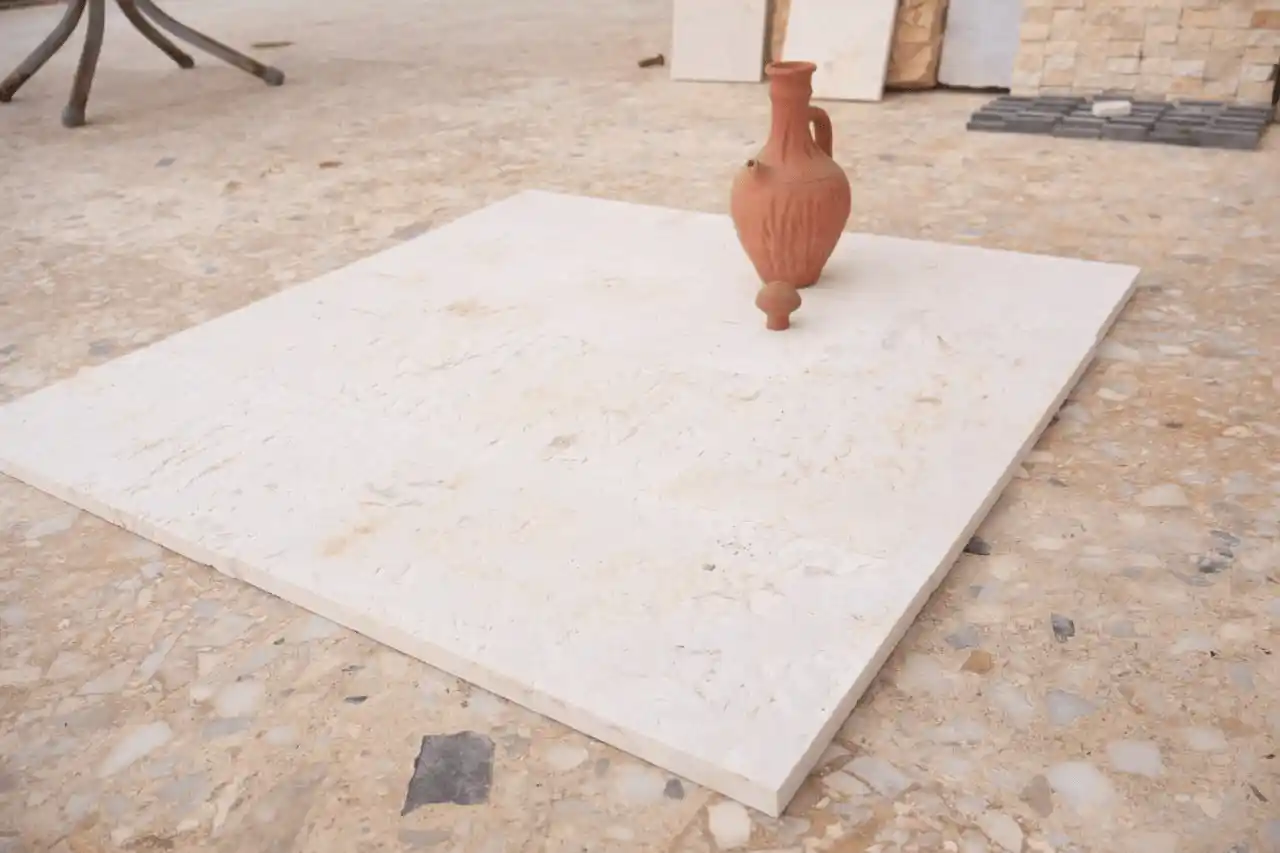
The travertine vs pavers pool deck debate comes up in nearly every project specification conversation, and there’s a reason — both materials have genuine strengths, and the right call depends on your specific performance priorities. Travertine brings natural porosity that moderates surface temperature and provides inherent slip resistance in its tumbled or brushed finish states. Large-format porcelain tiles offer dimensional consistency and near-zero water absorption, which appeals to some architects specifying for maintenance simplicity.
What travertine delivers that porcelain cannot replicate is passive thermal regulation. The open-pore calcium carbonate structure pulls heat away from the surface rather than storing it, which matters enormously for barefoot comfort in high-UV environments. According to NSI travertine pool paving performance data, the material’s absorption characteristics and open-pore geometry actively moderate surface temperatures in ways that dense, vitrified tile surfaces do not. That’s not marketing — it’s a direct function of the mineralogy.
Porcelain’s advantage is uniformity. Every tile comes off the production line at the same thickness tolerance, which simplifies setting bed preparation. Natural stone requires your installer to account for thickness variation — typically ±1/8 inch for standard travertine, tighter for premium-sorted material — and that variation demands skilled trowel technique to achieve a flat finished surface. Neither approach is categorically better; they just require different installation competencies.
Slip Resistance: The Non-Negotiable Specification
Your tile’s wet dynamic coefficient of friction (DCOF) needs to meet a minimum of 0.42 per ANSI A326.3 for wet floor applications — and pool decks are always classified as wet environments. Porcelain tiles with a polished finish frequently fall below this threshold. Honed limestone and tumbled travertine are the finishes usually specified to clear that threshold — request the wet DCOF test report for the exact finish before specifying it for a pool deck.
The PHTA pool deck safety standards address coping and deck surface requirements specifically, and they’re worth reviewing before you finalize a finish selection. Brushed travertine finishes typically deliver the strongest wet grip because the mechanical texture opens the surface without compromising the material’s natural drainage characteristics. Avoid polished stone finishes entirely in pool deck applications — they look exceptional dry and become a liability the moment water hits the surface.
- Tumbled travertine: open, heavily textured face — the usual choice for barefoot pool areas
- Brushed limestone: fine, evenly textured face — a more refined aesthetic
- Honed travertine: wet DCOF typically 0.42–0.52 — acceptable but finish-dependent; verify per lot
- Polished natural stone: wet DCOF often below 0.42 — not suitable for pool deck specification
- Textured porcelain (R11 rating): wet DCOF 0.50–0.70 — performs well when texture is maintained
Thickness and Structural Specification for Pool Deck Tile
Pool deck tile in the 1.25-inch to 1.5-inch nominal thickness range handles the loading conditions typical of residential and light commercial pool environments without flexing under point load. Thinner tiles — the 3/4-inch and 1-inch formats common in interior tile flooring travertine applications — are undersized for exterior pool deck use where thermal cycling, differential settlement, and heavy foot traffic create conditions interior floors never face.
Your setting bed specification matters as much as the tile thickness. A 1.25-inch travertine pool tile on a compromised mortar bed will crack within two to three freeze-thaw seasons in cooler regions. The setting bed should be a full 3/4-inch minimum of large-format tile mortar (polymer-modified), applied with a notched trowel that achieves at least 95% back-coverage — not the 80% minimum that shows up in generic installation guides. That extra coverage percentage is where long-term bond integrity lives.
- Minimum tile thickness for pool deck: 1.25 inches (30mm) nominal
- Setting bed: polymer-modified mortar, minimum 3/4-inch depth
- Back-coverage target: 95% minimum — verify by lifting a test tile after 10 minutes
- Joint width: 3/8 inch minimum with flexible, pool-grade sanded grout or epoxy grout
- Expansion joints: every 12–15 linear feet, never at the pool edge without caulk backer rod
Travertine Tile Flooring Performance at the Pool Edge
Tile flooring travertine specification for pool decks requires you to address one detail that doesn’t come up in standard interior flooring projects: chlorine and calcium hypochlorite contact. Travertine’s calcium carbonate base is mildly reactive to acidic cleaning agents and high-chlorine water at pool edge splash zones. This isn’t a dealbreaker — it’s a maintenance protocol you need to communicate to the pool owner up front.
Sealing travertine pool tile with a penetrating, breathable impregnator (not a topical coating) every 18 to 24 months is the correct maintenance rhythm in most climates. Topical sealers trap moisture beneath the surface in freeze-thaw regions and cause spalling at the face of the tile — a failure mode that looks like poor material quality but is actually a sealer specification error. Penetrating impregnators allow vapor transmission while protecting the pore structure from chlorinated water ingress. For broader guidance on how travertine and natural stone tile classifications are tested and specified, TCNA installation standards provide the industry reference framework installers and specifiers rely on.
At Citadel Stone, we recommend selecting travertine in the ivory or walnut shade range for pool decks specifically because the lighter tones reflect rather than absorb solar radiation, keeping surface temperatures lower — and because the natural color variation in these stones camouflages the minor efflorescence that all calcium-carbonate materials produce during their first two wet seasons. It’s a practical consideration that comes from watching installations age in real conditions, not just in specification documents.
Subgrade and Base Preparation: The Variable Most Specifications Miss
Here’s what most pool tile specifications overlook entirely: the subgrade beneath your pool deck is rarely uniform, and its composition directly determines how the best pool deck tile installation performs over a decade. Expansive clay soils present the most challenging condition — clay swells with moisture absorption and contracts during dry cycles, creating a dynamic subgrade that induces micro-movement in the setting bed. That movement accumulates at tile joints and eventually causes cracking or bond failure, typically within five to eight years of installation on an unprepared clay base.
The correct response to expansive clay beneath a pool deck is a compacted aggregate base of not less than six inches — ideally eight inches in high-plasticity clay zones — combined with a vapor-permeable geotextile fabric that prevents clay fines from migrating upward into the aggregate layer over time. Sandy soils present a different challenge: excellent drainage but poor bearing consistency. Sandy subgrades compress unevenly under point load, which shows up as lippage across tile joints after the first full seasonal cycle. Mechanical compaction to 95% proctor density is your baseline requirement regardless of soil type, but sandy soils need verification with a plate compactor test pass immediately before setting bed application.
- Expansive clay soils: minimum 6–8 inches compacted aggregate base, geotextile fabric required
- Sandy soils: compact to 95% proctor density, verify with plate compactor before setting bed pour
- Rocky subgrades: level variations with compacted crusher run before aggregate base — do not set tile over uneven rock
- Caliche layers: break up mechanically and remove before base placement — caliche does not compact uniformly
- Mixed soils: core sample at pool perimeter before specifying base depth — assume worst-case composition
You should also account for the pool shell’s own movement relative to the surrounding deck. The pool structure and the deck slab move independently in response to soil shifts and thermal changes. A properly designed isolation joint between the pool coping and the deck tile prevents the pool shell’s movement from telegraphing into the tile field — a detail that gets omitted on a surprising number of residential pool projects and shows up as cracked tile in the first two to three years.
Selecting Your Pool Tile: Where Natural Stone Fits Best
Natural stone pool tile is the right specification when you want thermal comfort, authentic material character, and a surface that improves aesthetically with age rather than deteriorating. Travertine, limestone, and similar calcium carbonate stones patina gracefully — the surface develops a soft sheen from foot traffic and UV exposure that polished porcelain tiles simply cannot replicate. That patina is a performance marker: it tells you the surface is wearing evenly and the installation is stable.
Explore our natural stone pool tile range if you’re comparing travertine against limestone or other calcium carbonate options for your pool deck specification — the range includes dimensional, finish, and performance data that helps you move from concept to specification quickly. Citadel Stone maintains warehouse inventory of core travertine and limestone pool tile products, which typically compresses lead times to one to two weeks compared to the six-to-eight-week import cycle that custom orders require. When your project schedule is tight, that warehouse availability is often the deciding factor in material selection.
Grout and Joint Specification for Wet Environments
Standard sanded cement grout is the wrong product for pool deck tile joints. Cement grout is porous, absorbs chlorinated water, and stains from organic material — algae, sunscreen, and tanning oil accumulate in the pore structure and cannot be cleaned out effectively without acid washing, which damages the adjacent stone. Your specification should call for either an epoxy grout or a polymer-modified, pool-grade sanded grout with a water absorption rate below 0.5%.
Epoxy grout is the premium option — zero absorption, chemical resistance to pool chemicals, and a 25+ year service life when installed correctly. The trade-off is installation difficulty. Epoxy grout has a short working time and requires experienced installers who understand how to clean excess from the stone face before it cures. On textured travertine surfaces, cleanup requires aggressive technique that can damage a novice installer. If your installation team doesn’t have confirmed epoxy grout experience on natural stone, specify polymer-modified pool-grade grout instead — it’s more forgiving and still outperforms standard cement grout significantly in wet pool environments.
- Epoxy grout: best long-term performance, requires experienced installation team
- Polymer-modified pool-grade sanded grout: good performance, wider installer availability
- Standard cement grout: not suitable for pool deck tile — absorbs pool chemicals and stains permanently
- Joint width: 3/8 inch minimum — narrower joints trap debris and are difficult to clean in pool environments
Ordering, Logistics, and Project Planning
Pool deck tile projects require material on-site before installation begins — not three days before, not the morning of. Your setting mortar needs a flat, protected staging area, and the tile itself needs to acclimate to site temperature for 24 to 48 hours before installation in environments with significant temperature differentials between warehouse storage and outdoor conditions. Tile set cold from a delivery truck in a hot outdoor environment experiences an immediate thermal differential that can affect early bond strength if the setting bed isn’t adjusted for the condition.
Order a 10% overage minimum on pool tile — 15% for irregular or cut-heavy layouts around pool curves and coping intersections. Matching tile from a different production lot six months after the original installation is rarely achievable with natural stone, and the color variation between lots is visible to any experienced eye. Your truck delivery should arrive with all material for the full deck area before a single tile is set, so lot consistency across the entire installation is guaranteed.
Verify warehouse stock availability before committing your project timeline to a specific material. Core travertine and limestone pool tile products that Citadel Stone stocks nationally are typically available within one to two weeks, but specialty formats and custom thickness orders require lead time planning — a detail worth confirming at the specification stage rather than discovering mid-project when the setting bed is already cured and waiting.
Decision Points
The specification decisions that define pool deck tile performance come down to a short list of variables that compound quickly when they interact. Subgrade preparation determines whether your setting bed stays stable over a decade of thermal cycling and moisture variation. Tile thickness and back-coverage determine whether the bond survives the loading conditions your pool deck actually experiences. Finish selection determines whether your surface stays safe for barefoot users in wet conditions year after year.
Natural stone — particularly travertine — delivers the combination of thermal comfort, genuine slip resistance in tumbled and brushed finishes, and authentic patina that porcelain cannot match. The maintenance protocols are straightforward when they’re specified correctly from the start: penetrating sealer on an 18-to-24-month cycle, pool-grade grout from day one, and isolation joints at the pool shell perimeter. Get those details right in the specification and the installation holds up beautifully. For a related material perspective worth bookmarking, silver travertine for pool surrounds explores how cooler-toned travertine performs across a range of pool deck applications and climate conditions — useful context when you’re narrowing down finish and tone selections for your best pool deck tile specification. When comparing travertine against porcelain for pool decks, Citadel Stone notes that natural stone generally drains more effectively through its surface structure.
Related reading: pools with travertine decks · pool deck travertine pavers · pool paver sealer guide.