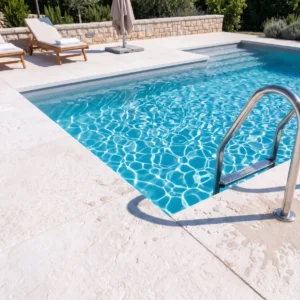
Why Travertine Pool Deck Problems Start Below the Surface
Most travertine pool deck problems don’t begin at the surface — they originate in the base layers, and by the time you see cracking, lifting, or discoloration, the underlying issue has usually been developing for months. The compressive strength of travertine itself (typically 3,500–8,000 PSI depending on density grade) is rarely the failure point. What fails is the system beneath it: inadequate base compaction, incorrect mortar bed thickness, or drainage geometry that channels water directly under the field stone rather than away from it. Understanding this distinction changes how you approach both specification and prevention.
Travertine’s open-pore calcium carbonate structure — the same characteristic that keeps barefoot surfaces cooler than dense igneous alternatives — also makes it highly responsive to what happens underneath and around it. According to Natural Stone Institute travertine properties and outdoor suitability, absorption characteristics and pore interconnectivity directly influence long-term performance in outdoor pool environments. That means your base preparation, joint detailing, and drainage routing aren’t supporting decisions — they’re primary performance determinants.
The Most Common Travertine Pool Deck Problems and What Causes Them
You’ll encounter a predictable set of failure patterns across travertine pool decking installations — and each one traces back to a specific decision made during design or installation. Knowing the failure mode tells you exactly where the spec went wrong.
- Hollow spots and debonding: mortar bed dehydration during hot-weather pours, or insufficient back-buttering on the underside of each paver before setting
- Efflorescence (white calcium deposits): water migrating through the base and carrying soluble salts to the surface — almost always a drainage or sealing failure
- Edge cracking and corner spalling: missing perimeter restraint, inadequate expansion joint spacing, or pavers cut too tight at the pool coping interface
- Surface pitting and erosion: chlorine chemistry interacting with untreated or insufficiently sealed travertine — fill-grade travertine is particularly vulnerable here
- Joint washout and settlement: sand joint loss due to surface water velocity across the deck during heavy rain events, combined with no edge containment to slow sheet flow
- Lippage (uneven paver heights): settling of isolated base sections, often in areas where the aggregate sub-base wasn’t uniformly compacted before setting
The travertine pool decking itself isn’t failing in most of these scenarios — the system around it is. That’s a critical distinction when you’re troubleshooting an existing installation or writing a spec for a new one.
Expansion Joints: The Detail Most Pool Deck Specs Get Wrong
Travertine has a thermal expansion coefficient in the range of 4.5–5.5 × 10⁻⁶ per °F — modest compared to concrete, but significant enough to require deliberate joint planning across a full pool deck field. The standard recommendation of one expansion joint every 15–20 feet applies in moderate conditions, but tighten that to every 10–12 feet when the installation runs adjacent to pool coping on three or more sides, where thermal movement is effectively trapped with nowhere to relieve.
Here’s what most pool deck specifications miss: the expansion joint at the pool coping interface is not optional, and it’s not the same as a standard grout joint. That perimeter joint needs to be filled with a flexible sealant rated for chemical exposure — polyurethane or silicone, not standard tile grout — because this is the zone where pool water chemistry, thermal cycling, and edge restraint forces all converge simultaneously. Skip this detail and you’ll see coping-line cracking within 18–24 months regardless of how well the field stone is installed.
- Field expansion joints: every 10–12 feet in all directions for pool-adjacent travertine pool decking
- Perimeter joint at coping: minimum 3/8-inch gap, filled with ASTM C920 compliant polyurethane sealant
- Control joints over concrete sub-slab: travertine joints must align with underlying slab control joints — never bridge them
- Transition joints at steps and level changes: these are high-stress concentration points that need oversized joint width (minimum 1/2 inch)
Base Preparation: Where Pool Deck Travertine Pavers Either Succeed or Fail
Base preparation determines 70–80% of the installation’s long-term performance, and the requirements for a pool deck environment are more demanding than a standard patio. Pool decks combine chemical exposure, constant moisture cycling, high foot traffic, and the need for precise slope-to-drain — all on a substrate that must remain stable under those combined stresses for 20+ years.
For pool deck travertine pavers installed over a concrete sub-slab, you need a minimum 1-inch mortar bed using a polymer-modified setting mortar rated for wet, exterior conditions. Standard gray mortar is not acceptable here — moisture penetration through the travertine’s pore structure will degrade an unmodified mortar bond within a few seasons. The slab itself needs a minimum 1.5% slope away from the pool edge and toward a collection drain, and that slope must be built into the concrete, not compensated for by varying mortar bed thickness. Compensating with mortar depth variation is a shortcut that creates inconsistent bond strength across the field.
- Concrete sub-slab: minimum 4-inch thickness, 3,000 PSI, with fibermesh or #3 rebar at 18-inch grid for pool deck applications
- Mortar bed: 1-inch minimum depth, polymer-modified exterior mortar (ANSI A118.4 or A118.11)
- Drainage slope: 1.5–2% minimum across the field, pre-built into the sub-slab
- Sub-slab drainage: French drain or channel drain positioned at the low edge — surface slope alone is insufficient in high-rainfall environments
- Pool deck travertine pavers in 2-inch nominal thickness handle the point loads of pool furniture and standard foot traffic effectively at this base specification
Drainage Design: The Overlooked Factor in Travertine Pool Deck Performance
Drainage design gets underspecified on more pool deck projects than almost any other variable. The assumption that a sloped surface handles water adequately ignores how water actually moves across pool deck travertine pavers during high-volume precipitation — and in regions that experience heavy rain seasons, monsoon cycles, or hurricane-driven rainfall events, inadequate drainage translates directly into accelerated stone deterioration and joint failure.
Surface water moving at velocity across a travertine pool deck does two things: it erodes joint sand progressively, and it carries calcium carbonate particles from the stone face, slowly bleaching and pitting unfilled or unsealed travertine. The solution isn’t just slope — it’s controlling water velocity by positioning trench drains or channel drains perpendicular to the primary flow direction, breaking sheet flow into shorter runs before it can build momentum. For decks in areas with pronounced wet-dry cycles (including drought-to-deluge patterns), account for sub-base shrinkage during dry periods as well: a French drain running beneath the slab perimeter prevents hydrostatic pressure buildup when heavy precipitation follows an extended dry season.
At Citadel Stone, we consistently recommend clients pair their travertine pool decking specification with a drainage plan reviewed by a licensed civil engineer for any deck exceeding 500 square feet. The material investment in quality travertine is significant — protecting it with a $500–$800 drainage consultation is straightforward math.
Sealing Protocols That Actually Protect Pool Deck Travertine
Sealing travertine pool decks requires a different approach than sealing interior travertine tile, and confusing the two protocols is one of the most common specification errors. Interior sealers are often film-forming products that create a surface layer — useful indoors, but problematic outdoors where trapped moisture under a film sealer causes spalling and delamination through freeze-thaw or thermal cycling.
For exterior pool deck travertine pavers, you need a penetrating impregnating sealer — silane-siloxane chemistry for water repellency, or a fluoropolymer sealer if you want additional resistance to pool chemical staining. ASTM C1527 travertine dimension stone standards outline the absorption thresholds that inform sealer selection, and travertine’s porosity range (typically 3–15% by volume) means a single sealer application at the standard coverage rate is often insufficient. Plan for two sealer coats on the first application, and budget for resealing every 2–3 years in high-UV, chemically active pool environments.
- First application: two coats of penetrating impregnating sealer at manufacturer’s recommended coverage rate
- Allow 48–72 hours cure time before pool deck is returned to use
- Resealing interval: 2–3 years in pool environments (chemical exposure accelerates sealer breakdown)
- Test sealer effectiveness annually: water beading test — if water absorbs within 3–5 minutes instead of beading, reseal immediately
- Never apply sealer over wet or damp travertine — trapped moisture causes permanent hazing
You can explore our travertine pool decking materials to find options matched to specific finish and porosity grades — this matters when selecting a sealer because fill-grade and non-filled travertine require different products and application rates.
Preventing Efflorescence in Travertine Pool Decking
Efflorescence is the white powdery deposit that forms when water migrates through a porous stone system, picks up soluble calcium and mineral salts from the mortar or sub-base, and deposits them at the surface as the water evaporates. In pool deck environments, it’s particularly persistent because the moisture source — pool splash, irrigation, rainfall — is effectively constant.
The prevention approach works on two fronts simultaneously. First, reduce water infiltration through the stone by sealing correctly (as described above). Second, eliminate the salt source by specifying low-alkali Portland cement in the mortar bed and using a pre-bagged polymer-modified mortar rather than site-mixed material. Site-mixed mortars have inconsistent alkali content and are a primary efflorescence contributor in field installations. According to USGS data on limestone and travertine mineral formation, the calcium carbonate chemistry that makes travertine naturally beautiful also makes it susceptible to soluble salt migration — understanding this mineralogy helps you spec the right mortar system from the start.
Existing efflorescence can be treated with a diluted phosphoric acid solution (5–10%) followed by thorough rinsing, but this is remediation, not prevention. You’ll repeat the treatment indefinitely if the underlying drainage or mortar specification isn’t corrected.
Travertine Pool Coping Installation: The Interface That Demands Precision
Travertine pool coping installation sits at the most demanding intersection on a pool deck project — it’s simultaneously managing the bond to the pool bond beam, the transition to the deck field stone, water shedding into the pool, and aesthetic continuity across a linear run that’s highly visible from every angle. Getting this interface wrong is the single most reliable way to create ongoing maintenance problems for the client.
Coping pieces should be set in a full mortar bed on the bond beam — not spot-mortared — with a minimum 1-inch overhang into the pool and the nose edge pitched slightly toward the pool surface (approximately 1–2% slope) to direct water inward rather than allowing it to track back under the coping. The joint between coping and field stone is your perimeter expansion joint — never fill this with grout. Use a backer rod and flexible sealant, and size the joint to accommodate the full linear movement of the coping run: for a 30-foot coping run, that’s approximately 0.25 inches of thermal movement at temperature differentials common in outdoor pool environments.
- Coping set in full mortar bed — no spot or ribbon setting
- Overhang into pool: 1–1.5 inches minimum, nose edge pitched 1–2% toward pool
- Perimeter expansion joint between coping and field stone: 3/8–1/2 inch, backer rod plus ASTM C920 sealant
- Coping joints: 1/4-inch minimum, filled with flexible exterior grout or sealant — never rigid Portland grout on exposed coping runs
- Verify bond beam is clean, structurally sound, and primed with a bonding agent before setting
Citadel Stone’s warehouse carries coping profiles in multiple edge configurations — bullnose, tumbled edge, and drop-face — so you can verify stock and confirm lead times before committing the coping profile to your construction documents. Truck delivery scheduling for coping runs should be coordinated with your pool contractor’s bond beam cure timeline: you typically need 21–28 days of cure before loading coping on a new bond beam.
Finish Selection and Slip Resistance for Pool Deck Travertine
The finish you specify on pool deck travertine pavers has direct safety implications that go beyond aesthetics. Polished travertine — beautiful indoors — becomes dangerously slippery when wet and is inappropriate for any pool deck application. The relevant standard here is ANSI A326.3, which measures wet dynamic coefficient of friction: pool deck surfaces should meet the ANSI A326.3 wet DCOF threshold (0.42), and polished travertine offers very little texture.
Tumbled, brushed, or unfilled travertine consistently outperforms honed and polished finishes on the wet slip resistance test — the textured surface increases friction, and the open pores allow water to drain away from the foot contact zone rather than creating a film between foot and stone. For pool deck travertine pavers in a tumbled or brushed finish, the surface carries pronounced texture, comfortably above the minimum requirement. The PHTA pool deck safety standards provide additional guidance on surface requirements for commercial and residential pool environments — these are worth referencing in your specification to establish the liability baseline clearly.
- Tumbled travertine: best slip resistance, natural rustic character, ideal for high-traffic pool deck areas
- Brushed travertine: good slip resistance, smoother appearance than tumbled, works well for contemporary pool designs
- Honed travertine: borderline wet slip resistance — acceptable only with regular anti-slip treatment application
- Polished travertine: NOT suitable for pool deck use — very little wet texture, well below safe requirements
Before You Specify Travertine Pool Deck Materials
The decisions that determine a travertine pool deck’s 20-year performance versus its 8-year replacement cycle are all made before the first paver is set: base specification, drainage routing, mortar chemistry, expansion joint placement, finish selection, and sealing protocol. You can source excellent material and still produce a failing installation if any one of these system elements is underspecified. Conversely, a well-designed system with quality pool deck travertine pavers and the right maintenance schedule delivers the kind of performance that justifies the investment in natural stone. Review your specification against each of the failure modes described here before the project goes to bid — the corrections cost nothing at that stage and significant remediation dollars once the deck is installed. For a broader evaluation of this material’s strengths and limitations, the full travertine pool deck tradeoff analysis covers the complete performance picture across climate conditions and project types. Efflorescence and joint failure are among the most common issues installers flag, and Citadel Stone provides guidance on prevention during the selection process.