

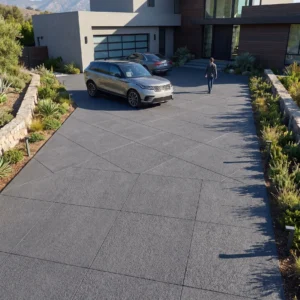
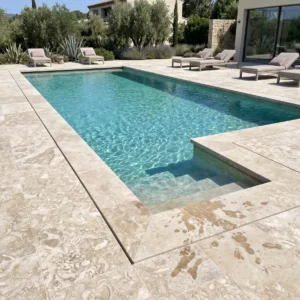


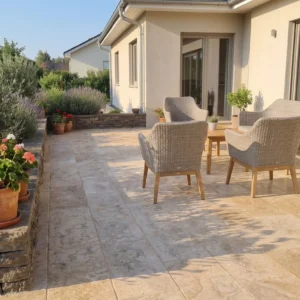

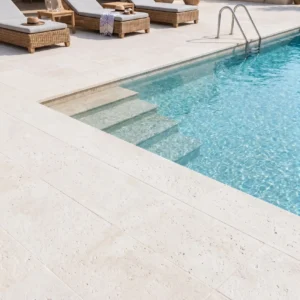




























A laying pattern is the cheapest big decision in hardscaping: the same pallet of stone reads formal, rustic or engineered depending on nothing but its arrangement. Buyers research the stone for weeks and inherit the pattern from whoever happens to install it – yet the layout decides how a floor reads from the curb, how a driveway carries its loads, and how much stone the order really needs. This guide is the pattern library we wish every drawing arrived with: each major layout, diagrammed, with the formats it wants and the waste it costs. It pairs with the stone finish library the same way – surface and layout are chosen together or regretted together.
How to Read a Laying Pattern
Every pattern in this library is a different answer to three questions:
- Where do the joints run? Long straight joints read calm but telegraph movement; broken joints hide it.
- Does the layout interlock? Patterns that turn each unit against its neighbor resist creep under load.
- What does it cost to cut? Any pattern that meets an edge at an angle pays for the privilege in offcuts.
Hold those three questions while you scroll, and the right pattern for a given project usually names itself.
Running Bond and Stack Bond
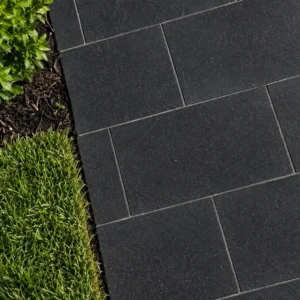
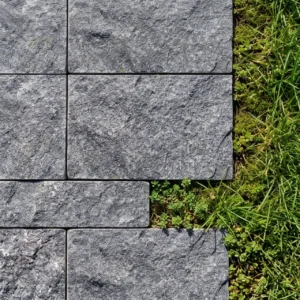
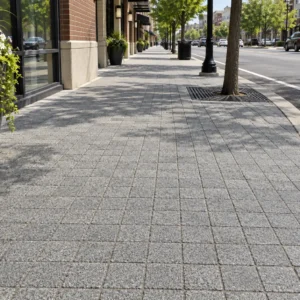
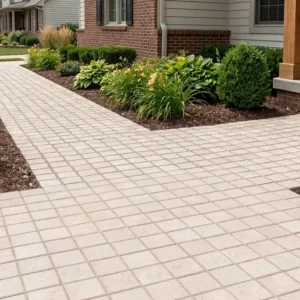
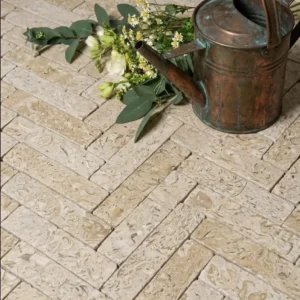
Running bond – each course offset half a unit – is the oldest pattern in the book and still the best default: fast to lay, tolerant of small size variation, and modest in waste. Stack bond aligns every joint into a clean modern grid; it photographs beautifully and forgives nothing, because every millimeter of drift shows down the whole line. Use stack bond with calibrated, sawn-edge material and a patient installer, and running bond almost everywhere else. Both straight lays carry working guides: running bond in full detail and the stack bond deep dive.
Herringbone, at Ninety and Forty-Five
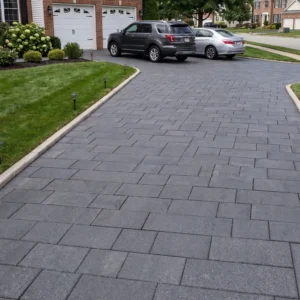
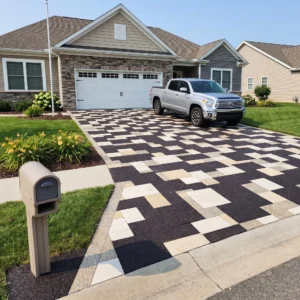
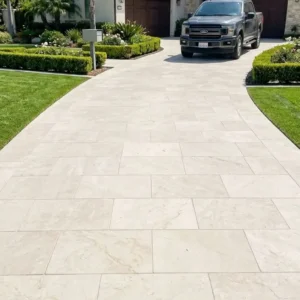
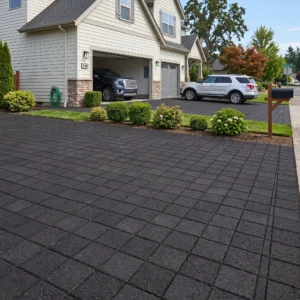
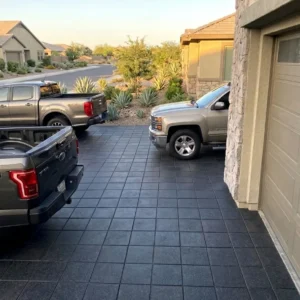
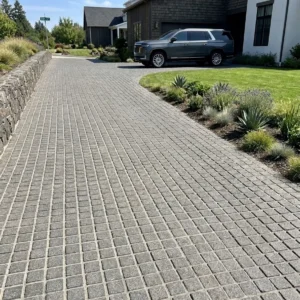
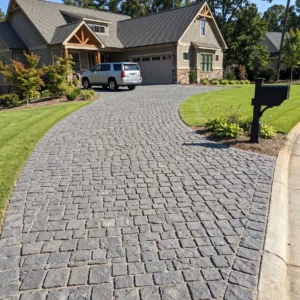
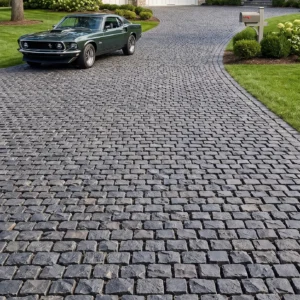
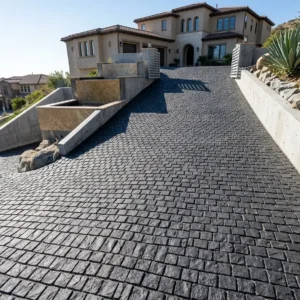
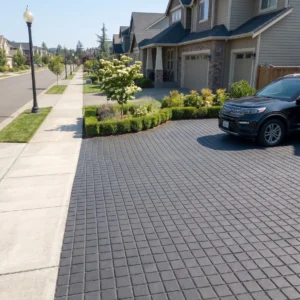
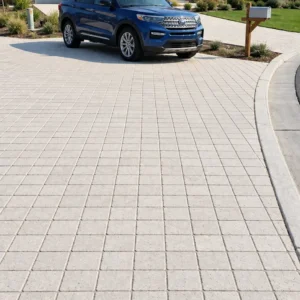
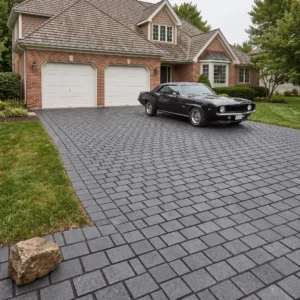
Herringbone turns every paver against its neighbor, and that interlock is why it has carried carts, then cars, for centuries – the pattern of choice for driveways and any surface that takes turning wheels. The ninety-degree set keeps cutting close to a straight-lay order; the forty-five-degree set is stronger-looking and stronger-working but cuts every border course. Our herringbone versus circular patio comparison walks a real decision between two of these layouts, and the complete herringbone guide covers the weave end to end.
Basketweave
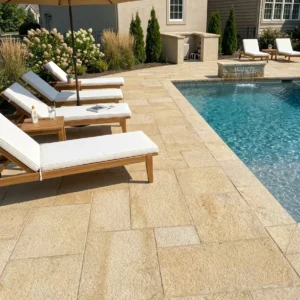
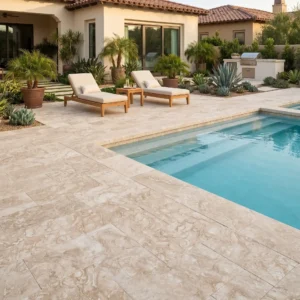
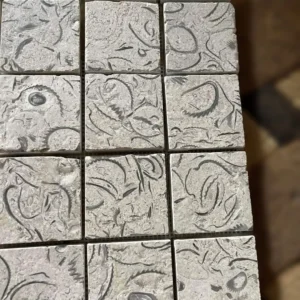
Basketweave pairs units in alternating direction, and reads instantly traditional – cottage paths, garden rooms, anywhere the brief says warmth rather than drama. It wants a true two-to-one format so the pairs square up, lays quickly once the first courses are set, and keeps waste near the straight-lay floor. The pattern has one quiet superpower: because the eye reads the woven pairs rather than the individual stones, it forgives small tonal variation better than any aligned bond – a useful trait in natural material. In a brushed limestone it softens further; in a dark basalt the same weave turns graphic and contemporary, proof that the pattern is a register, not a period costume. The basketweave layout guide goes deeper on formats and setting out.
The French Pattern - a Module, Not a Mystery
The French pattern – also sold as the Versailles pattern – intimidates buyers because it looks random and is anything but: four sizes combined in fixed proportions, long straight joints designed out, repeats offset so the seams never align into a grid. The full working guide, with the module arithmetic and ordering math, lives in the French pattern layout guide – the short version is that a one-of-each group of the four pieces covers just under six square feet, the working yardstick for sizing an order, with kits bundling the sizes in the proportions the field actually consumes. It is the pattern we cut most often for buyers who want custom character without custom prices.
Fans and Arcs, for Setts
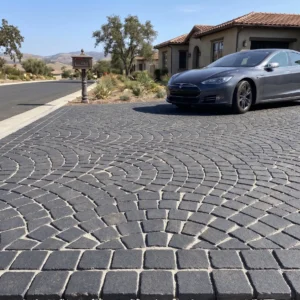
Fan patterns belong to small stone – cube setts turned through nested arcs above a fixed base course, the ground old European towns walked for centuries. What the fan asks of its stone:
- Small, near-cubic units that can turn along an arc without wedge-shaped joints
- Split or tumbled edges, so the joints read hand-set rather than machined
- A patient installer – fans are craft work, laid from guide strings, not screeds
The step-by-step is in the fan pattern paving guide, and the broader sett-layout family – coursed rows, arcs and circles – is covered in cobble sett patterns.
Random and Irregular Flagstone
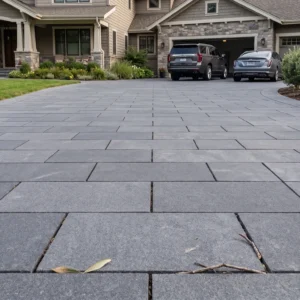
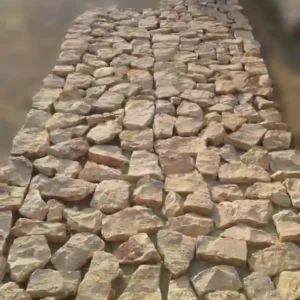
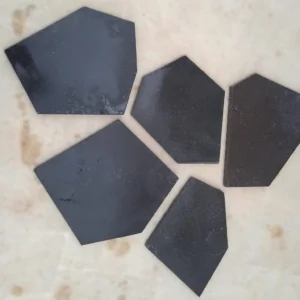
Random layout is not the absence of a pattern – it is a discipline of its own: irregular pieces fitted so joints stay tight and consistent, three-way meetings preferred over four, no runs of small stones huddled together, and the big anchor pieces spread through the field rather than clustered where the pallet happened to stand. It suits garden paths, informal terraces and anywhere geometry should disappear into planting. The trade-off is installer time: every stone is a decision, and a good layer makes several hundred of them per day. Gauged large-format pieces fitted loosely give much of the look at a fraction of the fitting labor – the honest shortcut in a layout that punishes dishonest ones. The random flagstone fitting rules write the discipline down.
Circles, Rosettes and Borders
The set-piece layouts – circle kits, rosettes in setts, contrast borders – work best as punctuation rather than prose:
- A circle anchors a dining terrace or a driveway apron; two circles argue with each other
- Sett rosettes mark thresholds and centers in fan or coursed fields
- A single-course border in a darker stone frames any field pattern and hides its edge cuts
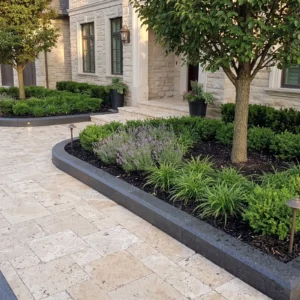
Borders earn their keep structurally too: a restrained soldier course in basalt gives a soft limestone field a hard, straight, protected edge. Circles have a dedicated circular pattern guide of their own, and frames get the border pattern treatment.
Waste Factors and the Ordering Math
Patterns cost stone before they cost labor, and the margin belongs in the order, not the apology afterwards:
- Running bond, stack bond, basketweave: around five percent over measured area
- Herringbone at ninety degrees: five to ten percent, depending on how many edges the field meets
- Herringbone at forty-five degrees, and any diagonal set: ten to fifteen percent – every border course is cut
- Fan and arc work in setts: roughly ten percent, consumed by closures, keystones and shared shoulders
- French module kits: little field waste, but order a spare set for the future repair nobody schedules
- Random flagstone: five to ten percent, absorbed in fitting choices rather than saw cuts
Dimension-stone properties themselves – the strength and absorption the surface must carry – sit under ASTM’s dimension stone standards; the pattern decides how many pieces you buy, the specification decides what each piece must be.
These are the allowances we order to. They assume a border to absorb the perimeter cuts, and they are planning figures rather than a guarantee, since site shape drives the real number more than the pattern does.
| Pattern | Straight edges | Curved or angled edges | What drives the number |
|---|---|---|---|
| Running bond, laid parallel to the edge | 5% | 8% | half-unit closers only, all at the perimeter |
| Stack bond | 5% | 8% | full-unit grid, cuts confined to the perimeter |
| Basketweave | 5% | 8% | square modules land clean on a set-out grid |
| French or four-size module | 5-8% | 10% | the module edge has to be filled with part pieces |
| Herringbone at 90 degrees | 10% | 12% | every perimeter unit is cut |
| Herringbone at 45 degrees | 10-15% | 15% | two cut triangles at every edge, both offcuts small |
| Fan or arc setts | 10-15% | 15% | arcs never meet a straight edge cleanly |
| Random flagstone | 10-15% | 15% | selection loss on top of fitting cuts |
| Circle or rosette | 15-20% | 20% | radial cuts and tapered closers, no reusable offcuts |
| Border or soldier course | add 5% on the run | add 8% | mitered corners and short closers |
Three things push a job toward the upper end of each band, and they are worth checking before the order is placed:
- Curved, angled or stepped boundaries, which multiply the number of cut units
- Small areas, where the perimeter is a large share of the total
- Any pattern laid diagonally to the dominant edge
- Natural stone with a wide thickness or shade range, where selection loss is real
The pattern also has to survive the traffic. The Concrete Masonry and Hardscapes Association is explicit that 45 or 90 degree herringbone is recommended wherever vehicles run continually, because it gives maximum interlock, and that guidance is set out in the application guide for interlocking concrete pavements.
Matching Pattern to Stone Format
Patterns are format-hungry in different ways, and the pairing is where a supplier earns its place in the conversation:
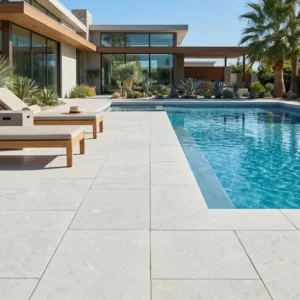
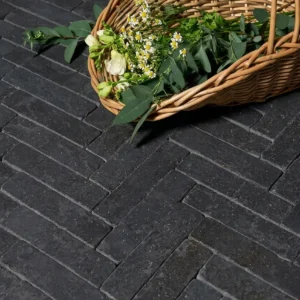
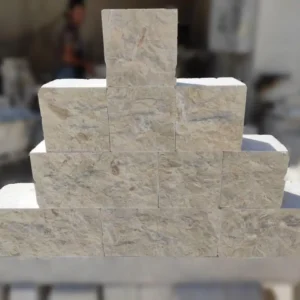
- Running bond and herringbone want true rectangles – white limestone pavers and basalt pavers cut to format in two-to-one sizes
- Stack bond wants calibrated, sawn edges – tiles more than tumbled pavers
- The French module wants its four sizes cut as a set, in one thickness
- Fans, arcs and rosettes want cube setts – the cobble sett range cut for arc work is sized for exactly this
- Random layout wants irregular flagstone with enough size spread to fit honestly
As a broad sedimentary material family, limestone takes every one of these layouts; dense basalt adds the vehicular patterns, and the Natural Stone Institute varieties guide is a fair independent primer on how the families differ.
Order Stone Cut for Your Pattern
Choose the pattern, and the cutting list writes itself – sizes, piece counts, waste margin, thickness for the load. Send the drawing and the pattern name with your quote request, or order small samples first to settle stone and finish – the first delivered pieces then confirm the layout on the ground. Citadel Stone cuts limestone, basalt and shellstone to the pattern you are laying – module sets, plank formats and cube setts, delivered nationwide with the waste margin already thought through.