The Case for the Frame
Nobody photographs the border – and every photograph is better because of it. A perimeter course earns its keep three separate ways. It declares the field finished, the way a mat finishes a print. It soaks up the cut pieces that patterns shed at their edges, hiding the saw work where nobody looks for it. And it stands first in line for every hard knock the perimeter will ever take. The field collects the compliments; the frame makes them possible. For a component priced by the linear foot rather than the square, no element of a paved surface returns more per dollar.
The Border Vocabulary
The trade’s frame options are few and old, which is a recommendation:
- Soldier course – units crosswise, short ends to the field: dense, formal, containing
- Sailor course – units lengthwise with the edge: calm, linear, contemporary
- Double border – a sailor line inside a soldier rank, the double-matted picture
- Contrast band – any of the above in a differing stone or finish
- Curb-backed border – the frame closing against a raised stone curb where levels change
Everything more elaborate is these five recombined.
What Borders Do – and Do Not – Hold
A persistent myth needs retiring: the border is not the edge restraint. Paving – border included – creeps outward under load unless something unmovable closes the system: a concrete haunch below grade, metal edging, a wall, a true curb. What the border genuinely contributes is sacrificial order. Its plain rectangles take the mower strikes, the snow-shovel scrapes and the delivery-trolley wheels, and any one of them lifts out and replaces without touching the patterned field. Frame damage is repair; field damage is surgery.
Pairings: Which Fields Want Which Frames
The frame should answer the field:
- Diagonal herringbone – the border is nearly mandatory, hiding every angled cut; the full herringbone guide budgets for exactly this
- Woven fields – a plain soldier rank gives the basketweave checkerboard its focus
- Straight bonds – optional; one contrast band upgrades them cheaply
- Random flagstone – a border tames the wild edge where formality begins
- Circles and rosettes – the border ring is the diplomatic zone between curve and course
The rule beneath the table: the busier the field, the plainer the frame.
Contrast, Handled Like an Adult
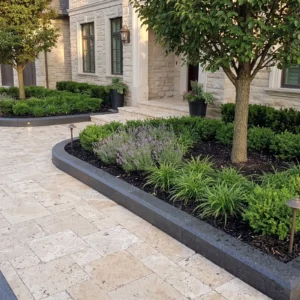
The border is where contrast belongs – controlled, linear, one decision wide. dark basalt border courses around a pale field remain the definitive move: the frame reads from the street, the field stays serene inside it. The inverse – a pale band around dark stone – lightens a heavy courtyard. And the connoisseur’s version uses one stone in two finishes, the border’s texture shifting against the field’s so the frame appears in raking evening light like a watermark. What rarely works is contrast inside the field and at its edge at once; pick one theater.
Corners, Curves and the Details That Show
Borders are judged at their corners, and the options each carry a character:
- Mitered corners – forty-five degree meets, tailored and exact, demanding true cuts
- Woven corners – courses lapping alternately, traditional and forgiving
- Butted corners – one course running through, the other stopping against it: the workmanlike default
- Radius corners – units radius-cut or downsized so joints stay even around the turn
Where a border meets steps, thresholds or a drive apron, resolve the junction on the drawing rather than the bedding: the frame is the surface’s handwriting, and corners are where the handwriting shows. A border that turns its corners well can carry an ordinary field; a field of any quality cannot rescue a corner that was improvised.
Where Border Jobs Go Wrong
Border failures cluster on a short list, none of them expensive to avoid:
- Treating the frame as the restraint – the whole edge then migrates together, border first
- Thin border stock on a full-thickness field, lipping at the very line the eye follows
- Contrast chosen from samples indoors, then shouting outdoors in full sun
- Corners left for the installer to improvise on the day, four different solutions on four corners
- No spare units held back, so the sacrificial course cannot be sacrificed gracefully
The pattern under all five: the border gets planned last because it is priced least. Reverse that – specify the frame with the field, on the same drawing, in the same thickness conversation – and the cheap component stops being the weak one. Ten minutes while the drawings are still drawings covers everything on the list.
Material and the Step Up to Curbs
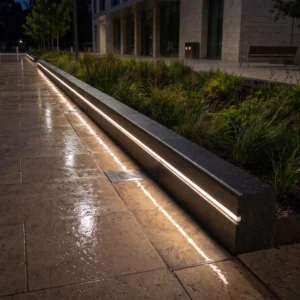
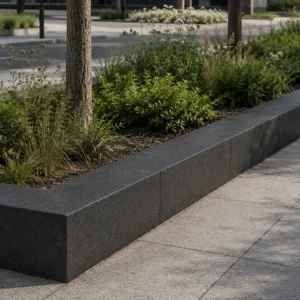
Border duty is edge duty, so specify accordingly – dense units, full thickness, finishes that keep grip where the perimeter meets weather. Where the edge does more than finish flat – holding a level change, meeting a lawn that mows against it, closing a driveway line – the border graduates into true curbing, and stone curbstones cut for edge work take over: deeper sections, set in concrete, built to be struck. A flush border and a raised curb are cousins with different jobs; plenty of good designs use both in sequence.
Ordering by the Linear Foot
Borders are measured around, not across: perimeter length, corner count and course count set the order, with a modest margin for closures and the odd corner recut. Quote the border with its field so thickness and tone are matched from one cutting list – and if the field pattern is diagonal, let the field order carry the waste allowance its angle demands along the border line. A border is the cheapest component on the drawing and the most visible discipline on the ground – frame the field, and the field will always look framed.
Ordering a Border by the Linear Foot
Borders are ordered on a different basis from the field, and mixing the two is the most common estimating error on a paving job. The field is bought by area; the border is bought by the running foot, with an allowance for mitered corners and short closers.
| Pattern | Straight edges | Curved or angled edges | What drives the number |
|---|---|---|---|
| Border or soldier course | add 5% on the run | add 8% | mitered corners and short closers |
| Running bond, laid parallel to the edge | 5% | 8% | half-unit closers only, all at the perimeter |
| Herringbone at 45 degrees | 10-15% | 15% | two cut triangles at every edge, both offcuts small |
| Circle or rosette | 15-20% | 20% | radial cuts and tapered closers, no reusable offcuts |
A border is not only decorative. It gives the field something to bear against, and the application guidance from the Concrete Masonry and Hardscapes Association treats edge condition as part of how the pavement performs.
Soldier, Sailor and the Pairings That Work
The vocabulary is worth using precisely, because it removes ambiguity from a drawing. A soldier course stands the unit on its long edge, perpendicular to the border line; a sailor course lays it flat with the long face outward.
- Soldier courses suit strong containment and read as a frame
- Sailor courses read wider and calmer, and suit generous terraces
- A double frame in two tones defines a space without a level change
- Match the border thickness to the field so nothing sits proud
- Take every field cut into the border, never into the visible field
Borders also carry more foot traffic than the field beside them, especially at thresholds and steps, so it is worth setting a measurable wet slip target using the method described in this account of frictional testing on stone walking surfaces.
Paver border patterns, measured by the linear foot
The border is where a paved area either resolves or unravels, and it costs very little to get right at drawing stage.
- Measure the perimeter and order the border separately from the field
- Allow for miters at every corner and for short closers
- Choose the course type for the containment you need, not only the look
- Detail the edge restraint behind the border, not instead of it
Which field pattern the border has to absorb cuts from is set out in our paver laying pattern library.
A field without a border is a field that ends wherever the last cut happened to fall.