Pairs, Turned Against Each Other
Basketweave is the simplest good idea in paving: lay two rectangles side by side to make a square, turn the next square ninety degrees, repeat. The surface that results reads as woven – over, under, over – though nothing overlaps and nothing bends. It is the pattern of cottage gardens and old brick dooryards, and it carries that warmth wherever it goes, which makes it the tool to reach for when a space should feel settled rather than styled. It is also, quietly, one of the best values in the library: the woven effect costs no diagonal cutting, no specialist layout, and no premium formats – just the discipline of a true start and a proportion checked at ordering.
The Geometry That Makes It Work
The whole pattern rests on one proportion:
- Length must equal exactly twice width – each pair then forms a true square
- Formats from 6 x 12 to 12 x 24 inches all weave; the smaller the unit, the finer the texture
- One calibrated thickness across the order keeps pairs flush at every turn
- Near-miss sizes do not average out – they accumulate, and the checkerboard drifts
Check the proportion at ordering rather than on site: a cutting list verified once beats a field argued with for days.
Laying: Slow Start, Fast Field
Basketweave rewards patience for exactly two courses. Set the first pairs true to the main sightline, confirm the squares are actually square, and the rest of the field assembles at straight-bond speed – each pair registers against the last, direction alternates mechanically, and there is no diagonal geometry to manage. Edge trimming happens only where the field meets its borders, which is why the offcut pile stays small – comparable to a running bond order despite the far more decorative result.
Setting Out the First Square
The whole field inherits its truth from one square meter, so spend the patience there:
- Dry-lay the first four pairs on the prepared bedding and stand back before fixing anything
- Measure both diagonals of that panel – equal diagonals mean a true square, and nothing else does
- Check that each laid pair actually forms a square before the next pair registers against it
- Keep a string line on the leading edge until the field is several courses deep
None of this is difficult and all of it is skippable, which is exactly how the drifting checkerboards of the world get laid. Twenty minutes of layout discipline buys a field that assembles itself; skipping it buys an afternoon of arguing with pairs that almost fit. The weave is mechanical once it is true – the craft is entirely in making it true.
Two Registers, One Pattern
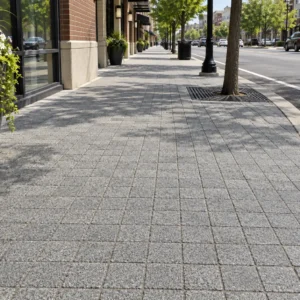
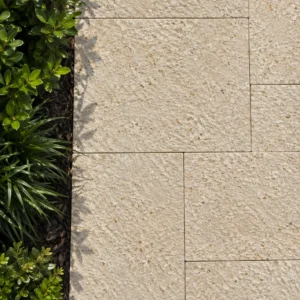
The same weave speaks two languages depending on the stone. In pale brushed white limestone pavers it goes soft: cottage paths, garden rooms, courtyards that look inherited. In a dark, sawn-edged stone the identical geometry sharpens into something architectural – a deliberate floor that photographs like tilework. Neither register is truer than the other; decide what the space should feel like, then let the material make the argument while the pattern stays constant.
Where the Weave Belongs
The pattern has a natural territory, and it is generous:
- Paths and walks – the weave turns a corridor into a feature at no extra waste
- Garden rooms, breakfast terraces and pool surrounds, where furniture and bare feet are the heaviest traffic
- Thresholds and landings – a small woven panel marks arrival inside a plainer field
- Period properties and cottage gardens, where the pattern has centuries of citizenship
The honest caveat: for driveways and turning wheels, the paired joints interlock less thoroughly than herringbone, so let strength questions go to the stronger weave and keep basketweave where its charm is the point.
Pairing the Weave with a Border
Basketweave and a plain border are old friends. A single soldier course around the woven field does three jobs at once: it frames the checkerboard so the pattern reads as a deliberate panel rather than wallpaper that ran out of wall, it absorbs the perimeter trimming so the weave itself stays uncut, and it gives lawn edges and planting beds a straight line to negotiate with. In a contrasting tone – dark border, pale weave, or the reverse – the framing effect doubles. Of all the patterns in the library, this one gains the most from that single extra course.
Finish, Joints and the Long View
Basketweave keeps its looks on a short list of conditions:
- Joints stay consistent – the weave is a rhythm, and uneven gaps break the beat
- The finish matches the duty – tumbled and brushed faces hide a decade of use gracefully
- Wherever the woven floor meets water or slope, the coarser textures in the finish library keep it walkable
Beyond that it asks almost nothing – no pattern this decorative costs this little to keep.
Ordering the Pairs
Send the area and the format you like; the cutting list comes back in verified two-to-one rectangles with the five percent margin included and thickness matched to the duty. Basketweave is the rare pattern that gives more character than it charges for – true rectangles, patient first courses, and the weave does the rest for decades.
Modules, Cuts and the Order Sheet
Basketweave is one of the kindest patterns to cut. The unit of the pattern is a square made of two units, so the field sets out on a simple grid and every closer falls at the perimeter. The catch is upstream of the saw: the format has to be a true two-to-one, or the square never closes and the weave reads as a mistake.
| Pattern | Straight edges | Curved or angled edges | What drives the number |
|---|---|---|---|
| Basketweave | 5% | 8% | square modules land clean on a set-out grid |
| Running bond, laid parallel to the edge | 5% | 8% | half-unit closers only, all at the perimeter |
| Stack bond | 5% | 8% | full-unit grid, cuts confined to the perimeter |
| Herringbone at 90 degrees | 10% | 12% | every perimeter unit is cut |
Format discipline matters more than pattern choice here, and the thickness and aspect-ratio bands are set out in the application guide for interlocking concrete pavements.
True Two-to-One, and Why Nothing Else Works
A basketweave built from a unit that is not exactly twice as long as it is wide will not close. The error compounds across every module, and by the third bay the crew is either opening the joints to absorb it or cutting units that should have been whole.
- Check the actual unit dimensions, not the nominal ones, before ordering
- Decide the joint width first, because it is part of the two-to-one arithmetic
- Use a single batch, since a shade or size shift shows at every module boundary
- Consider double basketweave on larger areas, which reads calmer at scale
- Set the module out from the most visible edge so part squares land out of sight
- Dry-lay two full modules and measure across them before bedding anything
The tolerance point is the same one that governs any aligned-joint layout: where units are not dimensionally accurate the pattern shows it, which is why the technical note on bonds and patterns singles out prematched or dimensionally accurate units for bonds that carry aligned joints. A basketweave carries them at every module boundary.
Basketweave paver pattern, ordered to the module
Get the format right and basketweave is among the simplest patterns on site. Get it wrong and no amount of skill on the trowel will rescue it.
- Confirm a true two-to-one unit in the actual delivered size
- Set the joint width before the arithmetic, not after
- Keep it to pedestrian areas, courtyards and terraces
- Frame it with a border so the module always ends whole
For the patterns that suit vehicles instead, and what each wastes at the saw, see our paver laying pattern guide.
Basketweave is a format decision wearing a pattern name.