

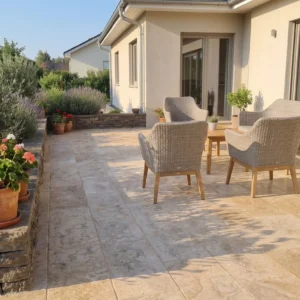
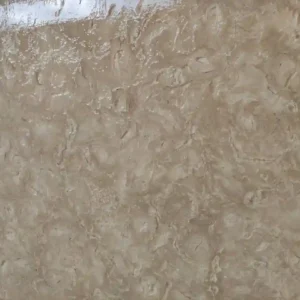
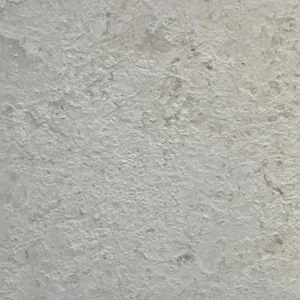
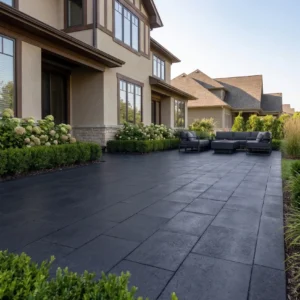

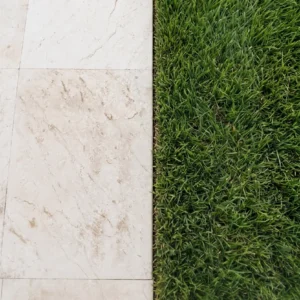


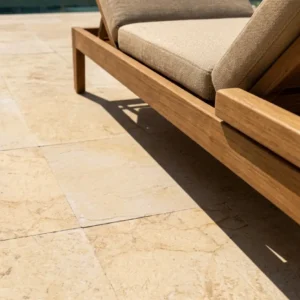
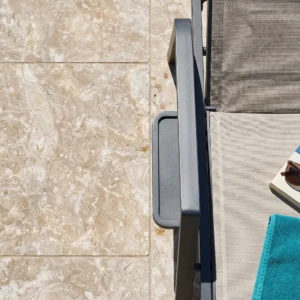
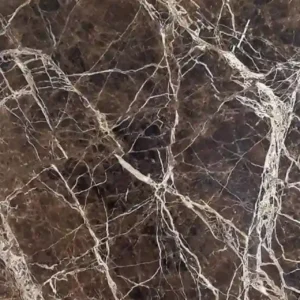
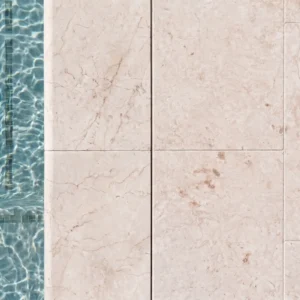
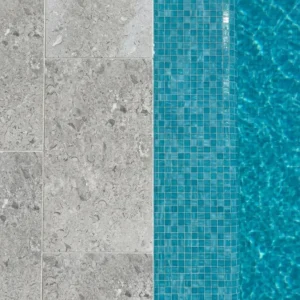
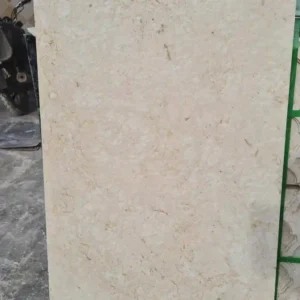
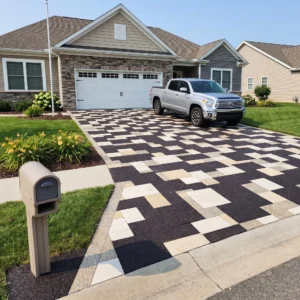
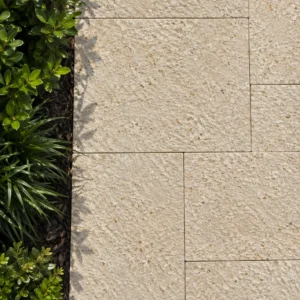
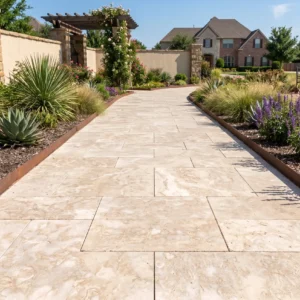
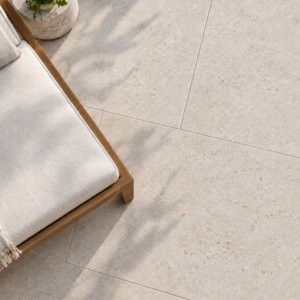
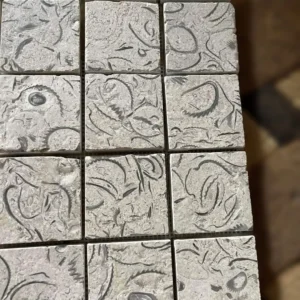
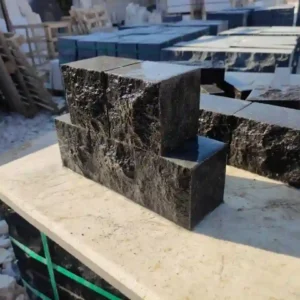
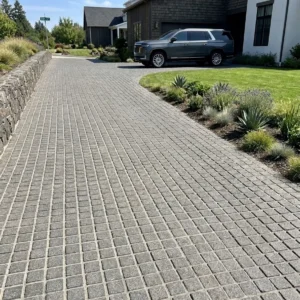
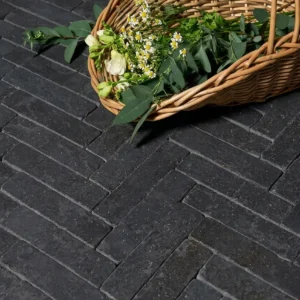
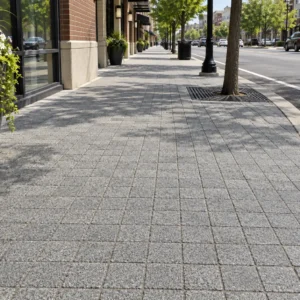
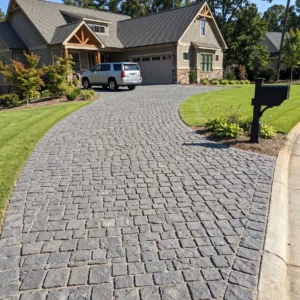
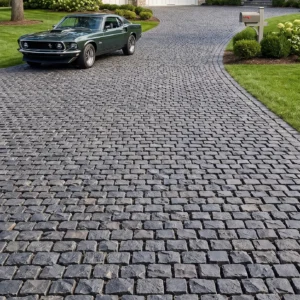
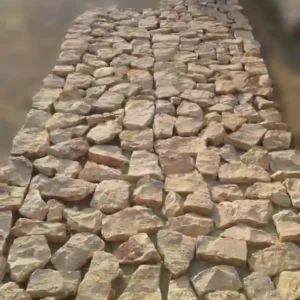
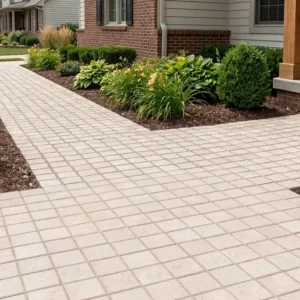
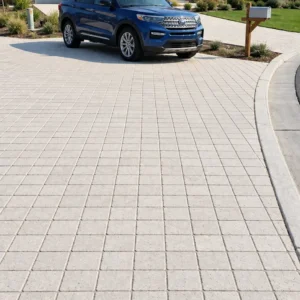
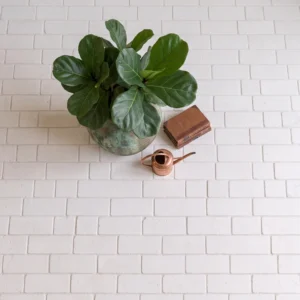
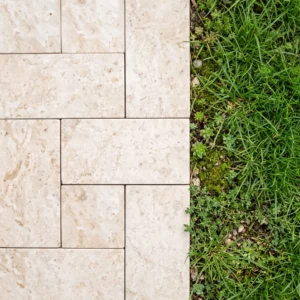
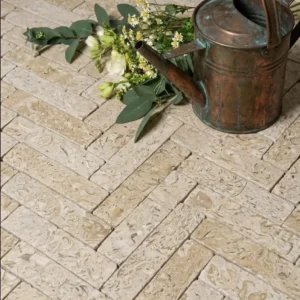
The absorption rate on Ivory Travertine sits between 2 and 4 percent by weight, and that single number drives more specification decisions than any color chart ever will. You’ll get far better long-term results when you treat that porosity as a design input rather than a defect to hide. The pale, warm-cream tone comes from calcium carbonate deposited in mineral springs over millennia, and its natural voids are what give the stone its acoustic warmth underfoot and its ability to shed surface water. Understanding how that pore structure behaves under load, moisture, and temperature swings is what separates a deck that ages gracefully from one that spalls at the fifth winter.
What Defines Ivory Travertine as a Material
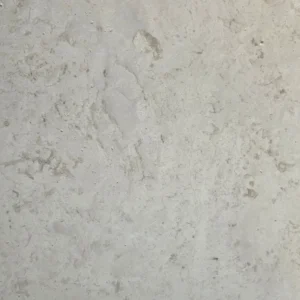
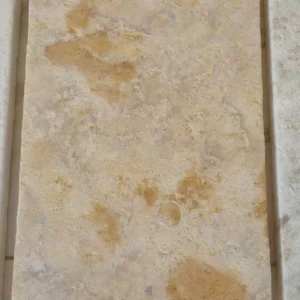
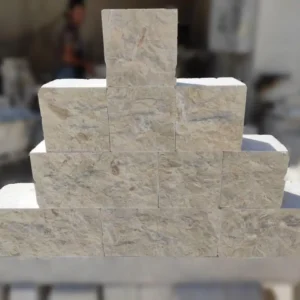
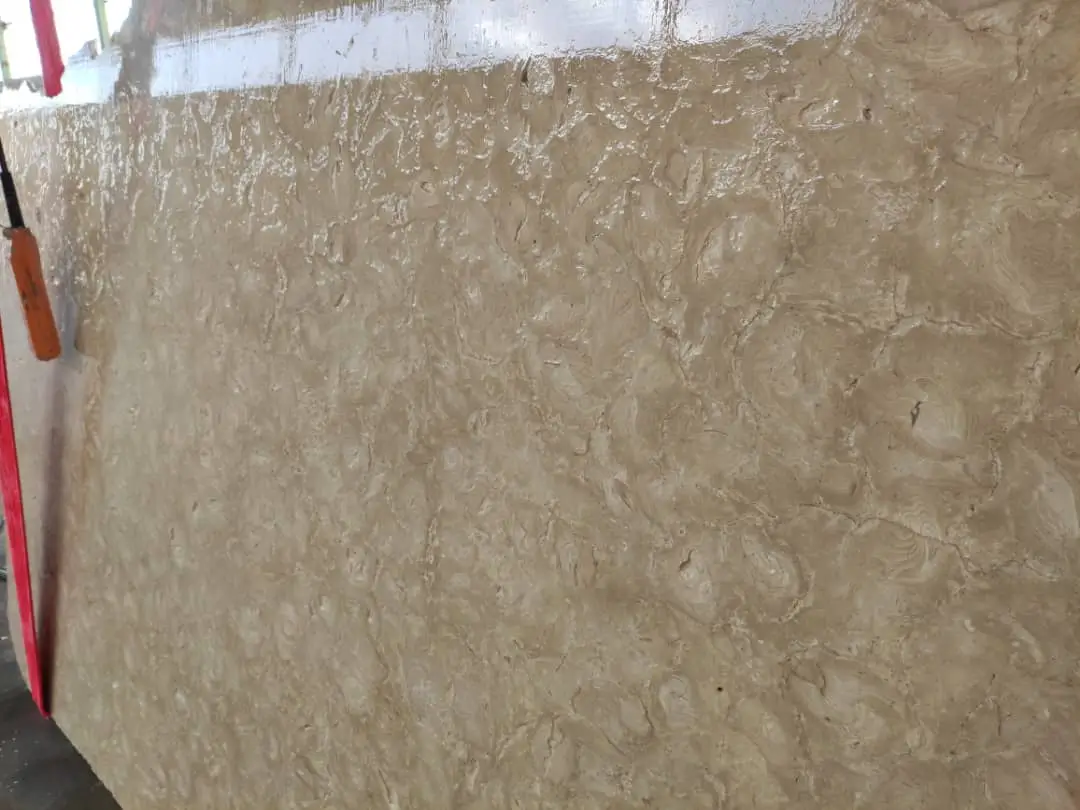
You’re looking at a sedimentary stone with a distinctive layered fabric, formed as dissolved calcium precipitates around geothermal vents. The ivory shade specifically reflects a low iron-oxide content — the more iron present, the more the stone drifts toward gold or walnut. Batch consistency matters here more than most buyers realize, because two pallets quarried six months apart can shift a full shade if you don’t specify tightly.
The material reads as a mid-range performer on the hardness scale, roughly 3 to 4 on Mohs, which means it accepts honing, tumbling, and polishing beautifully but scratches faster than granite. That softness is a feature for barefoot applications. According to industry travertine performance data, the calcium carbonate composition keeps surface temperatures noticeably lower than dense igneous stone in high-UV exposure, which is why you see it dominate poolside installations.
- Density typically ranges from 145 to 165 pounds per cubic foot depending on void distribution
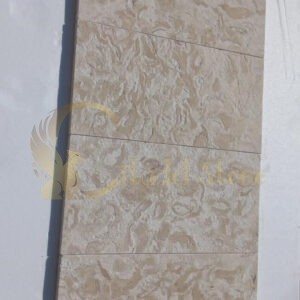
- Available finishes include tumbled, honed, brushed, and filled-and-polished surfaces
- Natural voids can be factory-filled with resin or left open for a more rustic texture
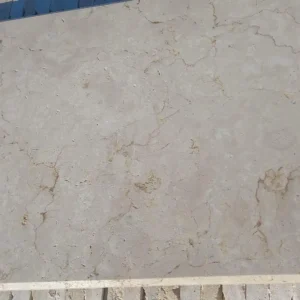
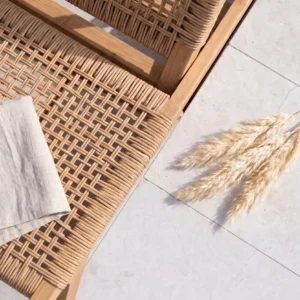
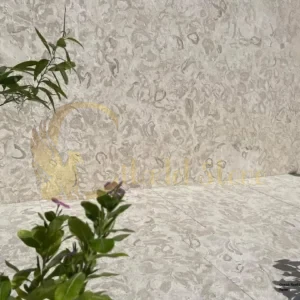
- Color falls in the warm cream-to-ivory band with subtle linear veining
At Citadel Stone, we inspect each incoming batch at the warehouse for shade consistency and void density before it clears for order fulfillment, because a mismatched dye lot is nearly impossible to correct once the stone is set. You can request sample tiles or thickness specifications from our team before committing to a full pallet order.
Freeze-Thaw and Thermal Cycling Considerations
This is where the porosity conversation gets serious in regions that see real temperature swings. Water expands roughly 9 percent when it freezes, and if that water is sitting inside a saturated void when the temperature drops below freezing, the expansion pressure works directly against the calcium carbonate matrix. Repeat that cycle a few hundred times and you get surface spalling, hairline cracking, and eventually delamination of the top layer.
The critical variable isn’t just how cold it gets — it’s the frequency of crossing the freeze line combined with how wet the stone is when it crosses. A location with wide day-to-night temperature ranges that repeatedly thaws and refreezes stresses the stone far more than a consistently cold climate where the stone stays frozen and dry all winter. You’ll find that drainage and sealing do more to protect against freeze-thaw damage than raw material selection.
- Specify a penetrating sealer that reduces absorption rather than a topical film that traps moisture
- Increase joint width slightly in cycling climates to accommodate thermal movement
- Choose denser, tighter-void batches for freeze-thaw exposure — request void density data before ordering
- Ensure the setting bed drains freely so voids don’t sit saturated going into a freeze
For projects in freeze-thaw regions, the honed or filled finishes generally outperform open tumbled surfaces simply because there’s less exposed void to collect and hold water. Thermal cycling also affects the joint material, so your grout or polymeric sand needs to be rated for movement, not the cheapest bag on the shelf.
Choosing Formats and Thickness for Your Application
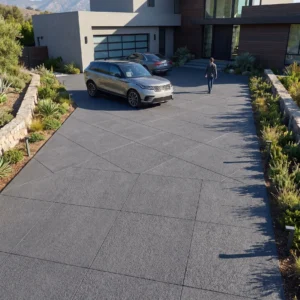
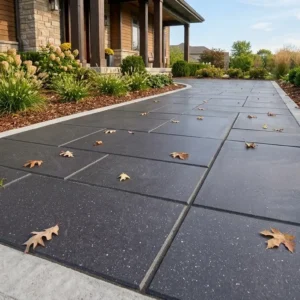
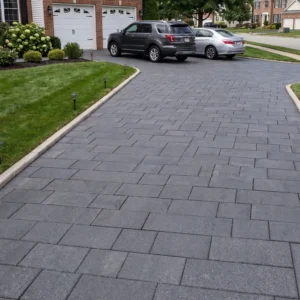
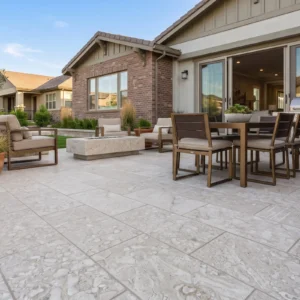
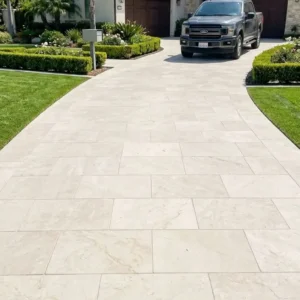
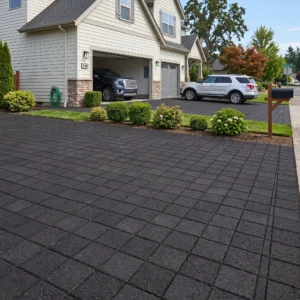
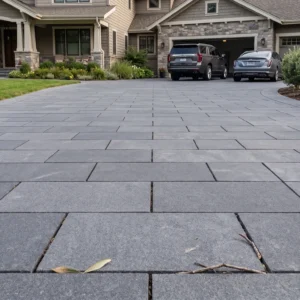
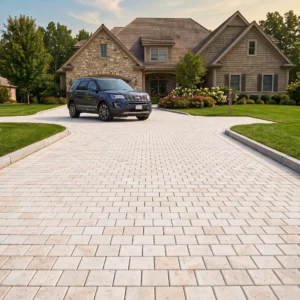
Your thickness decision should follow the load, not the aesthetic. Ivory travertine pavers in the 1.25-inch range handle pedestrian patio and pool deck loads comfortably when set on a proper compacted base, while vehicular or heavy point-load areas push you toward 2-inch material or a full mortar-bed installation.
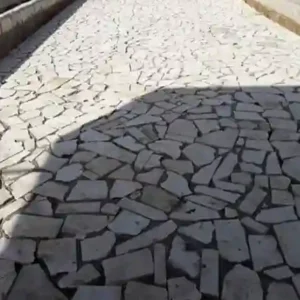
Format selection interacts with your climate too. Large-format ivory travertine tile looks clean and modern but has fewer joints to absorb thermal movement, so in high-cycling environments you’ll sometimes prefer a modular or French pattern that distributes movement across more joints. Consider how your layout handles expansion before you fall in love with a single oversized slab look.
- French pattern (mixed sizes) distributes thermal stress across more joints
- Standard 12×24 and 16×24 formats suit most residential decks and patios
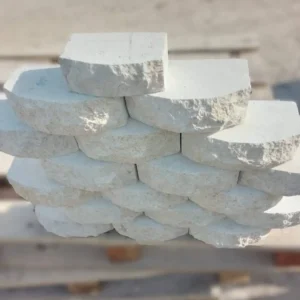
- Coping pieces come with bullnose, eased, or square edges depending on pool detail
- Paver thickness of 1.25 to 2 inches covers the majority of outdoor applications
Citadel Stone stocks Ivory Travertine in standard paver and tile formats along with matching coping profiles, and for projects requiring custom cuts or non-standard sizes, our team can advise on lead times before you finalize your layout. Available finishes range from tumbled to filled-and-honed to match your project requirements.
Ivory Travertine for Pool Environments
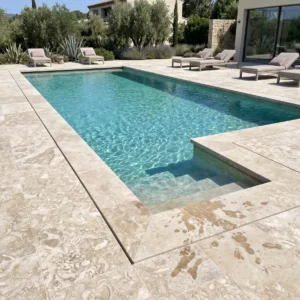
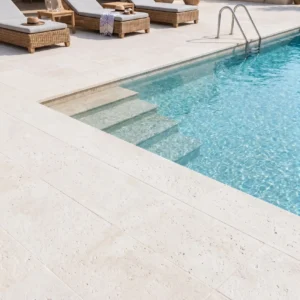
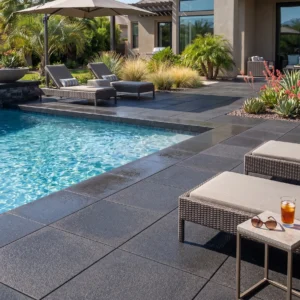
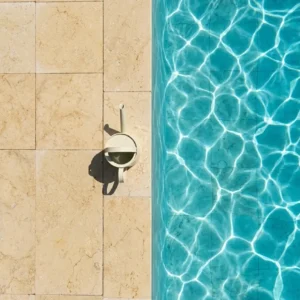
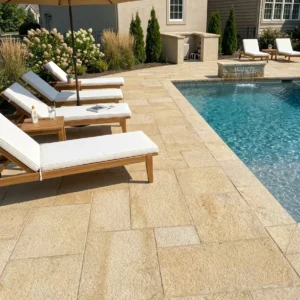
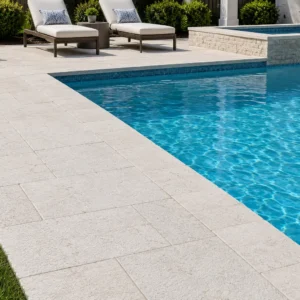
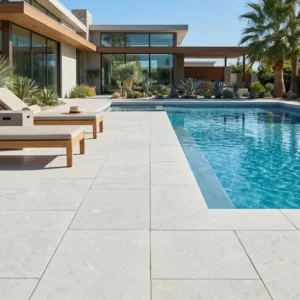
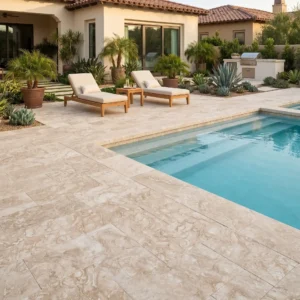
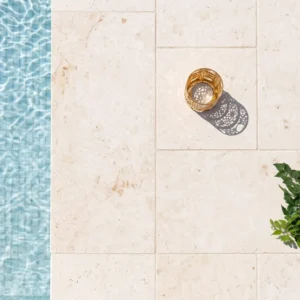
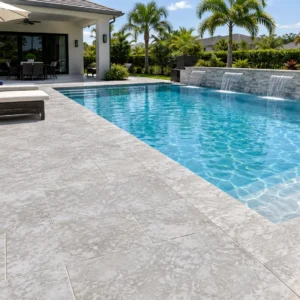
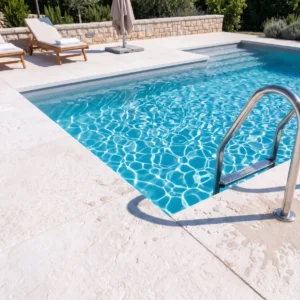
For pool surrounds we recommend brushed or bush-hammered finishes, which give more underfoot texture than polished stone. An ivory travertine pool deck stays cooler underfoot than concrete or dark stone because the pale surface reflects solar radiation and the calcium carbonate mass moderates heat gain. That first 30 minutes after peak sun is when most homeowners notice the difference between an ivory travertine pool deck and a dark alternative that becomes unwalkable.
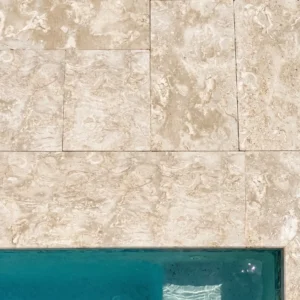
For the water’s edge, ivory travertine pool coping delivers a rounded, comfortable transition that resists chlorine and salt-system chemistry better than many manufactured options. Choose a textured finish where surfaces will be wet. When you’re comparing surface materials for a pool build, porcelain pool tile vs travertine walks through how the natural stone stacks up against porcelain in real deck conditions. Getting the coping-to-deck relationship right at the specification stage prevents most of the callbacks installers see later, and it is worth confirming the ivory travertine pool coping profile early.
- For pool surrounds we recommend brushed or bush-hammered finishes, which give more underfoot texture than polished stone.
- An ivory travertine pool surround reflects UV and stays cooler than dark alternatives
- Coping profiles handle the transition from deck to water with a comfortable edge
- Salt-chlorinated systems require diligent rinsing and periodic resealing
Slip resistance for any ivory travertine pool surface should be verified against recognized coefficient-of-friction standards. Per the static coefficient of friction test method, textured finishes measurably outperform polished ones in wet conditions — the data backs up what installers already know from experience.
Installation and Base Preparation
Field performance data shows that the vast majority of failures in this stone trace back to base preparation, not the material itself. Your aggregate base depth should account for soil type and frost depth — in clay-heavy or expansive soils, you’ll go deeper and add a geotextile separation layer to keep fines from migrating up into your setting bed.
When you’re specifying ivory travertine pavers over a compacted base, the sequence matters: compact in lifts, verify your slope before the bedding layer, and never skip the edge restraint. A deck with no perimeter restraint walks apart within a few seasons regardless of how good the stone is.
- Compact aggregate base in 3 to 4 inch lifts for consistent density
- Verify 1 to 2 percent drainage slope before laying the bedding course
- Install rigid edge restraint on all unsupported perimeters
- Use polymeric sand rated for the joint width and expected movement
Temperature during installation affects your setting materials more than people expect. Thinset and polymeric sand cure differently in heat, so on hot days you’ll adjust working time and mist-set accordingly. Our technical consultation team can walk you through base specs for challenging soil conditions if your site presents drainage or expansion concerns.
Maintenance and Sealing Protocols
Sealing protocols for ivory travertine tile differ from concrete maintenance because you’re managing absorption, not just surface appearance. A penetrating impregnating sealer is the right choice for most outdoor work — it reduces water uptake into the pore network without forming a film that can peel or trap moisture. You can expect to reseal exterior surfaces every 2 to 4 years depending on exposure, foot traffic, and whether the deck sees salt or chlorine.
The material tolerates neutral-pH cleaners well but reacts badly to acidic products. Vinegar, citrus cleaners, and many general-purpose bathroom products will etch the calcium carbonate surface, leaving dull spots that require honing to correct. This is honest limitation territory — if you or your client won’t commit to pH-neutral maintenance, that’s worth discussing before installation.
- Use penetrating sealers for exterior work, not topical film coatings
- Reseal every 2 to 4 years based on real exposure, not a fixed schedule
- Clean only with pH-neutral products to avoid etching
- Address spills promptly since open voids absorb liquids quickly
Sourcing, Availability, and Value Considerations
Where buyers get burned is on batch consistency across a phased project. If you’re building in stages, you’ll want to reserve enough material from a single quarry run to complete the visible field, because ordering the balance later almost guarantees a shade shift. This is a genuine advantage of buying from held inventory rather than made-to-order import cycles.
You can buy Ivory Travertine in wholesale quantities directly, and for larger projects the per-square-foot value improves meaningfully at pallet volumes. Citadel Stone maintains warehouse inventory nationwide, which typically reduces lead times to 1 to 2 weeks compared to the 6 to 8 week import cycle most projects face. Truck delivery scheduling depends on your site access, so verify clearance for a full pallet drop before your delivery window.
- Reserve single-batch material for phased projects to protect shade consistency
- Wholesale and trade pricing improves at pallet and multi-pallet volumes
- Nationwide warehouse stock shortens lead times versus import ordering
- Confirm truck access and offload capability before scheduling delivery
Sourced from our selected premium quarries, each batch is inspected for consistency before it enters our inventory, and you can request affordable sample sets to confirm color and finish against your design before you commit to volume.
Buy Ivory Travertine Direct — Citadel Stone
Ivory Travertine ships nationwide from regional inventory in standard paver, tile, and coping formats, with thicknesses from 1.25 to 2 inches and finishes spanning tumbled, honed, brushed, and filled-and-polished. You can request sample tiles, absorption and void-density data, or full thickness specifications before placing an order, and trade or wholesale enquiries are handled directly with volume pricing at pallet quantities. Lead times typically run 1 to 2 weeks from held stock, and our team can advise on custom cuts, coping profiles, and base specifications for challenging site conditions. As you round out the poolside detailing on your project, the edge treatment deserves the same attention as the field — for a closer look at coping specification, our guide to travertine coping for pool edges covers the profiles and installation details that finish the job cleanly. Contact us for a quote, to schedule a consultation, or to arrange delivery to your site. Architects and builders choose ivory travertine vs porcelain tile, sourced from quarries across the Mediterranean and Middle East, for outdoor installations.
Related guides: ivory travertine pool deck guide · ivory travertine sealing problems · ivory travertine french pattern layout · 7 Ivory Travertine Backsplash Ideas for Any Kitchen · ivory vein cut travertine · how to clean ivory travertine.