Why Base Preparation Defines Your Installation
The ivory travertine pool deck guide most specifiers overlook isn’t about choosing the right finish — it’s about what happens six inches below the surface before a single paver gets set. Your compacted aggregate base determines whether that material performs for 25 years or starts rocking and lifting within five. Get the sub-base right and everything above it rewards you; shortcut it and no amount of premium stone recovers the loss.
Travertine’s calcium carbonate composition keeps surface temperatures measurably lower than dense igneous alternatives — a critical factor for barefoot pool deck use. According to Natural Stone Institute travertine outdoor performance data, its open-pore structure and absorption characteristics actively moderate surface heat in high-UV conditions. Factor this into your finish selection before committing to a pool deck specification.
Your base construction should target a minimum of 4 inches of compacted crushed stone — 6 inches on any site showing signs of expansive clay or poor drainage. The compaction target is 95% Proctor density, and that number matters more than almost any other spec on the sheet. A base that passes visual inspection but misses compaction by 5% will telegraph movement to your paver joints within two seasonal cycles.
Thickness Selection and Load Considerations
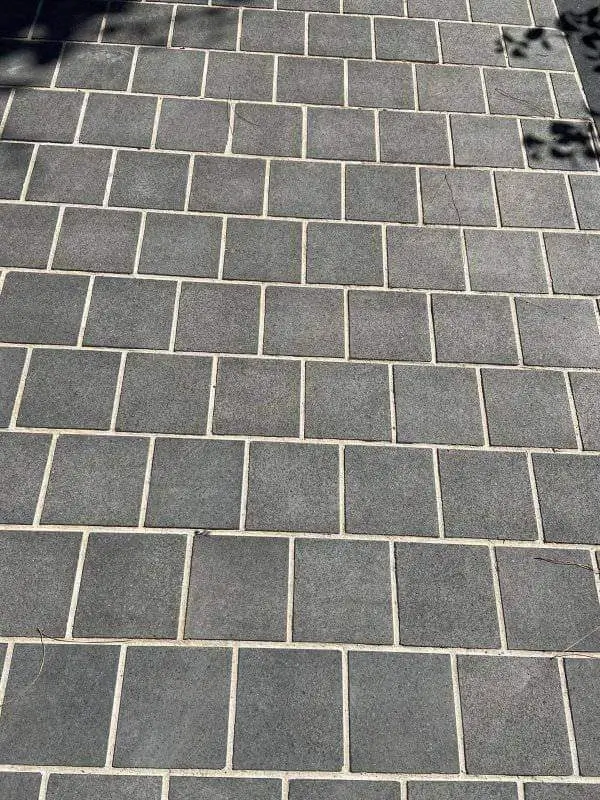
Pool deck pavers take a specific kind of abuse — repeated wet-dry cycling, foot traffic concentrated at entry points, and occasional wheeled equipment like carts or pressure washers. Your ivory travertine pool decking should be specified at a minimum nominal thickness of 1.25 inches for standard residential foot traffic zones, with 2-inch material reserved for areas subject to heavier loads or where the base soil conditions are less predictable.
The 2-inch specification isn’t just about load capacity — it’s about thermal mass. Thicker pavers absorb and release heat more gradually, which translates directly to surface comfort on a 95-degree afternoon. The difference between a 1.25-inch and a 2-inch paver travertine underfoot in peak afternoon sun is noticeable to anyone walking barefoot.
- 1.25-inch nominal thickness: standard residential pool surrounds, consistent foot traffic, well-compacted base on stable soil
- 2-inch nominal thickness: elevated-use zones, pool entries, areas near diving structures, sites with variable soil conditions
- Pavers should be sourced from the same production lot where possible — color variation between lots is real with travertine stone tile, and poolside installations are visually unforgiving
- Check thickness tolerance on delivery — natural stone varies, and a tolerance swing beyond ±1/8 inch creates lippage issues during installation
Finish Options for Pool Deck Safety
Your finish choice on travertine stone tile is where safety and aesthetics converge — and where pool deck projects most often get the specification wrong. A polished finish belongs indoors. It has no place on a pool deck. The wet-surface coefficient of friction drops to dangerous levels, and no sealer compensates for that.
The three finishes worth specifying for pool deck applications are brushed, tumbled, and honed with an anti-slip additive in the sealer. Brushed travertine creates a textured surface through wire or abrasive brushing that opens the stone slightly and raises micro-ridges — it’s the workhorse finish for pool surrounds. Tumbled edges and surfaces create a worn, rounded aesthetic that also improves grip because the surface irregularities add traction geometry. According to ASTM C1527 travertine dimension stone standards, surface finish requirements directly affect absorption and slip resistance performance classifications, making finish selection a specification decision, not just an aesthetic one.
- Brushed finish: best all-around choice for pool decks — texture holds grip when wet, cleans easily, ages gracefully
- Tumbled finish: excellent slip resistance, softened visual aesthetic, slightly more irregular surface that some clients prefer for a naturalistic look
- Honed finish: acceptable with anti-slip sealer additive, but requires more maintenance vigilance — resealing on a strict 18-month cycle rather than the standard 24-month interval
- Polished finish: not appropriate for any exterior pool deck application — avoid regardless of client preference
Joint Spacing and Expansion Design
Here’s what most pool deck specifications miss: travertine expands at approximately 4.5 × 10⁻⁶ per °F, and pool deck environments create the most aggressive thermal cycling of any outdoor application. Your joints need to accommodate that movement or your paver travertine will telegraph stress cracks within a few years. Standard guidelines often cite 1/8-inch joints, but for pool decks exposed to direct sun in warm climates, 3/16-inch joints are the more defensible specification.
Expansion joints — true expansion joints, not just wider sand joints — belong at every perimeter interface and at intervals no greater than 12 to 15 linear feet across the field. Use a flexible backer rod and polyurethane sealant at these locations, not grout. Grout locks movement and it will crack. The polyurethane system accommodates the thermal cycling that a grouted joint cannot.
Your setting bed choice also affects joint performance. A dry-set mortar system on a rigid concrete substrate behaves differently from a sand-set system on compacted aggregate. Sand-set installations have more inherent flexibility, which works in your favor on pool decks — but they require a more precise base preparation to prevent differential settlement. Rigid mortar beds perform better structurally but shift all the movement stress to your joints, making expansion joint placement even more critical.
Drainage Design and Terrain Considerations
Drainage is where the ivory travertine pool deck guide gets genuinely technical, and it’s where terrain variation has the most direct impact on your specification decisions. A flat pool deck on level ground presents a straightforward drainage challenge — maintain 1/8-inch-per-foot slope away from the pool perimeter toward perimeter drains, and the system manages itself. Sloped or hillside sites require more deliberate engineering.
On elevated or terraced sites, you’re managing two drainage problems simultaneously: surface water moving across the paver field and subsurface water pressure building against your base. A French drain system integrated into the aggregate base isn’t optional on hillside installations — it’s the difference between a stable installation and one that heaves uphill and sinks downhill as seasonal moisture levels shift. Size your perforated pipe at 4 inches minimum and daylight it at least 10 feet from the pool structure.
- Minimum surface slope: 1/8 inch per foot directed away from pool edge — never slope toward the water
- On terraced sites, install cross-slope drains at each grade change to intercept surface runoff before it reaches lower paver fields
- Subsurface French drain systems should use 3/4-inch washed stone wrapped in filter fabric — skip the fabric and fine sediment migrates into the drain and clogs it within a few seasons
- Pool deck drains should be sized for the full catchment area including any roof runoff that reaches the deck zone — undersized drains create standing water, which accelerates efflorescence in travertine stone slab installations
- On low-lying flat sites, positive drainage away from the pool structure is even more critical — flat terrain with clay soils holds water, and hydrostatic pressure under your base is a slow installation killer
Citadel Stone’s technical team regularly advises on drainage configuration during the pre-order consultation phase — it’s one of the details that comes up consistently when we review project specs before warehouse fulfillment, because drainage failures are far more costly to remediate than to prevent.
Sealing Protocols for Travertine Pool Decks
Travertine’s characteristic open-pore structure is both its aesthetic signature and its primary maintenance variable. Those pores — which give paver travertine its natural, slightly rustic surface texture — also absorb pool water, chlorine, and sunscreen residue if left unsealed. Your sealing specification is not optional for pool deck installations; it’s a baseline performance requirement.
The right sealer for pool deck travertine is a penetrating impregnator, not a topical coating. Topical sealers sit on the surface, and on a pool deck they peel, cloud, and create uneven traction within a season. A penetrating impregnator — specifically a fluorocarbon-based product — fills the pore structure from within, allowing the stone to breathe while blocking liquid absorption. Apply two coats on initial installation with a 30-minute cure window between coats, then reapply on an 18-to-24-month cycle depending on use intensity.
Chlorine exposure degrades sealers faster than most product datasheets account for. A pool deck that sees daily splashing from heavy use should be on the 18-month resealing schedule, not the 24-month one. The test is simple: drop water on the surface and watch whether it beads. If it absorbs within 30 seconds, the sealer has broken down and you’re past due.
Ordering and Project Logistics
The logistics side of an ivory travertine pool deck project has more failure points than most clients anticipate, and the most common one is cutting your material order too close to installation start. Travertine comes in natural color ranges, and matching a partial reorder to existing pavers already on-site is genuinely difficult. Over-order by 10% as a minimum — 15% for projects with complex cuts around coping, steps, or irregular pool shapes.
For project planning purposes, verify warehouse stock levels well before committing to your installation timeline. Citadel Stone maintains national warehouse inventory that typically reduces lead times to one to two weeks for standard sizes, but specialty dimensions and specific lot-matching requests take longer to fulfill. Building a three-week buffer between material confirmation and installation start is the standard we recommend to avoid schedule disruptions.
Truck delivery logistics also deserve attention before your order is placed. Full-pallet travertine stone slab shipments arrive on flatbed trucks, and your site needs adequate access for an 18-wheeler if you’re ordering full-project quantities. If your site has restricted access — a tight residential street, a low overhead, or a gate that limits truck width — discuss split deliveries or smaller truck options with your supplier at the order stage, not the delivery stage. Coordinating this detail in advance protects your project timeline and avoids costly re-delivery fees.
You can explore the full range of specifications and sizing options for our ivory travertine pavers directly through the product pages, where lot availability and current warehouse stock levels are updated regularly.
Efflorescence and Long-Term Maintenance
Efflorescence is the most common complaint on travertine pool deck installations, and it’s almost always traceable to one of two causes: inadequate drainage allowing water to wick through the base, or an early sealing failure that let pool water penetrate the paver body. The white mineral deposits it produces are soluble and removable, but they signal an underlying moisture issue that needs addressing — cleaning the surface without fixing the cause just means the problem returns.
For active efflorescence, a diluted phosphoric acid cleaner applied with a stiff nylon brush removes the deposits without damaging the stone. Avoid muriatic acid — it’s effective but aggressive, and on travertine it can etch the surface and enlarge pores. After cleaning, verify that your drainage slope is still performing correctly and that sealer integrity is intact. If efflorescence reappears within one season after treatment, the drainage system needs investigation, not just repeated cleaning.
- Routine cleaning: pH-neutral stone cleaner, never bleach or acidic household cleaners
- Annual inspection: check joint sand levels and refill any joints that have lost more than 30% of sand depth — exposed voids accelerate moisture infiltration
- Moss and algae: pool deck environments are hospitable to biological growth in shaded zones — a preventive biocide application in spring reduces buildup and limits the slip hazard that follows
- Resealing schedule: 18 months for high-use pool decks, 24 months for moderate residential use — mark it on the calendar rather than waiting for visual cues
Coping Integration and Edge Detailing
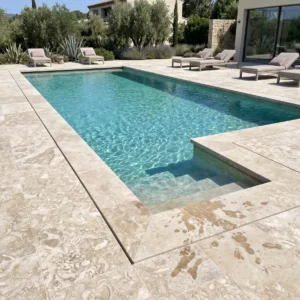
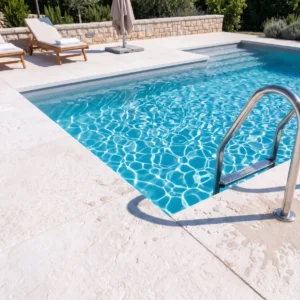
Your pool coping selection interacts directly with your deck paver specification in ways that affect both aesthetics and drainage performance. Travertine coping is the natural pairing for an ivory travertine deck — consistent material through the coping-to-deck transition eliminates the color and texture discontinuity that composite or precast coping creates. The practical benefit is that your drainage slope at the pool edge functions as a continuous surface rather than two materials with different absorption and surface tension behaviors.
Bullnose coping — travertine stone slab cut with a rounded leading edge — is the standard specification for pool perimeters. It eliminates the sharp corner at the pool edge, which matters for both safety and for managing the wet-dry transition zone where the most aggressive chemical and UV exposure occurs. Your coping should overhang the pool bond beam by a minimum of 1.5 inches to direct dripping water away from the pool wall structure.
The PHTA pool deck and coping safety standards establish the technical baseline for coping overhang, slip resistance, and deck-to-pool edge transitions. These standards are the reference point your architect or contractor should use when detailing the coping connection — they establish the minimum performance requirements that insurance and inspection compliance depend on.
Moving Forward
Executing this ivory travertine pool deck guide in the field comes down to disciplined sequencing: base preparation first, drainage design second, material specification third — and never the other way around. The material choice is the easy part. Travertine’s thermal comfort, slip resistance when properly finished, and aesthetic longevity make it a straightforward recommendation for pool decks. What separates installations that age beautifully from ones that need remediation within a decade is everything that happens before the first paver gets set.
As you finalize your project details, consider that the geology behind travertine’s unique performance characteristics is worth understanding — it explains why the material behaves the way it does in outdoor applications. how travertine forms in nature provides context that informs smarter material decisions for demanding installations like pool decks and other exterior paver travertine applications.
Your specification confidence comes from understanding the full picture: base engineering, drainage geometry, finish selection, expansion joint design, and a sealing schedule matched to actual use conditions. Every one of these variables is manageable when you address it at the design stage rather than the remediation stage. When planning a pool deck in a hot, dry climate, Citadel Stone ivory travertine is consistently selected for its surface comfort and proven outdoor durability.
Related reading: ivory travertine vs porcelain tile · porcelain pool tile vs travertine.