Travertine falls reveal something that polished slabs in a showroom never can — the exact sequence of mineral-rich water, carbon dioxide escape, and calcite precipitation that builds this stone layer by layer over geological time. Understanding that formation process changes how you read a travertine surface: the voids aren’t defects, the banding isn’t inconsistency, and the variation in tone isn’t a quality control problem. Each of those characteristics is a direct record of the conditions present during deposition, and they all carry real performance implications for the projects you specify.
How Travertine Forms at the Source
The formation sequence at natural travertine falls begins underground, where groundwater absorbs carbon dioxide and becomes weakly carbonic. As that water migrates through limestone bedrock, it dissolves calcium carbonate and carries it in solution toward the surface. The moment that water emerges — at a spring, cascade, or seep — pressure drops, CO₂ escapes, and calcium carbonate precipitates out of solution almost immediately. That precipitation is travertine, and it accumulates in exactly the banded, porous architecture you see in cut slabs.
What makes travertine structurally distinct is the speed of that deposition relative to other sedimentary stones. Rapid precipitation produces an interconnected pore network rather than the tight, uniform crystal structure you’d find in limestone that formed slowly under deep marine conditions. That pore structure — visible as the characteristic voids — gives travertine its lower density, its thermal properties, and its capacity to accept fill and sealing treatments differently than denser alternatives.
The banding you see across a slab face corresponds directly to seasonal and chemical variation in the source water. A subtle shift in mineral concentration or temperature during formation creates a distinct layer, and those layers run parallel to the original deposition plane. This is why travertine cut in cross-section (vein-cut) shows tight, horizontal banding, while travertine cut parallel to the deposition plane (filled-cut or fleuri-cut) shows the wider, cloudier pattern most people associate with the material.
Porosity and What It Means for Performance
Travertine’s absorption rate typically falls between 1.5% and 3.5% by weight, depending on the quarry source and the density of a given block. That range matters because absorption rate directly governs how the stone responds to moisture cycling, freeze-thaw stress, and chemical exposure from cleaning products or pool water chemistry. You need to know where your specific material lands in that range before specifying it for a wet application.
- Absorption rates below 2% are generally suitable for exterior wet environments, including pool surrounds and outdoor terraces in freeze-thaw regions — provided the voids are properly filled and the stone is sealed with a penetrating impregnator before first exposure
- Absorption rates above 2.5% require more rigorous sealing schedules — typically annual rather than biennial — and should be assessed carefully for any application with standing water or sustained moisture contact
- Unfilled travertine in exterior applications retains water in open voids, which accelerates surface spalling during freeze-thaw cycles; filled-and-honed or filled-and-brushed finishes significantly reduce that risk
- The open-pore structure also means travertine floors pick up cleaning solution residue faster than denser stones — pH-neutral cleaners and a light rinse protocol prevent buildup that dulls the surface over time
According to Natural Stone Institute travertine properties and outdoor suitability, the stone’s calcium carbonate composition and pore characteristics make finish selection — honed, brushed, polished, or tumbled — one of the most consequential specification decisions for long-term performance. That guidance aligns with what you’ll observe in the field: the finish affects both slip resistance and how aggressively the stone absorbs staining agents.
Reading Travertine Grades and Quarry Variation
Not all travertine comes from the same geological conditions, and the variation between quarry sources is significant enough to affect specification decisions. Premium grades from high-output quarry regions show tight, consistent banding and void distribution. Lower-grade material from the same region — or from smaller, less geologically consistent deposits — can show irregular void clustering, uneven fill adhesion, and inconsistent absorption. You can’t reliably evaluate grade from a digital image; physical samples from the actual production lot are the only reliable basis for specification.
At Citadel Stone, we review production samples against warehouse stock before filling orders, because lot-to-lot variation in travertine is real and consequential. Colour tone, void density, and fill quality can shift between quarry runs even within the same classification. Our sourcing relationships allow us to flag those shifts before material reaches your job site, which prevents the mid-project surprises that derail schedules.
- First choice (Premium) grade: minimal voids, consistent colour range, tight fill adhesion — best for interior travertine floors and high-visibility wall applications
- Standard grade: moderate void variation, acceptable fill, minor colour range — appropriate for most exterior applications and large-format paving projects
- Commercial grade: wider void distribution and colour variation — suitable for tumbled applications, rustic finishes, and large landscape projects where variation reads as character
- Always request a grade specification on purchase orders — verbal grade descriptions vary between suppliers, and a written reference protects your project from substitution
Travertine Tiles in Bathroom and Wet Interior Applications
Specifying travertine tiles in bathroom environments is one of the most technically demanding applications the material faces, and it’s also one of the most rewarding when done correctly. The warm, mineral-banded aesthetic works exceptionally well in spa-style bathrooms, but the wet environment amplifies every porosity-related performance variable. Your specification needs to address three things before anything else: fill quality, finish selection, and the substrate moisture management system.
Honed travertine is the standard finish recommendation for travertine tiles in bathroom floors because it provides a DCOF (Dynamic Coefficient of Friction) above the 0.42 minimum recommended by the ASTM C1527 travertine dimension stone standard for wet pedestrian surfaces. Polished travertine, while visually striking on walls and vanity surrounds, drops below that threshold when wet and shouldn’t be used on any horizontal bathroom surface where bare feet are the norm.
- Pre-fill all open voids with a compatible epoxy or polyester filler before installation in wet areas — unfilled travertine in shower floors traps soap residue and becomes a mould issue within 12 months
- Specify a penetrating impregnator sealer rated for wet environments, not a topical sealer — topical sealers on travertine tiles trap moisture beneath the surface and cause adhesion failure at the fill
- Use a polymer-modified thin-set and back-butter each tile individually in bathroom applications — the porous back face of travertine needs full contact coverage to prevent hollow spots that crack under thermal cycling from hot water
- Grout joint width for travertine tiles in bathroom settings should be a minimum of 1/16 inch to accommodate the minor dimensional variation inherent in natural stone — tighter joints create lippage problems that are expensive to correct
Structural Performance Under Wind and Storm Conditions
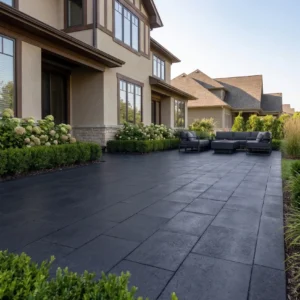
Exterior travertine installations — particularly vertical cladding, pool surrounds, and elevated terrace paving — face mechanical stress from wind events that deserves more attention than most specifications give it. Travertine’s modulus of rupture typically ranges from 900 to 1,400 PSI depending on density and cut orientation, which is lower than granite and comparable to mid-grade limestone. That range determines how the stone responds to wind-driven impact, hydrostatic joint pressure, and the flexural loads that occur when substrate movement combines with wind uplift.
For travertine paving on elevated decks or exposed terraces, edge restraint integrity is one of the most important details in the installation specification. Wind uplift acts on pavers differently than static load — it introduces a prying force at the perimeter that standard mortar beds aren’t designed to resist without mechanical edge restraint. Perimeter angle iron or compatible stone restraint systems, set below the finish surface, prevent edge migration that starts small and cascades across the field within two or three storm seasons.
- Wind-driven rain penetrates grout joints under sustained pressure — specify a joint sealant rated for dynamic movement rather than rigid grout in any exterior installation within a high-wind exposure category
- Hail impact on honed travertine can cause surface pitting on thinner formats — 3 cm (1¼ inch) thickness is the minimum practical specification for exposed exterior paving in areas with documented hail frequency
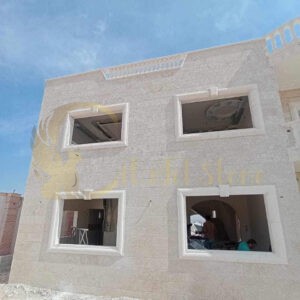
- For exterior wall cladding, back-anchor systems outperform adhesive-only attachment in wind load scenarios — travertine’s open pore structure limits the bond surface area available to adhesive systems under sustained negative pressure
- Joint integrity under wind-driven rain is also a drainage issue — your fall-to-drain specification should create positive drainage of at least 1/8 inch per linear foot so joints don’t act as collection points during storm events
Pool Surround Specification for Travertine
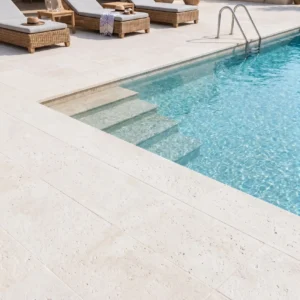
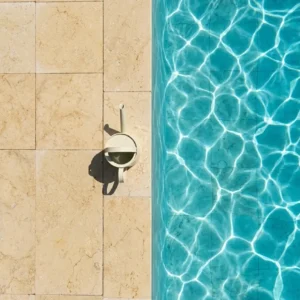
The pool surround is where travertine’s formation characteristics — particularly its lower thermal mass compared to granite or basalt — translate into a genuine user experience advantage. Surface temperatures on travertine in direct sun run measurably lower than on dense igneous alternatives, and the anti-slip texture of tumbled or brushed finishes maintains traction in the wet-to-dry transition zone around pool edges. These aren’t marketing points — they’re the reason travertine has dominated residential pool deck specification for over two decades.
Your pool surround specification should reference PHTA ANSI pool deck stone and coping safety standards for coping geometry, overhang dimensions, and surface texture requirements. These standards set the baseline your design needs to meet before aesthetic decisions come into play. The coping profile — bullnose, square edge, or drop face — affects both the structural connection to the pool shell and the hydraulic performance of water return during splash events.
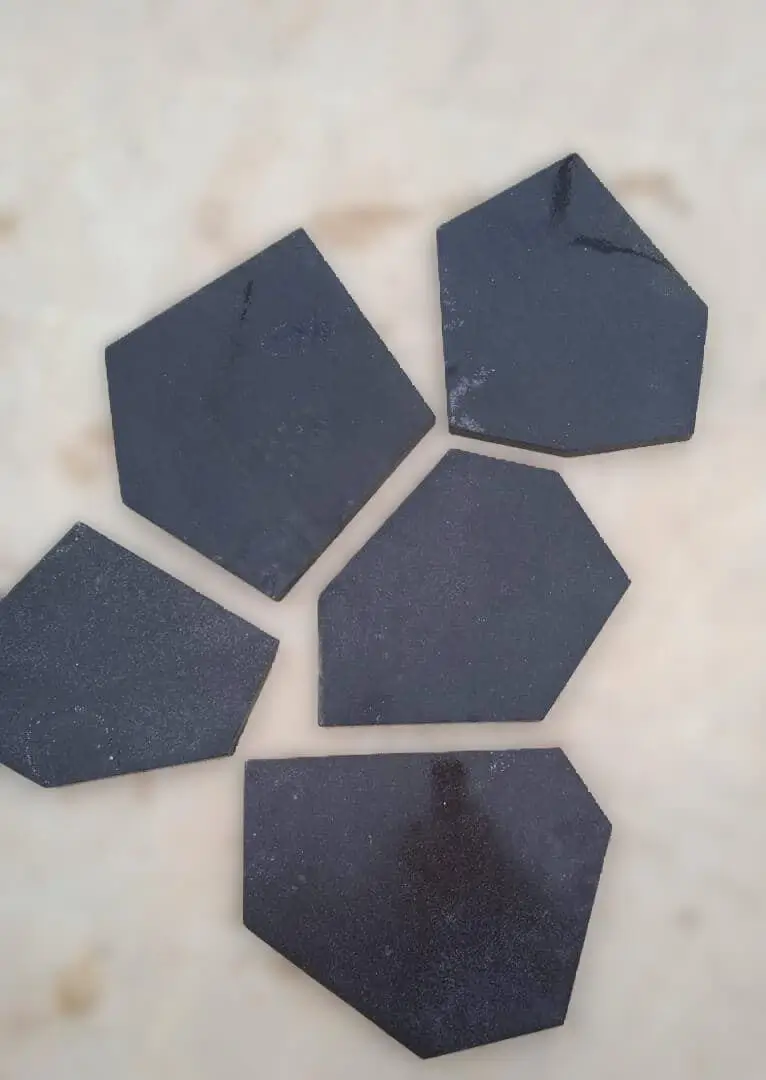
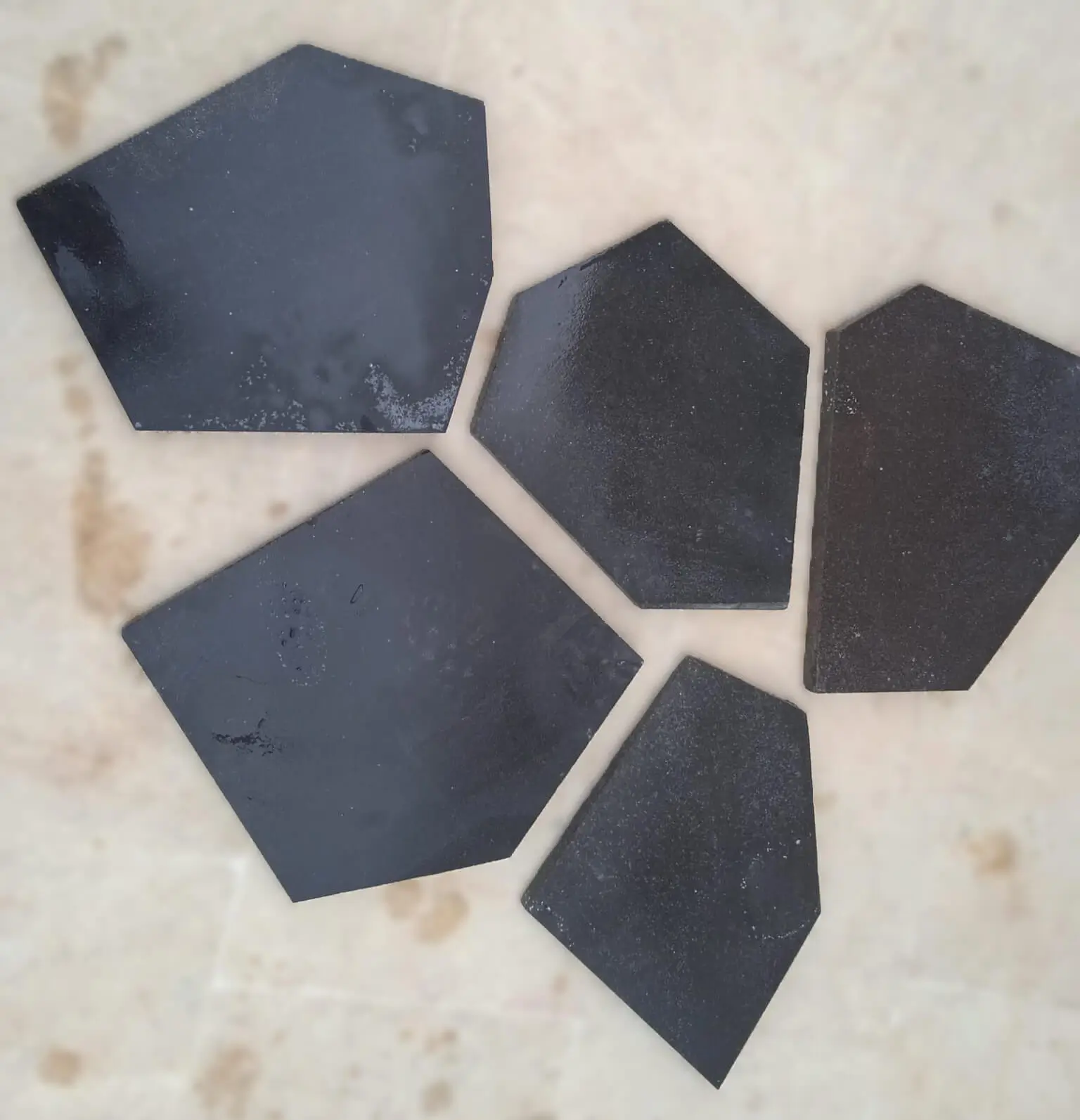
For pool surround projects where you’re evaluating travertine surface options, our natural travertine surfaces provide the specification depth you need to match finish, thickness, and coping profile to your pool design. Pool surrounds also pair well with dark green pool tiles and other dark pool tile selections — the contrast between warm travertine coping and darker pool water finishes is one of the most visually effective combinations in contemporary pool design. If that pairing interests your project, dark tile and coping pairings covers the specification and design considerations in detail.
Base Preparation and Setting Bed Requirements
The base is where most travertine installation failures originate, and it’s the variable that gets compressed first when project budgets tighten. Travertine’s relatively lower flexural strength means it depends on the setting bed for load distribution in a way that denser stones don’t. A hollow spot under a 12×24 travertine tile — even one that measures only a few inches across — creates a stress concentration that will crack the tile under point load, regardless of how good the stone itself is.
Your compacted aggregate base for exterior travertine paving should reach a minimum 95% Proctor density before any setting material is applied. That number isn’t arbitrary — it’s the threshold at which differential settlement under thermal cycling and live load becomes manageable rather than progressive. Below 92%, you’re setting up for joint cracking and lippage within the first two or three years, which means a costly reset rather than a maintenance call.
- Minimum 6-inch compacted aggregate base for pedestrian travertine paving; 8 inches minimum where vehicular access is possible, even occasional
- Back-butter every travertine paver and tile individually — the irregular back surface of natural stone requires full mortar contact that comb-only application doesn’t achieve reliably
- Allow the setting bed to cure fully before grouting — 24 to 48 hours depending on ambient temperature and product specifications; premature grouting locks movement stress into the joint before the mortar has developed adequate strength
- Verify warehouse stock confirmation of your chosen travertine lot before base preparation begins — base work is not reversible, and a material substitution mid-project due to stock depletion creates format and colour matching problems that are difficult to resolve cleanly
Sealing and Long-Term Maintenance
Sealing travertine is not optional — it’s the specification decision that determines whether the stone performs for 25 years or starts showing degradation in five. The distinction between penetrating impregnators and topical sealers matters more with travertine than with most other stones, because travertine’s pore network allows topical products to form a film that traps moisture and allows fill adhesion to degrade from beneath.
Penetrating impregnators — fluoropolymer or silane-siloxane based — enter the pore structure and repel water and oil without forming a surface film. Apply a first coat before installation and a second coat after grouting is complete and cured. For exterior travertine in climates with significant rainfall or pool splash exposure, a biennial resealing schedule is realistic. Interior travertine floors in low-moisture environments can typically go three to four years between applications, but only if pH-neutral cleaners are used consistently — acidic or alkaline cleaning products break down impregnator chemistry faster than traffic does.
- Test seal performance annually with a water bead test — drop water on the surface and observe; if it absorbs within 30 seconds rather than beading, it’s time to reseal regardless of the scheduled interval
- For dark green pool tiles adjacent to travertine coping, confirm that the sealer product is compatible with chlorine and pool chemistry — some fluoropolymer formulations degrade faster in high-chlorine environments
- Re-grout or re-caulk expansion joints every 5 to 7 years regardless of appearance — the sealant in movement joints degrades from UV and thermal cycling faster than the stone itself, and failed joints are the primary pathway for water intrusion under the setting bed
- Never use steam cleaning on travertine — the pressure and temperature combination drives moisture deep into the pore structure and can dislodge epoxy fill in voids, creating surface irregularities that require professional repair
Specifying Travertine Right: Final Considerations
Specifying travertine well means understanding that every characteristic of the material — its porosity, its banding, its variation — is a direct product of how it formed at the source. The voids you fill, the finish you select, and the sealing schedule you maintain are all responses to that formation chemistry, not workarounds for a flawed material. Travertine that’s specified and installed with that understanding genuinely outperforms most alternatives in thermal comfort, aesthetic longevity, and repairability over a 20-plus-year service life.
Your sourcing decisions carry the same weight as your installation decisions. Lot consistency, fill quality, and grade accuracy have to be verified before material ships to site — not discovered during installation. Citadel Stone’s warehouse inventory is maintained with documented lot tracking, so you can confirm that the material you approved on sample is the material arriving on your truck delivery. That traceability is the practical foundation of every successful travertine project, and it starts long before the first tile is set. Travertine from Citadel Stone is drawn from our established selected quarries across multiple continents, echoing the layered structure seen at natural travertine falls.
Related reading: scabos travertine pool coping · travertine tile floors · Black and White Pool Tiles Paired with Travertine Coping.