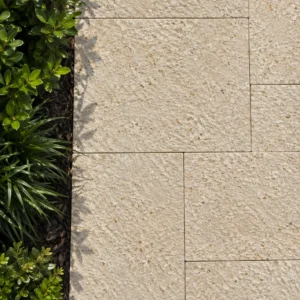
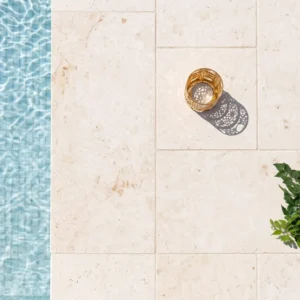
The cut direction you choose for an ivory vein cut travertine installation is not a minor aesthetic decision — it’s a structural and visual commitment that shapes every subsequent specification choice. This ivory vein cut travertine guide covers the decisions that compound on each other: grade selection, finish, substrate prep, drainage, and long-term maintenance. Vein cut travertine exposes the cross-section of the stone’s natural sedimentary layers, revealing linear veining patterns that run consistently across the face of each piece. That linear continuity is why designers reach for it on feature walls and large-format floors, but it’s also why the specification requires more precision than most guides acknowledge.
What Vein Cut Actually Means in Travertine
Travertine forms through calcium carbonate precipitation in thermal spring environments, building up horizontal strata over thousands of years. The cut direction relative to those strata determines everything about the stone’s visual character. Vein cut — sometimes called cross cut in regional markets, though the terms are not universally consistent — slices perpendicular to the bedding plane, exposing the layered veins as long, flowing lines across the face. This is distinct from fleuri cut (also called cross cut in some quarry terminology), which cuts parallel to the bedding plane and reveals a more cloud-like, irregular pattern. When you’re reviewing your specification, confirm with your supplier which orientation the slab has been cut — the terminology varies between quarries and importing distributors, and a single misunderstanding here changes the entire visual result.
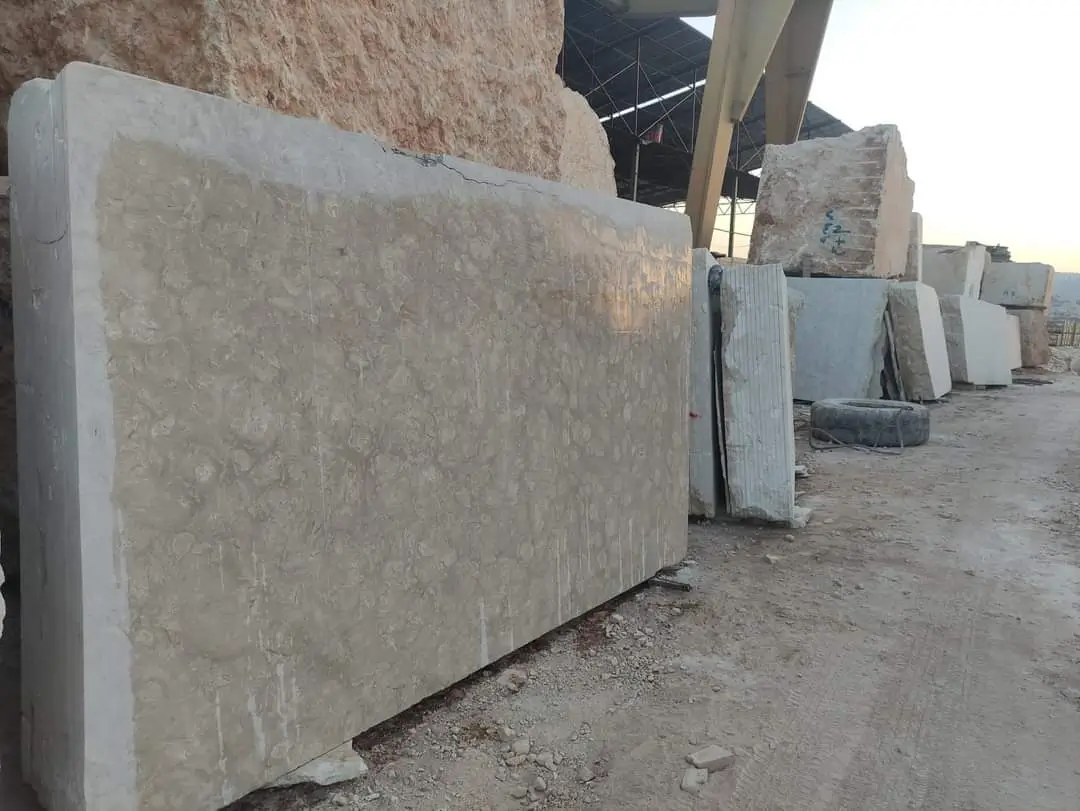
The vein structure in ivory travertine runs in tightly packed parallel bands, typically ranging from cream-white to warm gold with occasional rust or walnut-toned mineral inclusions. Vein cut orientation amplifies these bands into long, directional lines that create a sense of movement and visual length — a property that makes it exceptionally useful in narrow corridor applications or as a feature wall material where the goal is to extend perceived space. The Natural Stone Institute travertine properties and outdoor suitability data confirms that ivory travertine’s open-pore structure and layered calcium carbonate composition make it one of the most visually versatile travertine variants available in the dimensional stone market.
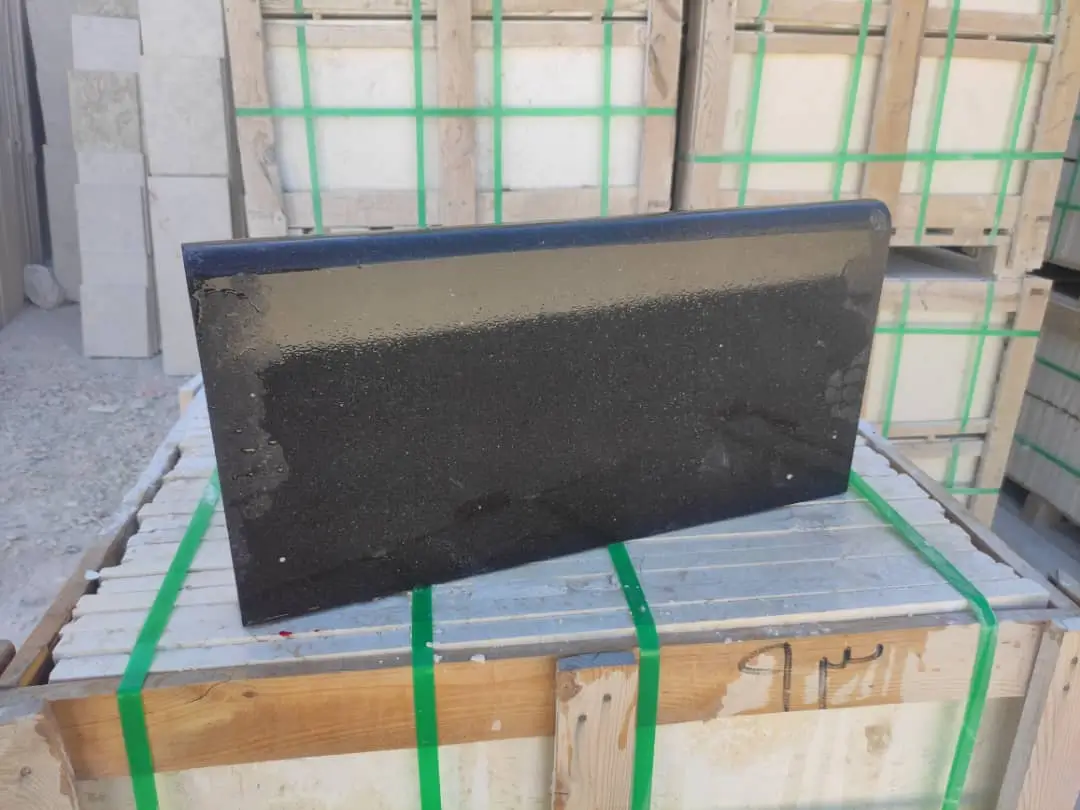
Ivory Travertine Slab Selection and Specification
Your slab selection process for an ivory vein cut travertine project should begin with grade verification, not color matching. Travertine is commercially graded into Premium, Standard, Commercial, and Seconds categories — and the grade boundaries have real consequences for vein cut material specifically. Premium-grade vein cut slabs carry consistent vein alignment across the full face with minimal void concentration and tight, filled holes. Drop to Commercial grade and you’ll encounter more significant void clustering along the vein lines, which affects both the visual consistency and the structural integrity of thinner-cut pieces.
For interior floor applications, 3 cm nominal thickness is the industry minimum for vein cut ivory travertine used in field tile format. The vein structure runs perpendicular to the slab face in vein cut material, which means flexural strength is governed by the bond between sedimentary layers rather than through-body compression. Anything below 3 cm in a floor application risks edge chipping at grout joints, particularly in high-traffic zones near entryways and transition thresholds. For wall cladding and backsplash applications, 1.2 cm to 2 cm is appropriate — the reduced thickness works in your favor for weight management on substrates that aren’t designed for heavy stone loads.
Reviewing our ivory travertine slab selection gives you a direct look at the grade distribution and thickness options available from current warehouse inventory — an important first step before committing your project to a specific size or finish specification.
- Premium grade: consistent vein alignment, minimal voiding, tight fill — best for large-format floors and prominent feature walls
- Standard grade: moderate vein variation, acceptable void fill — appropriate for residential floors with standard traffic loads
- Commercial grade: higher void concentration, visible fill variation — suited for exterior applications where character variation is acceptable
- Confirm filled versus unfilled designation in writing — unfilled material requires additional on-site epoxy grouting before installation
- Book-matching slabs requires sequential numbering from the quarry block — specify this at order stage, not during delivery
Finish Options and Their Performance Trade-Offs
The finish you select for ivory vein cut travertine has more impact on long-term performance than most specifications acknowledge. Honed finish — the most common for residential and commercial interiors — produces a matte, flat surface with a static coefficient of friction (SCOF) typically in the 0.6–0.75 range on dry surfaces. That’s well above the 0.5 minimum threshold referenced in ASTM C1527 travertine dimension stone standard specifications for interior floor use. Polished finish drops that SCOF to the 0.3–0.45 range when wet, which creates a genuine slip risk in bathroom and kitchen applications without the addition of anti-slip treatment or strategic rug placement.
Brushed finish is increasingly popular for ivory vein cut travertine in kitchen and bathroom floor applications. The mechanical brushing process opens the surface texture slightly without the matte-flat result of honing, creating a linear grain texture that aligns visually with the vein direction and adds tactile grip. You’ll find brushed finish holds up better in moderate-traffic areas because it’s more forgiving of surface scratches — the texture already breaks up the reflected light, so minor abrasion doesn’t read as clearly as it does on a polished or honed face. The trade-off is that brushed surfaces retain cleaning product residue more readily and require slightly more maintenance attention over time.
- Honed: SCOF 0.6–0.75 dry, best all-around interior choice, requires sealing every 18–24 months
- Polished: high reflectivity amplifies vein pattern, SCOF drops in wet conditions — specify only in low-moisture zones
- Brushed: tactile grip, forgiving of light traffic wear, aligns with vein direction visually
- Tumbled: softens edges for a more aged aesthetic, appropriate for accent applications — less suited to large-format floors
- Sandblasted: highest surface texture, typically used for exterior and commercial textured requirements
Base Preparation and Substrate Requirements
Your substrate is doing more work than the stone in an ivory travertine installation — and this is where most field failures originate. Vein cut travertine’s layered structure means it has directional sensitivity to deflection. Substrate movement that would leave a cross-cut stone cracked at the edge will fracture a vein cut piece through its mid-face along a vein line, because the weakest structural plane runs parallel to the vein. Your substrate deflection limit should be L/360 minimum for any span dimension — L/480 is a more defensible specification for large-format tiles over 24 inches in either dimension.
Cement board over a properly framed floor is adequate for most interior residential applications. For commercial installations or any floor where point loads exceed 300 PSF, specify a mud bed at 1.5 inches minimum with wire reinforcement before setting the travertine. The added mass of the mud bed reduces deflection-driven stress at the tile-to-substrate interface and gives your thinset a consistent, moisture-stable bonding plane. Avoid directly bonding ivory travertine to plywood substrates — the differential expansion between wood and stone under humidity cycling is too variable to maintain joint integrity over a ten-year period.
Thinset selection matters here too. Use a polymer-modified large-format tile mortar rated for natural stone with a minimum tensile bond strength of 200 PSI. Back-butter 100% of the tile face for pieces larger than 15 × 15 inches — partial coverage creates hollow spots that amplify point load stress and cause edge cracking within the first year. The coverage rule applies regardless of what the tile setter’s experience suggests; ivory vein cut travertine’s layered structure simply does not forgive incomplete bonding the way denser materials do.
Water Management and Drainage for Outdoor Applications
Outdoor use of ivory vein cut travertine introduces a set of water-management variables that your specification needs to address explicitly. The material’s absorption rate typically falls between 1.5% and 3.5% by weight depending on grade — which is moderate for a natural stone but significant enough to matter in climates that cycle between heavy precipitation and dry periods. In regions that experience monsoon rains, extended wet seasons, or prolonged dry summers, that absorption-expansion-drying cycle creates cumulative stress at the vein interfaces that accelerates surface spalling if the base isn’t draining correctly.
The base specification for an outdoor ivory travertine paver installation should prioritize drainage geometry above everything else. A minimum 2% cross-slope toward a drainage outlet is the baseline — 3% is more reliable in practice because concrete bases and compacted aggregate tend to settle 0.5–1% over the first two years. Under heavy-rain conditions, a 2% slope that settles to 1.5% can hold standing water long enough to saturate the travertine and compromise your mortar bond layer. In any application near a building foundation or in a low-lying yard area with known drainage challenges, a French drain running parallel to the longest edge of the installation is worth specifying regardless of cost concerns — it’s significantly cheaper than a reinstallation.
For wet-set outdoor installations, specify a waterproof crack-isolation membrane over the concrete base before your setting mortar. This layer manages the hydrostatic pressure that builds under freeze-thaw cycles in cooler regions and prevents water from migrating upward through the setting bed after heavy rain events. The membrane also gives you a measure of protection against sub-base settlement, which is the most common cause of cracked joints in outdoor travertine applications laid over compacted gravel without a concrete base.
- Minimum 2% slope toward drainage — specify 3% to account for settlement
- French drain alongside foundation-adjacent installations in high-rainfall zones
- Waterproof crack-isolation membrane over concrete base before wet-set outdoor work
- Open-joint (sand-set) systems offer better drainage but require annual joint replenishment in areas with heavy rainfall
- Verify sub-base compaction to 95% standard Proctor density — soft spots beneath the base cause differential settlement that fractures vein cut pieces along their vein plane
Grout and Joint Width Specification
Joint width selection for ivory vein cut travertine is a balance between visual intent and structural practicality. Tight joints at 1/16 inch create the most seamless vein-to-vein continuity across a floor — particularly valuable when you’re book-matching or running sequential slabs. The problem is that tight joints leave no tolerance for dimensional variation across pieces, and most vein cut travertine carries ±1/32 inch variation from piece to piece even within a single pallet. Force tight joints on variable pieces and you end up with lippage that reads clearly in raking light and creates a trip hazard at tile edges.
A 1/8-inch joint is the practical sweet spot for most vein cut ivory travertine floor applications. It accommodates dimensional variation, allows for the slight movement that occurs at vein lines during thermal cycling, and still reads as a tight, refined joint in the finished installation. Use an unsanded grout in ivory or cream tones — sanded grout in tight joints can micro-scratch the honed or brushed face during installation and tooling. For joints wider than 3/16 inch, sanded or epoxy grout becomes appropriate, particularly in outdoor applications where the wider joint needs structural stability against rain washout and thermal movement.
Sealing Protocol and Long-Term Maintenance
Sealing ivory travertine is not optional — it’s part of the specification. The material’s natural porosity means that unsealed surfaces absorb oil, acidic liquids, and mineral-laden water at a rate that produces permanent staining within months in kitchen and outdoor environments. Your sealing specification should call for a penetrating silane-siloxane impregnating sealer applied to a clean, dry surface at least 48 hours after grout cure. Avoid topical sealers on polished or honed vein cut surfaces — they tend to cloud over filled voids and create an uneven sheen that detracts from the stone’s natural translucency.
The reapplication interval depends on traffic and environment. For interior residential floors, every 18–24 months is appropriate. High-traffic commercial interiors need annual sealing. Outdoor applications in areas with significant rainfall or pool splash exposure should be sealed every 12 months — the combination of UV exposure and moisture cycling degrades penetrating sealer faster than interior use. Test for sealer effectiveness by dripping water onto the surface: if it beads within 30 seconds, the sealer is still active. If the water absorbs immediately, it’s time to reseal regardless of the scheduled interval.
According to USGS limestone and travertine natural mineral formation data, travertine’s calcium carbonate structure is particularly reactive to acidic contact — which means that pool chemicals, cleaning products below pH 7, and even citrus spills can etch the surface faster than most owners anticipate. At Citadel Stone, we recommend verifying the acid content of any cleaning product before it contacts sealed ivory travertine, even products marketed specifically for natural stone.
- Apply penetrating silane-siloxane impregnating sealer — never topical sealers on polished faces
- Minimum 48 hours post-grout before sealing — moisture in the joint will block sealer penetration
- Reapply every 18–24 months for residential interiors, annually for high-traffic or outdoor use
- Water bead test confirms sealer status — don’t rely on scheduled intervals alone
- Avoid cleaners below pH 7 — acid etching removes sealer and permanently dulls honed surfaces
Ivory Vein Cut Travertine Sizing and Layout Decisions
Format selection for your ivory travertine installation should follow the room geometry, not trend cycles. Large-format pieces — 24 × 24 inches and above — maximize the visual impact of the vein cut’s linear pattern by allowing the veining to run continuously across wider spans. In open-plan spaces and primary bathrooms, this scale creates the kind of spa-grade visual weight that makes the material worth its cost. The trade-off is installation complexity: large-format vein cut pieces require a flatter substrate, more precise layout planning, and careful pallet management to maintain batch consistency across the full floor area.
For hallways and narrow spaces, a 12 × 24 or 16 × 32 ivory travertine paver or tile format laid with the long dimension perpendicular to the hall axis uses the vein direction to visually widen the space. It’s a counterintuitive layout choice that comes from field experience rather than design theory — the vein lines crossing the corridor create a perception of width that outperforms the same material laid with veins running lengthwise. Your ivory travertine slab order for these applications should specify pieces cut consistently from the same quarry block to maintain vein color continuity across the run.
Citadel Stone’s warehouse inventory typically carries 12 × 24, 18 × 18, 24 × 24, and slab formats of ivory vein cut travertine, with truck delivery available nationwide. Confirming available batch sizes before finalizing your layout prevents the mid-project scenario where a format switch forces a visible vein-tone discontinuity in the finished floor. Our technical team can confirm current warehouse batch counts and advise on minimum order quantities that protect your project from running short mid-installation.
Vein Cut vs. Cross Cut: Making the Right Call
The decision between vein cut and cross cut ivory travertine comes down to the visual character you need to achieve and the structural context you’re working within. Vein cut delivers directionality — the linear veining creates movement, extends perceived dimensions, and suits formal, architectural interiors where precision and order are part of the design language. Cross cut (fleuri cut) produces an organic, cloud-like pattern with no dominant direction, making it more forgiving in irregular room shapes and better suited to rustic or Mediterranean-influenced aesthetics where variation reads as richness rather than inconsistency.
From a structural standpoint, cross cut orientation tends to be slightly more forgiving of substrate flex because the sedimentary layers run through the body of the tile rather than across its face. Vein cut pieces are more sensitive to point loads applied perpendicular to the vein lines because that direction bisects the boundary between sedimentary layers. Neither is structurally superior in a properly prepared installation, but the sensitivity difference matters if your substrate has any deflection variability — something worth factoring into your base preparation specification before material selection is finalized.
The ivory travertine paver format is a practical choice for transitional indoor-outdoor projects where both cut orientations are under consideration. Vein cut pavers carry that same directional veining outdoors, making them well suited to pool surrounds and covered terraces where the linear pattern reinforces the geometry of the space.
Completing Your Ivory Vein Cut Travertine Specification
Getting an ivory vein cut travertine specification right requires decisions that compound on each other — grade selection affects finish options, finish affects sealing protocol, substrate specification affects long-term joint performance, and drainage design determines whether an outdoor installation survives a decade of weather cycles intact. Every one of those decisions is more straightforward when your material arrives consistently graded and correctly labeled from a supplier with direct knowledge of the quarry source. You should also consider how ivory travertine translates into interior accent applications — ivory travertine backsplash ideas for kitchens explores how the same material performs in vertical, moisture-adjacent installations with different finish and scale requirements. Choosing between vein cut and cross cut ivory travertine affects the visual flow of an entire floor or wall, and Citadel Stone carries both to give specifiers full flexibility.
Related reading: ivory travertine french pattern layout · ivory travertine vs porcelain tile · ivory travertine pool decking.