

















































The British Virgin Islands import almost everything that goes into a building. The Territory supports small rum distillation, construction and boat building industries, and most industrial products arrive by sea. That single line explains why a paving specification here is really a logistics specification with a stone attached to it. A contractor working in Road Town rarely loses money on the price per square foot. He loses it on a pallet that lands three weeks after the masons were booked, on a slab format that cannot be carried up a switchback driveway on Tortola’s north side, or on a shortfall of forty pieces that has to wait for the next sailing. Everything below is written around that reality rather than around a product catalog.
Two further facts separate these islands from every neighboring territory in the region. The British Virgin Islands have used the US dollar since 1959, so nothing you are quoted needs converting and no exchange-rate clause belongs in your contract. And the Territory levies no VAT, no GST, no sales tax and no consumption tax of any kind. Landed cost here is the stone, the ocean freight, the insurance, the import duty assessed by HM Customs and the handling, with no further percentage added at the point of sale. That is a genuinely different arithmetic from the eastern Caribbean islands, and it is worth understanding before you compare a delivered price in Road Town with a delivered price anywhere else in the region.
Direct Ocean Freight From Florida to Port Purcell
The most useful logistics fact about the British Virgin Islands is that US-origin cargo does not have to be handed between carriers at a hub port on the way in. Tropical Shipping runs a direct service from Palm Beach, Florida to Tortola, discharging at Purcell, with vessels departing on Fridays, arriving on Thursdays, on a six-day transit. The service carries both full container loads and part loads. For a stone order that means the pallets loaded in Florida are the same pallets lifted off at Port Purcell: one carrier, one bill of lading, one set of handling, and a schedule you can actually build a crew around.
The port is operated by the British Virgin Islands Ports Authority, whose offices sit at #2 Port Purcell Road, Road Town, Tortola. Port Purcell is the main commercial cargo port and a designated customs station. Sailing schedules do change, so we confirm the current departure and arrival days at the time of booking rather than repeating a timetable that was accurate last season. On a job of any size the sailing calendar should be the first page of the program, not the last, because every other date on the job is derived from it.
- Book to a named sailing date rather than to a transit time, because a Friday cut-off missed by two hours costs a full week.
- Decide between a full container and a part load early, since shared loads are handled more times and released more slowly.
- Send the packing list with piece counts and pallet weights before the container closes, not after it sails.
- Build one spare sailing into the gap between delivery and the day the setters start work.
- Keep a small overage on the order so a shortfall never turns into a wait for the next sailing.
Import Duty, CAPS and the Missing Sales Tax Layer
The British Virgin Islands charge no VAT, no GST and no sales tax. That is unusual in the Caribbean and it materially changes what a stone terrace costs by the time it is on the ground. It does not, however, mean imports arrive untaxed. Import duty is provided for under the Customs Management and Duties Act, 2010 and its amendments, and it is assessed by HS classification. We do not publish a duty percentage for stone, because the rate depends on how your consignment is classified and because published schedules move. Ask HM Customs, or the person handling your entry, to confirm the classification and the rate against your actual invoice before you commit a budget to paper.
Declarations are completed and submitted online through CAPS, the Customs Automated Processing System. That is worth spelling out, because the eastern Caribbean islands run a different platform entirely and paperwork prepared for one will not simply drop into the other. Once the entry is processed you proceed to a designated customs station, either Port Purcell, Road Town or the Airport, to settle outstanding duties and port fees and collect the cargo.
- Commercial invoice showing the value of the goods, the freight and the insurance separately.
- Packing list with piece counts, pallet count and gross weight for each pallet.
- Bill of lading that matches the invoice line for line.
- HS classification agreed in advance rather than argued at the counter.
- A named person on island who will make the CAPS submission and clear the entry.
Two things regularly get confused. The British Virgin Islands have been an associate member of CARICOM since 1991 rather than a full member, so the Common External Tariff does not govern imports here and the Territory sets its own tariff. And the US$10 Environmental and Tourism Levy, introduced on 1 September 2017, is collected from arriving passengers at ports of entry. It is not a charge on your cargo, and anyone who bills it against a container has copied it from the wrong page.
Onward Delivery to Virgin Gorda, Anegada and Jost Van Dyke
Tortola is the gateway rather than the destination for a great many jobs. The Territory is an archipelago whose four main islands are Tortola, Virgin Gorda, Anegada and Jost Van Dyke, and stone bound for the others moves on from Tortola by onward inter-island delivery. That second leg is short in miles and long in consequences. It adds a handling cycle, it adds a booking that has to line up with the arrival at Purcell, and it is where damage happens, because a pallet that survived a six-day ocean passage sealed inside a container is far more vulnerable on an open deck for the second leg.
Plan around it rather than discover it. Order the whole area of a Virgin Gorda terrace in one consignment so that shade and thickness stay consistent and nothing has to chase the job across two islands. Mark pallets clearly for their final island and for their sequence on site, so the first pallets off the boat are the first ones the setters need. Keep the spares on the same trip, because sending four square feet of replacement stone by itself later is the most expensive stone you will ever buy.
- Confirm the onward booking before the container is released at Purcell, not after.
- Wrap and band every pallet for a second lift, even the ones going twenty minutes away.
- Number pallets in laying sequence so the site never opens the wrong one first.
- Add a small overage on island jobs, since the cost of a surplus is trivial next to a second freight leg.
- Where a site is remote or low density, agree who provides offload equipment before the stone moves.
Hillside Access, Truck Size and the Water a Site Will Need

Tortola is steep and mountainous, with housing dispersed across the hillsides, and the same terrain that makes public water distribution difficult makes stone delivery difficult. Access to a villa site is often a narrow switchback with a gate pinch point, a turning area barely wider than the vehicle, and a final stretch too steep for a loaded forklift. Decide early what size of truck can physically reach the slab, whether the stone will be craned, forked or barrowed the last hundred feet, and whether pallets should be built at half height so two people can move them by hand. Vehicles here drive on the left while most of them are left-hand drive, imported from the United States, so the equipment on site is US-spec and the turning geometry is not what a European crew expects.
The other site constraint is water, and visitors rarely see it coming. Rainwater harvesting is the practical water supply across the Virgin Islands, with more than 90% of the population collecting rain from rooftops into cisterns usually built into the house foundation, backed by desalination on Tortola. Water for mixing, cutting and washing down is therefore a real line in the budget and not a tap that runs for free. Cut dry where it is safe to do so, cut off site where possible, and agree in advance whose water is being used. Browse the full paver range with those handling limits in mind, because the right unit size is the one your access can actually receive.
- Measure the tightest gate and the tightest bend before choosing a slab size.
- Ask for half-height pallets wherever hand handling is unavoidable.
- Confirm offload equipment and an operator for the delivery window itself.
- Agree a water source for cutting and washdown before the first delivery arrives.
- Set down a hard standing for pallets that will not sink or slide on a slope.
Exposure Zones Across the Territory
Exposure is not uniform across these islands, and specifying as though it were is the commonest mistake an overseas designer makes. The north-facing coasts take open Atlantic weather and constant salt-laden air. The southern shores facing the Sir Francis Drake Channel are calmer and more sheltered but still fully marine. Ridge tops and saddles accelerate wind in ordinary weather, let alone extreme weather, and a terrace on an exposed shoulder behaves nothing like a courtyard cut into the lee of the same hill. Shade matters too, since an unshaded west-facing terrace takes a punishing afternoon while a north-facing gallery may never dry out fully in a wet week.
Hurricane Irma passed directly over the British Virgin Islands on 6 September 2017 as a Category 5 storm, with sustained winds reported up to 185 mph. Around 85% of the housing stock, roughly 4,200 homes, was damaged or destroyed, property damage was estimated at US$3.6 billion, and Hurricane Maria passed to the south as a Category 5 just two weeks later. Recovery was slow and hard won. The lesson recorded afterward was that buildings constructed to current codes performed far better than older stock, and that the critical weaknesses lay in design, construction and maintenance, particularly in roofing structures. Government committed publicly to review and upgrade codes on the stated view that the Territory must build for Category 5 and beyond.
We do not quote a design wind speed for the British Virgin Islands, and you should be wary of any supplier who does, because the figure that surfaces most often online belongs to the neighboring US Virgin Islands, which is a separate jurisdiction with its own code. Your registered architect works to the standard in force. What can be said about hardscape is specific and uncontroversial, and it comes down to mass, restraint and detailing.
- Favor substantial unit thickness in exposed positions rather than thin, light units.
- Bed and restrain paving on wind-exposed terraces instead of laying it loose.
- Detail edges positively, because a lifted edge is where a surface starts to fail.
- Keep loose gravel and light objects out of the debris path around glazing.
- Specify low absorption wherever salt spray is constant, not only where waves reach.
Formats, Thicknesses and Finishes That Suit These Islands
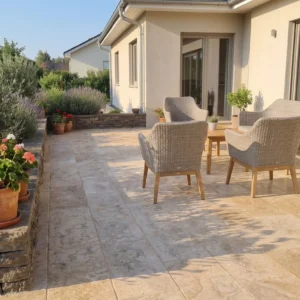
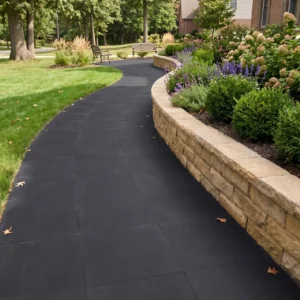
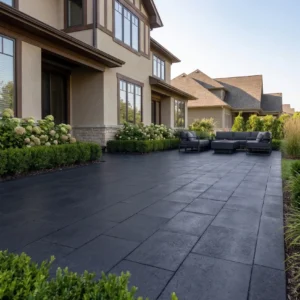
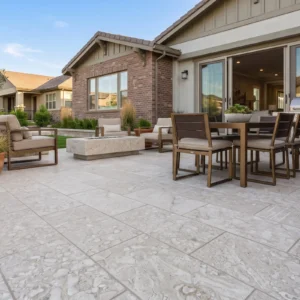
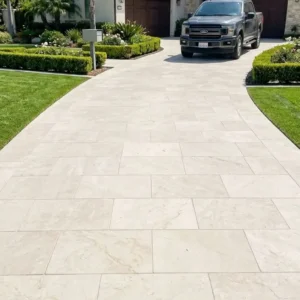
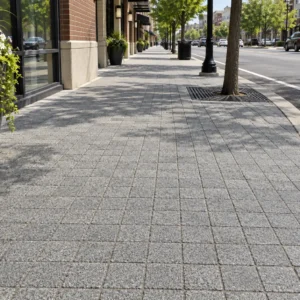
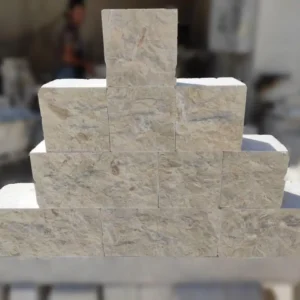
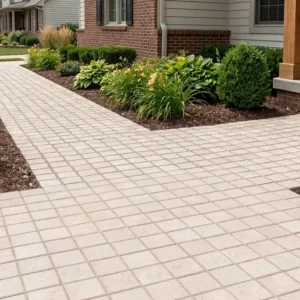
Format is where freight, access and exposure meet. Larger slabs read beautifully in a big villa terrace and cover ground quickly, but they weigh more per piece, they are less forgiving of an uneven base, and they are miserable to carry up a hillside path. Smaller modular sizes and multi-size patterns are easier to handle, easier to cut around curves, and easier to replace one piece at a time. Most jobs here end up with a mix: generous units in the main terrace where a machine can reach, and smaller units on the steps, the paths and the awkward ground.
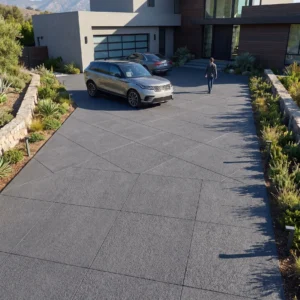
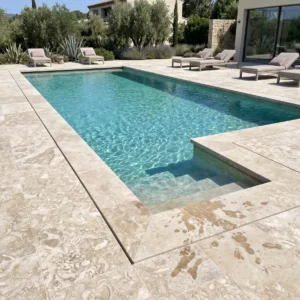
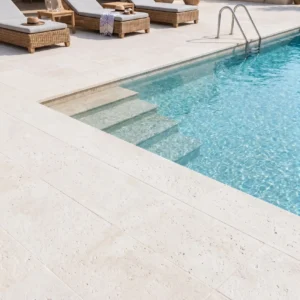
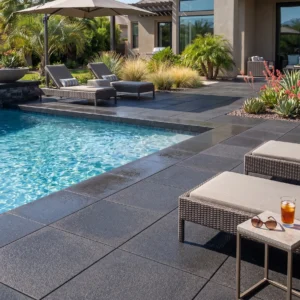
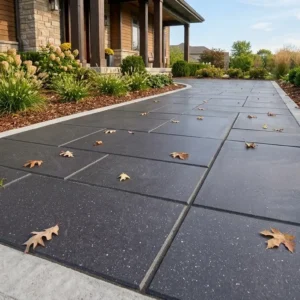
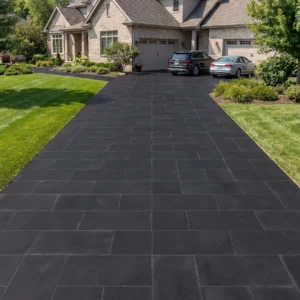
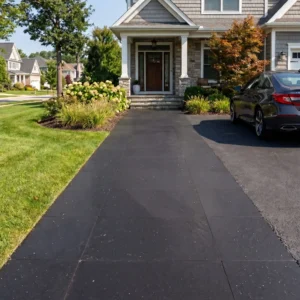
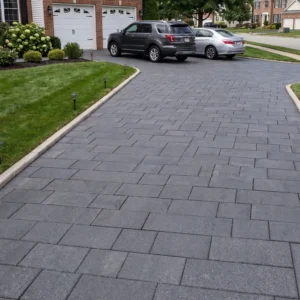
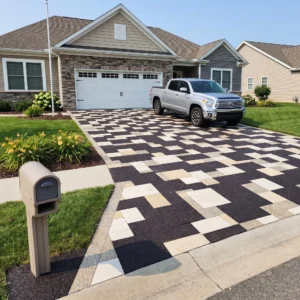
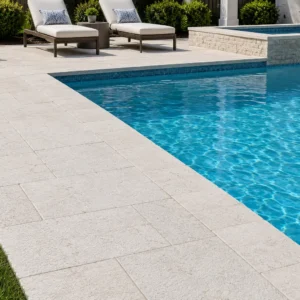
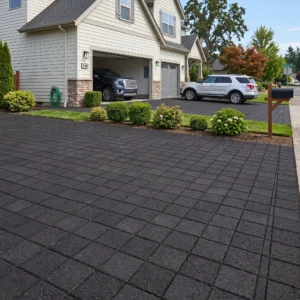
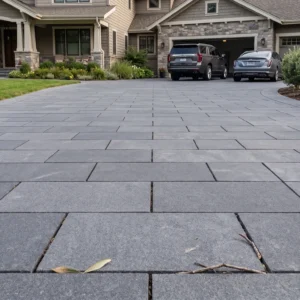
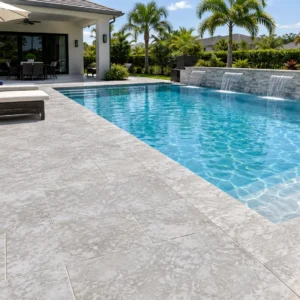
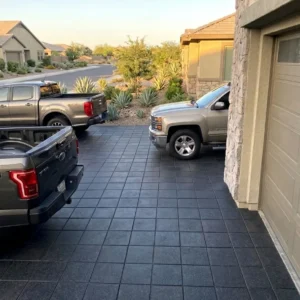
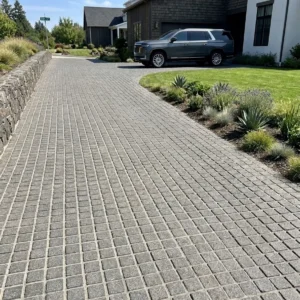
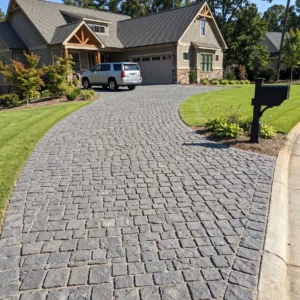
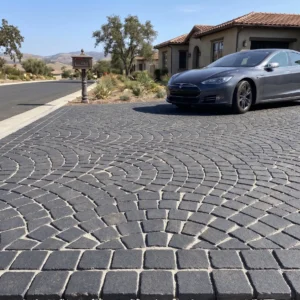
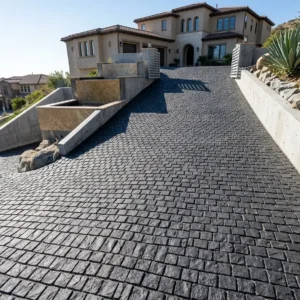
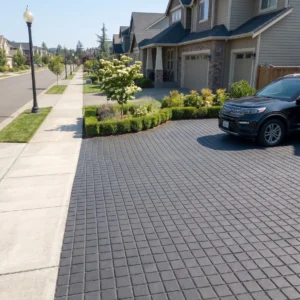
On thickness, work from use rather than from habit. Pedestrian terraces and pool surrounds are usually well served by a nominal one and a quarter inch calibrated paver on a bonded bed. Driveways, aprons and anywhere a delivery truck or a concrete truck will turn need a thicker section or a small-unit sett, with proper bedding and edge restraint beneath. Interior floors take a thinner tile, which also lands cheaper per square foot on a container, because weight rather than volume drives ocean freight on stone.
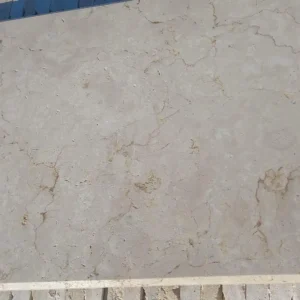
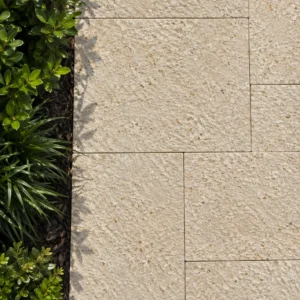
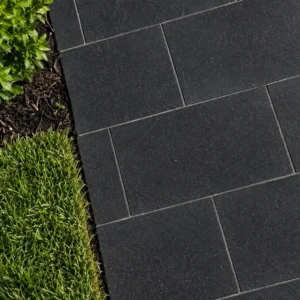
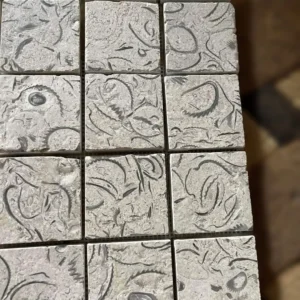
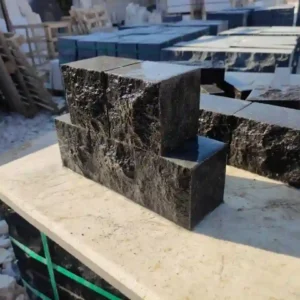
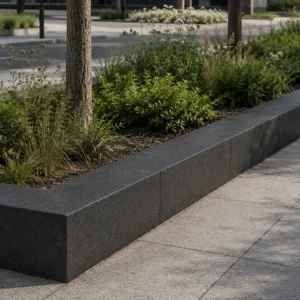
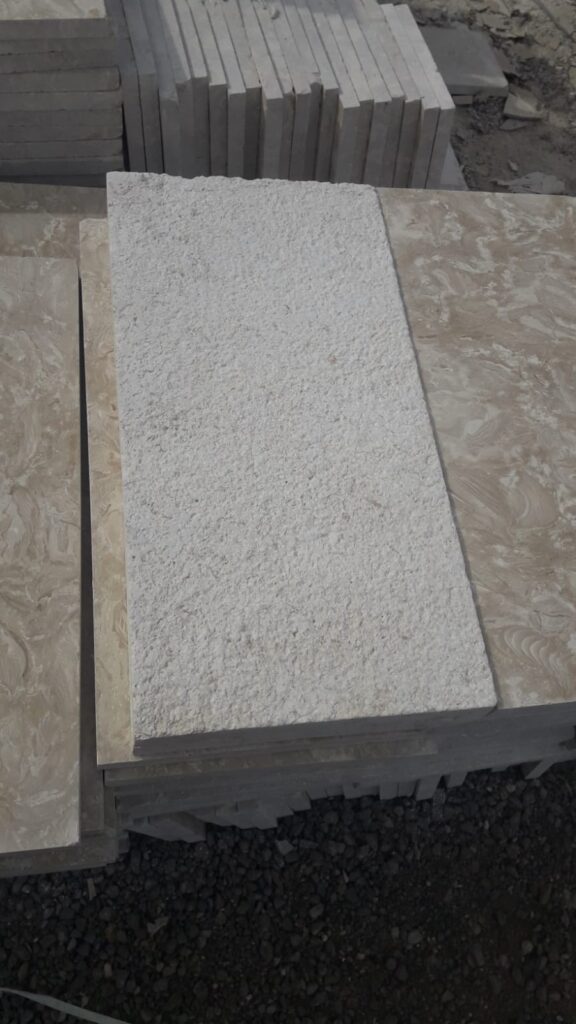
Finish drives both grip and appearance, and it is the cheapest specification change available to you. A honed surface reads calm and formal. Brushed and bush-hammered surfaces add texture and grip where water is present. Sandblasting gives an even matte face that hides the fine scratching caused by wind-blown sand. Our page of surface finish options explained sets out what each process does to the same stone, which is useful when you are choosing one material for a terrace, a pool edge and an entry hall at the same time.
- Match unit size to the tightest access point on the property, not to the widest.
- Use a thicker section wherever vehicles turn, load or park.
- Keep one stone across the property and vary the finish instead of the material.
- Ask for weight per pallet and pallets per container before comparing delivered prices.
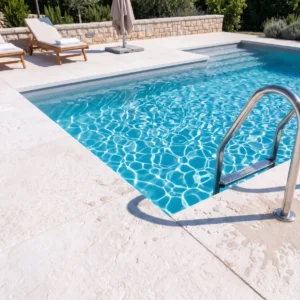
- Order pool coping and terrace field together so the shade range matches.
Consent, the Local Professional, and How to Order
Development in the Territory runs under the Physical Planning Act, 2004. The Town and Country Planning Department reviews applications and acts as the secretariat to the Planning Authority, and the Planning Authority, not the Department, makes the final decision. The Development Control section investigates and processes each application, and the Department conducts a field visit to the site. Applications are processed in accordance with the Land Development Control Guidelines of 1972. Most importantly for a supplier, a locally registered architect or surveyor must file the application together with the other required documents.
That last point tells you where a stone specification is actually decided. An overseas owner cannot file for permission personally, so there is always a local architect or surveyor in the loop, and that person is usually the one who writes the finish schedule, checks the setting details and signs off any substitution. We would far rather send the samples, the test data and the layout drawings to them at the start than argue about a substitution once a container is on the water.
Ordering is straightforward once the specification is settled. Tell us the areas by use, the finishes, the access constraints and the island, and we come back with a quote in US dollars, a pallet schedule and a sailing to aim at. Samples are small hand pieces sent for assessment rather than pallets, which is the honest way to do it when freight is the largest variable on the job. Mention the exposure, the neighboring properties and the water arrangement in your brief, because all three change the answer. In the British Virgin Islands the supplier who understands the sailing calendar and the hillside is worth more than the one with the shortest price list.