












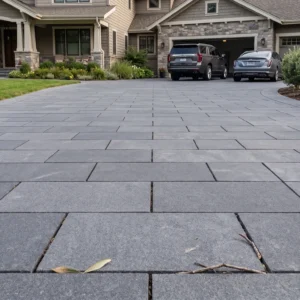
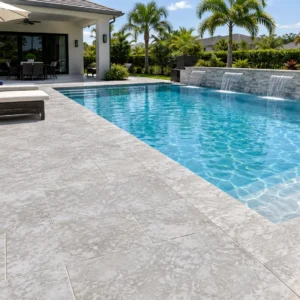



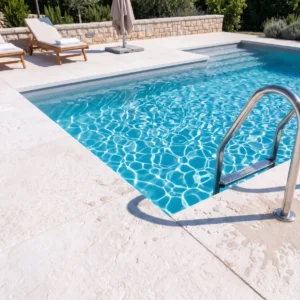
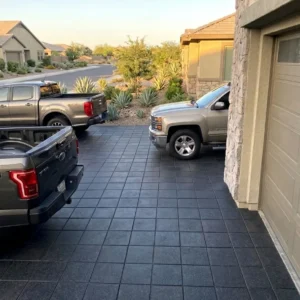



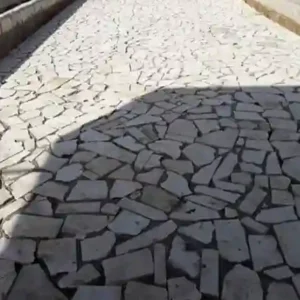

Most paving pages describe stone with adjectives. On an island where the air carries salt every day of the year, where a terrace can be soaked at four o’clock and bone dry at five, and where the cost of getting a mistake back off the site is higher than the cost of the stone itself, adjectives are not enough. This page deals in the properties that actually predict how limestone will perform in the British Virgin Islands: how much water it takes up, how dense and how strong it is, how its surface handles heat, and how much grip its finish gives when a wet foot lands on it.
There is no frost here, which removes the reason most northern specifications obsess over absorption. Salt does the same mechanical work by a different route. Salt-laden water is drawn into the pore structure, the surface dries in the sun, and the crystals that form expand inside the stone. Repeat that twice a day for years and a porous, weakly bound stone will fret and powder at the surface while a dense, low-absorption stone will not. That is why the numbers still matter, and why we would rather send you a test report than a mood board.
Absorption, Density and What They Predict Here
Water absorption is measured as a percentage of dry weight after the stone has been soaked under a standard method, and for external paving in a marine environment lower is better with no practical limit on how good it can be. Density, usually reported alongside absorption, tells you how tightly the stone is packed and correlates closely with how well it resists surface loss. Compressive and flexural strength matter for the loads a paver carries and the way it spans over any softness in the bed. Abrasion resistance matters most on steps and at entrances, where grit is dragged across the surface every day.
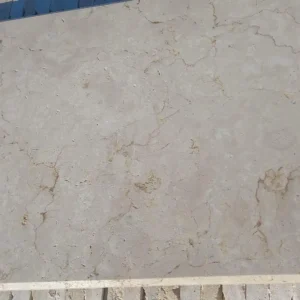
Ask for the actual figures for the stone you are buying rather than for a range published for the material family. Limestone is a broad category that runs from a chalky, highly absorptive building stone to a hard, tight, crystalline stone that behaves almost like marble in service. Two products described the same way on a website can perform completely differently on a north-coast terrace. The absorption and density test, the strength results and a wet slip figure together tell you more in five minutes than any amount of description will.
- Request the absorption and bulk density report for the specific material you are quoted.
- Ask for compressive and flexural strength rather than a general hard-wearing claim.
- Ask for a wet slip figure measured on the exact finish you intend to lay.
- For steps and entrances, ask about abrasion resistance separately.
- Keep the reports in the project file, because the architect will want them in the consent set.
Pale Stone, Full Sun and the Barefoot Test
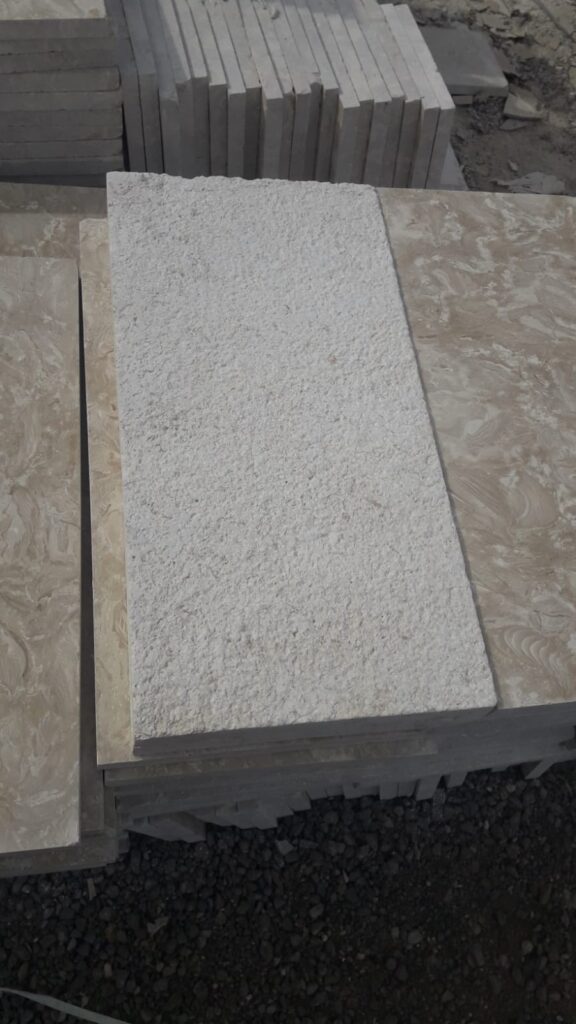
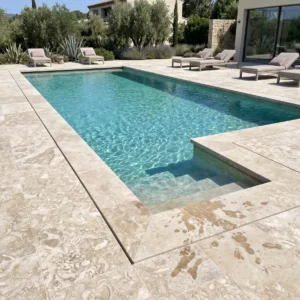
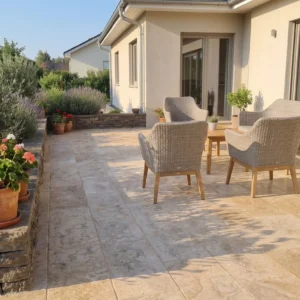
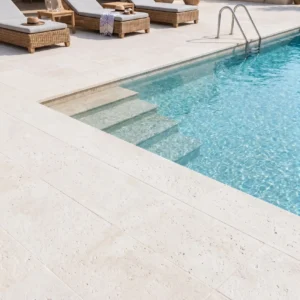
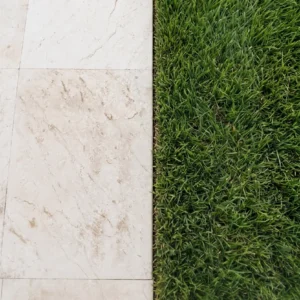
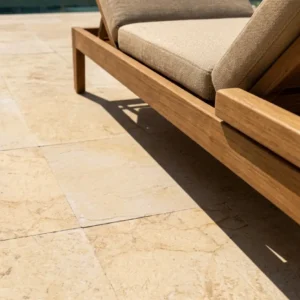
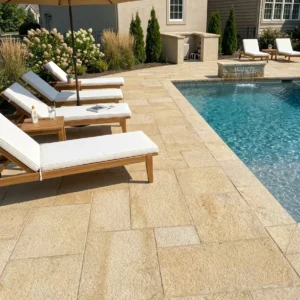
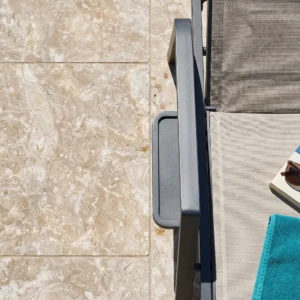
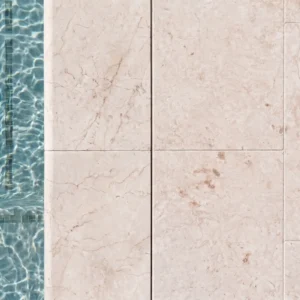
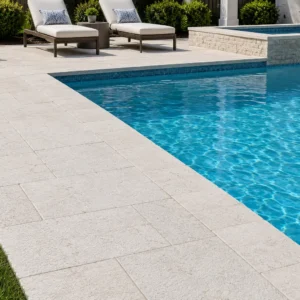
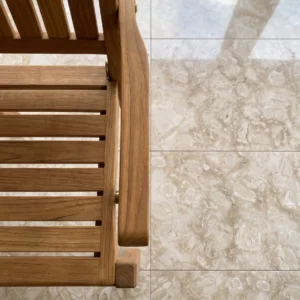
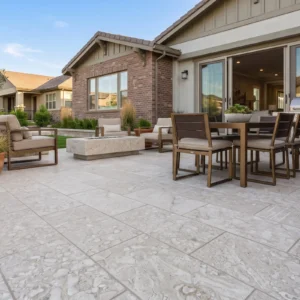
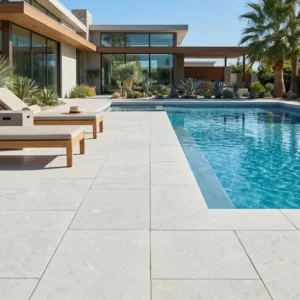
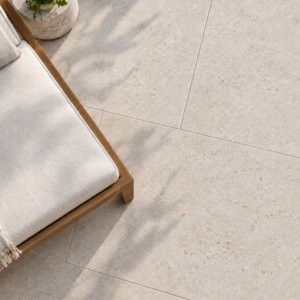
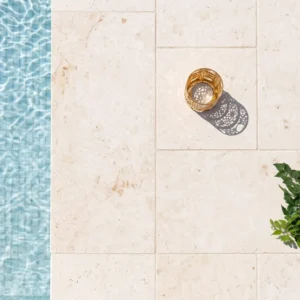
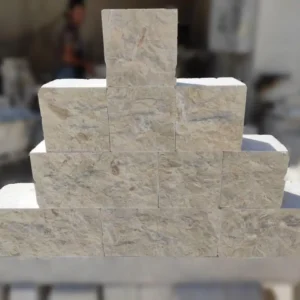
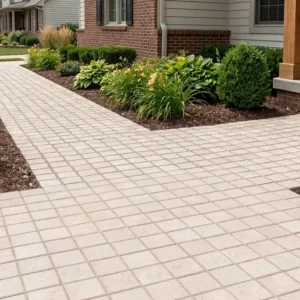
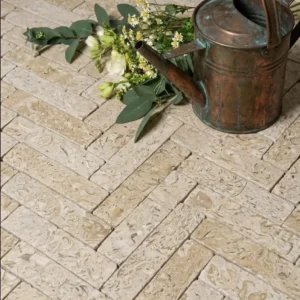
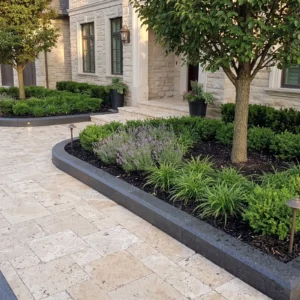
The most underrated performance property of a Caribbean terrace is its surface temperature. Sunlight that a dark surface absorbs turns into heat you cannot walk on, and a pool deck that is unusable between eleven and three has failed regardless of how good it looks in a photograph. Pale limestone reflects a large fraction of the light that hits it and stays markedly cooler than a dark stone laid in the same position on the same afternoon. That is the strongest single argument for a light stone on an open terrace here, and it is the one your client verifies with their own feet on the first day.
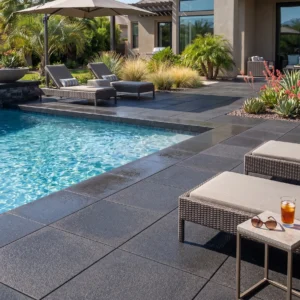
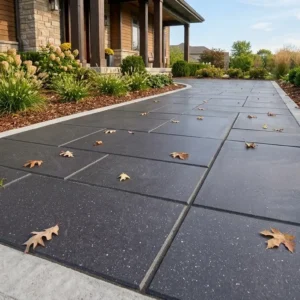
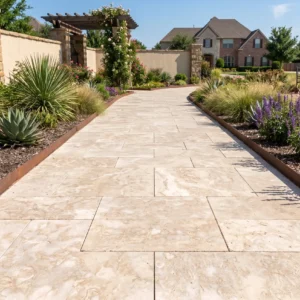
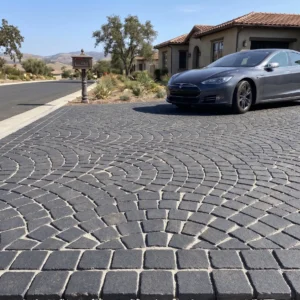
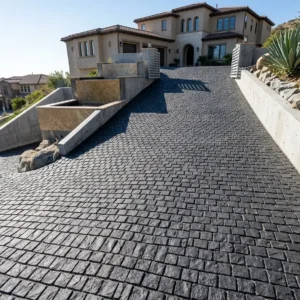
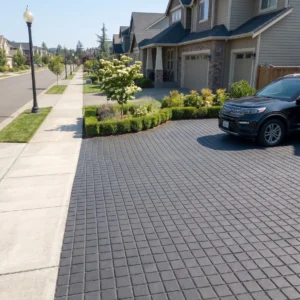
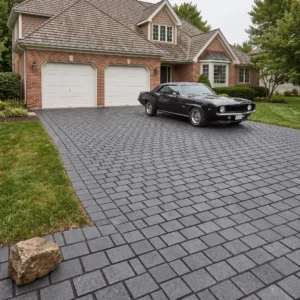
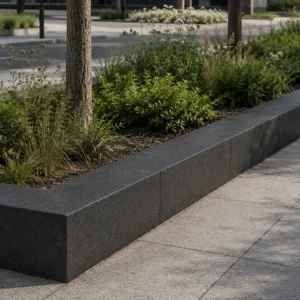
Thermal mass cuts both ways. A thick stone terrace absorbs heat all day and releases it in the evening, which is pleasant when you are sitting out after sunset and less pleasant where the terrace wraps a bedroom wall. Design around it. Pale, reflective surfaces in the open, shade structures over the seating, and a deeper or darker material only where it is shaded, wet or heavily trafficked. That is also the sensible division of labor between two materials on the same property: limestone paving specifications in detail for the open sun, and a darker dense stone for shaded steps, plant rooms and service routes where heat is not the issue and abrasion is.
- Choose pale stone for any surface used barefoot in the open.
- Reserve darker stone for shaded, wet or service areas.
- Shade the seating rather than trying to cool the whole terrace.
- Remember evening heat release next to bedroom walls and glazing.
- Test a sample in position for an afternoon before committing to a tone.
Grip Around Water
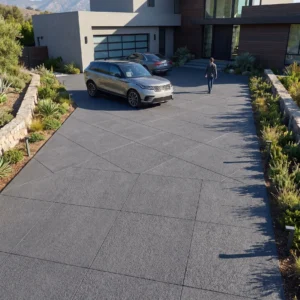
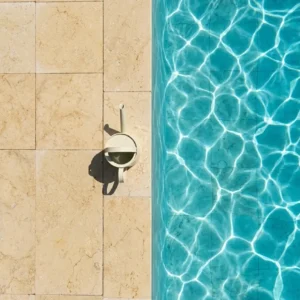
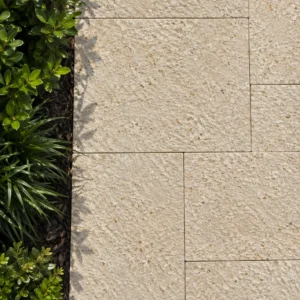
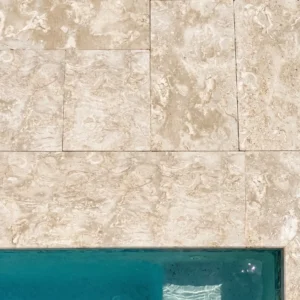
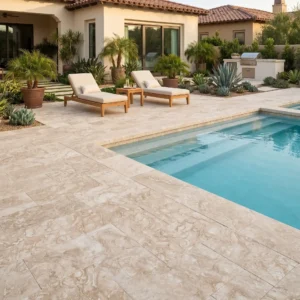
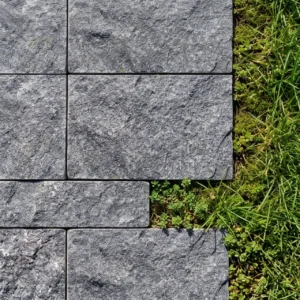
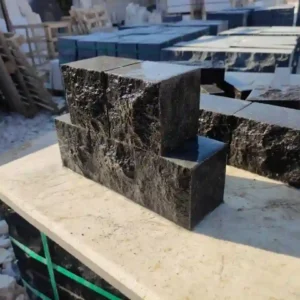
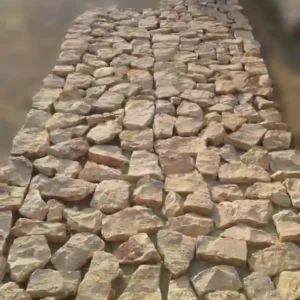
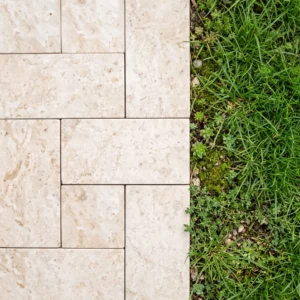
Grip is a property of the finish, not of the material name, and it is measured wet rather than dry. Around pools, outdoor showers and the drenching squalls that pass through in the wet season, specify a textured face and be specific about which one. Bush-hammering leaves a peened, undulating surface with excellent grip and a soft appearance that suits a landscape of boulders and water. Sandblasting gives a fine, even matte texture that is kinder to bare feet and hands than a coarse hammered face. Brushing sits between the two. One honest technical note belongs here: flaming is a process for granite and basalt, where quartz content lets the surface spall under heat. It is not the way to texture limestone, and a supplier offering flamed limestone is describing something else.
Detail the water as carefully as the finish. A fall of roughly one in eighty carries water off a terrace without being felt underfoot, while ponding is what makes a good finish slippery, because a thin film of standing water removes the benefit of any texture. Coping profiles around a pool should be rounded enough not to hurt a shin and undercut with a drip so water does not track back under the edge. Keep joints narrow and fully filled so nothing collects in them.
- Bush-hammered or sandblasted faces at pool edges, showers and steps.
- Honed faces only where the surface stays dry and shaded.
- Build falls and drainage so water never stands on the surface.
- Round and drip the coping edge, and test it against a bare shin rather than a hand.
- Do not accept flamed limestone, because flaming is a granite and basalt process.
Paving That Feeds a Cistern
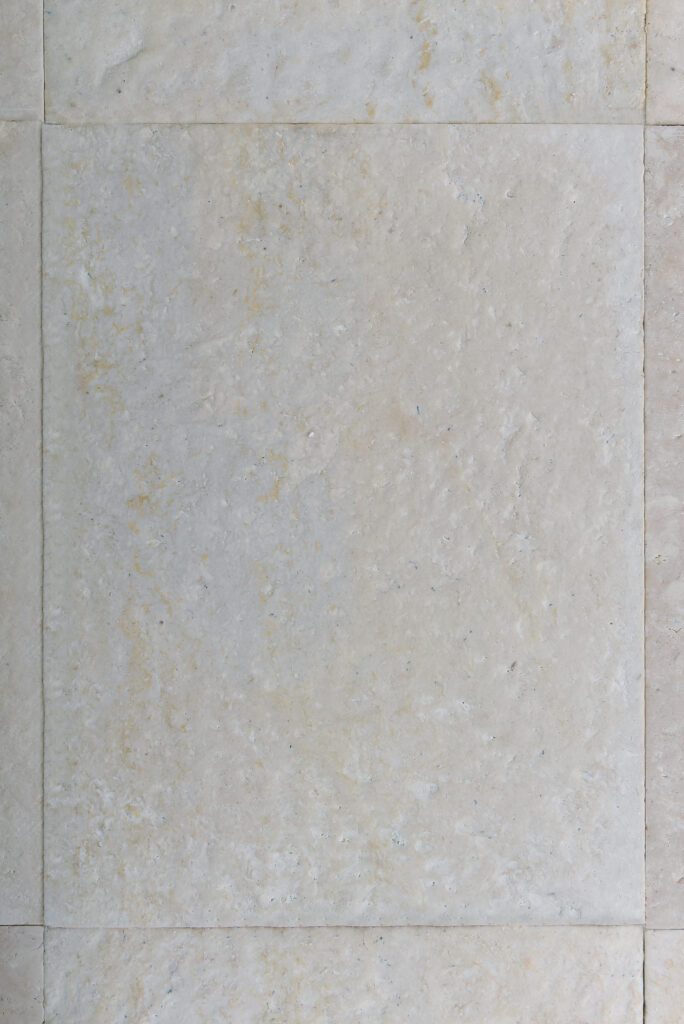
Water is the quiet constraint on every property in the Territory. Rainwater harvesting is the practical supply for most households, with rain collected from rooftops into cisterns usually built into the house foundation, and more than 90% of the population across the Virgin Islands relying on it. Desalination carries the rest on Tortola, where five plants are run by Ocean Conversion and Aqua Design, the first installed in 1988. Ocean Conversion’s Baugher’s Bay plant draws feedwater from shoreline wells about 75 feet deep and produces around a million imperial gallons a day at full capacity, and Biwater’s plant at Paraquita Bay, completed in 2014, is rated at 2.3 million imperial gallons a day.
That changes how hardscape ought to be thought about. In most places a terrace is designed to get rid of water. Here it is worth asking first whether the water should be caught. Roof catchment remains the potable source, and nothing on this page should be read as advice to drink terrace runoff, which is a decision for your engineer under whatever health requirements apply. But paved courts, drying yards, roof-adjacent terraces and the aprons around cisterns can be graded and detailed to deliver clean water toward storage for irrigation and secondary use rather than sending it into a soakaway on a hillside where it does nothing but erode.
- Grade paved areas deliberately, either toward collection or away from the building, but never ambiguously.
- Choose dense stone and full, stable joints so runoff carries as little material as possible.
- Keep leaf litter, planting debris and loose fill out of the collection path.
- Avoid harsh cleaning chemistry on any surface that drains toward storage.
- Fit a first-flush arrangement where terrace runoff is collected, and keep it maintained.
It is a small move at the drawing stage and it costs almost nothing, but on islands where water arrives by rainfall or by desalination it is the kind of detail a local architect notices immediately.
Where Limestone Is the Wrong Answer
An honest specification includes its exclusions. Limestone is an excellent terrace, pool surround, path and interior stone in this climate, and there are four or five places where we would tell you to use something else instead.
- Heavy vehicle turning and loading areas, including trash pads and service yards where a concrete truck pivots. Use a small-unit granite or basalt sett, or a purpose-designed vehicular section.
- The permanently wet splash zone on an exposed north-facing shoreline, where stone is saturated with sea water and taking wave energy. That is engineering rather than paving.
- Unrestrained edges in a fully exposed ridge-top position. If the edge cannot be restrained, change the design rather than the material.
- Anywhere routine acid cleaning is unavoidable, such as immediately beside concrete that will be etched or acid washed on a cycle.
- Directly beneath an untreated metal drip line or a planter that leaches iron, where staining is guaranteed and the stone will get the blame.
Chlorinated pool water is generally fine on a dense limestone deck provided the surface drains and is rinsed, though concentrated chemical dosing splashed onto the deck is not. Fertilizer, especially iron-bearing lawn feed, is the most common cause of orange staining on pale terraces anywhere in the world and it is entirely avoidable with a sweep before watering. None of these limits are peculiar to one supplier or one product. They are the ordinary boundaries of a calcium carbonate stone, and knowing them is what makes the rest of the specification reliable.
Limestone Alongside the Local Palette
These islands already have a stone identity, and it belongs to them rather than to any supplier. The Baths on Virgin Gorda are a labyrinth of massive granite boulders forming cavernous passages and sheltered sea pools, and the name is short for batholiths. The Virgin Islands batholith intruded into older volcanic and sedimentary rock roughly 45 million years ago, lifting ancient seafloor sediment above sea level. The granite is mainly feldspar and quartz and underlies much of eastern Tortola, Virgin Gorda and the surrounding area. The blocks cracked as the mass cooled and shrank, and weathering rounded their edges into the boulders people photograph today. The Baths National Park is a protected preserve of about seven acres and the Territory’s most recognized natural landmark.
None of that is a resource or a product comparison and it should never be treated as one. What it is, is a visual vocabulary worth designing with. A terrace on Virgin Gorda that sits comfortably beside rounded pale granite will use warm pale tones rather than cool grays, honed or bush-hammered surfaces rather than gloss, generous unit sizes rather than small busy modules, and planting at boulder scale. Imported stone works here as a complement to a landscape that is already complete and to a building supply chain that is already established. Aggregate in this part of the Caribbean is largely brought in by sea, and long-standing merchants such as Drakes Traders, in business since 1984, remain the right source for cement, block and everyday materials. Our published current natural stone pricing lets you set a delivered stone terrace honestly against a poured concrete or porcelain alternative.
Testing, Sampling and Getting the Specification Signed
Two practical steps remove almost all of the risk. The first is to get a sample onto the actual site and leave it there. A hand sample laid on the terrace slab for a month tells you how the stone reads under island light at different hours, how hot it gets at two in the afternoon, how it looks wet, and how it looks after a squall has dried on it with a little salt left behind. The second is to build a small mock-up panel with the real finish, the real joint width and the real bedding before the main order ships, and to have the architect or surveyor sign it off.
Bring the numbers with you when you do. The absorption and density figures, the strength results and the wet slip data belong in the same folder as the drawings, because the person filing the application is a locally registered professional who has to stand behind the specification in front of the Planning Authority. Ask us for that documentation early rather than late. It is not a trade secret and no reputable supplier should hesitate to hand it over.
Allow, finally, for the fact that stone has to arrive before it can be tested on site. Put the sample stage at the front of the schedule rather than in the week the setters land, and give it a full sailing of slack. Get the absorption number, the wet grip figure and a sample on the actual terrace, and the rest of a British Virgin Islands limestone specification is straightforward.