










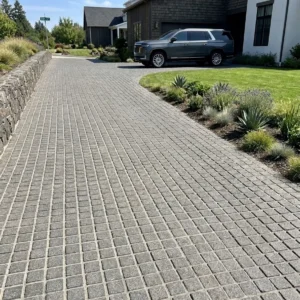
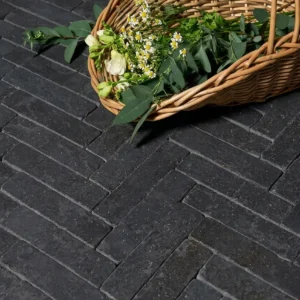
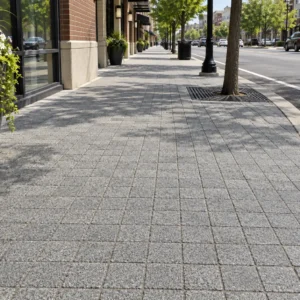
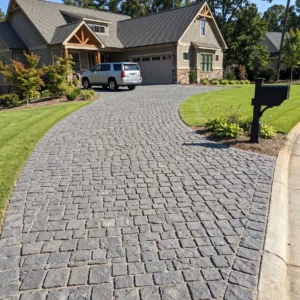
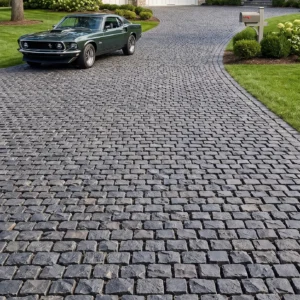
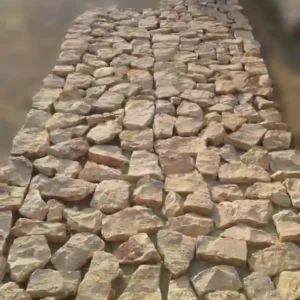
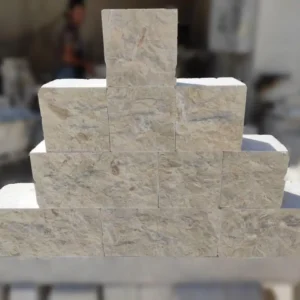
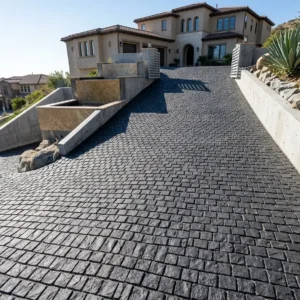
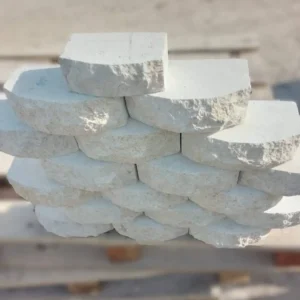
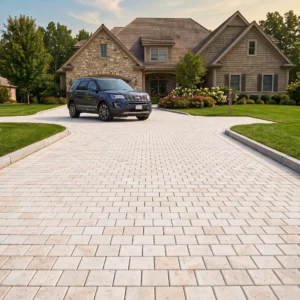
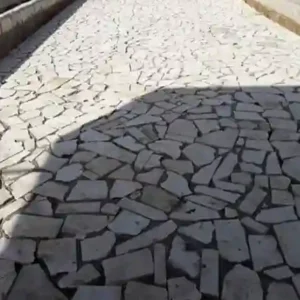
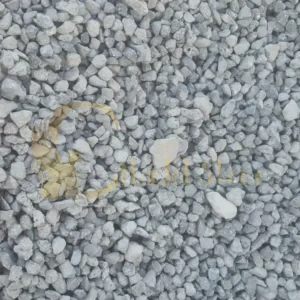
Large-format paving is a flat-ground product. It assumes a plane, a straight edge and a compactor with room to work. Saint Lucia offers few of those things. Sites climb, driveways switch back, gates open onto a slope, courtyards curve around existing trees, and older properties have ground that has settled into its own shape over decades. The small unit was invented for exactly these conditions, and it still solves them better than anything else available.
Cobblestones and setts are also the most misunderstood product in the hardscape catalog, because the price per piece is low and the price per finished area often is not. That inversion, where the material is cheap and the laying is the expense, is the single most important thing to understand before ordering. This page covers where small units genuinely outperform slabs on Saint Lucian ground, how to detail them for driveways and turning loads, how to set them out on curves and gradients, which patterns do which job, and how to think about the labor economics honestly rather than optimistically.
Why Small Units Suit Steep, Uneven Ground
A sett is small enough that the surface can change direction under it. Lay a run of setts down a driveway that steepens, crosses a crown and then flattens toward a gate, and the paving follows all of it, taking the change up through the joints a few millimeters at a time. Attempt the same in large slabs and every transition needs a cut, a fall correction or a step, and each of those is a place where water will eventually find a way in.
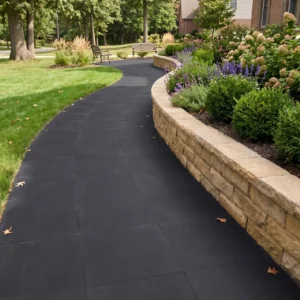
The same property helps on curves. A radius that would force wedge-shaped cuts across a slab layout is absorbed by small units simply by opening the outer joints slightly and coursing around the arc. Nothing is wasted, no piece is weakened by a thin cut, and the finished line looks intentional rather than negotiated.
- Gradients: setts follow changing falls without steps, cuts or awkward fall corrections.
- Curves: coursing rotates around an arc using joint width rather than saw cuts.
- Obstacles: tree pits, service covers, posts and drains are worked around with whole units.
- Settlement: individual pieces can be lifted, the base corrected and the same units relaid.
- Access: small units are carried by hand where no pallet truck or crane can reach.
That last point deserves weight in Saint Lucia. Plenty of villa sites above Marigot Bay, in the hills behind Soufriere or along the Cap Estate ridges are reached by a driveway that a delivery truck can only partly climb. A material that a two-person team can move in barrows and buckets, unit by unit, is a material that can actually be installed there.
Driveways, Gate Aprons and Turning Loads
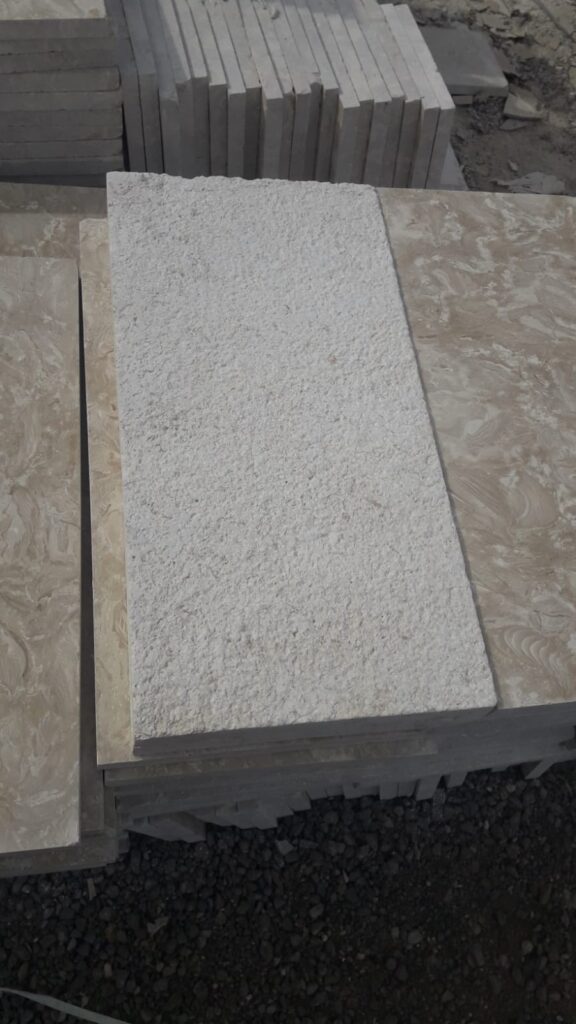
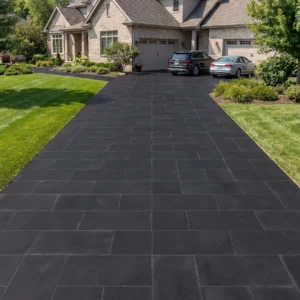
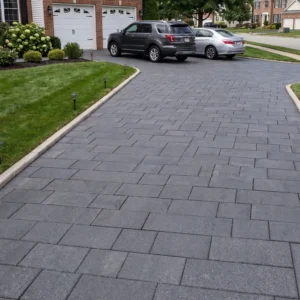
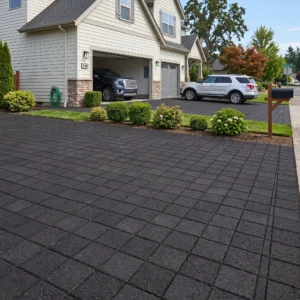
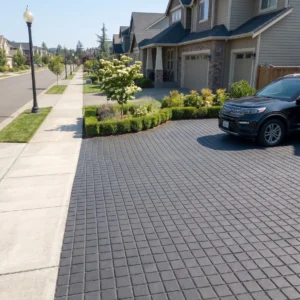
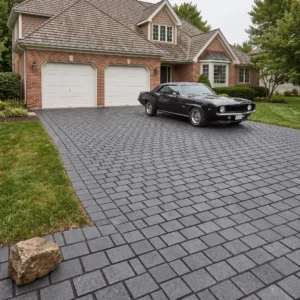
The hardest work any residential paving does is at the gate. A vehicle arriving at a Saint Lucian property typically slows on a slope, turns while moving slowly, and then either brakes or accelerates on the same patch of ground. That combination of vertical load, horizontal shear and repeated turning is what tears a poorly built surface apart, and it happens in the few square feet immediately inside the entrance.
Small units handle it because they interlock. Load applied to one sett is shared with its neighbors through the joint, and the tighter and better filled that joint is, the more of the surrounding surface takes the strain. That mechanism only works if the base is right and the perimeter is restrained; without both, interlock unravels from the edge inward.
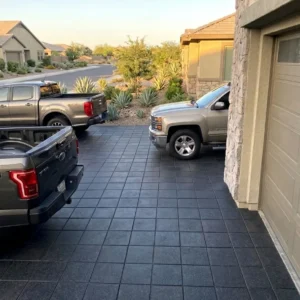
- Build a driveway base to a vehicular standard, compacted in layers, not a garden-path base with a thicker surface on top.
- Use a deeper sett for driveways and aprons than for a garden path, since depth is what resists rotation under a turning wheel.
- Restrain every edge, with haunching founded below the bedding rather than sitting alongside it.
- Fill joints completely, and top them up after the first few weeks of traffic.
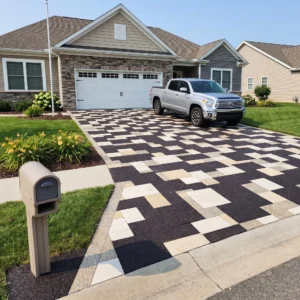
- Lay a herringbone bond in trafficked areas, since it distributes load better than a stack or straight bond.
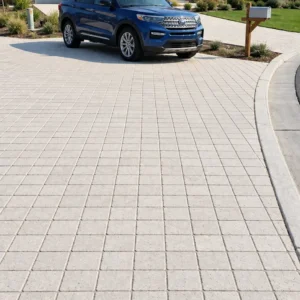
For an apron that faces the road, limestone and basalt cobble setts also give you a practical maintenance advantage. Where an oil drip or a gouge from a jack stand ruins one unit, that unit alone is lifted and swapped, and nobody can tell afterward. The same event on a poured or slab surface leaves a patch that stays visible for the life of the driveway.
Setting Out on Curves and Broken Ground
Setting out is where a sett job is won or lost, and it happens before the first unit is bedded. On flat, square ground you can start at a straight edge and work across. On Saint Lucian sites there is often no straight edge worth trusting: the boundary wall follows the road, the road follows the contour, and the house sits at an angle to both.
Work from the feature the eye will read. Usually that is the threshold of the house, the line of a step, or the centerline of the driveway, not the property wall. Establish that datum, set the coursing to it, and let the irregular perimeter absorb the discrepancy at the edges where a border course or a curb detail can tidy it. Level changes should be taken as deliberate steps with a defined nosing rather than as a stretched fall, and any transition between a path and a driveway should change pattern or introduce a border, so the joint between two differently loaded areas becomes a design line rather than an accident.
- Set the datum from the building or the drive centerline, never from an unsurveyed boundary.
- Use a border or soldier course to absorb the irregular perimeter and give the field a clean edge.
- Dry-lay a trial panel on the actual ground before bedding a large area.
- Take level changes as proper steps with textured treads, not as a stretched, uncomfortable fall.
- Keep string lines and gauge rods in use throughout, because joint creep across a long run is very visible.
Patterns That Earn Their Place
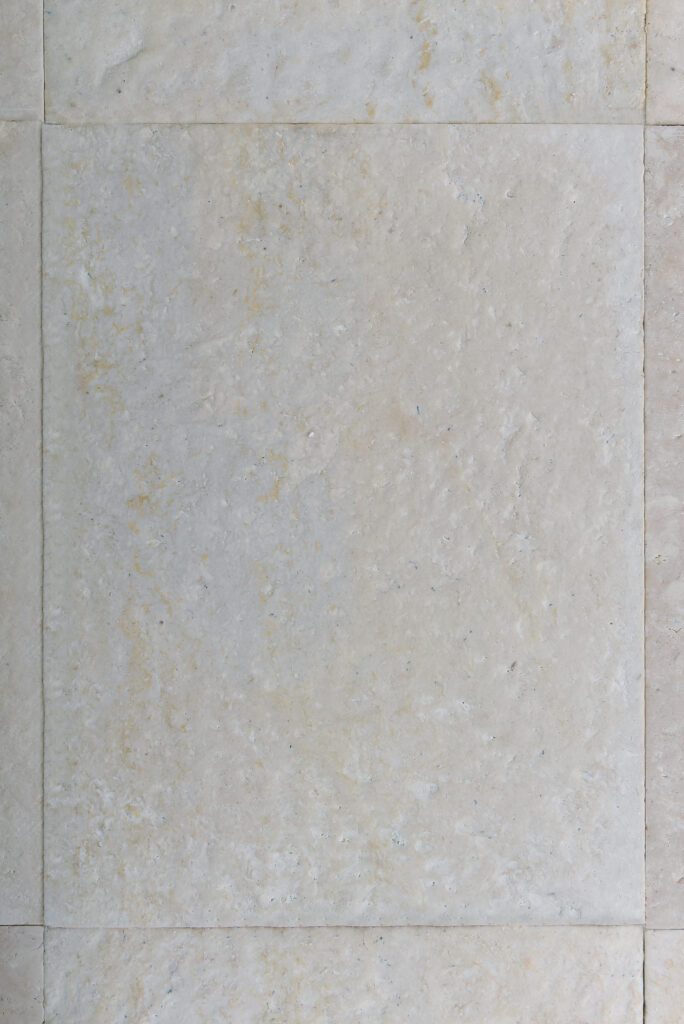
Pattern is not decoration in small-unit work; it is structure, and different bonds carry load and turn corners differently. Choosing the pattern before the setting out begins saves a great deal of argument on site.
- Herringbone: the strongest bond under vehicles, ideal for driveways, aprons and turning areas.
- Running bond: simple and quick, best kept to paths and lightly trafficked courtyards.
- Coursed random: a relaxed, traditional look for garden paths and informal terraces.
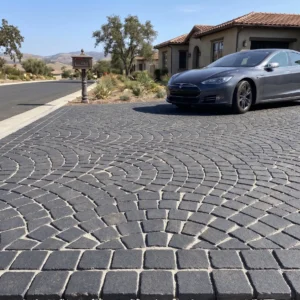
- Radial and circular: for turning circles, courtyard centers and any space with no true straight line.
- Border and soldier courses: define edges, absorb irregularity and protect the field from edge loss.
Curved and fanned layouts deserve particular attention on this island, because they solve a real geometric problem rather than merely looking handsome. A courtyard between three walls that meet at no right angle has no honest straight bond, and a radial layout treats the awkwardness as the design. Where a drive widens into a turning area, the same applies. If you want to see how the geometry resolves before committing, fan pattern setts on curves shows the coursing in detail and how the rings are gauged as they open outward.
One practical caution: complex patterns cost labor hours, and labor hours are the dominant cost in this work. Use the demanding layouts where they earn their keep, at entrances, turning circles and courtyard centers, and keep the long, unseen runs simple.
The Cost Inversion Nobody Explains
Here is the economics of cobblestones stated plainly. A single sett is an inexpensive object. A finished area of sett paving is not, because a skilled setter covers a modest area per day compared with the same worker laying large slabs. The material is the cheap part and the hands are the expensive part, which is the reverse of the ratio most clients assume from the quoted price per piece.
In Saint Lucia that inversion has an extra twist. Imported material is typically transacted in United States dollars, while local labor is quoted and paid in East Caribbean dollars, which are pegged to the US dollar. The two halves of the budget therefore do not swing against each other the way they would in a floating-currency market, but the labor line is still set by local rates and local productivity, and it is best estimated by the contractor who will actually do the work rather than by a supplier overseas.
What follows is a set of decisions that save money without cheapening the result. Use setts where their properties matter, on slopes, curves, aprons and entrances, and use larger units on the long, flat, straight runs where a slab is laid in a fraction of the time. Build a sample panel first and agree the joint width, the bond and the finished level on the ground before the main area starts, because a pattern argument discovered halfway through a driveway is expensive to resolve. And order enough in one shipment, including spares, since a second small order carries much the same clearance overhead as a large one.
- Budget labor as the dominant line item, and have it priced by the crew that will lay the work.
- Use setts selectively, where their geometry and load behavior actually earn the hours.
- Agree a sample panel on site before the main area is started.
- Order spares in the original shipment so future repairs match the run.
- Keep complex bonds for the areas people look at, not for the whole scheme.
Character, Restraint and Sensitive Settings
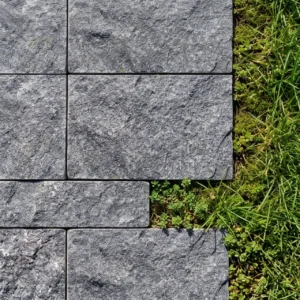
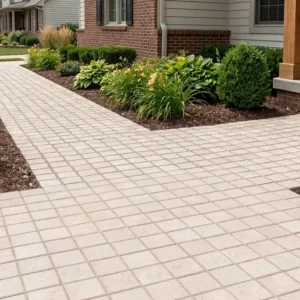
Small-unit paving carries a particular kind of visual weight. It reads as older, quieter and more grounded than a sheet of large-format stone, and in places where a new surface should not announce itself, that quality is the whole point. Around a restored property in Castries, at the entrance to a small hotel, or on a courtyard within an established garden, tumbled setts sit into the setting instead of sitting on top of it.
Restraint matters most in the south-west. The area around Soufriere lies within an internationally recognized landscape where development is closely watched and where intrusive building has drawn sustained criticism. Hardscape there should be low in reflectance, natural in tone, modest in scale and clearly subordinate to the landform. A tumbled, muted sett with a soft joint is a far better neighbor to that setting than a bright, sawn, high-contrast surface, and choosing it signals that the project understands where it is.
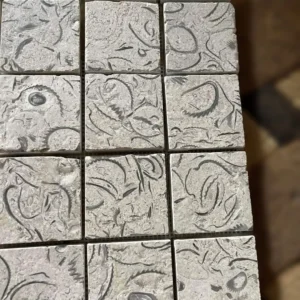
- Tumbled and aged finishes suit heritage settings and mature gardens better than sharp sawn faces.
- Keep tonal contrast low where the landscape, not the paving, is meant to be the subject.
- Match the scale of the unit to the scale of the space, since large setts overwhelm a small courtyard.
- Let the pattern follow the existing geometry of walls, steps and planting rather than overriding it.
- Confirm every consent before any work begins in a sensitive or protected area.
Ordering, Bedding and Living With Setts
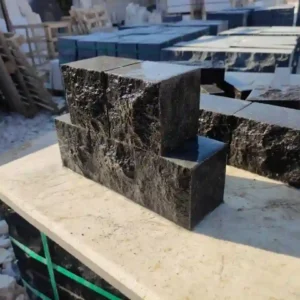
Ordering small units differs from ordering slabs, and a few habits prevent most of the problems. Coverage is calculated from the unit face size plus the intended joint width, so agree that joint width before the quantity is fixed; a couple of millimeters of difference across a large driveway changes the count noticeably. Setts also stack densely on a pallet, which makes them efficient freight, but a pallet of deep setts is heavy, so pallet weight rather than pallet footprint tends to be the limiting factor for hillside deliveries.
Bedding depends on use. A pedestrian courtyard can sit on a bound or unbound bed of modest depth over a compacted base. A driveway or gate apron needs a deeper, engineered construction with the sett depth chosen for the loading rather than for the appearance. Jointing material should be selected with the local rainfall in mind: an open, permeable joint drains but needs topping up, while a bound joint resists washout but has to be detailed so the water has somewhere else to go.
- Fix the joint width before calculating quantities, and hold to it on site.
- Match sett depth to loading: deeper for vehicles, shallower for pedestrian courtyards.
- Choose the jointing system for rainfall intensity, not for convenience during laying.
- Keep a labeled crate of spare units in a dry store for future repairs.
- Check joints and edge restraint after the first heavy rain, and top up where washout has occurred.
Lived with properly, a sett surface improves. Traffic polishes the high points, joints settle, tone deepens, and the paving starts to look as though it belongs to the ground rather than having been delivered to it. It is also the only hard surface that can be taken up, mended and put back so completely that the repair vanishes, which on an island where a single storm can move ground is a genuinely practical virtue. Tell us the gradients, the turning circles and the areas involved, and we will recommend a sett size, depth and pattern that your crew can lay well in Saint Lucia.