
























































There is one fact about buying paving in the US Virgin Islands that catches almost every mainland supplier out, and it belongs at the top of the page rather than buried in a footnote. The territory is American soil, its residents are US citizens, the money in the till is the US dollar, and the building codes on the drawings are the same international codes used in Florida. Yet the USVI sits outside the US customs territory and maintains its own customs law, enforced by the Virgin Islands Bureau of Customs. A pallet of stone leaving a mainland terminal for Crown Bay is not a domestic move. It is an import, entered locally, with a duty position and an excise position that a truck running from Miami to Orlando never encounters. Any quote that treats St Thomas as one more zip code will be wrong at the wharf, and the person holding the bill will be the contractor, not the seller.
The second fact is that these are not one delivery address. St Thomas, St John and St Croix are three islands in a territory of about 134 square miles, with different ports, different terrain, different economies and different construction pipelines. St Croix sits about forty miles south of the other two and might as well be a separate market. Citadel Stone loads containers in the United States and supplies dimension-sawn, calibrated limestone and basalt paving into all three, the architectural wearing course laid over the base course and ready-mix concrete that St Croix’s own aggregate industry supplies, but the routing, the offload and the last leg change depending on which island the job is on. This page sets out the whole category for a Virgin Islands buyer: how the freight actually runs, what happens at entry, what the roads and hillsides will allow, what the exposure demands of the assembly, and how to pick formats and thicknesses that do not waste money on the water.
Why a shipment from the mainland still clears customs
The USVI is an organized, unincorporated United States territory that lies outside the US customs territory. That one line changes the arithmetic on every container. Entry is filed locally, and the general rate is 6 percent ad valorem on articles manufactured or originating outside the territorial sovereignty of the United States and brought into the Virgin Islands. Goods of US origin are not charged that customs duty, but they are not free of everything either, because the territory levies a separate excise tax on articles imported for use or resale in a trade or business under 33 V.I.C. sections 42 and 43. Origin is therefore not a paperwork formality here. It is a pricing input.
Citadel hand-picks its material at selected quarries overseas and warehouses it in the United States, so the provision that usually governs our shipments is 33 V.I.C. section 525. Where a foreign-origin article moves into the Virgin Islands from within the US Customs Zone, the Virgin Islands duty payable is the amount which, added to the duty already paid to the United States, equals 6 percent of the value of the article on import. In plain language, you receive credit for the US duty already paid and the territory tops the total up to 6 percent. Keep the origin declarations and the mainland entry documents filed together, because your broker will be asked for both and a missing certificate turns a straightforward clearance into a delay you are paying storage on.
- Duty and tax are calculated on the CIF basis, so ocean freight and insurance sit inside the taxable value rather than outside it. A cheap stone on an expensive sailing is not as cheap as it looks.
- The excise rate that applies to a particular paving line should come from your broker against the actual commodity description, not from any supplier web page. We will not print a rate we cannot stand behind.
- There is no sales tax in the Virgin Islands. What exists instead is a gross receipts tax falling on the Virgin Islands business itself, which is a different thing from a percentage added at the register.
- Beneficiaries under the territory’s Economic Development Commission incentives can receive an exemption from excise tax on building materials used in constructing their facilities, together with a reduced customs duty rate of 1 percent. On a resort or commercial development that is worth confirming before anything is priced.
- Local importers watch excise unusually closely, and with cause. Collection was halted by federal injunction in November 2018 in the wake of the Reefco Services litigation and resumed in March 2021. Ask your broker where the current position stands on your line.
Ports, carriers and the route the pallets actually take
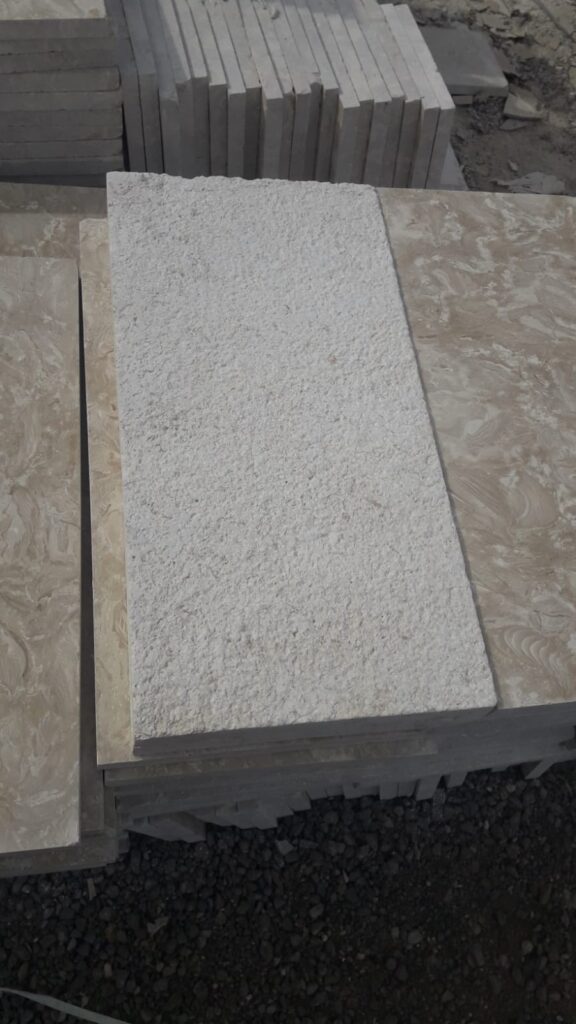
The Virgin Islands Port Authority operates the cargo facilities, and there is more than one of them. Crown Bay Cargo Port on St Thomas is the container gateway for the northern islands: about 20 acres of yard, a 2,720 ft bulkhead and a maximum draft of 30 ft, handling containerized and general cargo. VIPA itself describes Crown Bay as a hub for cargo bound onward to other Caribbean destinations, which is also why a stone consignment sitting there uncollected is neither welcome nor cheap.
St Croix does not depend on St Thomas. It has its own facilities: the Wilfred Bomba Allick Port and Transshipment Center at Krause Lagoon is the principal cargo point, with the Gallows Bay Marine Facility on the Christiansted side and the Ann E. Abramson Marine Facility at Frederiksted also in service. Direct ocean freight from the US mainland is ordinary here rather than exceptional, with Crowley, TOTE Maritime and Tropical Shipping all serving St Thomas, so architectural paving does not need to be funneled through a foreign hub to arrive. That is a genuine advantage over several nearby markets, and it shortens both the schedule and the number of parties who can lose your pallets.
- Tropical Shipping has operated in the territory since 1976 and, on 22 January 2024, executed 25-year leases with VIPA, carrying two five-year renewal options, to rehabilitate and expand both Crown Bay and the Wilfred Bomba Allick Port.
- Port works on that scale mean gate procedures, yard layouts and storage arrangements can shift during a long build. Confirm the current arrangement when you book rather than repeating what worked last season.
- Quote a St Croix job to a St Croix port. Moving a container from St Thomas to St Croix is a sea leg with its own handling charges, not a road leg.
- For anything landing on St John, agree the final leg with your carrier in writing before you commit a crew start or a pour date, covering how the cargo reaches the island, what lifting equipment exists at the receiving end, and who carries that cost.
- Demurrage and storage clocks start at the terminal, not at your gate. On a phased build it is almost always cheaper to stage pallets in a yard you control than to leave them accruing charges in the port.
Site access, and the detail mainland quotes get wrong
The US Virgin Islands drives on the left. That is unusual for a US territory and it is not a piece of trivia to drop into a blog post, because it decides which side of the truck the offload happens on, which shoulder a flatbed can hold while a forklift works, and how a delivery vehicle turns into a steep estate driveway without stopping traffic in both directions. A logistics plan copied from a mainland job has that geometry reversed, and the crew discovers it with a loaded trailer halfway up a hill.
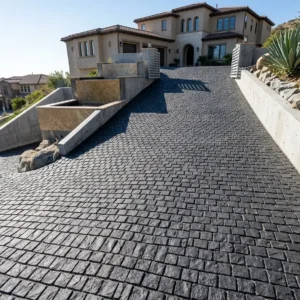
Terrain finishes the argument. St Croix is the largest and flattest of the three and is generally the most forgiving to serve with a standard truck and a forklift. St Thomas and St John are steep. A villa above Charlotte Amalie or behind Cruz Bay may be reached only by a narrow switchback road that a full-length trailer cannot negotiate at any speed. Transloading to a smaller flatbed, or breaking pallets down at a yard closer to the site, is frequently the difference between a delivery that lands and a delivery that gets abandoned. We would rather plan that with you at quotation stage than improvise it on the day.
- Measure the pinch points rather than the distance: the tightest bend, the lowest overhang, the steepest short pitch and the turning space at the top of the drive.
- Tell us what lifts on site. Stone arrives palletized, and a site with no forklift or telehandler needs the load broken into hand-manageable crates before it leaves our yard.
- Estate addressing is normal here and satellite navigation does not always cope with it. A working phone number for the site foreman beats a map pin dropped from a mainland desk.
- Book the offload against the weather. May through October is the wet part of the year, and a saturated sloping unloading area will bog a machine that would have been perfectly fine in March.
- Where the access road is narrow, take the least-trafficked hour you can negotiate. A stone delivery that closes half a hillside road at the morning school drop-off is remembered for years.
Exposure: what 2017 and the plate boundary ask of a surface
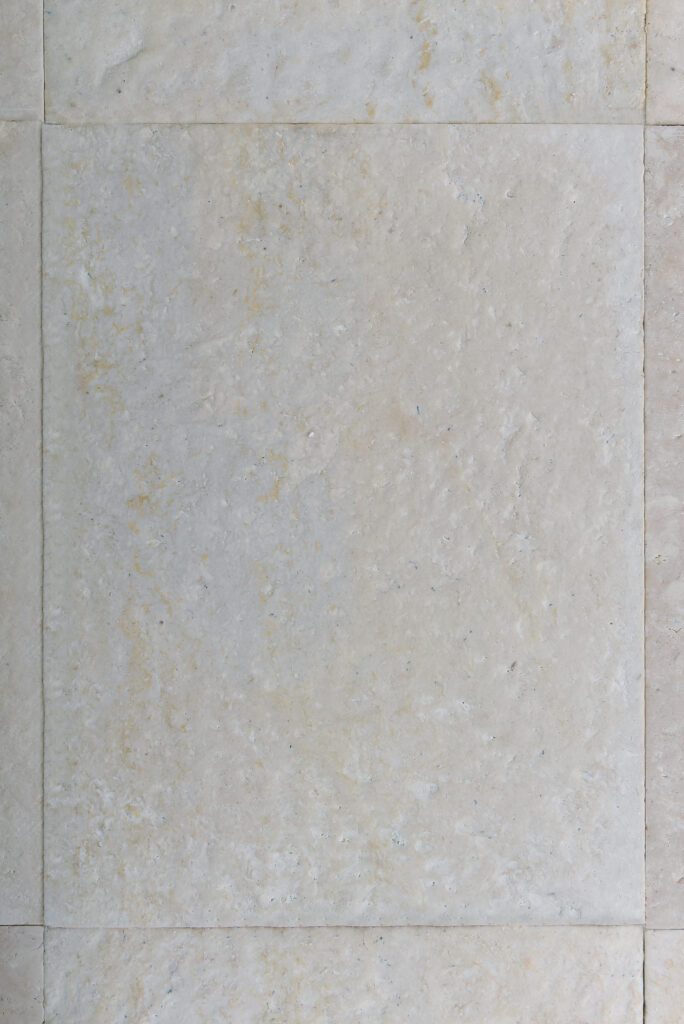
The territory sits squarely inside the hurricane belt, and its reference year is 2017, when two Category 5 storms crossed different islands of the same territory inside two weeks. Irma struck St Thomas and St John on 6 September. Maria followed on 19 and 20 September and hit St Croix, where winds of 99 to 104 mph were recorded with gusts reaching 137 mph. Officials reported that around 90 percent of buildings in the Virgin Islands were damaged or destroyed. Anyone specifying exterior work here is specifying against that memory, and a supplier who names only one of those storms has told the reader everything about how much local knowledge sits behind the quote.
Wind is not the only load case. The islands lie on the North American and Caribbean plate boundary. The reference seismic event is the Virgin Islands earthquake of 18 November 1867, magnitude 7.5, in the Anegada trough between St Croix and St Thomas, consisting of two shocks roughly ten minutes apart and generating tsunamis exceeding 30 ft on some islands, with Charlotte Amalie and Frederiksted heavily affected. That history is exactly why flexible, sand-set or drainage-mat paving with proper edge restraint carries a real engineering argument in this territory rather than merely a cost argument. A jointed surface that can absorb a little movement, and that can be lifted and reset unit by unit, behaves better after an event than a monolithic slab that cracks and then has to be broken out and carted off an island.
- Design the whole assembly rather than the paver. Sub-base, bedding layer, restraint and joint all fail before a sound stone unit does.
- Edge restraint matters more here than in most places. Wind-driven rain and surge scour attack the perimeter first, and one unraveled edge takes a whole terrace with it.
- Federally funded reconstruction work carries floodplain obligations. DPNR’s Division of Permits runs Floodplain Management and the National Flood Insurance function alongside building codes, so drainage and levels are reviewable, not incidental.
- Rainfall is concentrated from May through October, so size falls and outlets for a downpour rather than an annual average. Roof catchment discharging across a terrace is a routine condition here, not an unusual one.
- Let your engineer fix the design wind speed from the codes DPNR has adopted. Figures circulating online for this territory disagree with one another, and the number on your drawings should come from a signed calculation.
Formats and thicknesses matched to the duty they carry
Because the stone arrives by sea and is charged by weight and by volume, format discipline pays off here far more than it does on a mainland job. Over-specifying thickness across a pedestrian terrace adds tonnage to the freight invoice, to the customs value and to the excise base simultaneously. Under-specifying it on a driveway apron costs a great deal more than that once units begin to rock. The sensible method is to divide the site into duty bands and buy each band to the depth it genuinely needs, rather than picking a single comfortable thickness and applying it everywhere.
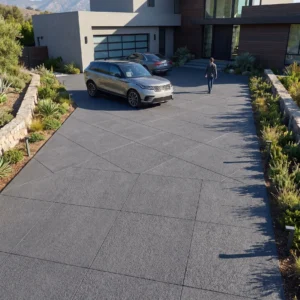
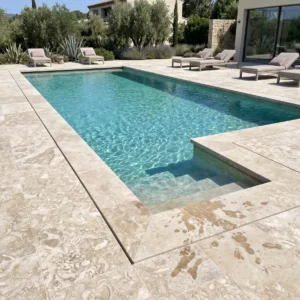
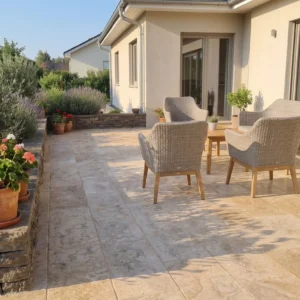
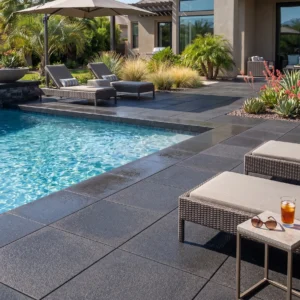
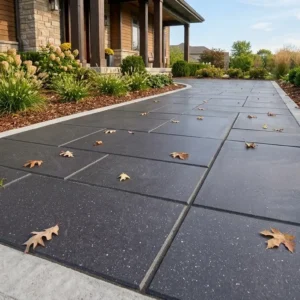
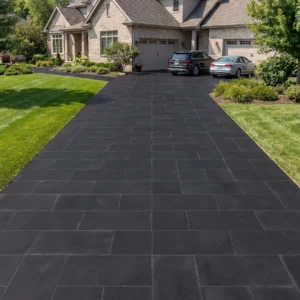
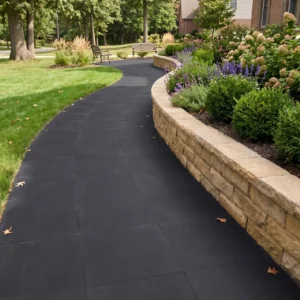
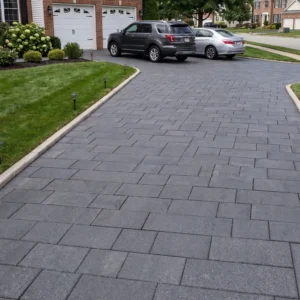
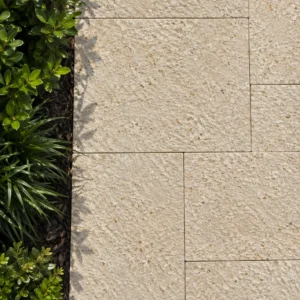
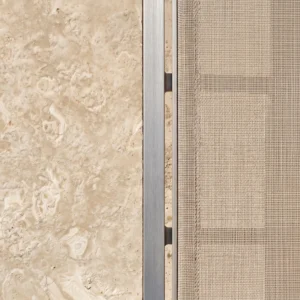
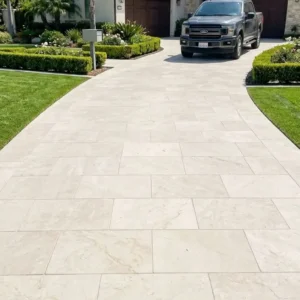
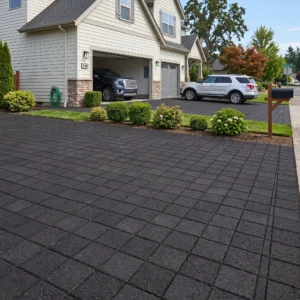
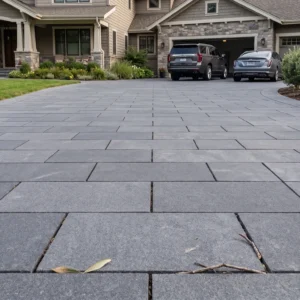
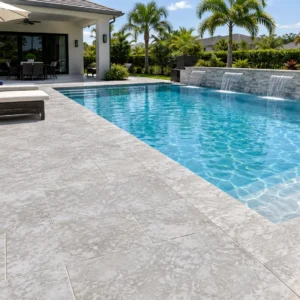
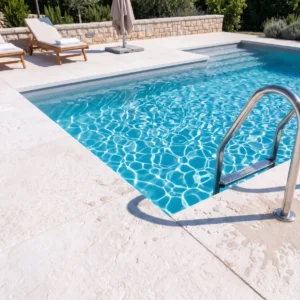
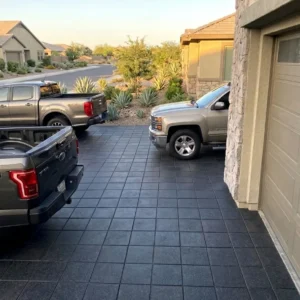
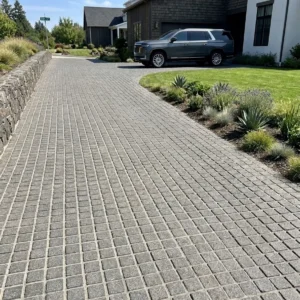
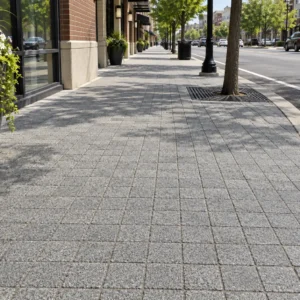
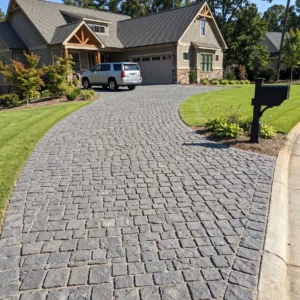
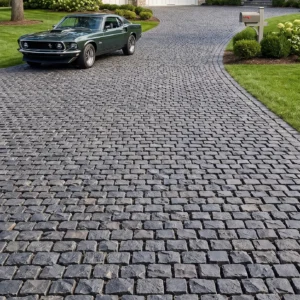
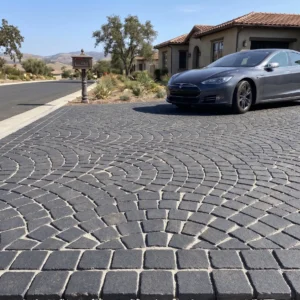
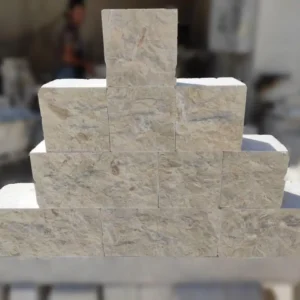
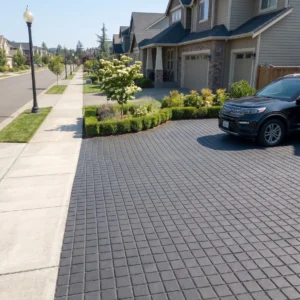
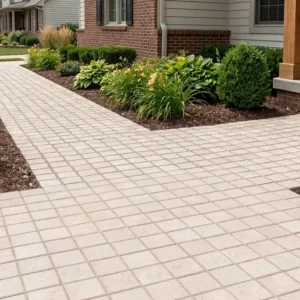
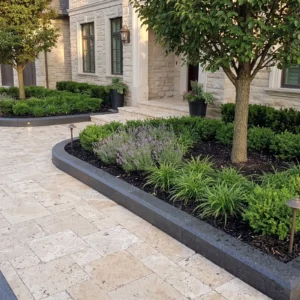
As a working guide, interior floors and covered galleries sit around three-quarters of an inch. Pool surrounds, terraces and pedestrian paths are usually comfortable at an inch and a quarter over a properly prepared bed. Light vehicle areas move up to about two inches. Driveway aprons, turning areas and anywhere a delivery truck swings its rear axle perform better as small units at three to four inches. Those bands, together with the formats, edge details and surface textures we hold in stock, are set out in our paver formats and depths, so a schedule can be matched to them before the take-off is priced and before a container is booked.
- Calibrated thickness is worth paying for on a sand-set job. It is what allows a crew to screed once and lay, instead of packing and adjusting every unit by hand.
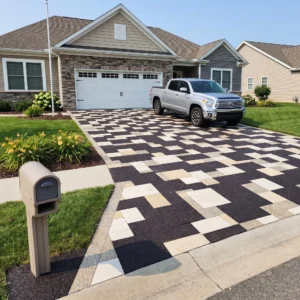
- Mixing formats within a single lot cuts waste on irregular island plots, where very few terraces and almost no driveways are true rectangles.
- Carry a proper allowance for cuts, breakage and future repairs in the first container. A short order is not a phone call here; it is a second customs entry.
- Heavier units mean fewer square feet per ton, which means more containers for the same area. Run the coverage arithmetic before you settle on a thickness you like the look of.
- Tell us the exposure of each zone separately. A sheltered courtyard and a windward pool deck on the same property do not want the same specification.
Permits, coastal zone work and the historic districts
Approvals run through the Department of Planning and Natural Resources. Its Division of Permits covers building codes, floodplain management, National Flood Insurance and tropical energy code implementation, and the territory enforces the International Building Code 2021, the International Residential Code 2021, the Uniform Plumbing Code 2021 and the National Electrical Code 2020. Applications can be filed through the CitySquared e-permitting system or on paper, and the department publishes a general contact line on 340-777-7777. Architects and contractors here work to those codes and to ASTM test methods, and they expect a supplier to produce data sheets rather than lifestyle photography.
Two further routes matter specifically for paving. Coastal work is a Coastal Zone Management matter, handled by a separate DPNR division reachable at czm@dpnr.vi.gov, and a shoreline terrace or waterfront apron should be raised there early rather than discovered late. Work inside a historic district is reviewed by the Virgin Islands Historic Preservation Commission, and the DPNR State Historic Preservation Office has issued an updated Historic Districts Guide covering Charlotte Amalie, Christiansted, Frederiksted and Cruz Bay, addressing architectural materials, masonry repair, landscaping and the approval process itself. If a site falls inside one of those boundaries, the paving is part of what gets reviewed, and it is far cheaper to know that at design stage.
Pricing a Virgin Islands paving package honestly
A defensible budget here is assembled in layers, and each layer has a different owner. The stone is the first layer and the only one a supplier can publish with any honesty. Ocean freight and insurance form the second, and they convert into the CIF value that the territory then assesses. Duty and excise are the third. Brokerage, terminal charges, island haulage and any transload for a steep site make up the fourth. Installation is the fifth, and on a hillside villa it can quietly exceed everything listed above it. A number that skips a layer is not a budget; it is a guess that somebody will pay for later.
Start with what the stone costs per square foot, then build the remaining four layers on top of it using real figures from a broker and a carrier instead of assumptions carried over from the mainland. Send us the drawings, the island, an honest description of the access and the exposure of each area, and we will come back with quantities by format, container counts and a delivered position you can hand to a client without caveats. Small samples travel ahead of any commitment so a specification can be tested against the actual light and the actual salt on the site. Get the customs position and the access geometry right at the start, and the rest of a Virgin Islands paving project is ordinary good building.