




















































Sint Maarten is a small island with a large port, and that combination changes how paving stone is bought here. The Dutch side covers roughly 34 square kilometers, climbs quickly into the Sint Maarten Hills and the Cole Bay Hills, and carries a construction pipeline far heavier than a population of about 58,477 would suggest. Tourism accounts for something close to 80 percent of the workforce, so the work that needs hard surfaces is resort and timeshare refurbishment, villa terraces above Dawn Beach and Cupecoy, public realm along Front Street and the Boardwalk at Great Bay, and the housing rebuilt after 2017. All of it lands on the same question: what surface will still be flat, gripping and whole after the next wet season.
This page covers the broad category. How natural stone pavers physically reach Point Blanche, what the island’s import regime does and does not charge, how to get crated stone up a hillside driveway, and how to match unit size and thickness to the duty a surface will actually carry. Citadel Stone supplies calibrated paving units into the Caribbean from stock loaded in the United States. We are not a local contractor and we claim no portfolio on this island. What we bring is graded, dimension-sawn stone in repeatable lots and finishes, plus the freight and specification detail that gets it onto your site in the condition it left the warehouse.
How Paving Stone Reaches Point Blanche
Port St. Maarten sits at Point Blanche on Great Bay, immediately around the headland from Philipsburg. Its cargo terminal, the Captain David Cargo Quay, is a working multipurpose facility rather than a lighterage beach, and the difference matters enormously when the cargo is dense. It takes direct ocean freight. Stone loaded in the United States can discharge here without an intermediate leg, which is the opposite of the position several neighboring islands are in.
- Berth length of 540 meters, with 10.5 meters of alongside depth.
- A container storage yard rated at 3,000 TEU.
- Gottwald HMK 260E mobile harbor cranes at 100 tonnes each, working up to 23 moves per hour.
- A 24/7 multipurpose terminal handling containerized and breakbulk cargo alike.
- St. Maarten Shipping and Stevedoring N.V. is described as the primary terminal operator and stevedoring company.
The port describes itself as the first port of call for inbound cargo from Europe, and it runs a feeder service to Anguilla, Montserrat, St. Barths, St. Kitts and Nevis, and Antigua and Barbuda. That is worth understanding even if your project never leaves the Dutch side, because it tells you what kind of terminal you are dealing with. This is a facility built to break a deep-sea call into smaller regional legs, with the crane capacity and yard space that implies. A container of paving stone is an ordinary lift here, not an exceptional one, and breakbulk is handled as routine rather than as a favor.
If you are also building on one of the islands fed from here, ask your forwarder whether a single consignment can be split at this point rather than shipped twice from origin. That is a question for the forwarder and the terminal, not an assumption to build a schedule on, but it is the kind of option a hub port makes available and a lighterage port does not.
What the Free Port Does and Does Not Charge
Sint Maarten has been a constituent country within the Kingdom of the Netherlands since 10 October 2010, with equal status to Aruba, Curacao and the Netherlands itself. It runs its own customs regime, and that regime is unusually simple. Customs Sint Maarten states on the government website that it is mainly a law enforcement agency and not primarily an import duty collecting organization, and that the only tax it levies is tax and excise on unleaded gasoline. For a pallet of paving stone, that means no ad valorem tariff on arrival.
- No import duty applies to a stone consignment discharged at Point Blanche.
- The CARICOM Common External Tariff does not apply; Sint Maarten is not a CARICOM member state.
- Turnover Tax runs at a standard 5 percent on a local business’s realized revenues. It is a tax on the seller’s turnover, expressly not a border charge on your goods.
- Turnover Tax returns are monthly, with filing and payment due by the 15th of the following month and a 15 percent surcharge on default.
- Customs formalities still exist. Declarations and clearance agents remain part of the process, and whether a licensed broker is required is worth confirming locally before you book freight.
The practical consequence is that landed cost here is freight plus handling plus local margin, not freight plus tariff. That is a different arithmetic from almost every other market in the region, and it quietly changes what is worth importing. Where a duty jurisdiction pushes a specifier toward thinner units and lighter loads to keep the tariff base down, Sint Maarten does not penalize mass in the same way. The constraint is ocean freight and handling, which are real costs but linear ones, and they do not multiply with the invoice value of the stone.
On money: the Caribbean guilder, XCG, became the official currency of the Curacao and Sint Maarten monetary union on 31 March 2025, replacing the previous guilder one for one at a peg of one US dollar to 1.79. The US dollar remains widely used, and construction and hospitality routinely price in US dollars. Quotes from us are in US dollars, which removes one variable from a comparison exercise that already has plenty.
Moving Crated Stone Around a Hilly Island
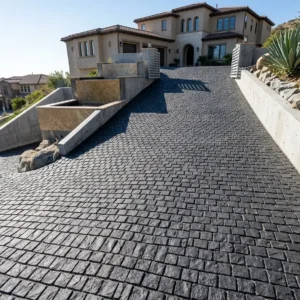
Thirty-four square kilometers sounds like nothing until you drive it. The Dutch side rises into the Sint Maarten Hills and the Cole Bay Hills, with Sentry Hill reaching about 341 meters, or 1,119 feet, and villa sites here can sit part-way up a slope, on a driveway cut for a car rather than a flatbed. Delivery planning is a genuine part of the specification here, and it belongs in the conversation before the order is placed, not after a container is sitting on the yard accruing storage.
- Confirm what can physically reach the site: truck size, turning space, and whether the last leg needs a smaller vehicle.
- Ask whether a crate can be set down close to where the paving will be laid, or whether every piece will be carried by hand.
- Stage large orders into separate drops so a site with no lay-down area is not storing pallets in the open through a wet month.
- Agree in advance who supplies the offload equipment, because a hillside villa gate is not a loading dock.
- Check routing and any bridge or traffic timing constraints with your hauler rather than assuming an open road across the island.
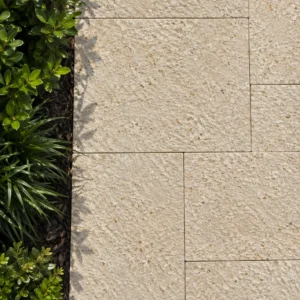
Before any of that is booked, work through the paving formats we carry and settle on one unit size and depth per area. Mixed formats arriving on one truck are how sites end up with the wrong stone in the wrong place. Because there is no duty to save on, there is also no reason to under-order. Buy the measured area plus a sensible cutting and breakage allowance, keep a small reserve from the same lot for future repairs, and store it dry and covered. Stone from a later lot will not match a five-year-old terrace exactly, and on an island where a replacement piece has to be shipped in, the cheapest storage you will ever pay for is the corner where the spare pallet lives.
Exposure Zones Across the Dutch Side
The island does not present a single exposure condition. The Atlantic-facing eastern shore around Dawn Beach and Oyster Pond takes wind and salt straight off open water, while leeward Great Bay, Simpson Bay, Maho and Cupecoy sit in a different aspect entirely. That is reasoning from geography rather than a published exposure map, so treat it as a way to think rather than a code clause. Aspect is still worth establishing before anything is specified, because an exposed shoreline position asks more of a surface than a sheltered bay does.
The calendar matters as much as the compass. Rainfall averages about 1,047 mm a year, the drier stretch runs from January to July, and the wettest months, September through November, sit directly on top of peak hurricane risk. That coincidence sets the design case. You are not detailing for gentle drainage. You are detailing for wind-driven rain and, on low frontage, for water that arrives with energy behind it. Hurricane Luis in 1995 and Hurricane Irma on 6 September 2017 are both within living memory here, and Irma destroyed a reported 70 percent of the infrastructure on the Dutch part of the island. Philipsburg and the Boardwalk along Great Bay Beach were rebuilt afterward. Nobody on this island needs a paving supplier to explain the weather, and no honest supplier will call a surface storm-proof.
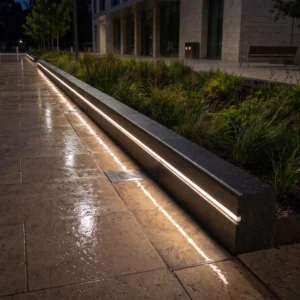
What follows is unglamorous and correct. The bedding, the jointing and the edge restraint decide whether a terrace survives, far more than the slab itself does. Scour starts at a free edge and works inward, so every open margin wants restraint, the base wants proper compaction in layers, and the jointing detail wants to be something that will not wash out in the first hour of a squall. Get those three right and an ordinary paver outlasts an expensive one laid carelessly.
Choosing Format and Thickness by Duty
Duty, not taste, should drive the first two decisions: how big each unit is, and how thick. Color, finish and pattern can all follow once those two are fixed, and they are much cheaper to change on paper than on site.
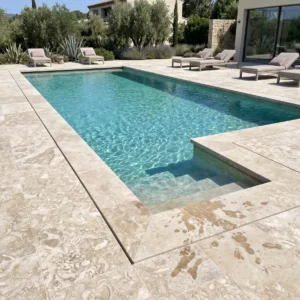
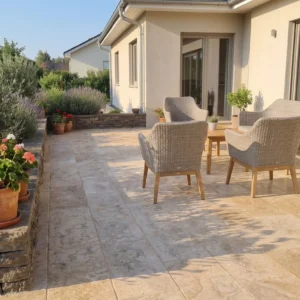
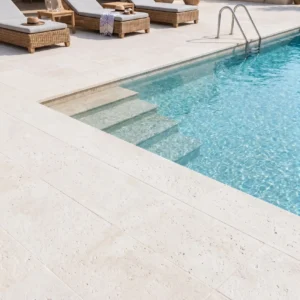
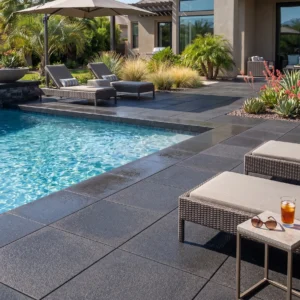
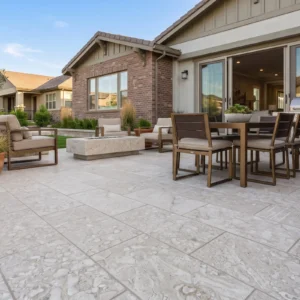
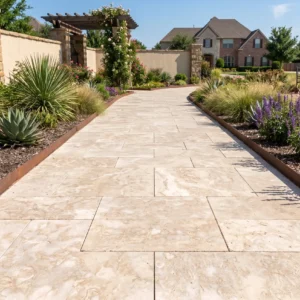
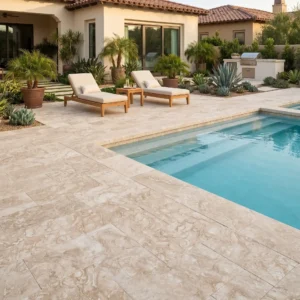
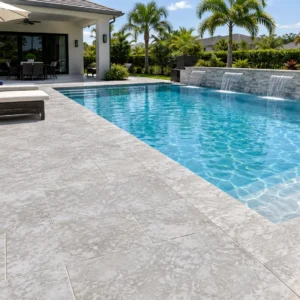
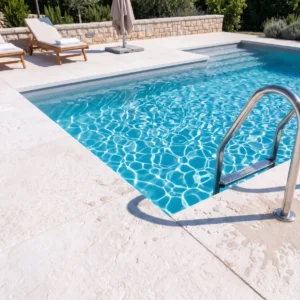
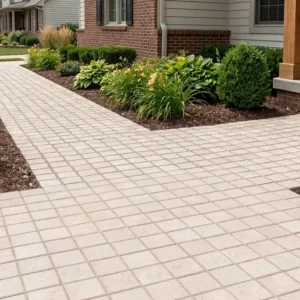
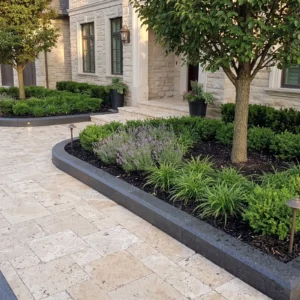
- Terraces, pool surrounds and courtyards: larger slab formats on a properly compacted base, with the finish chosen for wet grip before it is chosen for looks.
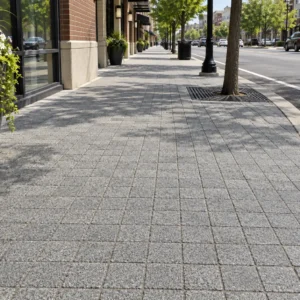
- Pedestrian commercial areas: Philipsburg’s retail spine carries cruise foot traffic that passed a million passengers a year by 2018, which is a commercial wear specification rather than a residential one.
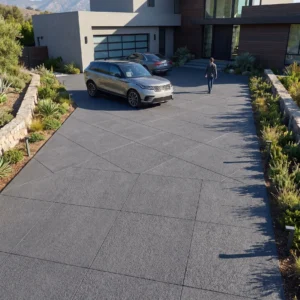
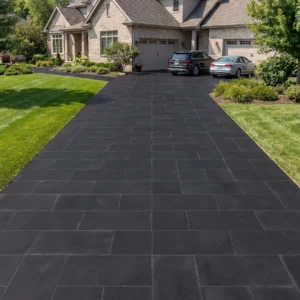
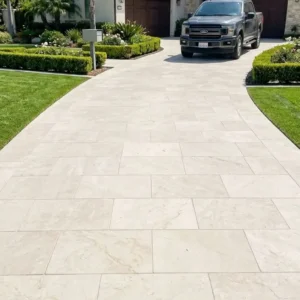
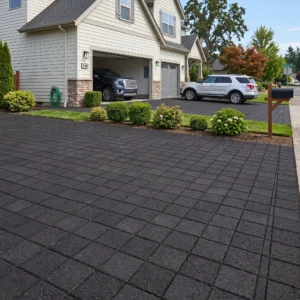
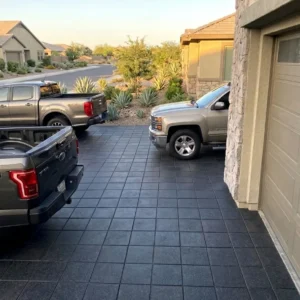
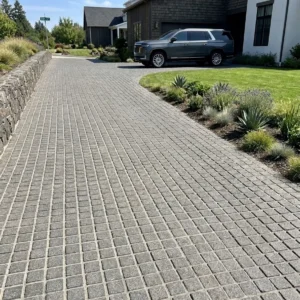
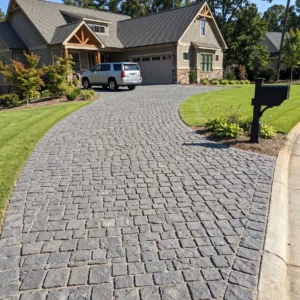
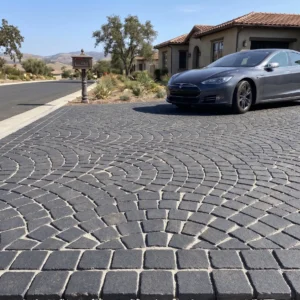
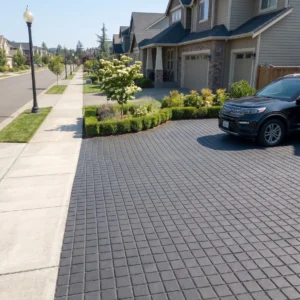
- Driveways and turning areas: thicker units or small setts on a bound base, with joints and restraint detailed for turning loads rather than straight-line traffic.
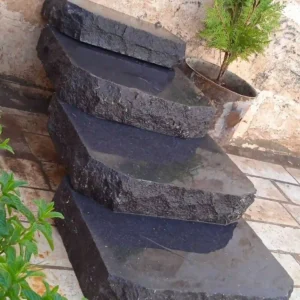
- Steps, thresholds and copings: fewer, larger, well-anchored pieces beat many small ones anywhere a foot lands wet.
- Service yards and back of house: choose for abrasion and cleanability, and accept that this is where a hard, dense unit earns its keep.
Thickness bands follow the same logic. Pedestrian-only work can run thinner because the load spreads and the base is doing the structural job. Anywhere a vehicle turns, the unit has to survive a point load applied through a rotating wheel, which is a different and far more punishing action than rolling straight over it. Get that wrong and the failure will not appear in the middle of the drive. It will appear at the gate, where every car stops, pivots and pulls away, and where the repair is most visible.
There is a second reason to fix format early on a small island. Unit size drives crate size, crate size drives weight per package, and weight per package drives what can be lifted off a truck at the top of a steep driveway. Format is not only an aesthetic decision here. It is a logistics decision wearing an aesthetic hat.
Permits, Groundworks and the Local Base
Hardscape on Sint Maarten is not always a purely private matter. The Ministry of VROMI, covering Public Housing, Spatial Planning, Environment and Infrastructure, and its Department of Permits sit over building activity. A building permit, the bouwvergunning, is required for new buildings and for extension or modification of existing ones. The National Building Ordinance sets out the rules for building activities, the ministerial approval required, preparatory civil works and demolition. The National Ordinance on Spatial Development Planning, the Landsverordening Ruimtelijke Ontwikkelingsplanning, was reintroduced in 2021.
- Civil works permits are required from VROMI for activity that alters terrestrial, coastal or marine terrain, and excavation is explicitly named.
- Those civil works permits are prerequisites for building permits, so groundworks sequencing is a permitting question and not only a program question.
- Approved permits are published biweekly in the National Gazette.
- A six-week objection window follows publication, which is a real date in your program rather than a formality.
- Coastal terrain alteration is named specifically, so shoreline-adjacent work deserves early advice from someone who files these applications regularly.
There is a second reason to think carefully about what happens below the paving. Sint Maarten’s own rock is volcanic. Andesite tuff and tuff breccia, intruded by basalt and other igneous rock, with limestone and marl deposited later on top, and the layered Point Blanc stone at the headland where the port itself stands, a sample of which is held in the Sint Maarten Museum. Rock has been quarried on this island for aggregate. On 34 square kilometers, extraction is a live and contested subject, and permit objections are raised publicly.
None of that puts imported stone in competition with local material, and it should not be written as if it does. Local aggregate and ready-mix make the sub-base and the concrete. The imported unit is the wearing surface that sits on top of them. What does not come out of a small island is calibrated, dimension-sawn paving in repeatable lots, thicknesses and finishes, which is a question of processing and supply rather than of one rock being better than another.
Ordering, Samples and What to Send Us
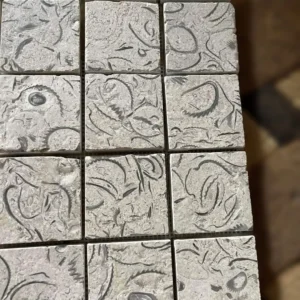
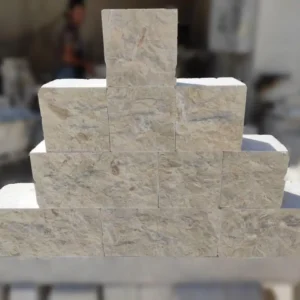
Start with a sample. Small hand samples are the cheapest specification tool in existence, and seeing stone under Caribbean light beside your actual render color, roof tile and pool coping tells you more than any photograph will. Wet it. Stand on it barefoot at midday. Leave it outside for a week. Put a drop of your pool water on a corner and see what happens. Then decide, with the piece in your hand rather than a screen in front of you.
When you are ready to cost the job, send areas broken out by use rather than one total, and you can price a container of pavers against a real schedule instead of an average. The details that make a quote useful are simple:
- Square footage split by duty: terrace, pool surround, path, driveway, service area.
- Aspect and rough location, whether that is windward eastern shore, leeward bay, hillside or street frontage.
- Access notes covering truck size, turning space and whether a lay-down area exists.
- Target program dates, including the objection window if a permit is in play.
- Whether you want one delivery or staged drops, and where each drop goes.
From there the conversation stays short, because the cost model is honest and has few lines in it. Material, freight, handling, and your own installation. There is no tariff to argue about and no duty surprise waiting at the quay, which means the numbers you compare between suppliers are actually comparable. Get the format, the depth and the site access settled first, and the rest of a Sint Maarten paving order is simply logistics done in the right order.