




























Puerto Rico sits in a category of one. Every other Caribbean market a stone supplier serves involves a customs entry, a broker, a tariff line and a clearance window that can stretch a delivery date by a week. Puerto Rico is inside United States customs territory, so pavers moving from a mainland warehouse to San Juan travel as a domestic shipment. There is no federal customs duty on that leg and no international clearance file to open. Contractors who have imported from Florida into other islands notice the difference on their first order, and they usually notice it as an absence: nothing to wait for, nobody to chase, no demurrage clock running while a document is corrected.
What replaces the customs problem is a different pair of constraints, and they shape every decision on this page. The first is the Jones Act, which requires that cargo moving between mainland ports and Puerto Rico travel on US-flag, US-built and US-crewed vessels. That raises the freight line on a quote, and it also delivers something most islands never get: frequent, scheduled, predictable weekly sailings out of Jacksonville and Port Everglades. The second is IVU, the island’s sales and use tax, which lands on the total delivered cost rather than on a customs value. Get those two right and the rest of a paver package – format, thickness, finish, pattern, pallet count – falls into place quickly.
Jones Act sailings, San Juan and the run past the main island
Stone for Puerto Rico is consolidated on the mainland and loaded for San Juan, where the terminals at Puerto Nuevo handle the overwhelming majority of the island’s container cargo. Carriers such as Crowley and TOTE run US-flag tonnage on fixed weekly rotations from the Florida gateways, and that rhythm is worth more to a construction schedule than most buyers expect. You are not waiting for a vessel to fill or for a consolidator to find a partner shipment. You are booking a slot on a sailing that departs whether your pallets are aboard or not.
The practical result is that a paver order for Puerto Rico can be dated with real confidence at quotation stage. Loading day, sailing day and terminal availability are knowable rather than estimated, and a contractor can back-schedule base preparation against them instead of holding a crew on standby. Where the picture gets more interesting is the last leg, because Puerto Rico is not one delivery geography but several.
- Jacksonville and Port Everglades are the two mainland gateways that matter for building materials, both on regular scheduled service into San Juan.
- Jones Act carriage requires US-flag, US-built and US-crewed vessels; that shows in the freight line, and reliability is what you get back for it.
- Vieques and Culebra take a barge leg from Ceiba, which adds a handling and puts a hard ceiling on pallet weight per movement.
- Drayage reaches the whole island from Puerto Nuevo, but a Rincon or Cabo Rojo delivery is a very different trucking day from a Guaynabo one.
- Pallets should be built for the final site rather than for warehouse convenience, which is the single cheapest way to control the last mile.
None of this removes the need to plan. It simply moves the planning away from clearance risk, which you cannot control, and toward loading and handling decisions, which you can.
IVU is not a customs duty, and it behaves differently
The most common budgeting mistake on a Puerto Rico stone order is treating the absence of federal duty as the absence of tax. It is not. Puerto Rico levies IVU, its sales and use tax, at a combined 11.5 percent – 10.5 percent at the state level and 1 percent municipal – and it is calculated on the total landed cost of the goods, which includes shipping and insurance rather than a bare invoice value. That base is wider than most mainland buyers expect, and it is the figure that belongs in your budget line rather than the ex-warehouse price of the stone.
The mechanics are administered by Hacienda through the SURI portal, not by Customs and Border Protection. CBP does not collect IVU and there is no broker fee attached to it, because there is no customs entry to file. An electronic declaration of imports is submitted for goods arriving on the island, and use tax generally falls due at filing unless the receiving party holds a bond. Rates and filing rules do change, so confirm the current position with your CPA or tax advisor before you lock a budget.
- No federal customs duty applies to stone moving from the mainland – the shipment is domestic in every legal sense.
- IVU is charged on landed cost including freight and insurance, so a heavier pallet costs twice: once in freight, once in tax.
- Hacienda administers the tax through SURI, and the declaration of imports is filed electronically.
- Use tax typically falls due at filing unless a bond is in place, which is worth arranging before a large multi-container project.
- Resellers, general contractors and homeowners each handle IVU differently, so the entity buying the stone changes the final figure.
Because tax is calculated on weight-driven landed cost rather than on a tariff classification, the specification lever in Puerto Rico is mass, not paperwork. That is a genuinely different way to optimize an order.
Format and thickness when weight is the lever, not the tariff
In duty markets, thickness is partly a tax decision. In Puerto Rico it is purely a structural and logistics decision, which is a far cleaner way to specify. Nothing in a tariff schedule is pushing you toward a thinner slab to save points of duty, so the only real questions are what the surface must carry and what the crate weighs by the time it reaches its final address.
The conventions we work to on the island are straightforward. Two centimeter material belongs under cover – interior floors, roofed terraces, marquesina bays that never see a wheel. Three centimeter is the general exterior standard for foot traffic on a prepared base or a mortar bed over concrete. Five to six centimeter is what goes where vehicles turn, and turning is the load that breaks paving, not straight-line driving.
- Interior and covered areas: 2 cm, honed or brushed, in modular or large-format losas.
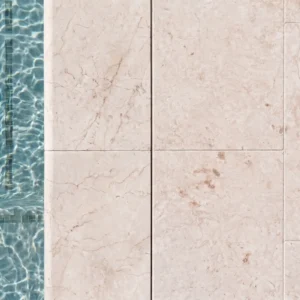
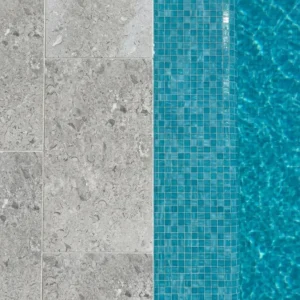
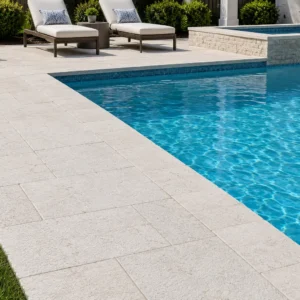
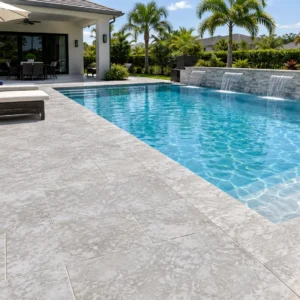
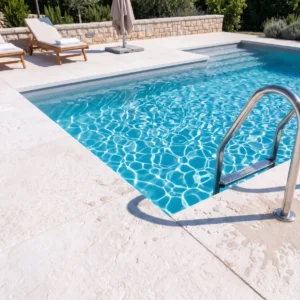
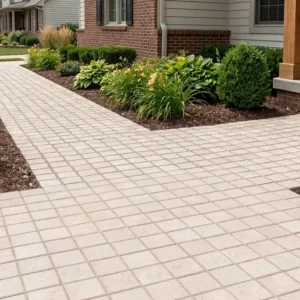
- Pool decks, terraces and garden paths: 3 cm with a textured face, bedded rather than left loose near water.
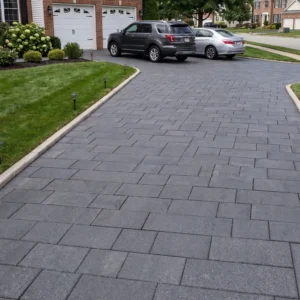
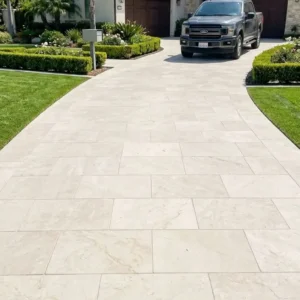
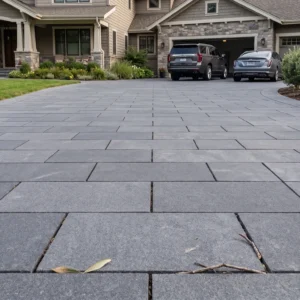
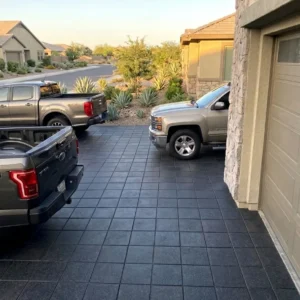
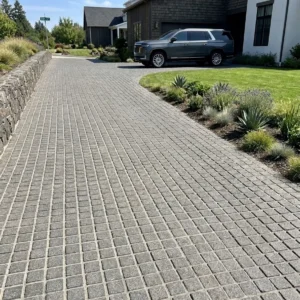
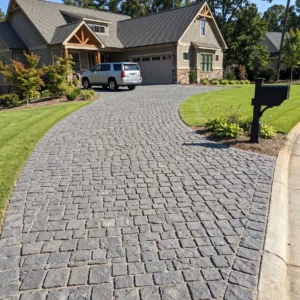
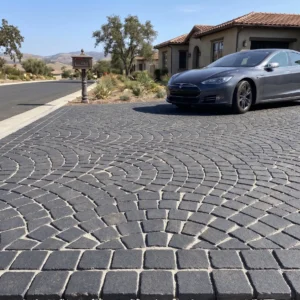
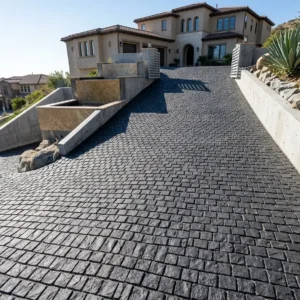
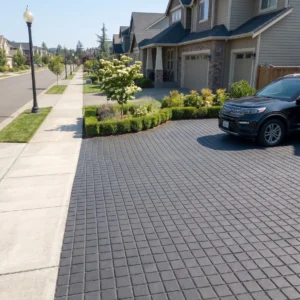
- Driveways, aprons and service yards: 5 cm or more, or small-unit setts, with a properly restrained edge on every side.
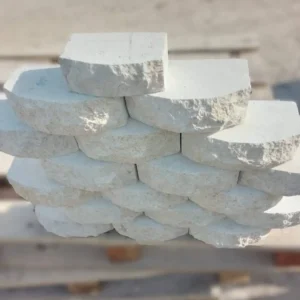
- Steps, coping and thresholds: made as dedicated pieces with a drip or bullnose, not cut down from field tile on site.
- Wall cladding and seat tops: thinner sawn material, gauged so the setting bed does not have to correct for thickness swing.
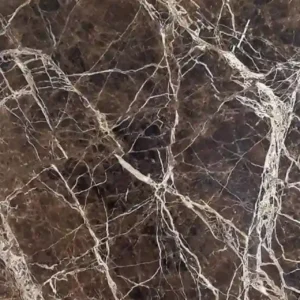
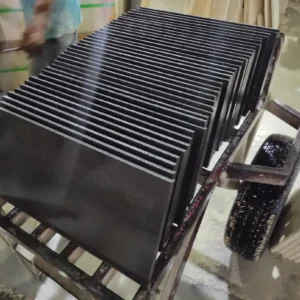
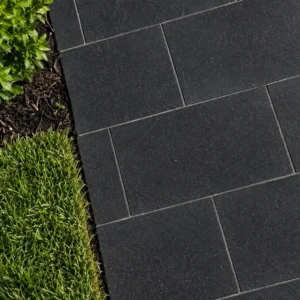
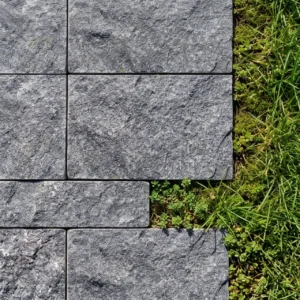
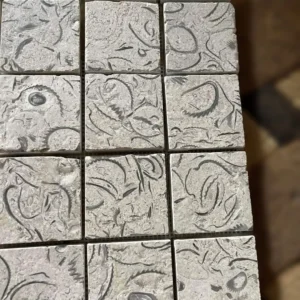
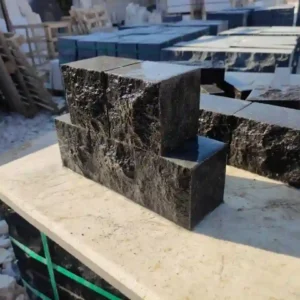
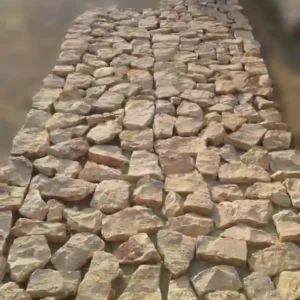
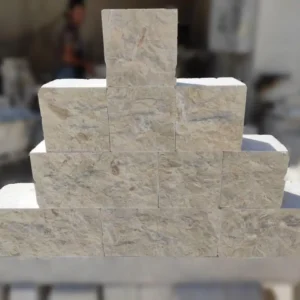
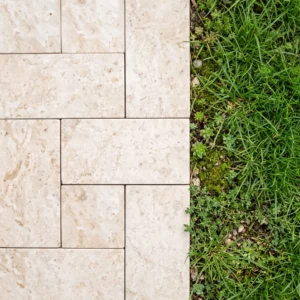
Sizes follow the same logic. Modular rectangles, square formats, a French or Versailles set and plank shapes all ship well and all cut cleanly against the concrete geometry Puerto Rican houses are built from. If you are still deciding between families, it is worth taking the time to browse the paver range before you commit a pattern to a drawing, because format changes the pallet count as much as it changes the look.
One island, several climates - specify for the zone
Puerto Rico is small enough to drive across in a morning and varied enough that a single specification will not serve all of it. The north coast and the karst interior are wet; El Yunque is a rainforest by any definition; the south around Ponce and Guanica is genuinely dry, with a scrub landscape and a very different maintenance profile. A pale limestone terrace behaves one way in Guanica and another way on a shaded north-facing patio in Bayamon, and pretending otherwise is how suppliers earn callbacks.
- Wet north and karst interior: constant damp and shade encourage growth in joints, so choose textures that can be brushed clean and drain the field properly.
- El Yunque foothills and the Cordillera: heavy, sustained rainfall makes base drainage and joint permeability matter more than surface hardness.
- Dry south, Ponce to Guanica: intense sun and long dry spells make surface temperature and reflected glare the leading comfort questions.
- West and northwest surf coast, Rincon to Isabela: salt aerosol carried inland by the trade winds, plus sand abrasion on every threshold.
- San Juan metro: heat held by concrete and asphalt overnight, tight sites, and paving that has to look composed under strong artificial light.
The island’s own quarry industry works the north karst and mogote belt for crushed aggregate, sand and cement feedstock, and that material sits in the base course under almost every paved surface here. Imported dimension paving goes on top of it. The two are complements, not competitors, and any honest specification for Puerto Rico uses both.
Access: gated urbanizaciones, historic streets and resort windows
Delivery in Puerto Rico is rarely a problem of distance. It is a problem of the final two hundred feet. Gated urbanizaciones often have a guardhouse with vehicle length restrictions, and a full-size tractor-trailer that cannot swing the entry radius will cost you a transfer to a smaller truck. Old San Juan’s streets are narrow, one-way in places and controlled for loading. Resorts at Dorado and Palmas del Mar generally run booked delivery windows through a service entrance, and missing the window means a return trip, not a wait.
- Confirm the entry radius and any vehicle length limit at the guardhouse before the truck is dispatched, not on the morning of delivery.
- Ask whether the site has a forklift or whether pallets come off by tailgate lift, because that decision changes pallet size and crating.
- Mountain roads to Utuado, Adjuntas and Jayuya carry real weight and turning constraints, so split loads rather than gambling on one heavy delivery.
- Historic core work needs its loading arrangements agreed in advance, and the crew has to be on site when the stone lands.
- For Vieques and Culebra, size the pallets for the Ceiba barge first and for the warehouse second.
None of this is exotic. It is simply the difference between a delivery that takes an hour and one that takes a day. Send us the site address, access photographs and the target date and we will build the load around them – the fastest way to start is to request a project quote with the square footage and the delivery constraints in the same message.
Stone as a finish layer on a reinforced-concrete island
Puerto Rico builds in reinforced concrete more thoroughly than almost anywhere in the hemisphere. Roofs are slabs, walls are block and concrete, and the storm history explains why. That has a direct consequence for paving: stone here is almost always a finish layer over a structural element that is already doing the work, rather than a structural surface in its own right. The detailing questions therefore become bond, movement and edge restraint rather than load spreading.
The regulatory frame is the Puerto Rico Building Code and the Puerto Rico Residential Code adopted in 2018, developed from the 2018 I-Codes with local amendments and put in place after Hurricane Maria on the recommendation of the FEMA Mitigation Assessment Team. Wind resistance recommendations across structure types and risk categories run roughly in the 150 to 200 mph band, which is a serious number and one your engineer of record will hold you to. Paving is not usually the item being certified, but loose or poorly bedded units, unsecured coping and unrestrained edges become debris in that wind, so they belong in the same conversation.
In practice that means mortar-set or adhered installations over concrete for elevated terraces and roof decks, mechanically restrained edges on anything sand-set at grade, coping fixed rather than dry-laid, and drainage sized for a rainfall event rather than an average afternoon. Maria did not change what limestone is. It changed what the island expects of the way anything is fixed down, and a paving package specified in 2026 should reflect that expectation rather than a mainland habit.
How a Puerto Rico order actually runs, step by step
Most of the friction in a stone order comes from sequence, not from the stone. Here is the order of operations we use for the island, deliberately front-loaded so that surprises show up while they are still cheap to fix.
- Samples first: small pieces, in the finishes you are shortlisting, seen wet and dry on the actual site under the actual light.
- Quotation with freight and crate count shown alongside the stone, so the delivered figure is visible before commitment.
- Confirmation of format, thickness, finish and quantity, with cutting allowance and attic stock agreed at the same time.
- Production and pallet build, sized for the final site access and for any barge leg to Vieques or Culebra.
- Loading against a named sailing, then drayage from Puerto Nuevo and delivery inside the agreed window.
IVU sits alongside that sequence rather than inside it, handled by the buying entity through SURI at filing. Because there is no customs entry, there is no clearance step to stall between the vessel and the truck, and that absence is the whole practical advantage of buying stone as a domestic shipment. It is also why a well-planned Puerto Rico order tends to land on the day it was promised. Send us the square footage, the exposure zone and the access limits, and we will come back with stone, crate count and sailing on a single page.