













































Buying paving for a Jamaican site is really two jobs running at the same time. The first is choosing stone that will still look right after ten wet seasons and ten hot ones. The second is getting that stone onto the ground without the landed cost surprising anybody at the end. This page concentrates on the second job, because it is the one most often left vague: which port shortens your road leg, what stacks onto a CIF value once the container reaches the Jamaica Customs Agency, which thicknesses are worth paying ocean freight on, and what happens between the wharf gate and a hillside site in St. Ann.
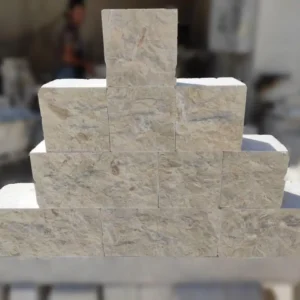
Jamaica is not short of rock. Limestone underlies roughly two thirds of the island, and quarrying is supervised by the Mines and Geology Division within the Ministry of Transport and Mining under the Mining Act and the Quarries Control Act. The non-metallic list those rules cover reads limestone, silica sand, marble, marl and fill, and clay, so this is a country with its own stone industry and its own marble rather than a blank map. What arrives in a container from us is a different product line rather than a competing one: dimension paving cut to a stated thickness, sorted for tone, with absorption and density figures attached. The material underneath it, the marl and the crusher run, comes from Jamaican pits and always will.
Kingston or Montego Bay: pick the port that shortens your road leg
Jamaica gives an importer a genuine choice of two entry points, and the right one is decided by the road leg on the far side rather than by the ocean leg. Kingston Freeport Terminal on the south coast is the island’s deep-water container gateway and a CMA CGM group concession that also works as a regional relay point, so it sees the widest range of scheduled services and the most predictable consolidation options. If your site is in Kingston, St. Andrew, Portmore, Mandeville or anywhere along the south, Kingston is the obvious routing and your truck leg can be measured in a single morning.
Montego Bay serves the north-coast resort belt directly. For work at Rose Hall, Ironshore, Ocho Rios, Runaway Bay, Falmouth or Negril, landing at Montego Bay avoids dragging a loaded flatbed across the interior on roads that climb, twist and wash. That inland haul is not a trivial line item. It costs money, it costs a day, and it is where corners get chipped and pallets get shaken loose. Weigh the two options honestly before anything is booked:
- Kingston suits the capital, the south coast, Manchester, and anything routed through a bonded warehouse or a consolidator.
- Montego Bay suits the resort belt and the western parishes, and shortens handling for hotel deliveries with narrow service windows.
- Sailing frequency and consolidation choice are usually wider through Kingston, so a part-container order may still route there and truck across.
- A full container discharging nearest the site is almost always cheaper overall than a keener ocean rate followed by a long domestic haul.
- Tell us the parish and the nearest main road at quotation stage and the port decision falls out of the arithmetic by itself.
What actually stacks onto the invoice at Jamaica Customs
The number that matters is not the price of stone. It is the price of stone landed, cleared and standing on your site. Jamaica calculates its charges on the CIF value, meaning the goods, the ocean freight and the insurance taken together. Several separate lines then sit on top of that base, and they are administered by the Jamaica Customs Agency rather than by any supplier.
- Import duty, commonly around twenty percent for many goods under the CARICOM Common External Tariff, with the exact rate following the tariff line your broker classifies the stone under.
- General Consumption Tax at a standard rate of fifteen percent.
- An Environmental Levy of half a percent, charged on the CIF value.
- A Standards Compliance Fee of three tenths of a percent, collected by Jamaica Customs on behalf of the Bureau of Standards Jamaica.
- A Customs Administrative Fee, which is payable alongside all of the above.
Read that as a stack rather than as a single rate, because a stack is how it behaves in a cash-flow forecast. Two practical consequences follow. First, freight sits inside the taxable base, so a well-loaded container is taxed more efficiently than a half-empty one and part loads carry a hidden penalty. Second, because the percentages apply to everything inside the box, it pays to decide early whether you genuinely need a heavier unit across every area or only where vehicles run. Rates and classifications change, and only a licensed customs broker can give you the figure that will apply on the day your container arrives, so confirm the current rate with your broker before you commit a budget line. We supply the commercial documentation your broker needs, in the format they expect, without being chased for it.
Reading Jamaica's exposure map before you specify
Jamaica’s regulatory picture changed decisively with the Building Act 2018, which came into operation on 15 January 2019 and adopts the National Building Code of Jamaica published by the Bureau of Standards Jamaica. For the first time the country has national mapping of seismic, wind-speed, rainfall, flood-plain and land-slippage hazards, which means the exposure of a particular site is now a documented input rather than a matter of local memory. Paving is not a structural element, but it lives inside that same envelope, and the details around it, meaning drainage, retaining, fixing and edge restraint, all sit under the same rules.
Wind is the part everybody remembers. After Hurricane Gilbert crossed the island in 1988 the design wind speed used in Jamaica was raised from 120 mph to 150 mph, and Gilbert remains the benchmark storm in the national conversation. Beryl reached the south coast in July 2024 and refreshed the lesson for a younger set of site managers. For a paving specification the takeaway is unglamorous but real: loose-laid units, lightweight coping and unrestrained edges are the parts that move, and they move first.
- North-coast salt exposure at Montego Bay, Ocho Rios and Negril, where airborne salt reaches horizontal surfaces every single day.
- Kingston and St. Andrew urban duty cycles, covering forecourts, apartment courts, delivery yards and long hot afternoons on hard surfaces.
- Blue Mountain and interior rainfall, where orographic rain arrives hard and often and drainage design governs every other decision.
- South-coast sites around Treasure Beach and along the plain, drier and brighter, with a different maintenance rhythm entirely.
- Slope and land-slippage sensitivity across the hill parishes, where paving loads and surface water have to be thought about together.
Formats and thicknesses worth paying freight on
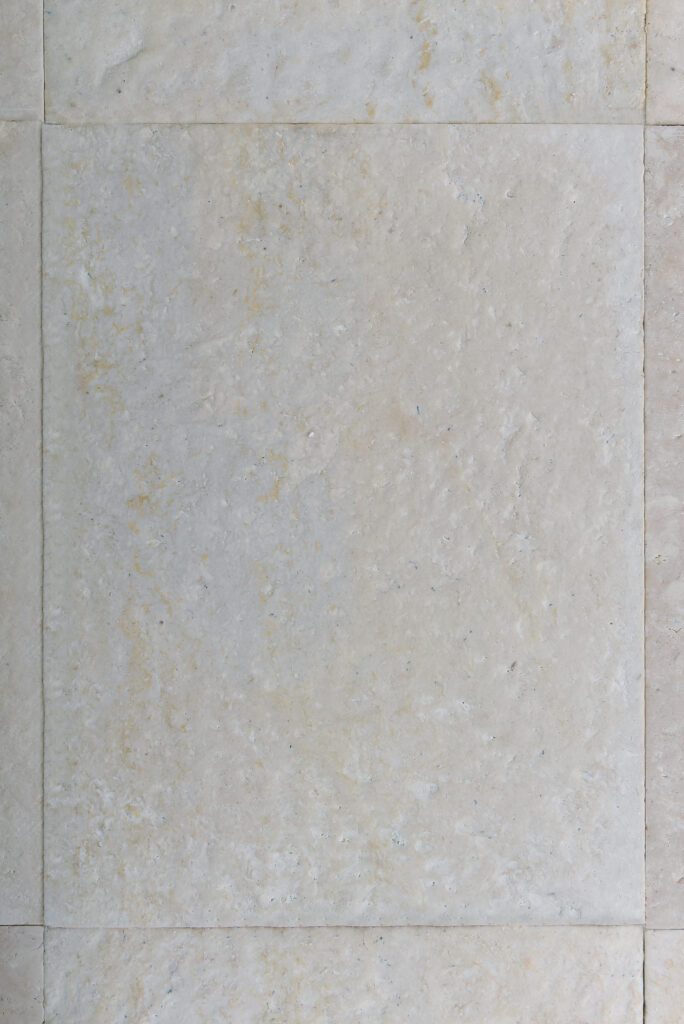
Because duty, GCT and the levies all apply to the value inside the box, thickness is a commercial decision as much as a technical one. The temptation is to specify a single heavy unit everywhere for simplicity. On an island where every kilogram has crossed water and been assessed on arrival, that simplicity is expensive. Zone the project instead and let each area carry the thickness its duty actually needs.
- Two centimeters for covered interior floors, verandah rooms and anywhere the stone is fully bedded on a sound slab.
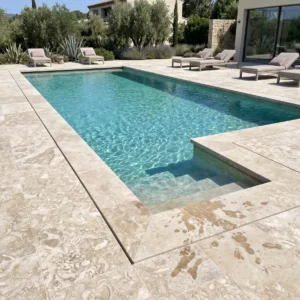
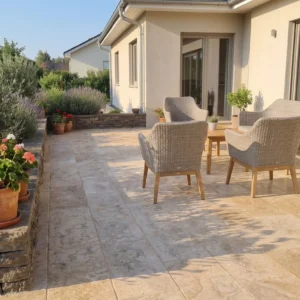
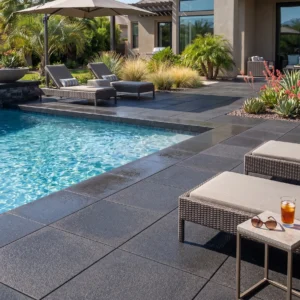
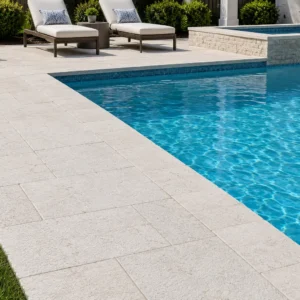
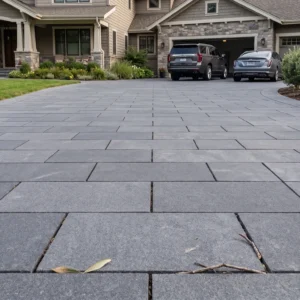
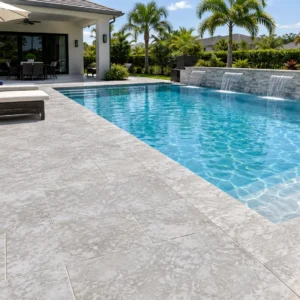
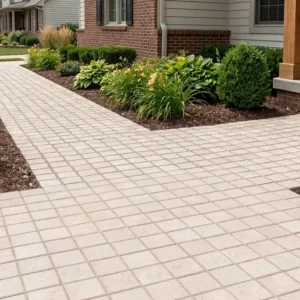
- Three centimeters as the general exterior working thickness for terraces, pool surrounds, walkways and courtyards under foot traffic.
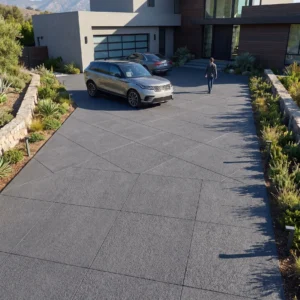
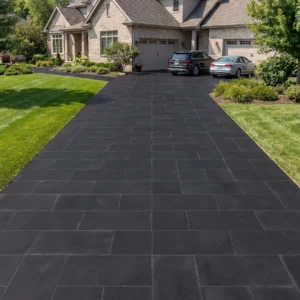
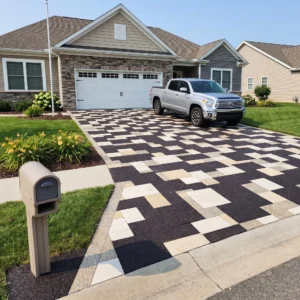
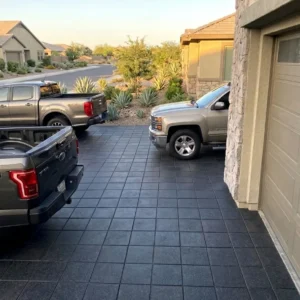
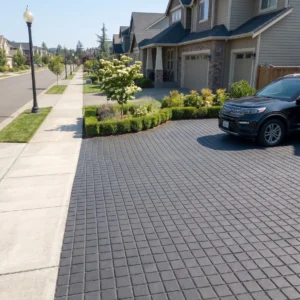
- Five to six centimeters where private cars, service vehicles or a delivery van will cross, including aprons and turning areas.
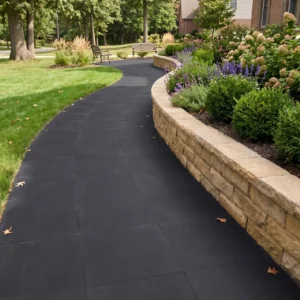
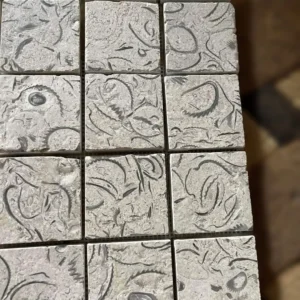
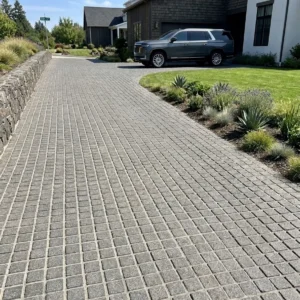
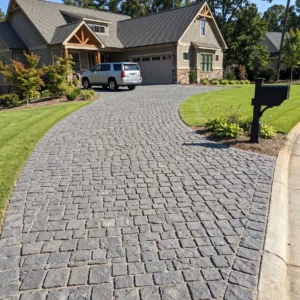
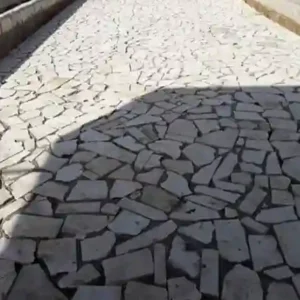
- Small units and setts for slopes, arcs and awkward geometry, where large slabs would have to be cut to death to fit.
- A modest palette of sizes rather than a wide one, because sorting and cutting on site costs more here than the stone it saves.
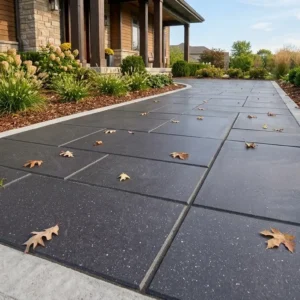
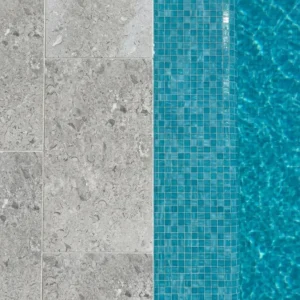
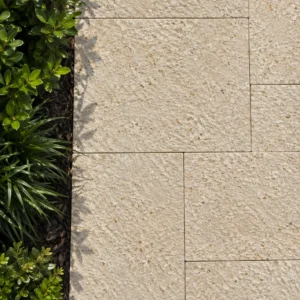
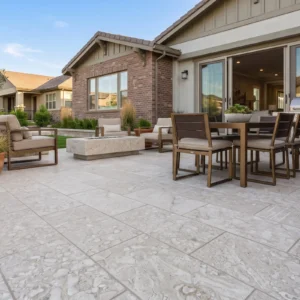
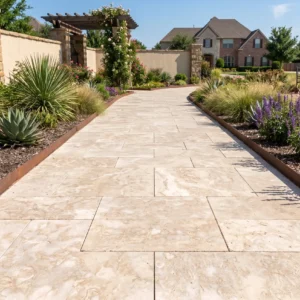
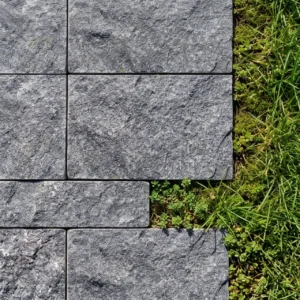
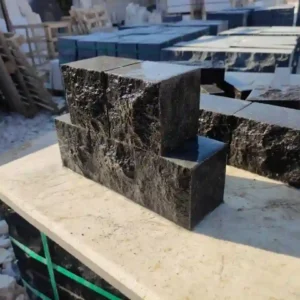
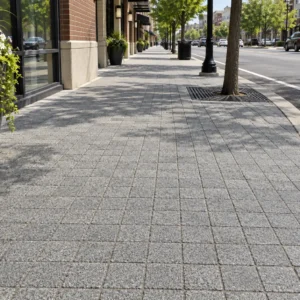
Format matters just as much as thickness. Large-format slabs read calm and modern on a resort lobby terrace and shorten total joint length, which reduces cleaning for the life of the surface. Smaller modular sizes are more forgiving on ground that is not perfectly flat and far easier to carry by hand up a flight of steps, which is the reality on plenty of hillside sites. Look through our full paver range and the sizes each material is cut in, then work backwards from what your site can physically receive. Weight, not volume, is the limit on a stone container, since a box reaches its weight ceiling long before it runs out of space, so mixing thin and thick units in one shipment is very often the efficient answer.
From the wharf gate to the actual work
Clearance is a milestone, not the finish line. The last mile in Jamaica is where schedules are won or lost, and it deserves planning before the container is even booked. Ask one simple question about your site: can a flatbed with a forklift get within pallet distance of the work, and if it cannot, who is carrying the stone the rest of the way and on what day?
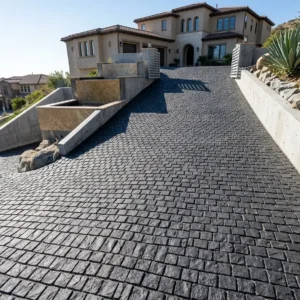
- Hillside driveways in St. Andrew, Portland and the hill parishes often have switchbacks and gradients a loaded truck simply cannot take.
- Resort deliveries usually run through back-of-house service roads on fixed windows, and guest-facing routes are closed to pallets during daylight.
- Gated developments and apartment courts may require prior notice, an escort, or a delivery slot outside working hours.
- Soft or freshly graded ground will not take a forklift after rain, and a stuck machine costs more than a full day of labor.
- Stairs, garden gates and narrow side returns mean hand-carry, which changes the sensible unit size and the weight per piece.
Where hand-carry is unavoidable, smaller units earn their keep immediately. A crew moving stone up a garden stair will lay far more square footage in a day with pieces one person can lift than with slabs that need two people and a walk-around at every turn. Where a forklift can reach, larger slabs stop being a burden and become the faster option. It is the same job with two completely different answers, and the answer is decided by a driveway rather than by a design preference. Storage matters too. Stack pallets on firm level ground, keep them well away from the red soil that stains, and cover them if they will sit through a wet week.
Ordering against the Jamaican calendar
The Atlantic hurricane season runs from June through November, and it shapes construction planning across Jamaica whether or not a storm arrives. Contractors compress exterior work, insurers ask more questions, and site logistics get harder at exactly the moment the weather makes them harder. Ocean freight has its own rhythm as well, and a container that misses a sailing waits for the next one rather than leaving an hour later.
The practical answer is to place stone orders earlier than feels necessary. Stone is one of the few trades that can be ordered well ahead of installation because it does not spoil, does not expire and stores outdoors without complaint provided it is stacked properly. Getting pallets onto site during a settled stretch and laying them when the crew is ready removes the worst dependency from a program. If you want dates and a landed figure against a real drawing, request a delivered Kingston quote and we will work it against your parish rather than a generic island average.
- Order the bulk quantities before the season rather than during it, and keep a small overage on site for future repairs.
- Plan mortar-bedded work for a settled window, since rain on green mortar is the commonest cause of a rework claim.
- Protect laid areas during storm preparation, because furniture and planters dragged in a hurry cause more damage than wind does.
- Allow for a wet-week pause in your program rather than pretending exterior work runs at a constant rate all year.
- Record the batch, format and finish you used so that a future repair matches instead of announcing itself.
Starting an order for a Jamaican site
A good stone order starts with three pieces of information and almost nothing else: the areas in square footage with their uses, the site access reality, and the port that suits the parish. From those we can propose materials, thicknesses and a sensible size palette, price it delivered, and give your broker the documents they need for clearance. Samples come first, and they are small hand samples rather than pallets, because the point is to see how a stone behaves in Jamaican light on your own terrace rather than under a showroom lamp.
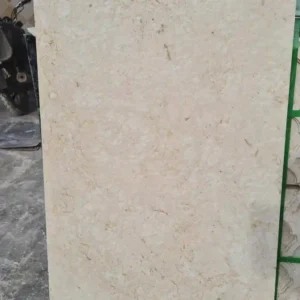
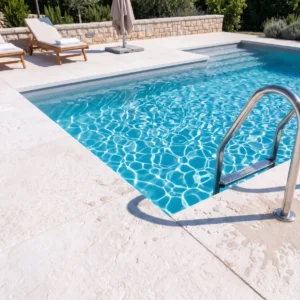
Look at samples outdoors, wet them, and look again in the middle of the afternoon. Pale limestone changes character between a cloudy morning and hard midday sun, and a stone that looks flat indoors often comes alive outside. Put the sample next to whatever it has to live with, whether that is the render tone, the roof, the pool tile or the existing marble in a lobby, and judge it in company rather than alone. Order enough for the whole scope in one shipment wherever you can, since a single batch is more consistent than two, and consistency of tone is the thing clients notice years later.
We supply calibrated limestone, basalt and shellstone paving to contractors, hotel groups, architects and homeowners across Jamaica, with documentation that stands up to a specification review and freight arranged to whichever port serves the site best. Send us the drawings and the parish and we will send back a landed figure you can actually build a budget on.