




























Paving in the Cayman Islands is bought under a set of conditions that exist nowhere else in the region. There is no income tax and no property tax, so import duty is not a small line at the bottom of a budget. It is the way the country funds itself, which means the rate your stone is classified under is a first-order commercial decision rather than an afterthought handled by somebody else at the end. George Town also has no deep-water container berth, so every pallet that reaches a Grand Cayman site has been barged ashore rather than lifted straight from ship to quay. And the islands sit low, flat and fully exposed to the Atlantic hurricane season, which is why the local build standard leans hard on bonded, mortar-set surfaces rather than loose-laid ones.
This page takes the broad view: how paving stone physically gets here, what it costs to clear on each island, what the building code expects of an exterior surface, and which formats and thicknesses make sense once those constraints are understood. It is deliberately the logistical and commercial page. The material science of absorption and grip, the interior tile detailing and the small-unit sett work each have their own page. Here we are dealing with routes, rates, risk categories, pallets and the calendar.
How paving stone actually reaches a Cayman site
George Town is a lighterage port. Ships do not come alongside and discharge boxes onto a quay the way they do at a deep-water terminal; cargo is worked over the side into barges under the Port Authority of the Cayman Islands and brought ashore in stages. For heavy palletized stone this matters far more than it does for boxed consumer goods. Every extra handling movement is another chance for a corner to be chipped, a band to be cut, or a pallet to be set down out of square, and dimension stone is unforgiving about all three.
The practical consequence is that stone bound for these islands has to be packed for handling, not merely for shipping. We build pallets to a controlled height and weight rather than to the maximum a container will physically carry, edge-protect every course, and double-band anything with a dressed or profiled edge. Sailings from Miami and Port Everglades run weekly, which gives a construction schedule a predictable rhythm, but it also means a missed cut-off costs a full week rather than a day. That is worth knowing before you promise a client a terrace for a specific weekend.
- Grand Cayman deliveries clear through George Town and are barged ashore, so pallet weight and stability are settled before the container is loaded.
- Cayman Brac cargo works through Creek on a smaller, less frequent rotation than the Grand Cayman service.
- Little Cayman receives most building material on an onward inter-island leg, which rewards small, tightly built pallets over oversized ones.
- A weekly Florida departure usually makes the shipping calendar, not the quarry, the binding constraint on a tight completion date.
- Every pallet is labeled with island, zone and lay sequence so material never has to be re-sorted on a site with no laydown room.
The three-island duty ladder and the 2030 date
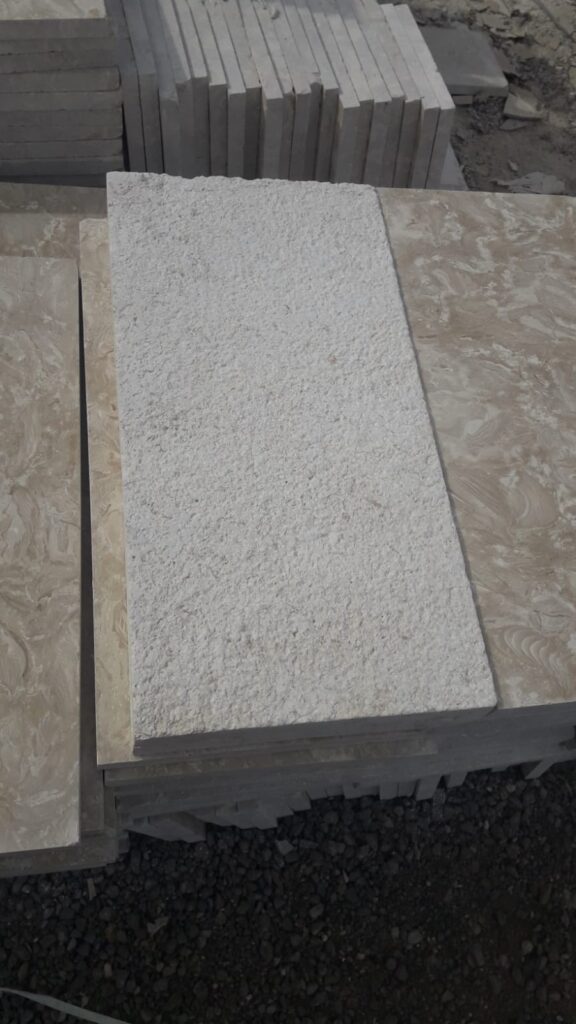
This is the single most valuable thing a Cayman buyer can understand before ordering stone, and it is genuinely different on each island. The general import rate runs at roughly 22 percent, with some goods assessed higher, up to around 27 percent. Building materials landing on Grand Cayman are treated differently, at a concessionary flat rate of about 15 percent. On Cayman Brac and Little Cayman there is a full import duty waiver on building materials, extended through 31 December 2030.
Read that ladder twice, because it changes real decisions. A villa on the Brac and an identical villa on the Seven Mile Beach corridor do not carry the same stone budget, and the gap is not freight, it is classification. The waiver also has a date attached. A Sister Islands scheme that completes inside the window sits under it; one that runs past the end of 2030 does not, and phasing a large project around that date is a legitimate commercial exercise rather than a technicality. Duty is administered by Customs and Border Control, and rates and tariff classifications do change over time. Confirm the current rate and the correct tariff line with your broker, or directly with Customs and Border Control, before you commit a number to a client.
- General goods: approximately 22 percent, with certain lines assessed up to around 27 percent.
- Grand Cayman building materials: a concessionary flat rate of roughly 15 percent.
- Cayman Brac and Little Cayman: a full building-materials duty waiver running to 31 December 2030.
- Duty is assessed on landed value, so freight and insurance sit inside the figure the rate is applied to.
- Quotes are normally written in US dollars; the Cayman dollar is pegged at roughly one CI dollar to US$1.20, so conversion is stable but not one for one.
What the building code expects of an exterior surface
The Cayman Islands Building Code is a custom document rather than a borrowed one. The International Code Council delivered the first code written specifically for these islands, the 2016 edition is the one currently in force, and a successor built on the 2021 International Building Code has been anticipated for adoption in 2026. If you are designing now for a build that completes later, it is worth asking your architect which edition the permit will actually be assessed against, because the answer affects details well beyond paving.
Wind is the reason the code reads the way it does. Design wind speeds under the 2009 code ran at approximately 150 mph for Risk Category I structures, around 170 mph for Risk Category II, and in the region of 186 to 200 mph for Risk Categories III and IV. Those figures describe buildings rather than paving directly, but they shape everything a paved surface touches: the slab beneath it, the wall it abuts, the shutter track it runs under, and the loose objects a storm can pick up off it. Siting is governed under the Development and Planning Act (2021 Revision) through the Central Planning Authority, and the regulations use the ironshore itself as a reference in coastal setback distances, which makes the seaward edge of a terrace a planning question rather than purely a design one.
- Cayman Islands Building Code, 2016 edition, currently in force, with a 2021 IBC-based edition anticipated for adoption in 2026.
- Approximate 2009-code design wind speeds: 150 mph Risk I, 170 mph Risk II, and 186 to 200 mph for Risk III and IV.
- Development and Planning Act (2021 Revision), administered through the Central Planning Authority.
- Coastal setback distances are measured with reference to the ironshore, so seaward terrace extents need checking early.
- Bonded, mortar-set paving is the working expectation on exposed terraces rather than an upgrade option.
Exposure zones across the three islands
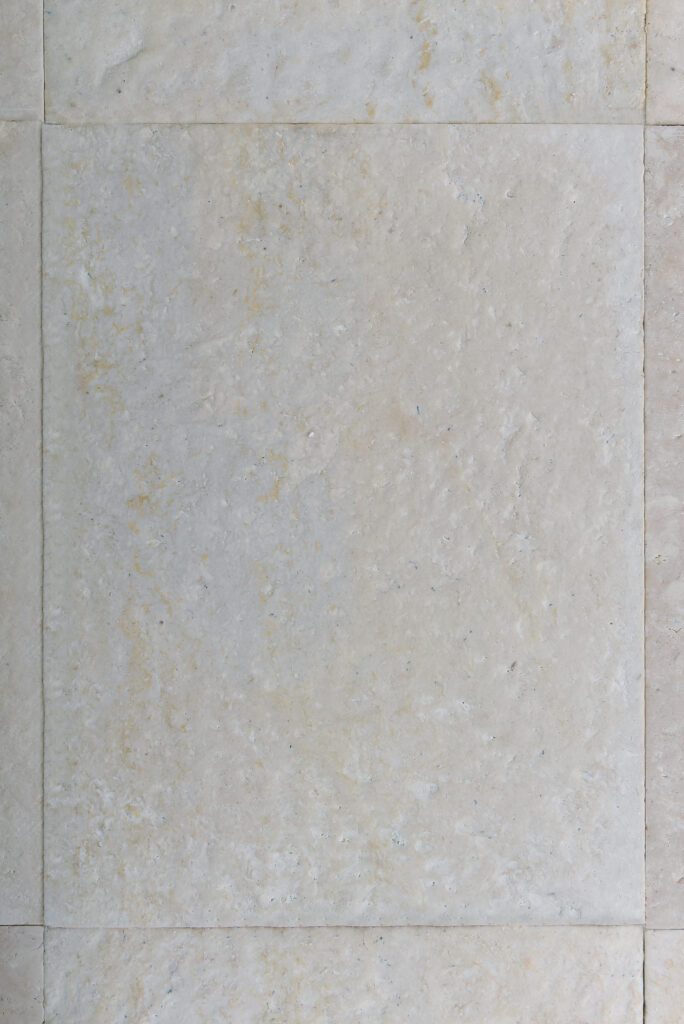
Grand Cayman is not one environment. The leeward west, meaning West Bay, the Seven Mile Beach corridor and George Town, sits on the sheltered side of the island. The daily problems there are salt haze, fine wind-blown sand and very heavy foot traffic rather than direct wave energy. The eastern districts, North Side and East End, face the weather. Surfaces there take wind-driven spray, a coarser salt loading and occasional overwash, and a specification written for a resort amenity deck should not simply be copied across to them.
Hurricane Ivan in September 2004 remains the reference point for how buildings and their surroundings are assembled here, and you can read it in the build stock: bonded terraces, capped walls, restrained edges and a general unwillingness to trust anything that can float or lift. The islands are also very low. Drainage falls carry more weight than they would on a hillier island because there is often nowhere lower to send the water, and a paved area that ponds after a squall will show it in staining long before it shows it in failure. On Cayman Brac the Bluff gives the territory its only real grade, which changes both site access and drainage strategy on that island.
- Leeward Grand Cayman: salt haze, sand abrasion and high pedestrian volumes across resort and amenity decks.
- Windward east: direct spray, heavier salt loading and a much harder case for bedding and jointing.
- Low elevation everywhere means falls, outlets and joint permeability must be designed rather than assumed.
- Ivan-era build habits favor bonded systems, restrained edges and fixings a storm cannot lift.
- The Bluff on Cayman Brac is the one place in the territory where grade, not exposure, drives the layout.
Formats, thicknesses and how duty changes the math
Because duty on Grand Cayman is assessed on landed value, thickness stops being purely a structural choice and becomes a cost choice as well. A 3 cm slab and a 5 cm slab of the same stone covering the same area do not carry the same freight weight or the same dutiable value, and on Grand Cayman that difference is multiplied by the building-materials rate before it reaches your budget. On the Sister Islands, inside the waiver window, that particular arithmetic largely disappears and thickness can be selected purely on engineering grounds, which is a rare luxury.
Container economics set the other boundary. A loaded container of stone runs to roughly 24 to 26 tonnes, which is broadly 280 to 320 square meters at 3 cm depending on the density of the stone and how it packs. Once the paved area is known, that figure tells you immediately whether you are ordering one container or two, and part-container shortfalls are where budgets quietly break. It is nearly always better to design the areas to the container than to ship a second box for forty square meters. The complete size list sits on our full natural stone paving range page, and anything on it can be cut to a project dimension.
- 2 cm: interior and protected covered terraces on a bonded bed, and the lightest dutiable weight per square meter.
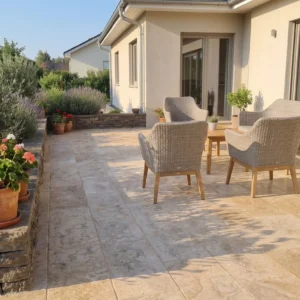
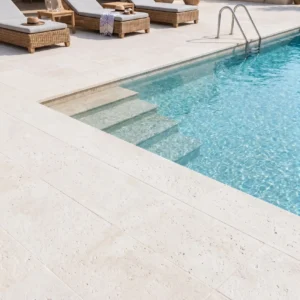
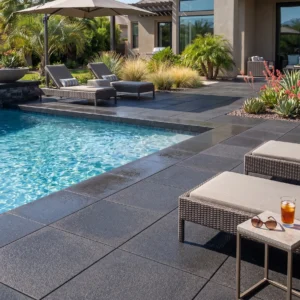
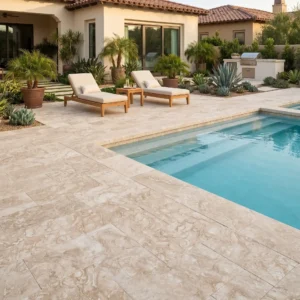
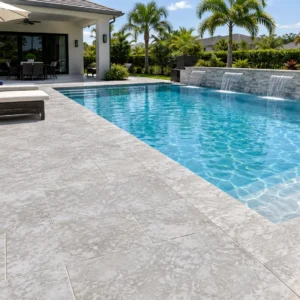
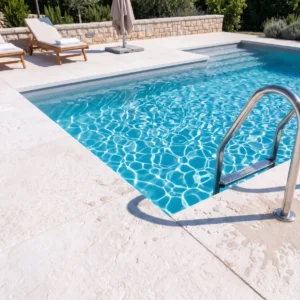
- 3 cm: the general exterior workhorse for terraces, pool surrounds and pedestrian courtyards.
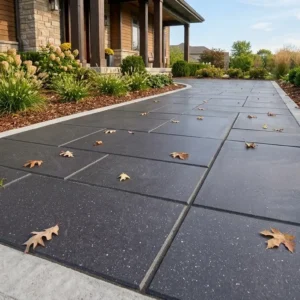
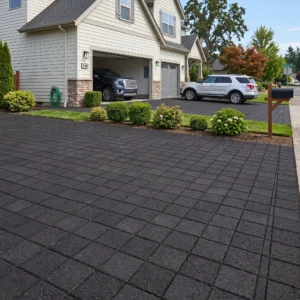
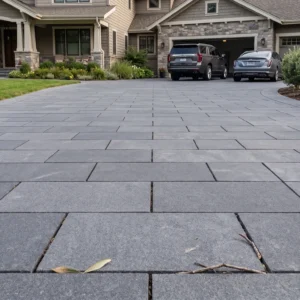
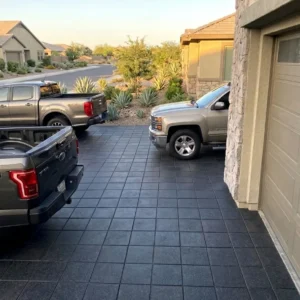
- 5 cm and above: driveways, aprons and anywhere vehicles turn, brake or stand.
- Roughly 24 to 26 tonnes per container, approximately 280 to 320 square meters at 3 cm.
- Cut-to-size reduces waste on irregular terraces, which counts for more here because offcuts cannot be economically returned.
Site access, condo decks and delivery windows
A large share of Cayman paving work happens on sites with almost no laydown space. An amenity deck sitting above a parking level on the Seven Mile Beach corridor, a courtyard inside a finished building, a villa on a narrow lot with a single access point. Stone is heavy, and the difference between a smooth delivery and a bad one is usually decided weeks earlier, when somebody either did or did not check what the site could physically take.
Strata and building-management rules add a layer that new arrivals routinely underestimate. Occupied resort and residential buildings often restrict noisy work and heavy deliveries to defined hours, close service elevators during peak periods, and require floor protection to be installed before anything crosses a finished lobby. Hurricane season, June through November, adds a second calendar of its own, and nobody wants a hundred pallets standing exposed on a deck in September. If you are shaping a budget before the design is fixed, our natural stone price index guide sets out the relative cost bands to plan around.
- Confirm crane, hoist or elevator capacity per pallet before the order is packed, not after it lands.
- Split large orders into staged pallet deliveries wherever a site has no secure storage.
- Check strata rules for delivery hours, service-lift access and lobby protection requirements.
- Plan installation around the June to November season so material is not stored exposed at peak risk.
- Agree who receives, inspects and signs for pallets at the gate, because damage claims rest on that record.
Costing a Cayman paving order without surprises
Most budget overruns on imported paving here are not caused by the stone price. They are caused by the lines underneath it. A complete Cayman paving cost is the ex-works stone, the packing, the ocean freight to George Town, the lighterage and port handling, the duty at whichever rate genuinely applies to your island and classification, the broker’s fee, the inland haul, the site handling and the wastage allowance for cuts. Leave any one of those out of an early estimate and the figure you hand a client is optimistic by a margin somebody will notice later.
Wastage deserves particular attention on this kind of work. On a plain rectangular terrace an allowance of a few percent is enough. On a curved pool surround with coping, steps and a raised spa it is materially more, and offcuts cannot be sent back across the water. We would rather quote a realistic allowance at the start than have a client finish six square meters short with a five-week lead time to the next available sailing. Ask for the quotation broken out line by line so you can see exactly where the money sits and which lines change if the island or the thickness changes.
- Ex-works stone, packing, pallets and protection.
- Ocean freight on the weekly Florida service, plus lighterage and port handling at George Town.
- Duty at the applicable rate, confirmed against the tariff classification before you commit.
- Inland haul, site handling and any crane or hoist time the building requires.
- A wastage allowance sized to the actual geometry rather than to a default percentage.
Send us the paved areas, the island and the target installation window, and we will come back with a stone selection, a pallet plan and a landed cost you can put straight into a tender.