





































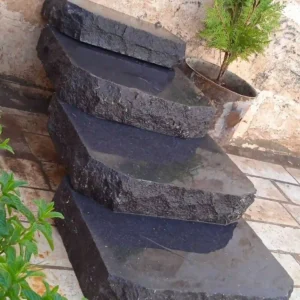
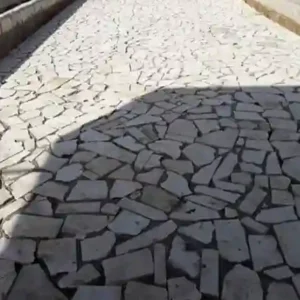

Caribbean paving advice is usually written for storm country. Aruba is not storm country. The island lies below the main Atlantic hurricane track, and the force that works on a paved surface here is not a once-a-decade event but a continuous one. A trade wind that barely pauses carries a fine salt mist and an equally fine abrasive dust across every terrace, deck, driveway and lobby floor on the island, day after day, month after month. Specify for that and paving does very well in a demanding place. Specify instead for a storm that is not coming, and you have paid for properties you will never use while ignoring the ones you needed.
This page treats pavers as a whole category on Aruba: how stone actually reaches the island now that cargo runs through Barcadera, what the border adds to an invoice and how to keep that number honest, how the island’s building zones load a surface differently, and which thicknesses and formats belong under feet, furniture and vehicles. The material behavior of limestone in a dry salt climate, interior tile work, and small-unit sett paving each have their own page. This one is the route, the money and the format schedule.
Cargo lands at Barcadera, not at the cruise pier
Barcadera has been Aruba’s cargo port since it officially opened on 12 April 2016, and LCL cargo is directed there. Oranjestad now works as the cruise and passenger port. Barcadera is the second-largest container port in the ABC islands after Willemstad in Curacao, and it operates under the customs and documentary procedures of a constituent country of the Kingdom of the Netherlands.
The practical version of that is short. Every document, every delivery instruction and every broker note for your stone should name Barcadera. If a supplier’s paperwork still routes your cargo to Oranjestad, that paperwork was written from information which went stale a decade ago, and spotting it is a cheap early test of whether anyone in the chain has moved freight to Aruba recently.
We load in the United States. Stone leaves the yard banded, crated and manifested for a sea leg, and your broker clears it on arrival. The sequence looks like this in practice:
- A full container where the area justifies it. Stone reaches a container’s weight limit long before it fills the space, so the box will look half empty at the moment it is legally full.
- Consolidated part-load shipping for villa-scale quantities, which suits a single terrace, a driveway apron or a pool surround.
- Crating built for forklift handling at both ends and for a sea leg, rather than the light packing used for warehouse shelving.
- A commercial invoice, packing list and accurate weights supplied with the shipment, because those are the documents your broker will ask for first.
- Delivery from the port gate treated as its own local movement, planned and priced as a separate line rather than assumed to ride along with the ocean freight.
What Aruban import charges actually add to a pallet
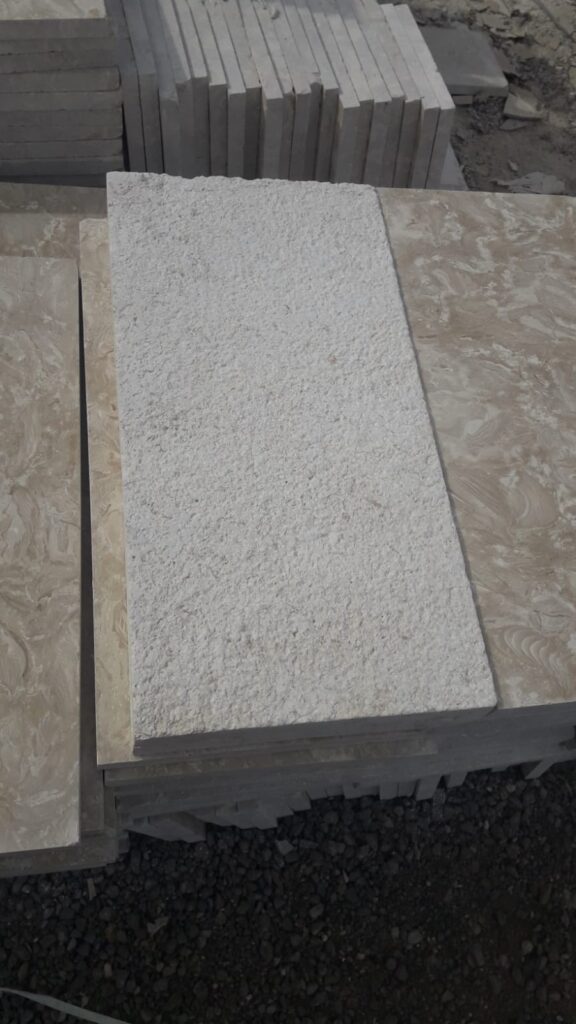
Two charges sit on top of the stone price, and neither one is mysterious once you see how they are built. The first is customs duty, which varies roughly between 2 and 22 percent depending on how the goods are classified. Your broker does the classification, and it is worth asking for the tariff line in writing before you commit to a budget rather than after the container is on the water. The second is turnover tax. Since 1 August 2023 it has been levied at the border rather than collected downstream, at a combined 7 percent made up of BBO at 2.5 percent, BAVP at 1.5 percent and BAZV at 3 percent.
Both are computed on the CIF value, and that is where a small invoicing habit turns into real money. If freight and insurance are not itemized on the invoice, Aruba Customs adds a 16.5 percent surcharge to the invoice value on shipments arriving from the Americas. An invoice that quietly folds transport into the goods price can therefore be assessed as though transport were 16.5 percent of that price, whether it was or not. The fix costs nothing and takes one email.
- Ask every supplier for goods, freight and insurance as three separate invoice lines, in that order, on the commercial invoice itself.
- Obtain the tariff classification from your broker at quotation stage, so the duty band you are budgeting is the one that will actually be applied.
- Model the 7 percent border turnover tax against the landed CIF figure, not against the goods price alone, or the estimate will come in light.
- Keep packing-list weights accurate, since weight drives freight and freight drives the CIF number that everything else is calculated from.
- Remember the florin’s peg at 1.79 to the US dollar, which at least makes the conversion arithmetic in your budget stable and predictable.
We quote in that shape as standard. If an architect sends you a Dutch-language specification, the units may appear as klinkers and the interior work as tegels; the same schedule of sizes, depths and finishes reads correctly in either vocabulary.
Exposure zones on a small, windy island
Aruban construction sits in a handful of recognizable settings, and each of them loads a paved surface in its own way. Getting the zone right matters more than it does on a bigger, wetter island, because the wind reaches almost everywhere and the difference between settings is often a matter of how wet the salt is when it lands.
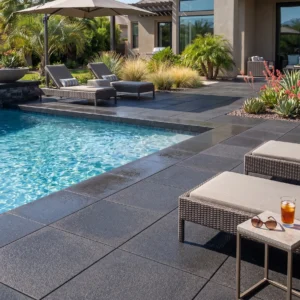
- Palm Beach, the high-rise resort corridor, with amenity decks, pool surrounds and podium-level circulation carrying constant wet-foot traffic and a busy service route behind the scenes.
- Eagle Beach, low-rise resort and timeshare property, where renovation work comes around on a cycle and hands back on a fixed date that nobody wants to move.
- Noord and Malmok, villa country, with open plots, private pool decks and driveways, and about as little shelter from the wind as anywhere people live on the island.
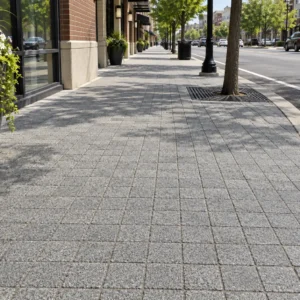
- Oranjestad, commercial forecourts, entrances and public frontage, carrying an urban duty cycle of trolleys, chairs, deliveries and continuous footfall.
- San Nicolas and the east coast, the windward side, where salt tends to arrive wet and the road leg from the port runs longer.
The difference between these zones shows up in surface choice more than in depth. Wind-carried salt dries to a film on every horizontal surface, and wind-carried dust behaves as a mild abrasive that is always being resupplied. In that combination, a face which holds grip when wet and hides a light scratch pattern is worth more than an extra centimeter of thickness on a pedestrian terrace. Depth answers the load. Surface answers the weather. On Aruba the weather argument is the one that runs all year, so make the surface decision first and let it survive value engineering.
Thickness and format, chosen by what drives over it
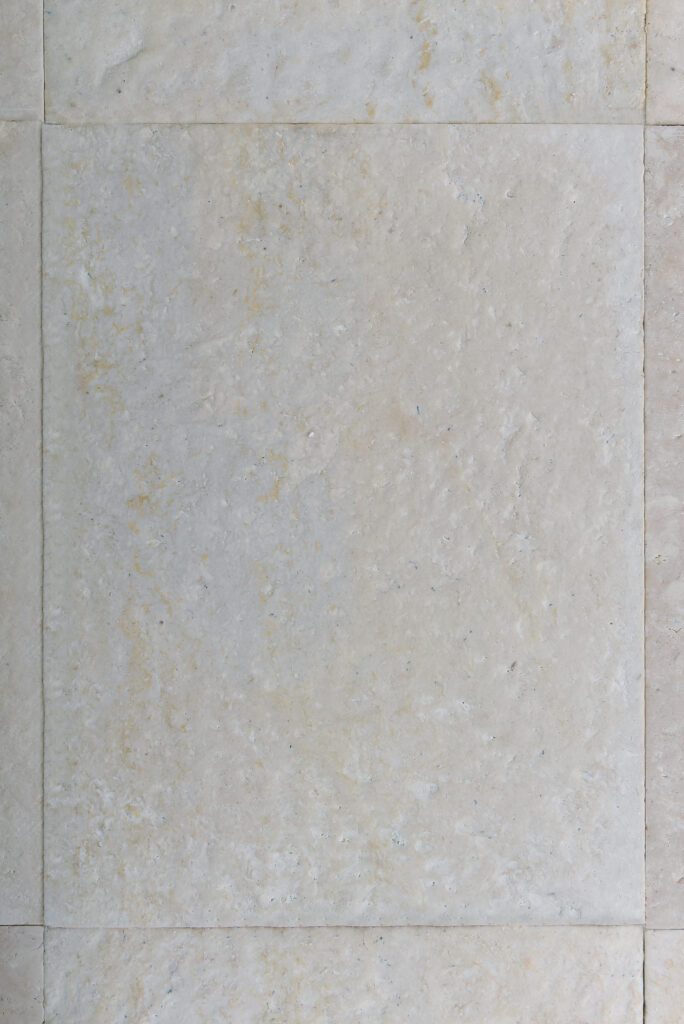
Depth follows the load, and the load is a short list. Nothing about the Aruban climate calls for unusual thickness, because the island is not asking paving to resist a storm surge. What it asks for is that the depth genuinely matches the traffic, since a unit that is too thin under a wheel will find its weakness within a season rather than announcing it slowly.
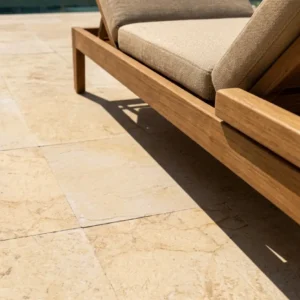
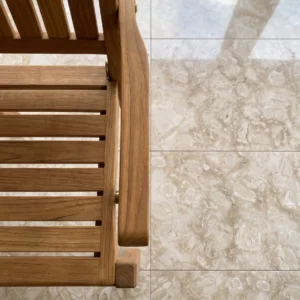
- Two centimeters for interior floors and covered terraces, bonded onto a properly prepared bed.
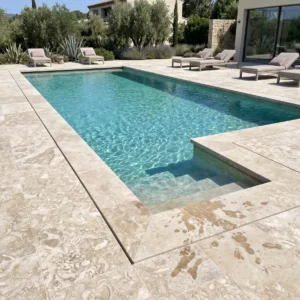
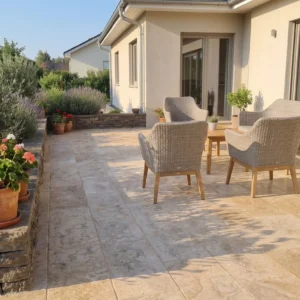
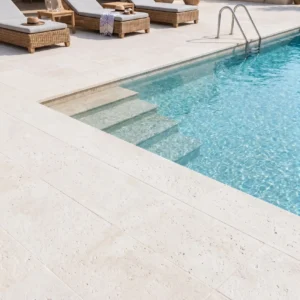
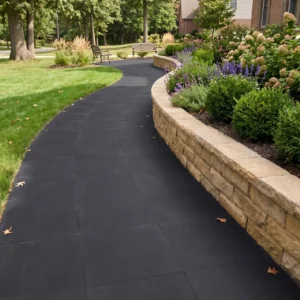
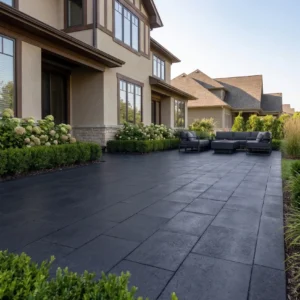
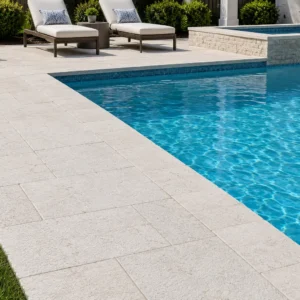
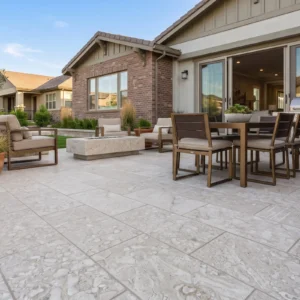
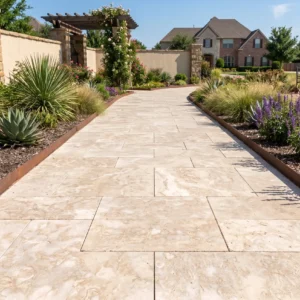
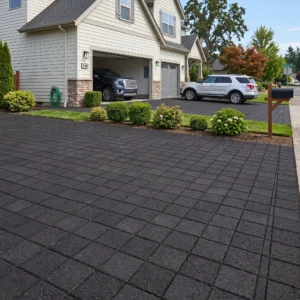
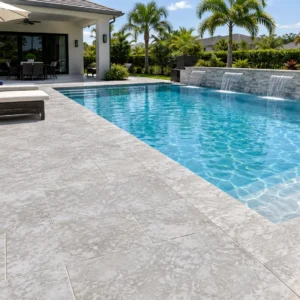
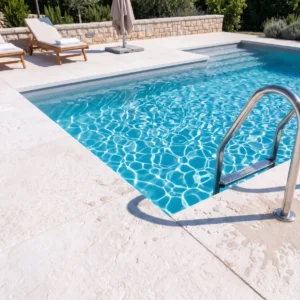
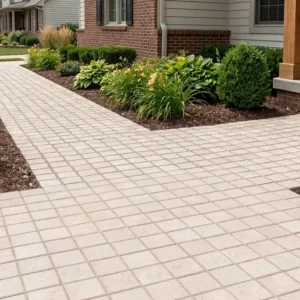
- Three centimeters as the standard exterior depth for pedestrian terraces, pool surrounds, walkways and garden paths.
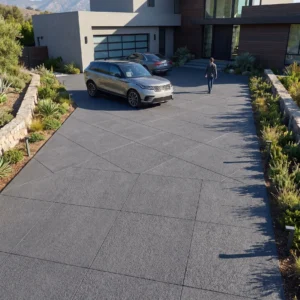
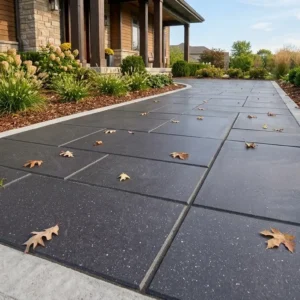
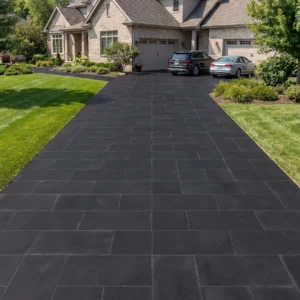
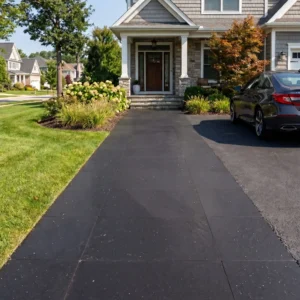
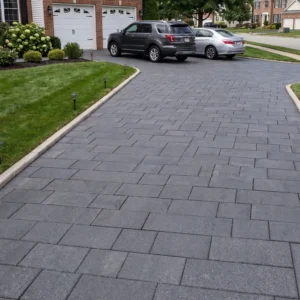
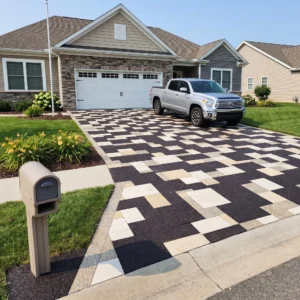
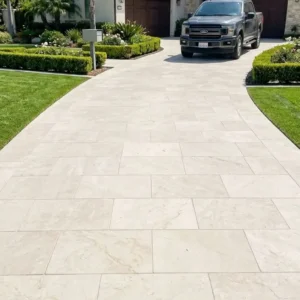
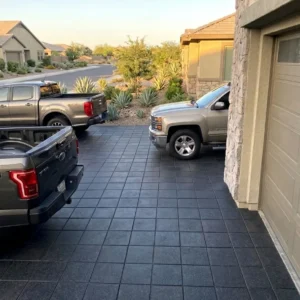
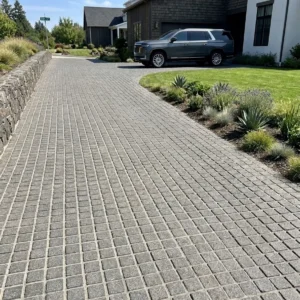
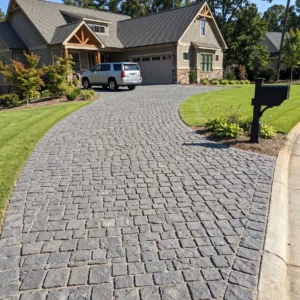
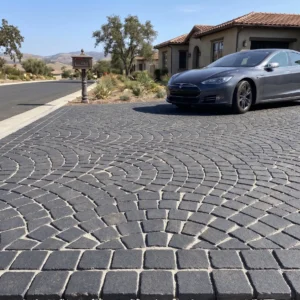
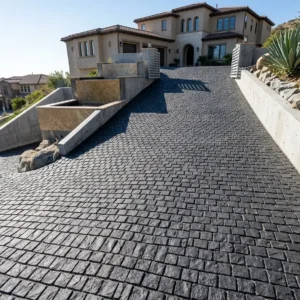
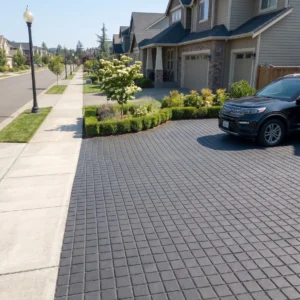
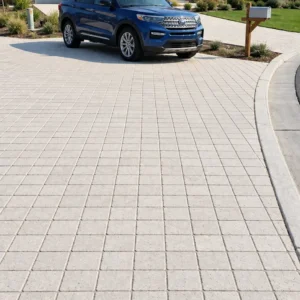
- Five centimeters and above anywhere a vehicle stands, turns or parks, including the driveway apron at the road edge and the gate threshold.
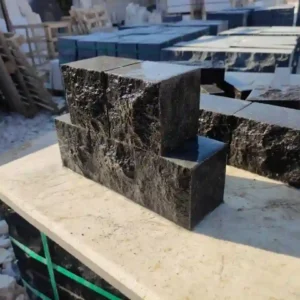
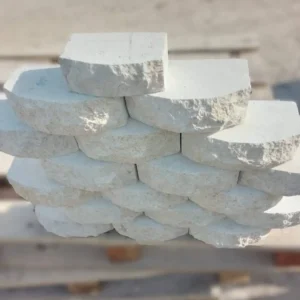
- Setts at roughly eight to ten centimeters where wheels turn tightly or the ground falls away, which is a subject with its own page.
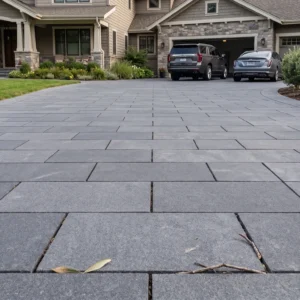
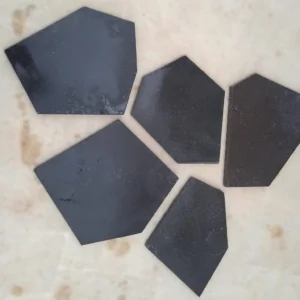
- Slabs cut to size for open decks, with a smaller module reserved for layouts complicated by falls, drainage runs and pool coping.
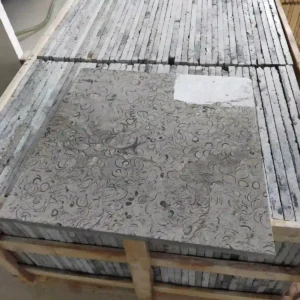
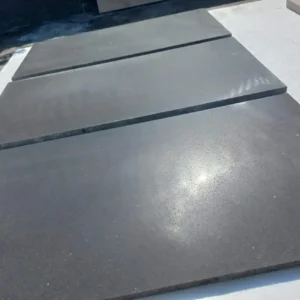
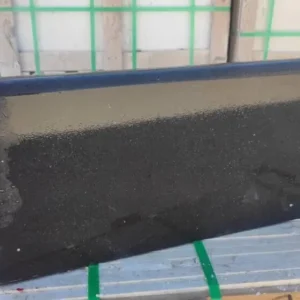
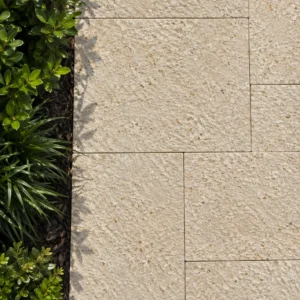
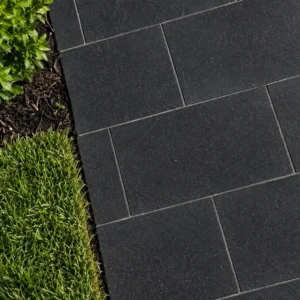
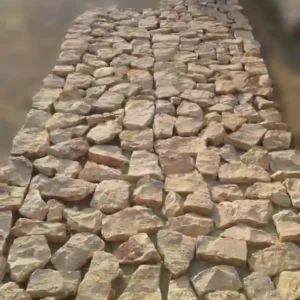
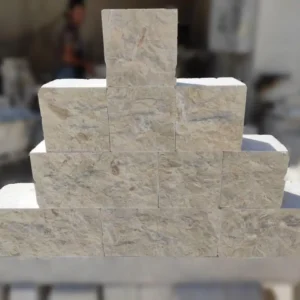
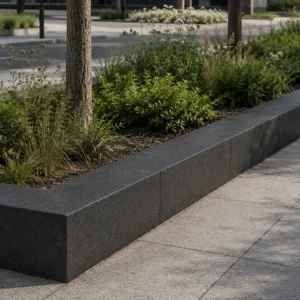
The paver formats we land in Aruba are sawn on six sides and calibrated to a consistent thickness, which is the one thing an aggregate operation is not set up to produce. Calibration is not a luxury on this island; it is what allows a fitter to hold a level line across a long deck without packing individual units, and it is what keeps the joint width even enough that blown grit does not settle into a ragged edge and stay there. Ask for the format schedule with tolerances stated, and compare quotations on that basis rather than on a photograph.
Getting a pallet from the port gate to the terrace
The last few hundred meters are where an otherwise clean import turns awkward, and they are worth planning before the stone ships rather than on the morning it arrives. Aruban sites divide neatly into three access problems, and the answer to each of them changes how the material should be packed at our end.
High-rise work in the Palm Beach corridor usually means a service elevator, a weight limit on it, and a deck that has its own loading restriction. That points to smaller pallets, more of them, and a break-down plan agreed in advance. Timeshare renovation adds a second constraint, because units are handed back on a date and the building around your work may well be occupied while you are cutting.
Low-rise and villa work in Eagle Beach, Noord and Malmok is a driveway problem instead. There may be room for a forklift, or there may be a gate, a turning circle and a lane that decides the question for you. Tell us which, because a pallet sized for a yard is not a pallet sized for a residential gateway.
- Confirm who receives the delivery on site and what lifting equipment will actually be there on the day.
- State any elevator or deck loading limits in advance so pallet weights can be built to suit them.
- Flag narrow lanes, gate widths and turning restrictions in Noord, Malmok and the older parts of town.
- Allow a longer road leg for San Nicolas and east-coast sites, and book the delivery window accordingly.
- Nominate a covered or sheltered store on site, because open stacks collect blown dust and salt before they are ever laid.
A twelve-month build calendar and what it is worth
Elsewhere in the Caribbean, procurement is shaped by a season. Materials are pulled forward, work is compressed into a window, sites are secured in a hurry, and budgets carry the cost of all that hurry whether or not a storm arrives. Aruba’s position below the main hurricane track takes that shape away. There is no season to race against, no storm-preparation mobilization to price into the schedule, and none of the seasonal insurance surcharges that distort budgets on the fully exposed islands.
What that is worth in practice is planning freedom. A resort can schedule an amenity deck replacement for September without arguing with a risk manager. A villa can pour a base in October. A phased job can be genuinely phased, with deliveries spread evenly instead of stacked into a rush before a cut-off. For a buyer, the useful consequence is that lead time becomes a choice rather than a constraint, and stock can be ordered when the price and the program suit rather than when the calendar dictates.
The calendar does not, however, remove the wind. A twelve-month working year on Aruba is a twelve-month exposure year, and site practice has to reflect that. Cut stone left uncovered collects dust. Open bedding left overnight collects dust. Saw slurry blows where it is not wanted. None of this is difficult to manage, but it is constant, and crews arriving from wetter markets tend to underestimate it for the first week and then never again.
Ordering: what to send us before we price it
A useful quotation needs four things, and most delays come from one of them being missing. Send the area schedule broken down by zone and by traffic duty, the finish you have in mind or the effect you want if you are not sure, the target date for arrival at Barcadera, and the name of the broker who will clear the shipment. If a design is still moving, send the version you have and mark what is unsettled; we would rather price a live drawing than wait for a frozen one.
- Square meters or square feet by area, separated into pedestrian, poolside, vehicle and interior.
- The finish direction, including whether anyone will be walking on it barefoot or in wet feet.
- Any format that is fixed by the design, such as a coping module, a step tread or a drainage channel width.
- Access notes for the delivery, including elevator limits, gate widths and the site contact.
- The date the material needs to be on site, working back from handover rather than forward from today.
Send that and we will come back with a delivered Barcadera quote split into goods, freight and insurance, so the CIF figure your broker works from is the real one and the duty and turnover tax calculations land where they should. Small hand samples go out before any crate does, because a stone that looks right on a screen in one light rarely looks the same on a windy deck at two in the afternoon. Get the port right, get the invoice lines right and get the depth right, and paving on Aruba stops being an import adventure and becomes an ordinary, well-run trade purchase.