

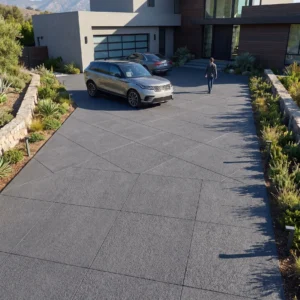
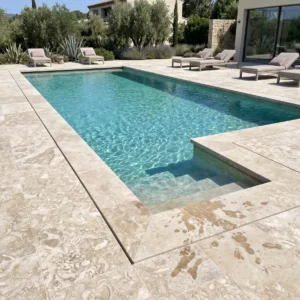
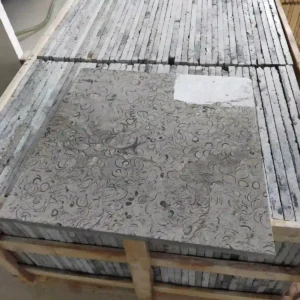
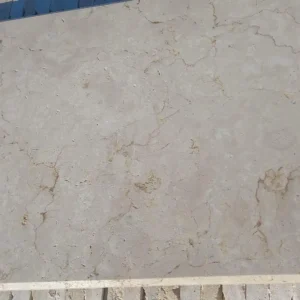













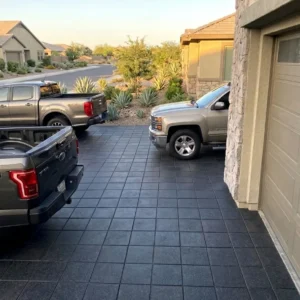
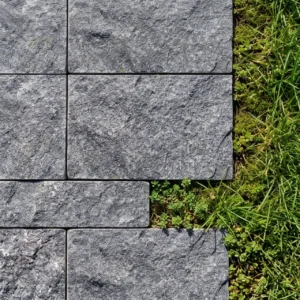
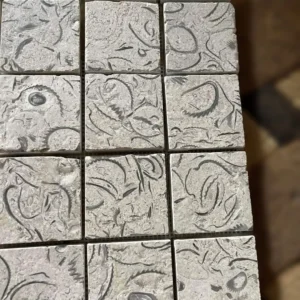
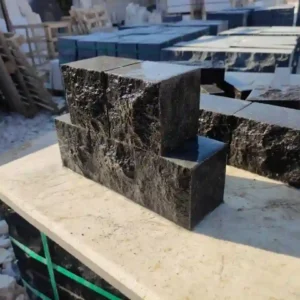
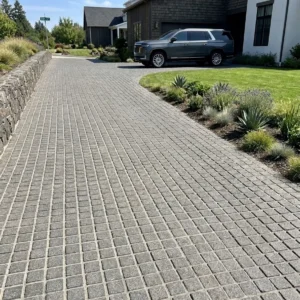
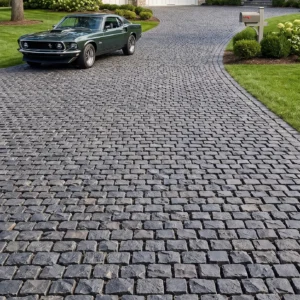
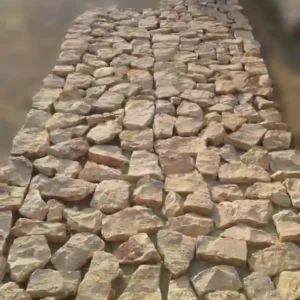
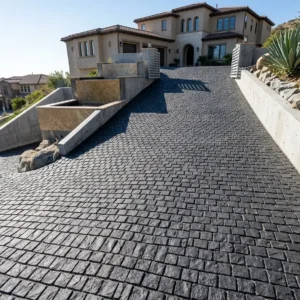


Puerto Rico is not flat. Beyond the coastal plain the island climbs quickly, and a great deal of its housing sits on slopes that a mainland developer would have bulldozed. Driveways run up at gradients that make a car’s underside a design consideration. Entrances curve because the lot curves. Ground settles, roots lift, and heavy rain finds the low line whatever the drawing said. Large-format paving is unforgiving of all of that: a big slab has to be supported evenly across its whole footprint, and where the ground moves, the slab cracks.
Small units answer the problem differently. A cobblestone or sett distributes movement into hundreds of joints instead of concentrating it into one plane. It follows a slope without stepping. It turns a radius without a cut on every piece. It can be lifted individually and reset when a root, a trench or a storm disturbs it. On an island where ground is rarely level and where outdoor surfaces occasionally have to be repaired rather than admired, that behavior is worth more than it looks on a price list. This page is about that behavior, the labor it demands, and the heritage story that surrounds it.
The work itself lands in recognizable places. Renovation across the San Juan metro area, where an older urbanizacion driveway is being rebuilt rather than extended and the new surface has to meet a wall and a gate that are already there. Gated resort development at Dorado and Palmas del Mar, where the entrance sequence is the first thing anyone sees and the last thing anyone is willing to patch. Surf-coast houses around Rincon. Relocation builds that arrive carrying a mainland drawing and meet Puerto Rican ground for the first time. And the quieter register on Vieques and Culebra, where every pallet has crossed on a barge and nobody wants to order twice.
Why small units suit ground that refuses to be flat
The mechanics are simple. A properly bedded paving unit spans nothing; it transfers load straight down into the base beneath it. The smaller the unit, the smaller the area of base that has to be perfect underneath it, and the smaller the consequence when a patch of base is not. That tolerance is the entire argument for setts on real ground, and it is why they outlast slabs on difficult sites.
- Slopes: small units follow a continuous gradient without the stepped risers a large slab layout forces on a hillside.
- Curves: a radius is built by adjusting joint width across a course rather than by cutting every single piece.
- Settlement: a dropped area is lifted, the base corrected, and the same units go back with no visible patch.
- Trees and roots: a sett field can be opened around a root and reset later, where a slab would have to be broken out and replaced.
- Awkward shapes: courtyards, tree surrounds and irregular boundaries consume far less cutting labor in small units.
There is an aesthetic argument too, and it is not a small one on this island. A sett field reads as texture rather than as a surface. Under strong tropical light, hundreds of small joints and slightly varied faces produce a depth that a flat monolithic plane cannot, and the effect tends to improve rather than deteriorate as the surface weathers and the joints settle.
It is worth being plain about where local material sits in all of this. Puerto Rico’s quarries work the karst and mogote belt across the north of the island, producing crushed limestone, sand and cement feedstock in volume, and that output is exactly what a sett field needs beneath it. The sub-base, the bedding layer and the concrete in the haunching will almost always be island material. What no local operation produces is small units sawn and gauged to a consistent thickness, and that is the part which arrives on a pallet. Imported setts are the wearing course; the base carrying them is Puerto Rican.
The adoquin question: what Old San Juan is really paved with
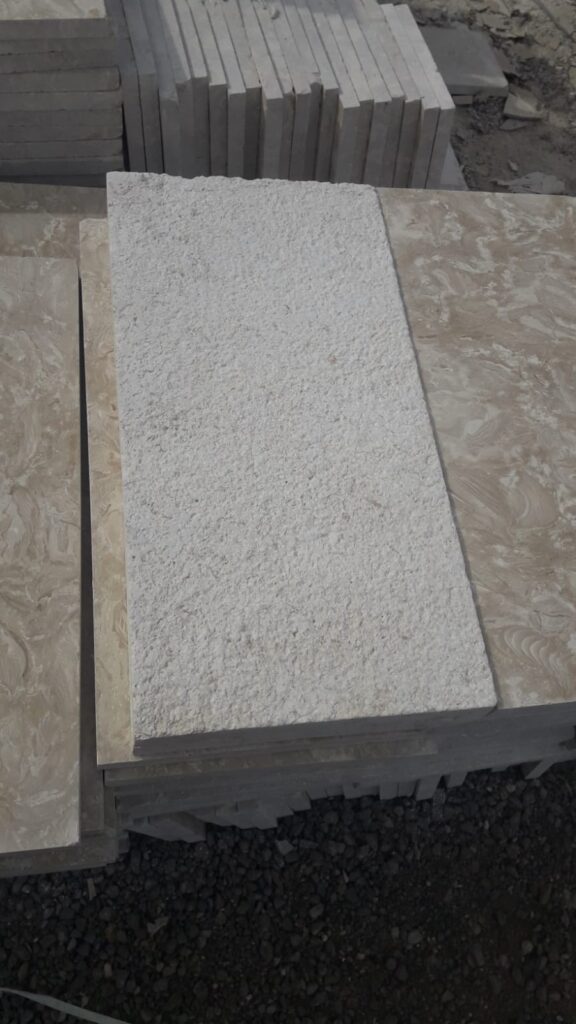
Any conversation about small-unit paving in Puerto Rico eventually reaches Old San Juan, and it is worth getting the history right rather than borrowing it. The famous blue-gray blocks in the old city – the adoquines – are not natural stone. They were cast from iron furnace slag, carried as ship ballast from the sixteenth century onward, and laid as street paving in the eighteen hundreds. They are a genuine and unusual part of the island’s paving memory, and they are also a manufactured product rather than a quarried one.
That matters commercially because it means nobody can honestly sell you an adoquin. What can be supplied is natural stone in the same family of sizes and the same setting logic: small, thick, individually handled units laid in courses, with the joint doing the work. The visual reference is legitimate. The claim that a limestone or granite sett is the same thing is not, and any supplier who tells you otherwise is guessing about your island rather than working in it.
For heritage-sensitive work in the historic core, the practical route is to agree material and pattern with the relevant authorities before drawings harden, because approvals in that district govern the public realm as well as the building itself. Outside it, on private driveways, courtyards and garden work, the choice is open – and the useful starting point is the range of cobblestone and sett sizes that are actually available in a consistent, gauged thickness.
Driveways, marquesina aprons and turning loads
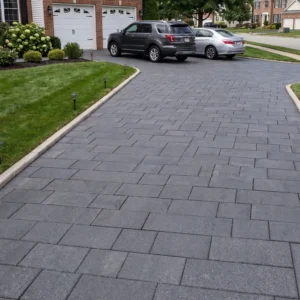
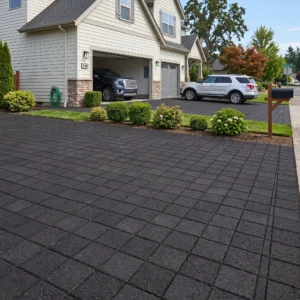
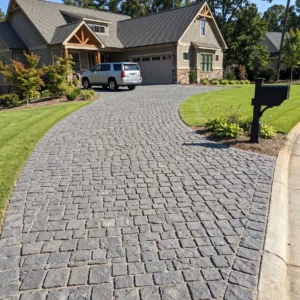
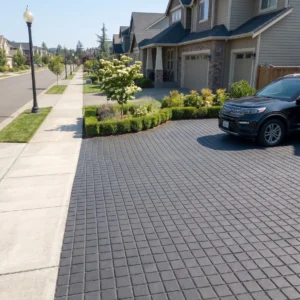
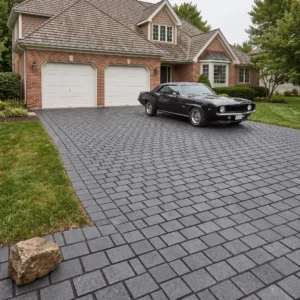
The Puerto Rican driveway is a specific engineering problem. It is often short, often steep, frequently ends in a marquesina or carport beneath the house, and it takes the same vehicle turning onto it in the same place several times a day. Turning is what destroys paving. A wheel that pivots applies a horizontal shearing force at the surface, and it applies it in a concentrated arc rather than spread along a line.
- Use a thicker unit at the apron and the turning arc than in the open field, because that is where the work happens.
- Restrain every free edge properly, since an unrestrained edge lets the whole field creep, and creep is irreversible.
- Bed on a compacted base built for the vehicle rather than for a footpath, because the base decides the lifespan, not the stone.
- Lay the courses across the direction of travel on a slope so the joint lines resist movement rather than channel it.
- Give the surface a texture: a steep wet driveway with a smooth face is a genuine hazard, not a style choice.
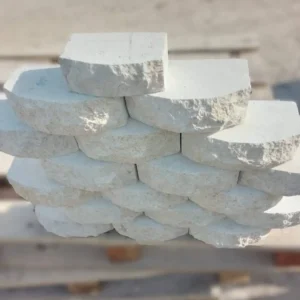
Where the driveway meets the street, the conten – the curb line – deserves its own detail. A sett course or a purpose-cut curb unit gives a defined, repairable edge and takes abuse from tires far better than a feathered edge of field paving. On steep entries, a short run of small units at the transition also breaks up the scraping point that flat slabs tend to create at the change of grade.
Patterns, curves and how the layout carries load
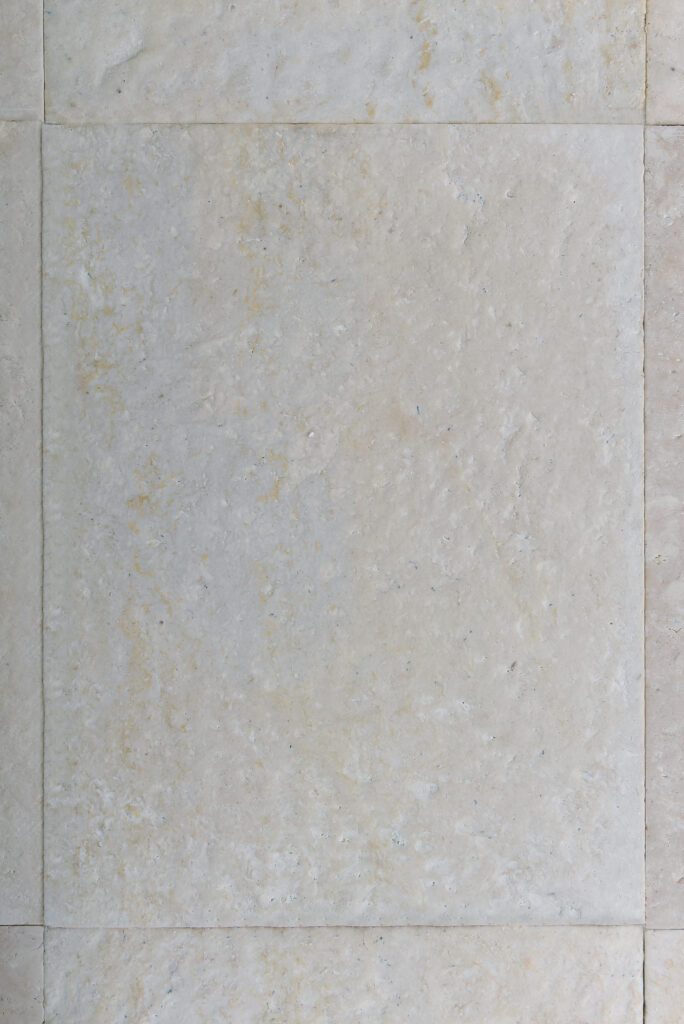
Pattern is not decoration in small-unit work; it is structural behavior. The way courses run decides how load transfers between units, how a curve is negotiated, and how visible a future settlement will be. It also decides how fast the crew works, which on a sett job is the dominant cost.
- Running bond laid across the fall is the simplest and most forgiving pattern on a slope.
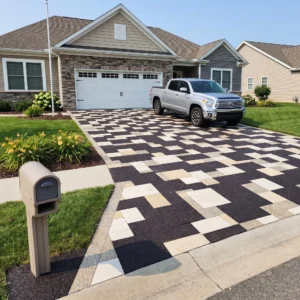
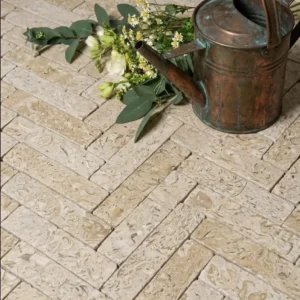
- Herringbone interlocks in two directions and is the strongest choice under vehicles, which is why it survives on driveways.
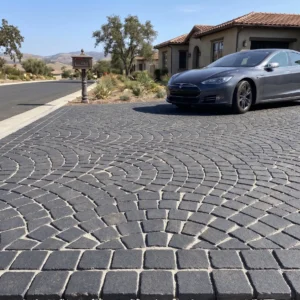
- Fan or arc patterns absorb curvature naturally and suit exactly the irregular ground this island produces.
- Circle and radial sets work in courtyards, tree surrounds and the middle of a turning area where the eye needs a focus.
- Banding in a second color or a larger unit breaks a big field into readable areas and hides an unavoidable change of level.
Pattern also governs waste. A fan set on a curve produces very little cutting, while a rigid grid forced around the same curve produces a cut on every perimeter piece and a slower, more expensive day for the crew. If a layout is still open, review the setting patterns for small units before the base is set out, because the pattern decision is cheap on paper and expensive on site.
The cost inversion: labor over material
Here is the part of small-unit paving that surprises most first-time buyers, and it is the single most useful thing on this page. With large-format slabs, the stone is usually the larger share of the installed cost. With cobblestones and setts, that relationship inverts: the material is comparatively modest and the labor becomes the dominant line. A crew lays a great deal of square footage a day in big slabs. The same crew lays far less in setts, because every piece is handled, aligned, tapped down and jointed individually.
That inversion has consequences worth planning around rather than discovering halfway through a job.
- Book the setting crew early, because skilled sett layers are a narrower trade than general concrete work on the island.
- Judge quotes on installed cost rather than material cost, or you will be comparing two numbers that are not comparable.
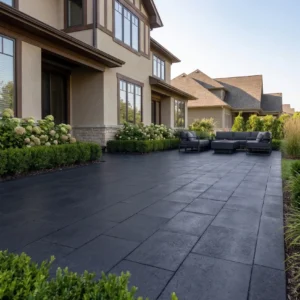
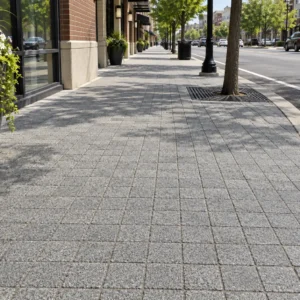
- Use setts where their behavior earns the labor – slopes, curves, driveways, aprons and repairable areas – and larger units on open flat terraces.
- Mixing systems is normal and sensible: a sett driveway and apron with a slab terrace behind the house is a common, economical layout here.
- Remember the other side of the ledger, because a sett field stays repairable unit by unit for decades, which is a maintenance saving a slab cannot offer.
None of this makes small units expensive. It makes them a different shape of expense, weighted toward the days the crew is on site rather than toward the day the pallets arrive.
Edges, contenes, channels and repairs
The details that decide whether a sett field lasts are almost all at its boundaries. A field fully restrained on every side behaves as a locked mass. A field with one soft edge will migrate toward it, opening joints in a slow fan across the whole area, and no amount of jointing material stops it once it starts.
- Restrain every perimeter with a haunched edge, a curb unit or a purpose-cut edging course, on all sides including the ones that do not show.
- Build drainage channels into the pattern with a course of setts falling to a gully rather than adding a separate product later.
- Detail tree surrounds with a flexible joint and a sacrificial ring you expect to lift and reset as the tree grows.
- Keep spare units from the original batch on the property, because a repair with matching stone is invisible and a repair with new stone is not.
- After a storm, lift, clean, correct the base and reset rather than topping up joints over ground that has washed out beneath them.
Joint choice follows the use. A rigid mortared joint suits vehicular areas and steep entries where movement must be resisted outright. A sand or polymeric joint suits garden paths and terraces where a little flexibility and some permeability are welcome, and where lifting and resetting is an expected part of the life of the surface. In the wet north and the interior, the joint is where growth appears first, so choose one you can clean without resorting to acid.
Sizes, tolerance and how to order
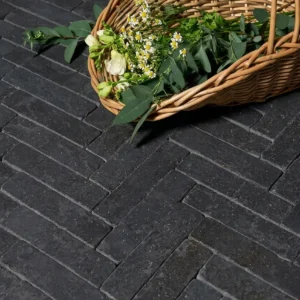
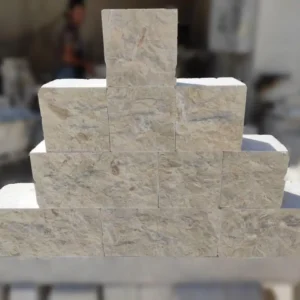
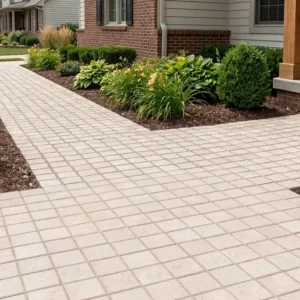
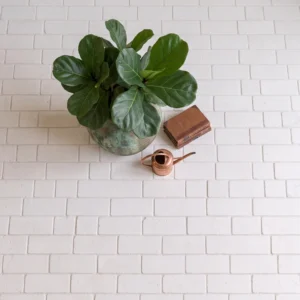
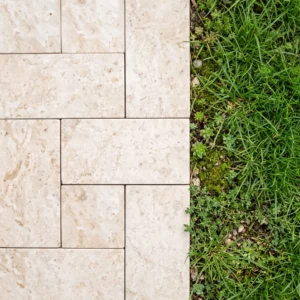
Cobblestones and setts are sold by size, thickness and face treatment, and the combination decides both the look and the setting rate. Tumbled units give a soft, worn face and a slightly wider effective joint. Sawn sides with a textured top give tighter joints and a more precise line. Thickness follows the load: garden and pedestrian work sits at the lighter end, and anything with vehicles on it belongs at the heavy end regardless of how it looks.
- Give us the total area, the slope, the turning radius and the heaviest vehicle before we quote a size.
- Decide on tumbled versus sawn-sided early, because it changes joint width, waste and the crew’s daily rate.
- Order the full quantity in one run, with spares for repairs, and store the spares somewhere dry and findable.
- Size pallets for the site, since mountain deliveries and any barge leg to Vieques or Culebra cap what a single movement can carry.
- Confirm the pattern before the base is set out, because pattern determines the setting-out lines and the cutting allowance.
Two structural facts shape a delivery date more than the size of the order does. Puerto Rico sits inside US customs territory, so stone from the mainland moves as a domestic shipment with no federal duty line and no international clearance leg to schedule around. And the Jones Act requires carriage between the mainland and the island to run on US-flag, US-built and US-crewed vessels, which lifts the freight cost but also buys frequent scheduled sailings rather than an occasional international call, with Jacksonville and Port Everglades the usual load ports for San Juan. Vieques and Culebra add a barge leg out of Ceiba, and that leg carries its own schedule and its own weight limit.
Stone ships into San Juan as domestic freight on scheduled sailings, with no federal customs duty and IVU at a combined 11.5 percent on the landed cost, so the administrative side of a sett order is short – check the current rate with your tax advisor before you budget. The planning that matters is on the ground. Send us photographs of the slope, the entrance and the turning area, and we will tell you the unit size, the thickness and the pattern we would use.