

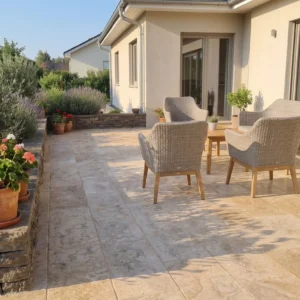
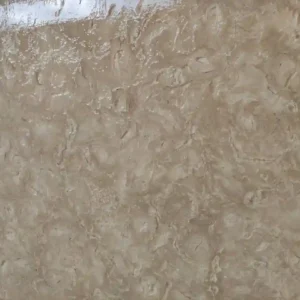
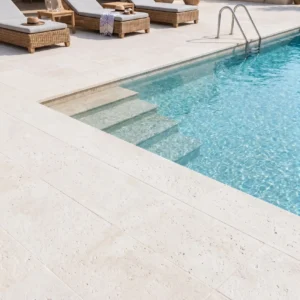



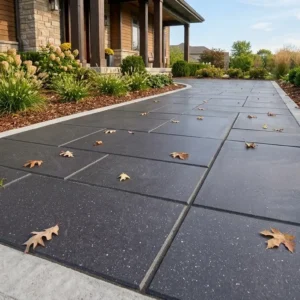



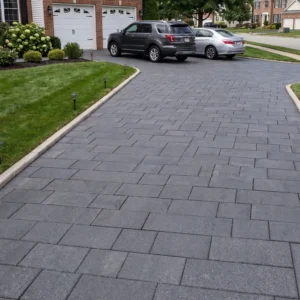

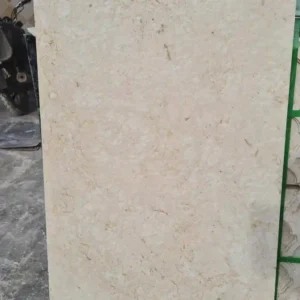
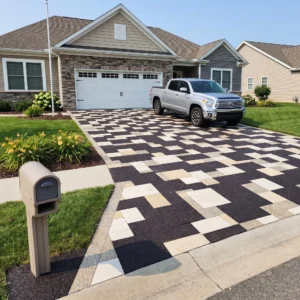
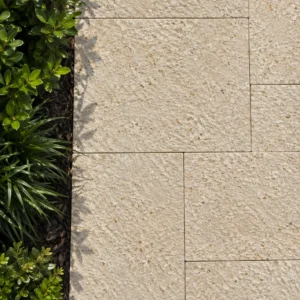
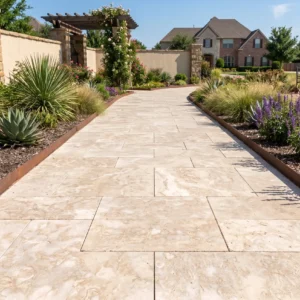
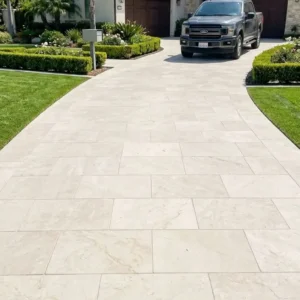



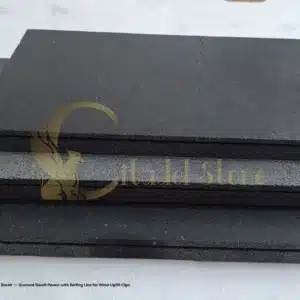
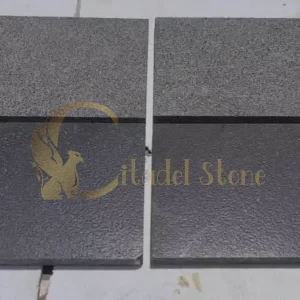
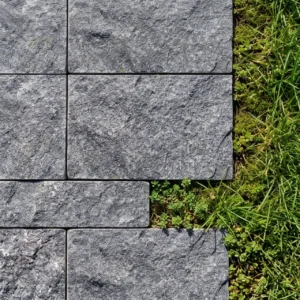
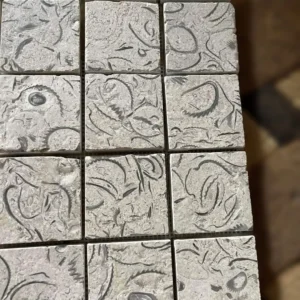
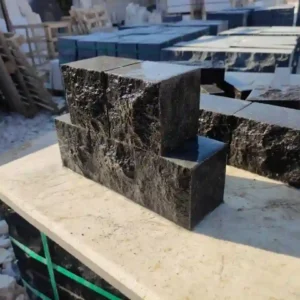
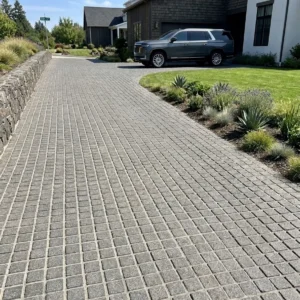
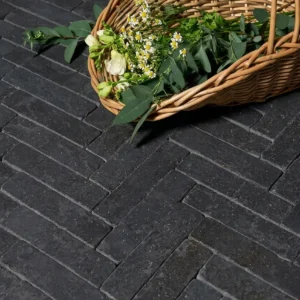
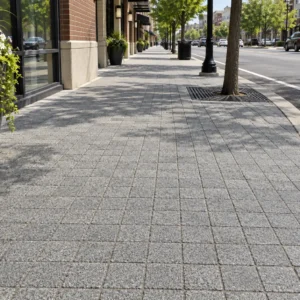
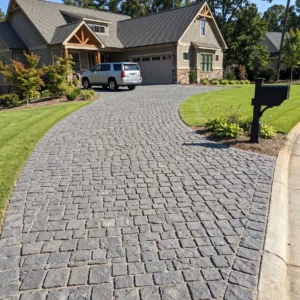
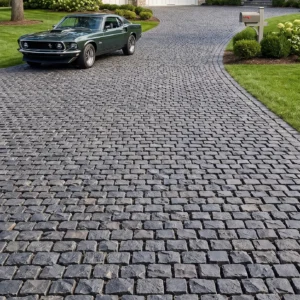
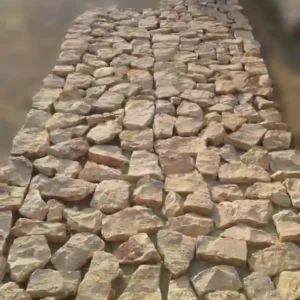
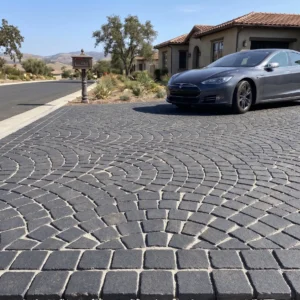
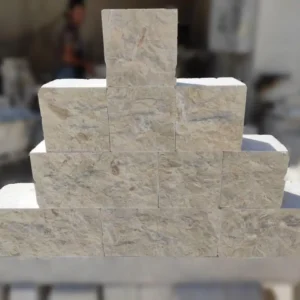
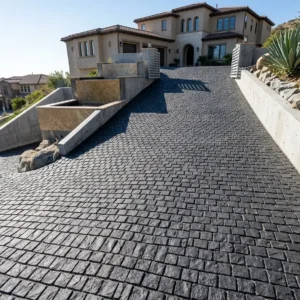
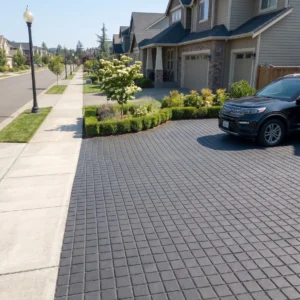
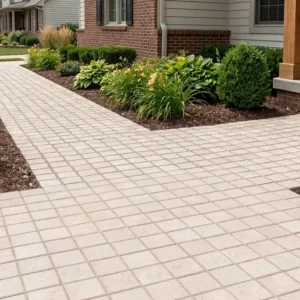
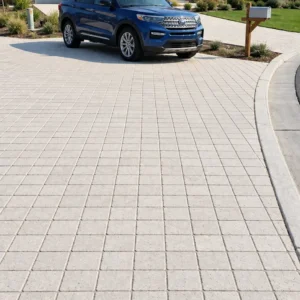
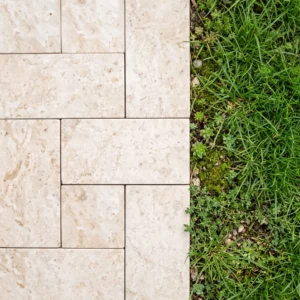
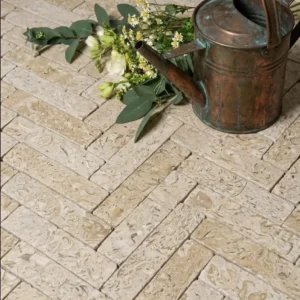
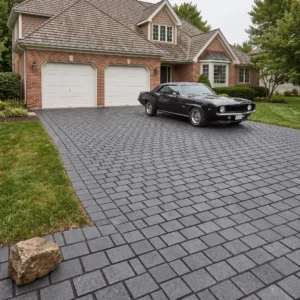
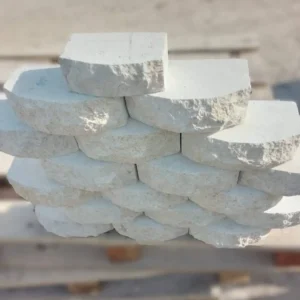

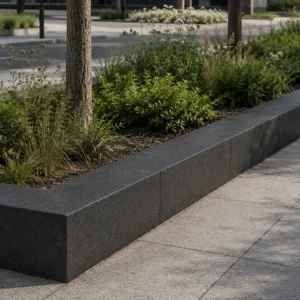
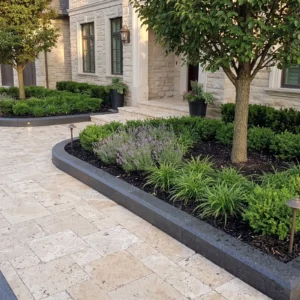
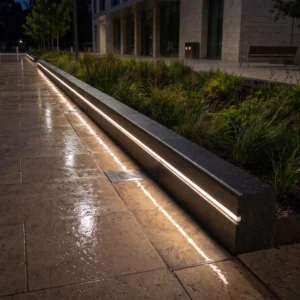
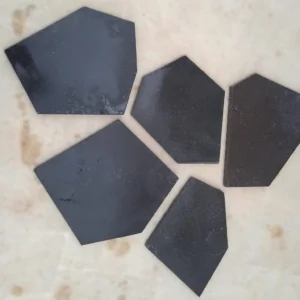
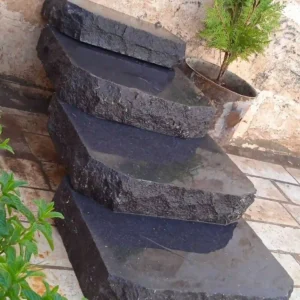
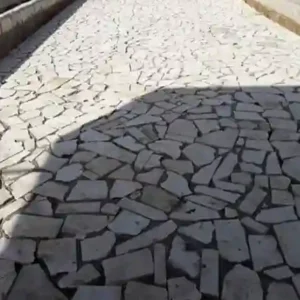
Setts do things no slab can. Because each unit is small, the surface follows ground that moves, turns a radius without a cut, and absorbs the irregularity of a substrate that was never going to be flat. Because there are many joints, water has many routes off the surface instead of one. And because a single unit can be lifted by hand, a section can be taken up and put back for a service trench, a settled corner or a change of mind, without the scar that lifting a large slab leaves behind.
On Curacao those properties line up with real conditions. Plots run up and down slopes away from the coast. Driveway entrances meet the road at whatever angle the road happens to take. Ground can be hard and thin over rock. And some of the most demanding work sits next to buildings that are old, listed, or both. What setts are not is the cheap option. On a route supplied by sea they are the expensive one, for reasons set out further down this page. Used where they belong, that cost buys a result a slab layout cannot produce at any price.
Where Small Units Beat Large Slabs
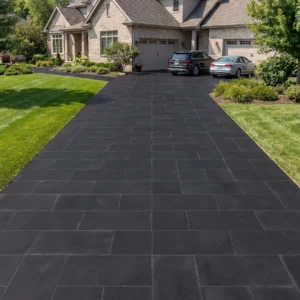
The choice between setts and slabs is a decision about geometry and movement rather than taste, and it is worth making area by area. A job can perfectly well run large modular slabs across a level terrace and setts on the approach without looking indecisive; in fact that combination usually reads better than either material used everywhere.
- Falling ground: a small unit steps down a gradient in many tiny increments, so the surface follows the fall without the wedge cuts a slab layout needs.
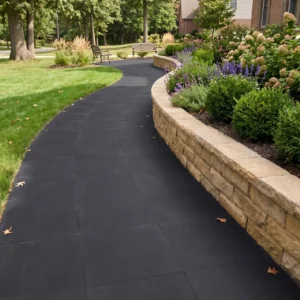
- Curves and radii: setts turn an arc by opening the joint slightly on the outside of the curve, with no cutting at all.
- Uneven or rocky substrate: small units tolerate a bed that varies, where a large slab telegraphs every high spot as a rock or a crack.
- Awkward shapes: entrance thresholds, tree surrounds, odd corners and narrow margins are far quicker to close out in a small unit.
- Anywhere that will be dug up again: services running under a driveway are a strong argument for a surface that can be lifted and reinstated cleanly.
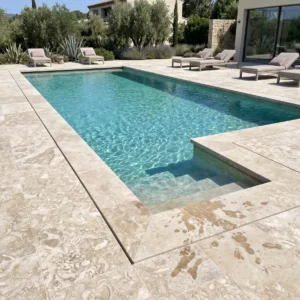
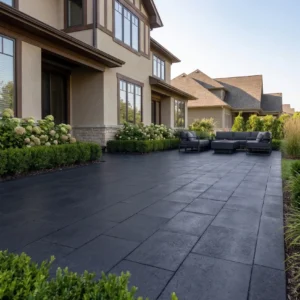
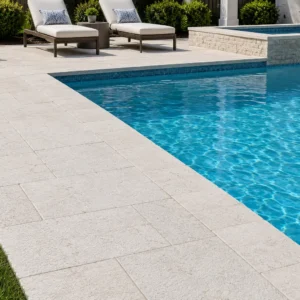
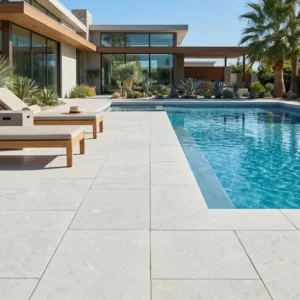
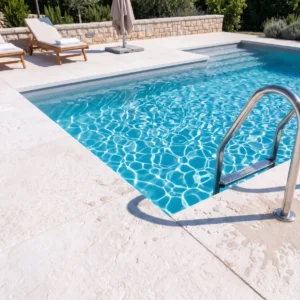
The reverse is equally true and worth saying out loud. Long open terraces, pool surrounds where bare feet are the main traffic, and interior floors are slab and tile territory. A sett surface has a joint every few centimeters and a face that is rarely dead flat, which is a virtue on a driveway and a nuisance under a dining chair. Decide by area, not by preference.
Driveway Aprons And Turning Loads
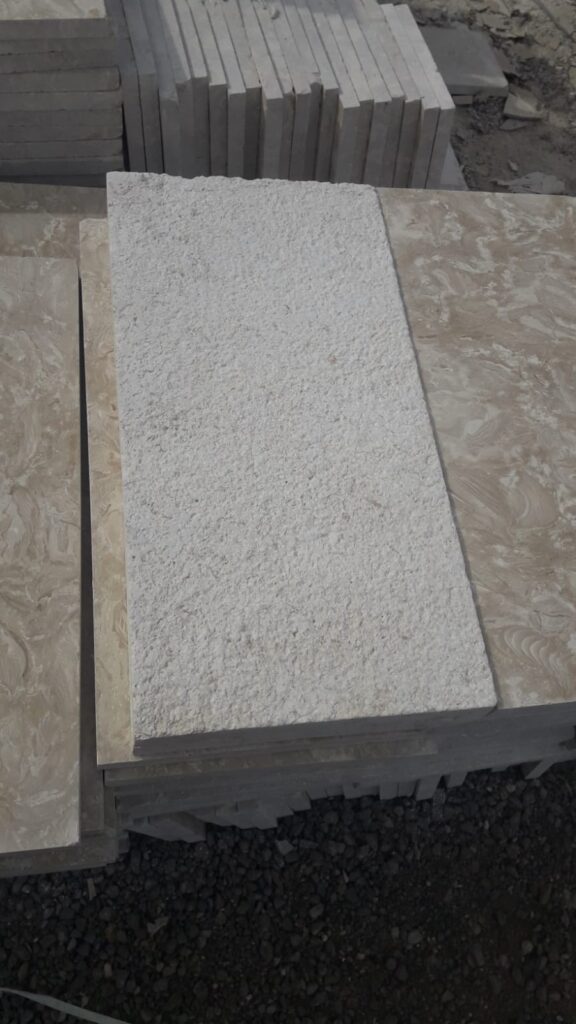
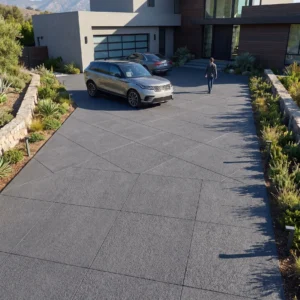
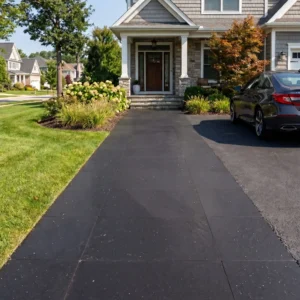
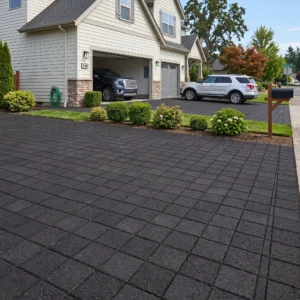
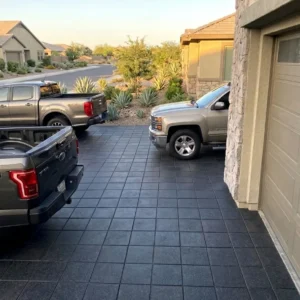
The apron, where a private oprit meets the public road, takes the hardest life of any hardscape on the plot. Every vehicle entering turns on it, often with the steering loaded and the wheels barely rolling, which is the condition that destroys a paved surface fastest. Turning tires apply a horizontal shear force rather than a simple vertical load, and shear is what pushes units out of line and grinds a joint open. A surface that would last indefinitely under straight-line traffic can fail in a season under turning traffic if it was detailed for the wrong force.
- Take the depth up on the apron itself; this area justifies a thicker unit than the drive behind it, even if that means two depths on one order.
- Lay on a bound bed with a bound joint where turning is concentrated, rather than on loose sand.
- Restrain both edges properly with an opsluitband or trottoirband style edging haunched in concrete, because an unrestrained field creeps in the direction of its traffic.
- Set the courses so joints do not run parallel to the direction of travel; a running bond or a herringbone locks against shear far better than a stack bond.
- Watch the transitions to the road surface and to any gate track, because interfaces are where failure starts, not the middle of the field.
Gates deserve more thought than they usually get. A sliding gate running on a track needs a rigid, level path with no differential settlement along its length, and a swing gate needs clearance over a surface that may not stay perfectly flat for its whole arc. Decide the gate arrangement before the paving is set out rather than after, because retrofitting a track into a finished sett field means cutting into exactly the area that is working hardest.
Setting Out Curves, Radii And Falls
Sett work lives or dies at setting out. Any stratemaker will tell you the pattern is decided before the first unit goes down, because a course laid slightly out of true does not correct itself as the work proceeds. It accumulates, and by the time it is obvious the fix is to lift back to where it started.
For curves there are two usual approaches: radial fans and concentric arcs. A fan pattern lays units in repeated arcs so that each course turns naturally, which suits a wide entrance, a turning area or a courtyard meant to look deliberate when seen from a gallery above. Concentric coursing follows a fixed radius, which suits a drive sweeping around a planted island. Running bond handles straight runs and takes a gentle curve by opening the outer joints slightly. Herringbone gives the best mechanical interlock under vehicle loads but is the least forgiving on a tight radius, because every unit sits at an angle to the line and every deviation shows twice.
Falls need the same discipline. On a slope, decide early whether courses run across the fall or down it. Across is easier to keep true and gives more edges underfoot; down the fall sheds water faster and shows a laying error more clearly. Where a gradient is steep enough to want steps, plan each step as a separate element with its own bedding rather than trying to lose the level within the field. If the shape of a job is doing anything more than a straight rectangle, cobble units for curved work will handle geometry a slab layout simply cannot, and it is worth setting the pattern out in chalk on the prepared base before the first bed is mixed.
Working Near Older And Listed Buildings
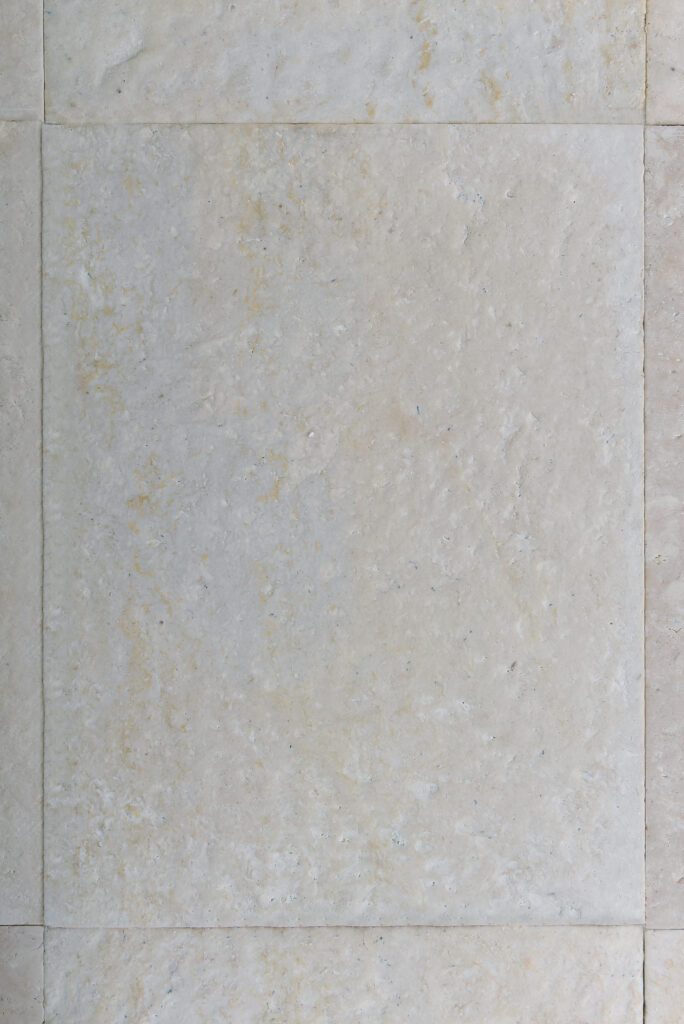
Willemstad’s historic inner city and harbor were inscribed on the UNESCO World Heritage List in 1997. The inscribed area takes in four districts, Punda, Otrobanda, Pietermaai and Scharloo, together with the harbor, and holds 743 listed monuments, with most of the urban fabric dating from between 1650 and 1900. Any hardscape work inside those districts is work inside a World Heritage area, and it needs to be planned on that basis.
- The Monuments Office sits within the Department of Urban Planning, Development and Housing and is responsible for the protection and conservation of monuments and of the historic townscape.
- Restoration funding runs through the Meerjarenprogramma Bijdrageregeling monumentenzorg, and a restoration scheme drawing on it should confirm what its conditions require.
- Stichting Monumentenzorg Curacao separately manages more than 120 monuments, including town houses, forts, plantation houses and a former synagogue.
- A building permit is required for construction works in any case; inside the historic districts the heritage route runs alongside the planning route rather than instead of it.
- None of this is a retail purchase, so build the approval time into the schedule before you commit to a delivery date or a client handover.
The material question beside an old building is a question of what sits well with what is already there. The traditional wall fabric of Curacao is coral stone and quarry stone finished in lime plaster, with brick used for detailing: a soft, matte, hand-worked set of surfaces. A tight, machine-perfect, high-gloss paving field reads as an intrusion beside that, while a small unit with a worked or tumbled face and a visible joint sits quietly against it. The same logic applies at the landhuizen, the restored plantation houses found across the island, where a paving field generally needs to defer to the building rather than announce itself. Ask the Monuments Office what it will accept before falling in love with a pattern.
Bedding, Jointing And Trade-Wind Scour
Bedding and jointing decide whether a sett surface lasts, and two local conditions push the decision here. The first is wind. Trade winds run at roughly fifteen to twenty-five knots for most of the year and carry fine grit, which scours an open joint and slowly empties it. The second is rain that arrives all at once rather than steadily, which will lift a dry sand joint straight out of a surface on any kind of slope.
- On slopes, in wind-exposed positions and anywhere vehicles turn, use a bound joint rather than a loose sand joint.
- Sheltered, level, pedestrian-only courtyards can carry a sand joint, but plan on topping it up rather than treating it as permanent.
- Build the sub-base from the island’s own material, since graded base course and screened sand are produced on Curacao, and compact it properly, because imported stone laid over a poor base fails as a base rather than as a stone.
- Use a salt-tolerant bedding and jointing specification on coastal sites, and avoid any detail that holds standing salt water against the units.
- Give the field a hard edge on every side, because without restraint a sett surface migrates in the direction of its traffic.
Joint width is itself a specification item, not an accident of laying. A wider joint gives tolerance on unit size and reads as traditional work; a narrow joint reads as tight modern work and demands closely gauged units, which costs more at the quarry and more on site. Decide which you want, write it into the specification, and check the first square meter laid against it before the crew settles into a rhythm. A joint width that drifts by two millimeters over a driveway is visible from the gate.
The Labor Versus Material Balance
There is a piece of trade folklore holding that setts are the cheap material with the expensive labor. On an island supplied by sea the first half of that is simply wrong, and believing it will wreck a budget before the first pallet is booked.
Here is why. A sett is a cube-like unit, and a cube covers far less area per kilogram than a slab does. Cover one square meter in setts around 100 mm deep and you are handling several times the weight of stone needed to cover the same square meter in a 30 mm slab. On a route where stone is charged by weight, which is how paving travels and how the customs value is built up, that weight goes straight into the freight line and into the duty base. The result is that setts land in Curacao at a higher material and freight cost per covered square meter than slabs do, not a lower one. The domestic version of the truism assumes a short road haul from a local quarry, and it does not survive a container crossing.
The labor half of the folklore is true, and it is the real reason sett paving costs more to install. A slab layer places a few large units per square meter. A sett layer places dozens, each one set to line, to level and to joint. Cutting, coursing round a curve and closing out edges all consume skilled time, and that skilled time is visible in the finished surface, which is exactly what a client is paying for when they choose setts over a poured surface.
So budget it honestly. Expect the material line to be higher than a slab equivalent, expect the laying line to be higher again, and expect the result to do things a slab cannot. Compare sett formats and unit depths before pricing the labor, because unit size drives the number of pieces per square meter and the piece count drives the day rate you will be quoted. Phasing helps: an apron and an entrance can be done in setts while the terrace behind them uses a slab format, and the two together often cost less than one material used everywhere.
Ordering Setts For A Curacao Site
Quantities for setts are worked out by coverage rather than by piece count, and coverage depends on unit size, joint width and pattern. A fan or a herringbone generates more cuts at the edges than a running bond, so the waste allowance rises with the ambition of the layout. Tell us the pattern when you ask for quantities and the take-off will be much closer to what you actually lay.
- Give the area, the pattern, the joint width you intend and the depth required for each zone, since aprons and terraces rarely want the same depth.
- Allow for edge cuts and add a reserve on top for repairs and for the service trench nobody has drawn yet.
- Ask for crates to be marked by zone on a phased job, so the heavier apron material is not opened first by mistake.
- Confirm the site can take a full crate and a machine to move it, because hand-balling setts off a truck is slow, expensive work.
Samples are small. A few hand pieces are enough to judge face texture, edge treatment and tonal range, and enough to lay four or five together on the ground to see how a joint will actually read at walking distance. That last test is the one that matters, because a sett never appears on its own; it is always seen as a field. Look at them outdoors in island light, and if the job is beside a lime-plastered wall, hold a piece up against the wall before deciding anything.
Finally, order against the permit and the approvals rather than the drawing date, and keep the reserve on site once the job is done. A sett surface is the easiest paving to repair invisibly, but only if the material for the repair came out of the same crate. Send the pattern, the joint width and the zone depths, and we will price the coverage you will really lay.