

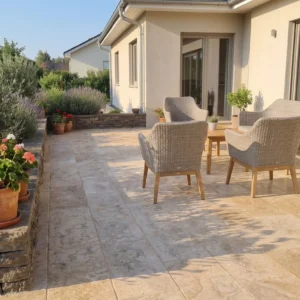

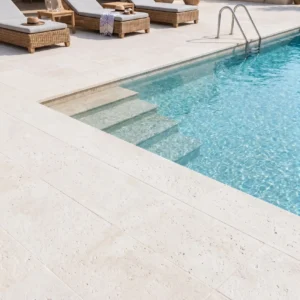


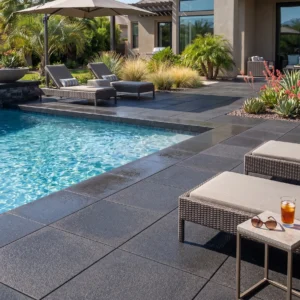
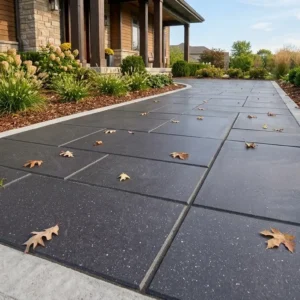
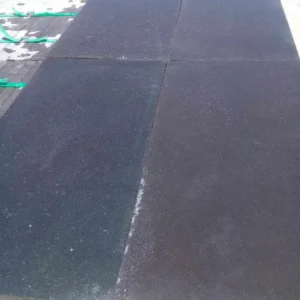
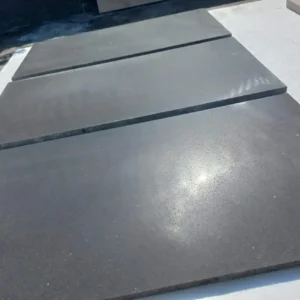

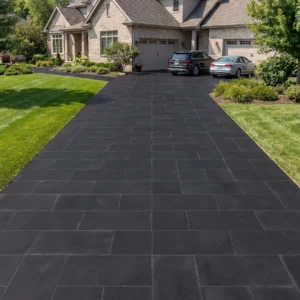
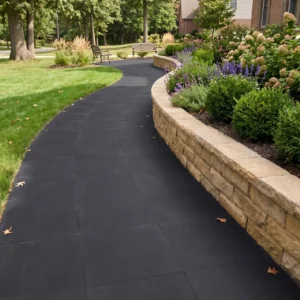




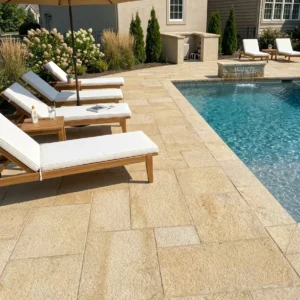

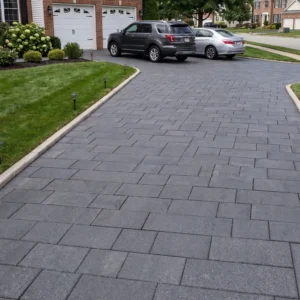
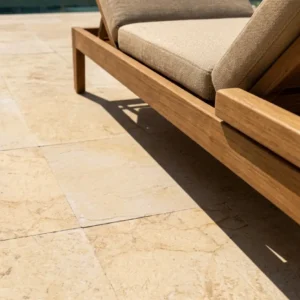

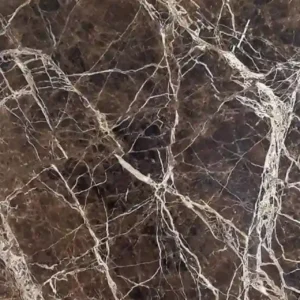
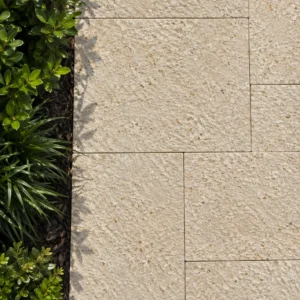
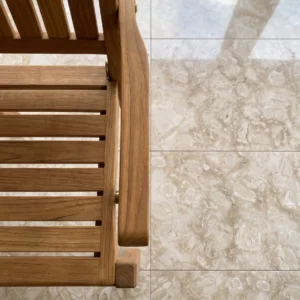
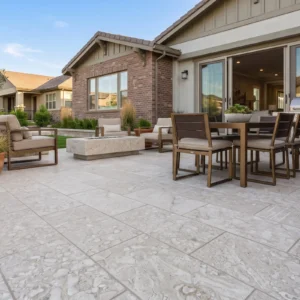

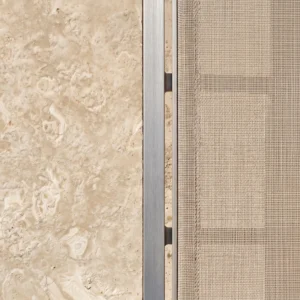
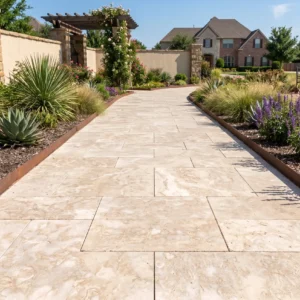
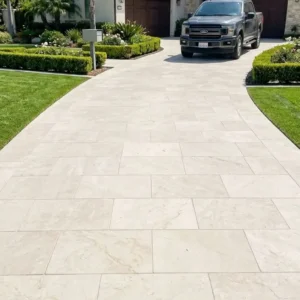
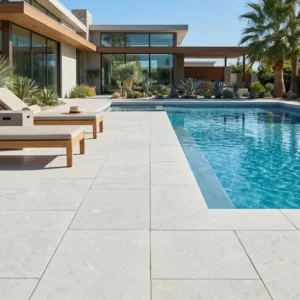

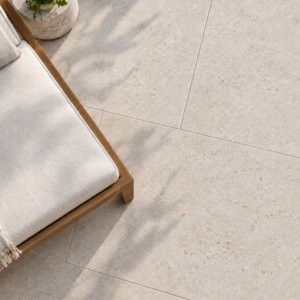

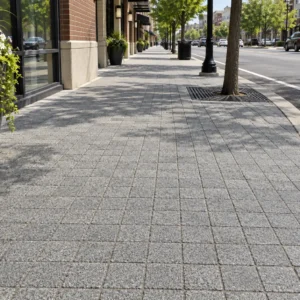
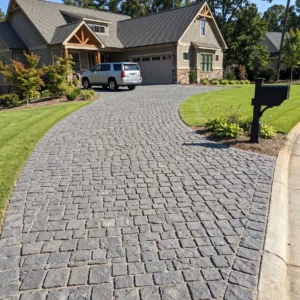
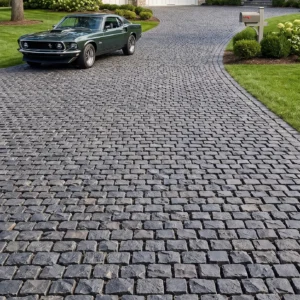
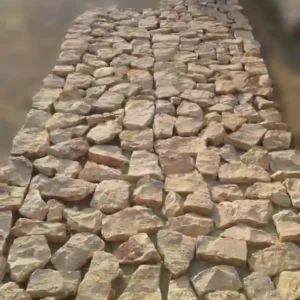
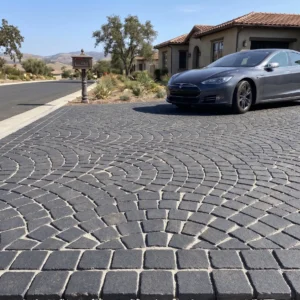
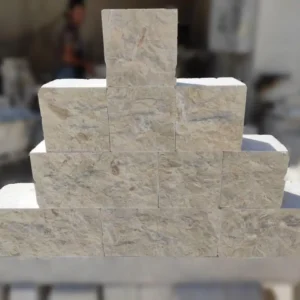
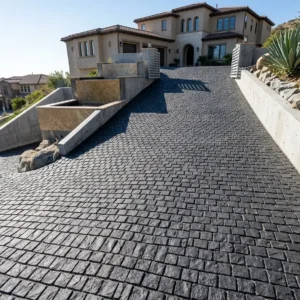
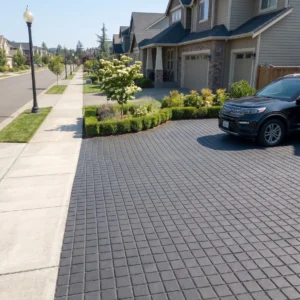
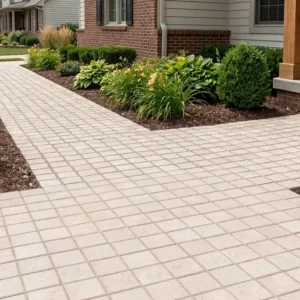
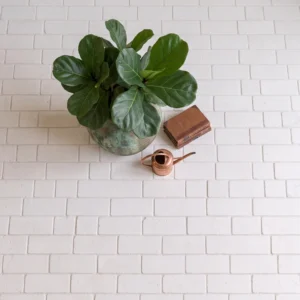
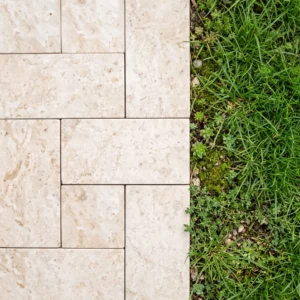
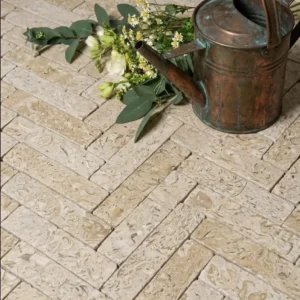
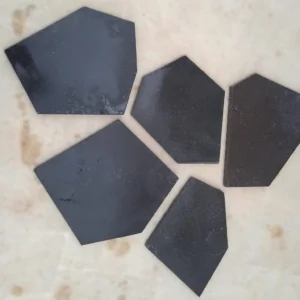
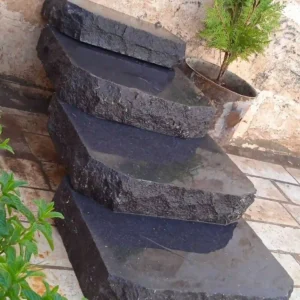
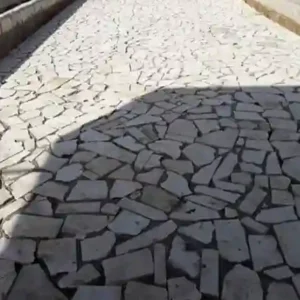
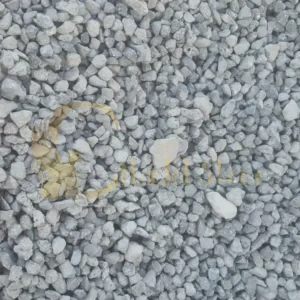
Bermuda is hilly, narrow and old in places, and that combination is precisely what small paving units are for. A slab wants flat ground, a straight edge and room to be carried. A sett wants none of those things: it will follow a fall, turn a radius, sit against an irregular old wall and be carried up a flight of steps in one hand. On an island where lanes are tight, lots are steep and a fair amount of the built fabric predates any machine that would help you, that is a practical advantage rather than a stylistic preference.
This page is about small-unit work specifically: where setts beat slabs, how aprons and turning areas should be built, what to do around older and protected settings, which patterns suit which shape of ground, and what sett paving genuinely costs once freight and labor are both on the page. Routes and duty sit on the broad pavers page, material data on the limestone pavers page and interiors on the tiles page. The cost section here is the one most worth reading, because the trade’s usual assumption about setts does not survive a sea crossing and a lot of Bermuda budgets have been written as though it does.
Where small units beat slabs on this island
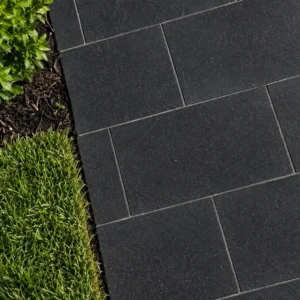
The case for setts in Bermuda is geometric before it is aesthetic. Ground that falls in two directions at once, a driveway that curves as it climbs, a courtyard bounded by walls that are not parallel, a path threading between mature planting – all of these are awkward in slabs and straightforward in setts. Every unit is small enough to take up the fall in the joint rather than in a cut, which is why sett surfaces look resolved on ground where slab surfaces look forced.
- Slopes: a small unit follows a changing gradient without the visible steps a large slab produces.
- Curves and radii: setts turn an arc by opening the joint rather than by cutting a wedge from a slab.
- Irregular boundaries: old walls are rarely straight, and a sett course closes against them cleanly.
- Confined access: one person can carry setts along a route no barrow or machine will manage.
- Phased work: a sett area can be built in sections without leaving a visible construction joint.
There is a hidden logistics advantage as well. Where a lane, a gate or a flight of steps rules out mechanical handling, the piece size a person can carry becomes the piece size the job can actually use. Setts are self-delivering in that sense: the same constraint that makes a large-format slab difficult on a tight Bermuda lot makes small units easy. That does not make them the cheaper answer, as the cost section explains, but it frequently makes them the only answer that gets built without a crane and a road closure.
Aprons, turning loads and the vehicles that actually use them
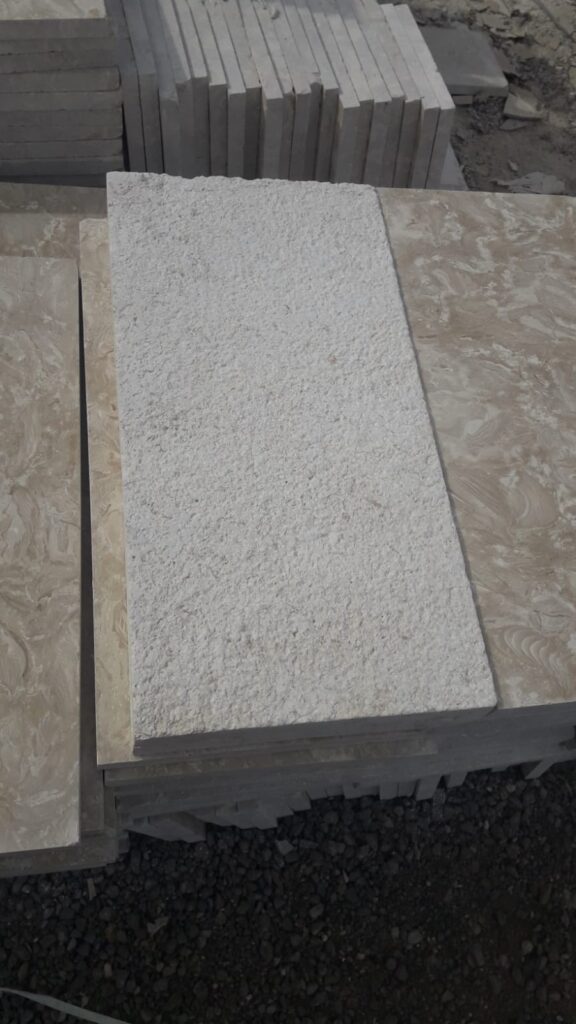
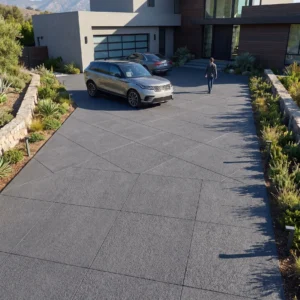
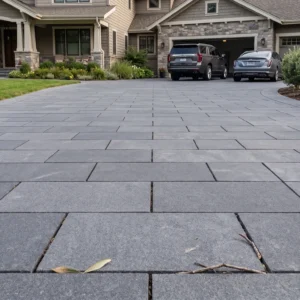
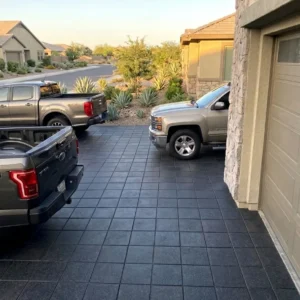
Vehicle size is limited on Bermuda and private cars are modest by North American standards, but that does not mean an apron is lightly used. Delivery vehicles, service trucks, plant hire and the occasional heavy load all turn on the same piece of ground, and a turning wheel imposes a very different stress from a rolling one. It grinds, it scuffs and it concentrates load on the corner of whatever unit sits beneath it, which is why aprons fail at the edges long before they fail in the field.
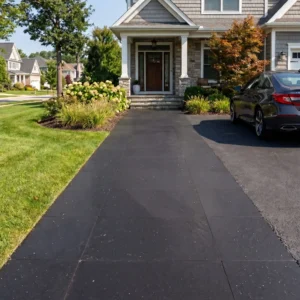
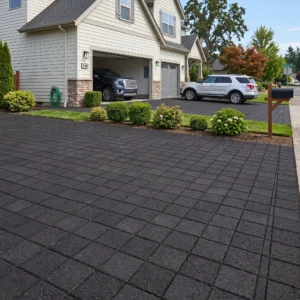
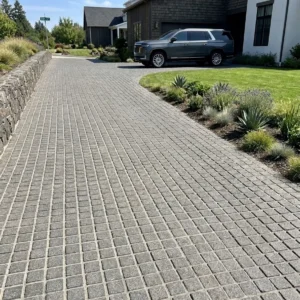
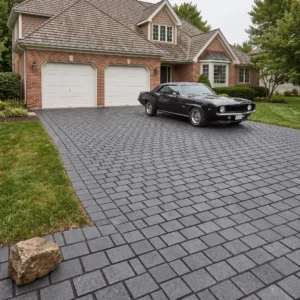
- Build aprons and turning areas on a concrete base with a full bed rather than a sand-set construction.
- Use a heavier sett depth where vehicles turn, in line with the 5 cm and above convention for vehicular surfaces.
- Restrain every edge, because an unrestrained perimeter under turning traffic migrates within a season or two.
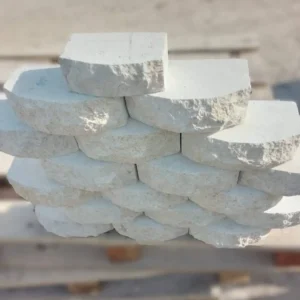
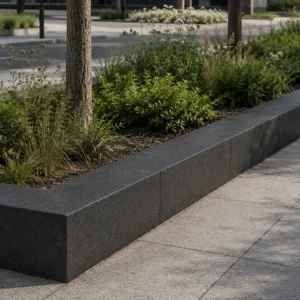
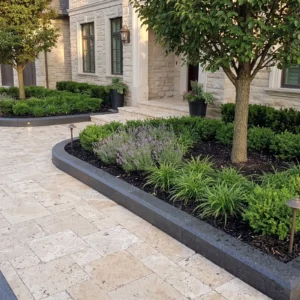
- Run curbstones or a haunched edge where the apron meets soft ground or planting.
- Keep the joint tight and filled, since an open joint under a steering wheel loses its fill quickly.
The apron is also where the two halves of a Bermuda property meet: it takes a vehicle, it sits directly beside the house, and it often carries water toward or away from a collection area. That is why we generally suggest ordering setts sized for narrow lanes and tight turning circles rather than scaling up a unit intended for an open forecourt. A smaller sett gives more joint per square meter, more grip for a turning tire and a far better chance of following the fall the drainage design actually needs.
Older walls, protected fabric and settings that deserve restraint
Bermuda’s built history is a limestone history. The island’s own aeolianite went into the walls and the stepped roofs, and the remaining fabric of that tradition is protected and closely watched. St. George’s and its related fortifications hold UNESCO World Heritage status and carry the strictest heritage sensitivity on the island, and the Department of Planning applies real scrutiny to external work well beyond that boundary. Khyber Pass in Warwick Parish, a disused building-stone quarry exposing lithified dunes formed around 120,000 years ago, is a plain reminder of how directly the island’s ground and its buildings are related.
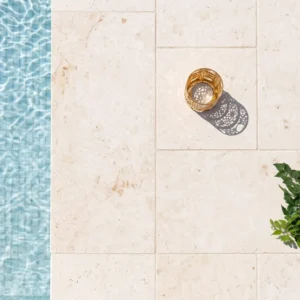
What that means for sett work is restraint rather than pastiche. Setts are not a Bermuda vernacular and there is no reason to pretend otherwise. The job is to lay a surface that defers to the walls and the roofline above it rather than competing with them, and tone, texture and joint do most of that work. A quieter choice almost always ages better in a sensitive setting than a bold one, and it is far easier to defend at application stage.
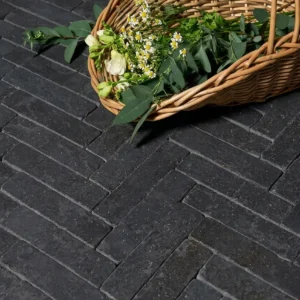
- Pick a tone that sits under the building rather than announcing itself against it.
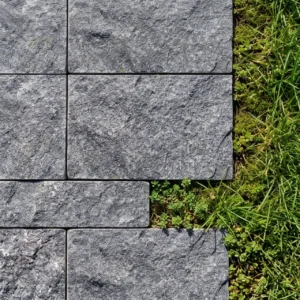
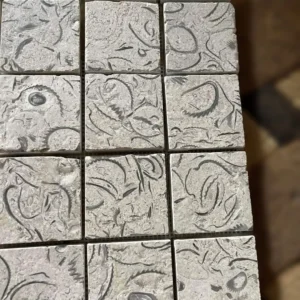
- Avoid high-gloss or sharply sawn faces next to weathered limestone masonry; a tumbled or split face sits more quietly.
- Keep patterns simple where the architecture is the subject of the view.
- Discuss any work in or near a protected setting with the planning authority before the design hardens.
- Hold a sample against the existing wall in daylight before ordering, because stone that matches on a screen rarely matches on site.
Patterns, and setting out before the first sett is bedded
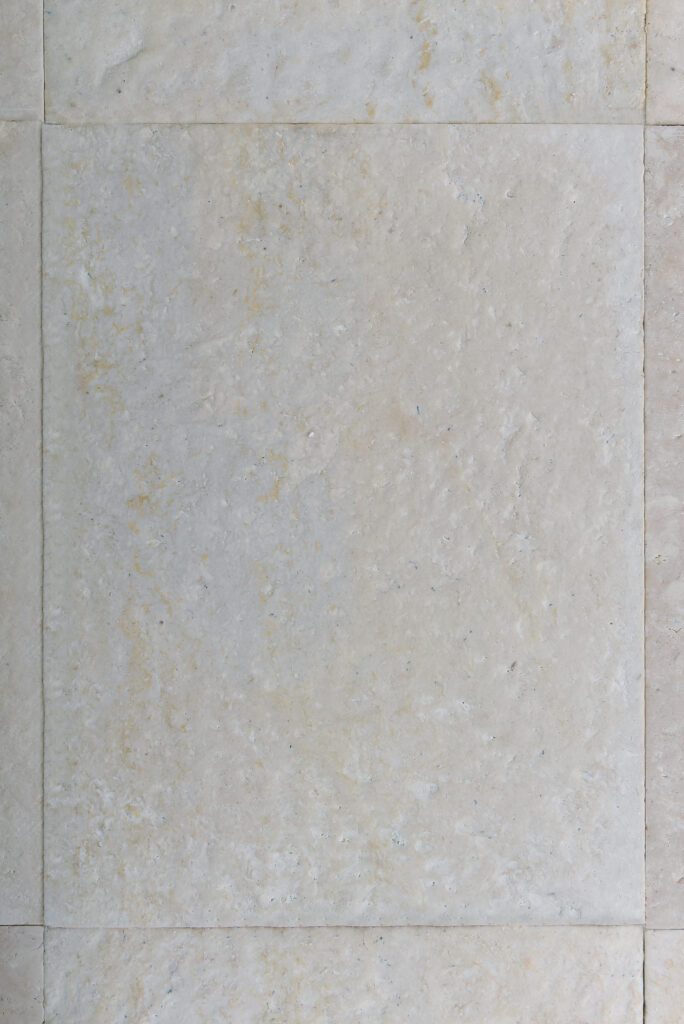
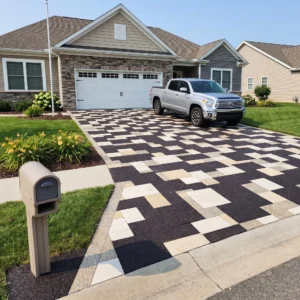
Pattern choice is a structural decision as much as a visual one. A running bond laid across the direction of traffic locks better than one laid along it. Herringbone interlocks in two directions and is the sensible choice for a driveway or an apron that takes turning loads. Fans and radial arcs absorb curves and changes of level gracefully and are worth the extra setting-out time on ground that is not flat, which on Bermuda is most ground.
- Herringbone for driveways, aprons and anywhere vehicles turn, because the interlock resists creep.
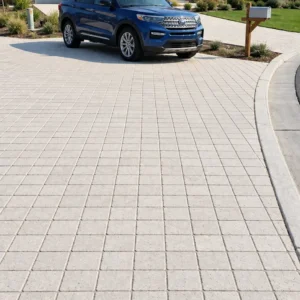
- Running bond across the traffic direction for paths and service routes.
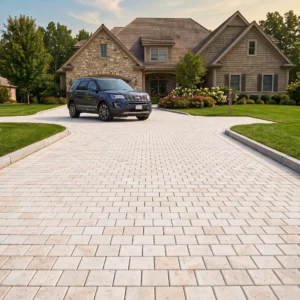
- Fan and radial coursing for curves, level changes and courtyards where a rectilinear grid fights the shape.
- A soldier or double-sett border to close every edge and take the cuts out of the open field.
- Set out from the most visible line and push the cuts to the least visible edge.
Setting out is where sett jobs are won or lost, and it happens on paper before it happens on the ground. Work through radial and running bond coursing against a scaled plan of the actual area, mark the string lines and the border, and calculate the cut allowance from the drawing rather than from optimism. A pattern that looks simple on a flat sample panel can consume a surprising number of cut units on ground that falls two ways, and on an island where the next crate is a sailing away, running short is an expensive kind of surprise.
What sett paving actually costs, honestly
There is a familiar line in the trade that setts are the cheap material and labor is the expensive part. On an island supplied by sea, the first half of that sentence does not survive the crossing, and it is worth being straight about why rather than letting a client discover it at quotation stage.
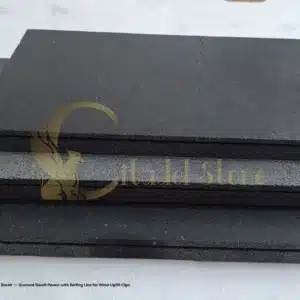
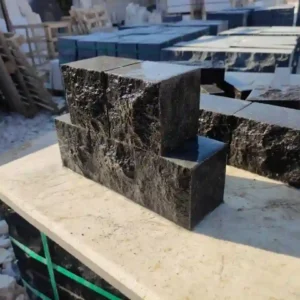
A sett covers its square meter with far more stone than a slab does. A 5 cm sett laid to cover the same area as a 3 cm slab carries substantially more mass, and mass is what a shipping route charges for. So the material costs more per covered area at the quarry, more per covered area on the vessel, and – because duty is charged on value at the 10 percent building-materials rate – more on the duty line as well. None of that is a reason to avoid setts. It is a reason to budget them properly and to use them where their geometry earns its place rather than as a default surface spread across an entire property.
- Setts weigh more per covered square meter than slabs, so freight per finished area is higher rather than lower.
- Duty is charged on value, so a higher material cost carries a higher duty line with it.
- Labor is the reason sett paving costs more to install: every unit is placed, aligned, bedded and jointed by hand.
- Cut allowance on curved or radial work is real and belongs in the quantity from the start.
- Phasing suits setts well, so a large scheme can be built in stages against separate sailings.
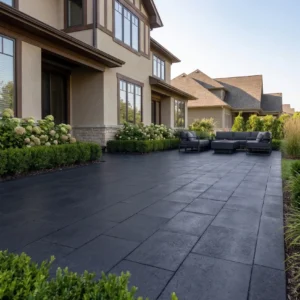
The honest framing is that setts are a considered choice for ground that needs them – slopes, curves, aprons, tight courtyards and sensitive settings – and an expensive one for a large flat terrace where a slab would do the job better and cost less to land and to lay.
Handling, sorting and packing for a sett order
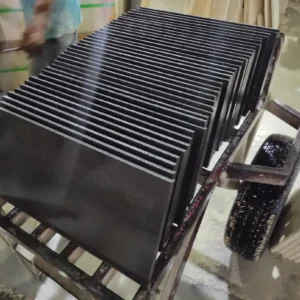
Sett orders behave differently from slab orders once they reach a site. There are many more pieces, they arrive in heavy crates, and natural variation between crates is normal rather than a fault. Handling that variation well is what separates a sett surface reading as one continuous field from one that shows visible bands where the crates changed over, and the fix is a laying discipline rather than a specification clause.
- Blend from at least three crates as you lay rather than emptying one crate before opening the next.
- Sort obvious outliers into borders and cut areas rather than scattering them through the open field.
- Check crate weights against what your site handling can lift before the order is packed.
- Keep setts off soft ground while stored, because a crate that sinks is a crate that will not be lifted cleanly.
- Order the cut allowance with the main quantity so replacements come from the same batch.
Because Bermuda’s island distribution runs on smaller vehicles and genuinely narrow lanes, we build sett crates to a weight the receiving site can actually handle rather than to a standard that suits a mainland yard. Tell us the access, the lifting equipment available and the storage space you have, and the packing follows from that instead of being discovered on delivery day with a truck blocking a lane. It costs nothing to specify and it removes the single most common delivery problem on the island.
How a sett order runs from quote to laid surface
Start with an area take-off and a pattern rather than a piece count. Give us the square meters per area, whether each takes vehicles or feet only, the tightest radius on the job and the fall across the ground, and we will convert that into sizes, depths, a cut allowance and a delivered figure. Samples are small hand pieces, and for sett work they matter more than usual, because size tolerance and face texture are things you judge in the hand rather than on a screen.
- Areas, uses and the tightest radius anywhere on the site.
- The pattern you intend, so the cut allowance is calculated rather than guessed.
- Access, lifting capability and storage, so crates are built to suit the site.
- Whether any area sits in or near a protected setting.
- Your target laying week, so the order can be matched to a sailing.
Phased work suits this island particularly well. A driveway apron, a courtyard and a flight of steps can be quoted together and delivered across two or three sailings, which spreads both the cash and the site pressure without breaking the batch or leaving crates stacked in a lane for a month. Treads, edge units and curbstone runs should be specified with the main quantity so they are cut from the same material, and a modest overage held back for later repairs is worth far more than the small saving of leaving it out. Send us the plan, the falls and the radii, and we will size the setts, the pattern and the delivery around the ground you actually have.