

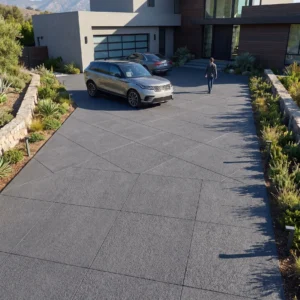
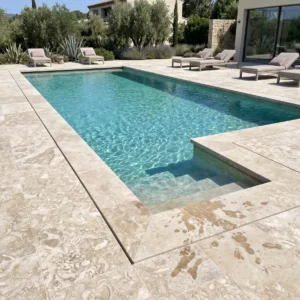


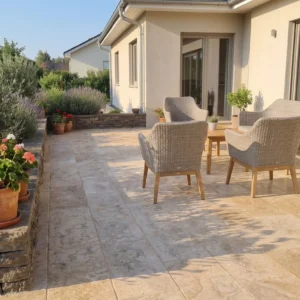

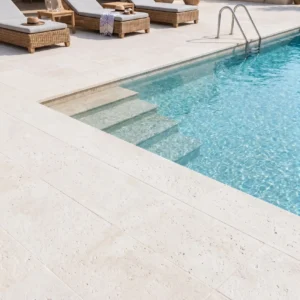


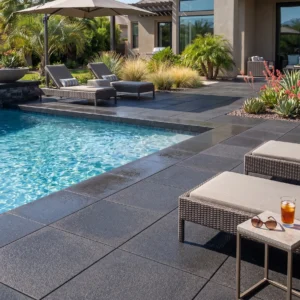
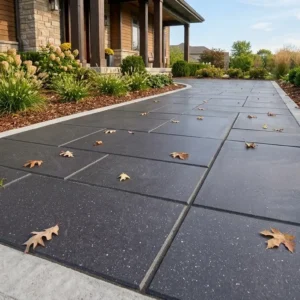


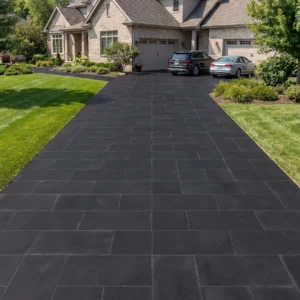
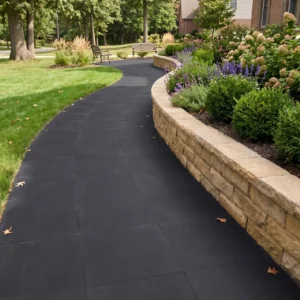











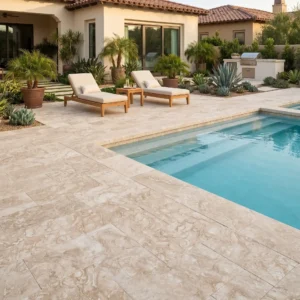

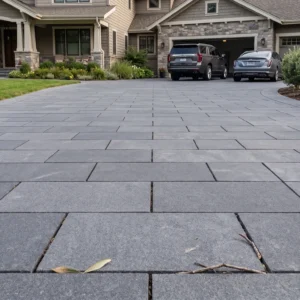
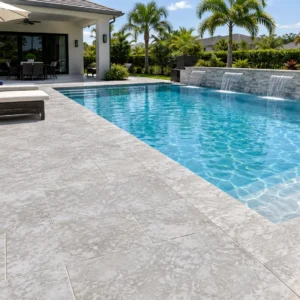



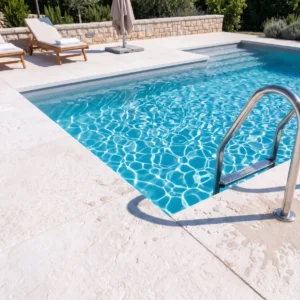
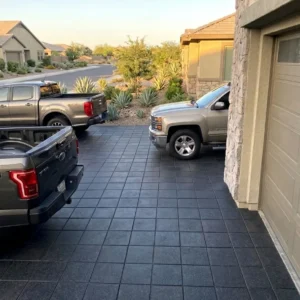
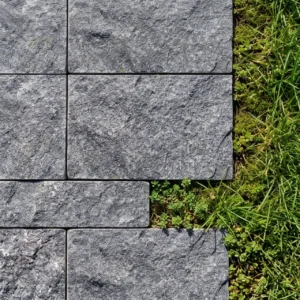


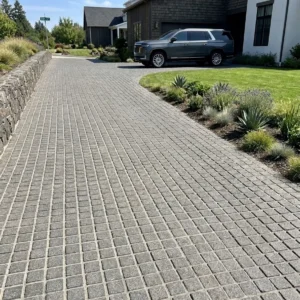
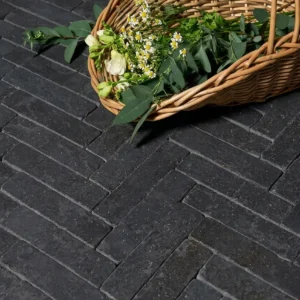
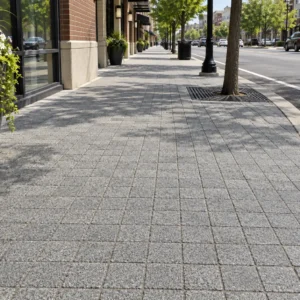
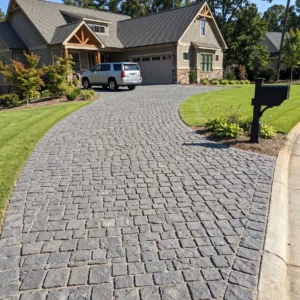
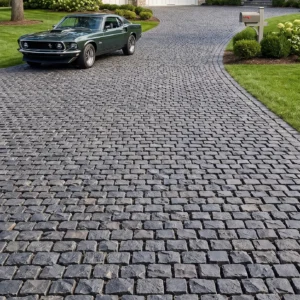


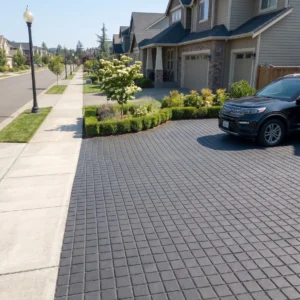
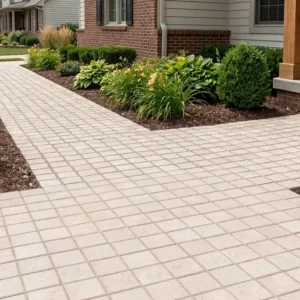
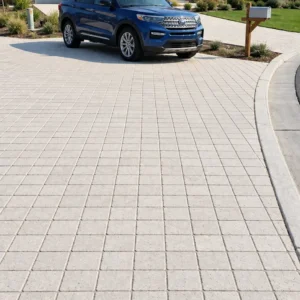
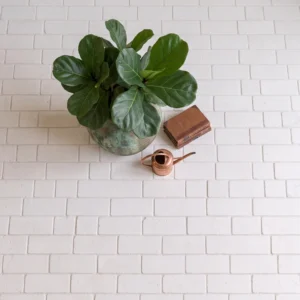
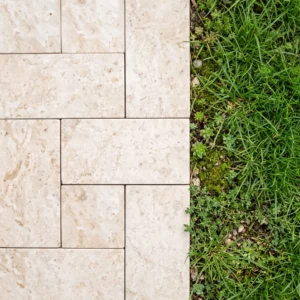
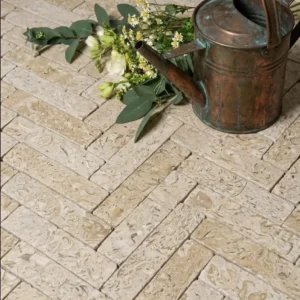
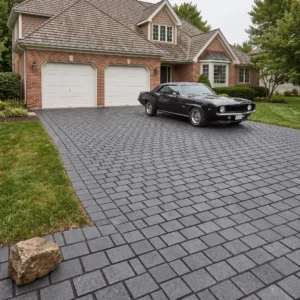

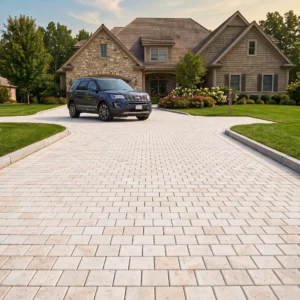





A sett is a small paving unit, roughly cubic or block-shaped, laid by hand one piece at a time. That description sounds humble and it hides the reason setts survive every change of fashion: a small unit can do things a large one cannot. It can follow a fall without stepping. It can turn a radius without a wedge-shaped cut. It can be lifted one piece at a time to reach a service run and put back without a visible repair. And it distributes a turning wheel load across many joints rather than concentrating it on one large slab.
On Aruba those properties are worth a good deal, because the ground is not uniformly flat, driveways meet public roads at angles nobody drew, and villa plots in Noord and Malmok often combine a slope, a curve and a vehicle in the same twenty meters. This page covers where small units belong, how deep they need to be under wheels, how to work respectfully near the island’s older stonework, which patterns suit which problem, and what setts genuinely cost once freight is in the arithmetic.
Small units are what work when ground refuses to be flat
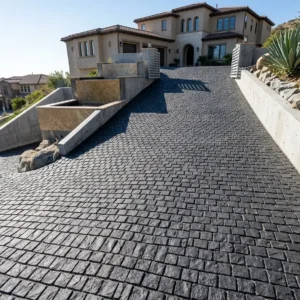
Large-format paving wants a plane. Give it one and it is superb. Take the plane away, introduce a fall in two directions at once, a curve, a manhole and a planting bed, and every one of those features becomes a cut, a wedge or a compromise. Small units simply absorb the geometry. Each one adjusts slightly to its neighbor, and a surface built from many small pieces can be persuaded down a slope or around an obstacle without any single unit having to be modified.
- Falling ground, where a sett surface follows the grade continuously instead of being broken into stepped platforms.
- Curved driveways and turning circles, where coursing bends naturally rather than being cut to a radius.
- Awkward junctions around drains, service covers, planting beds and mature cactus or divi-divi that nobody intends to move.
- Transitions between two paved areas of different levels, where a band of setts absorbs the difference gracefully.
- Any surface that will be opened again later for services, since setts lift and relay without a patch showing.
That last property is undervalued. Utilities get added, irrigation gets rerouted, pool plant gets moved, and a slab terrace repaired after a trench never quite recovers. A sett surface does. The pieces come up, the trench is backfilled and compacted properly, and the same pieces go back without the patched look a repaired slab terrace keeps. On a property that will be worked on repeatedly over decades, that alone can justify the format across driveways and service routes.
Aprons, gateposts and what a turning wheel puts down
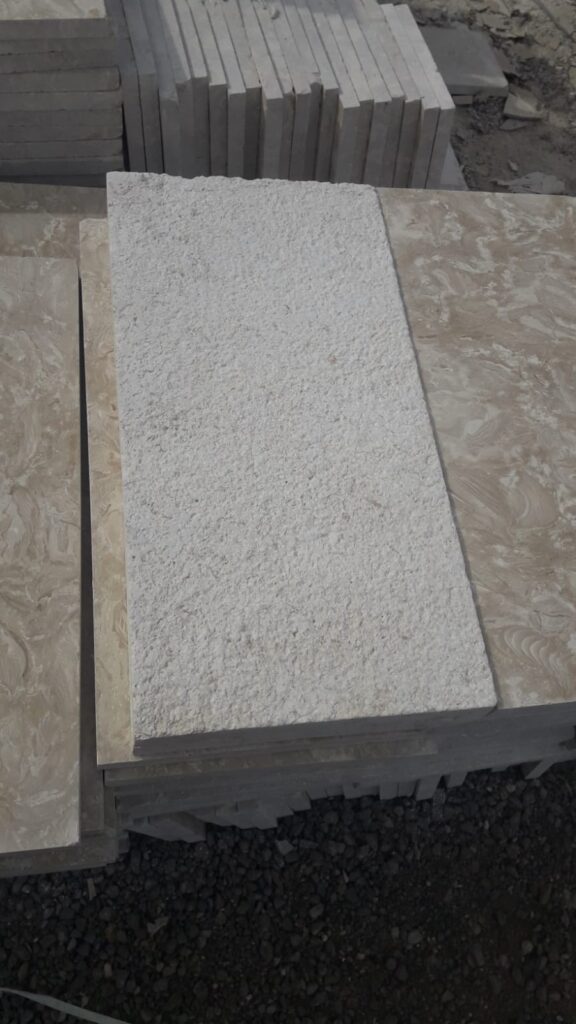
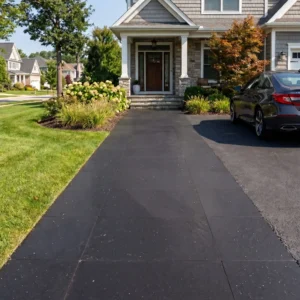
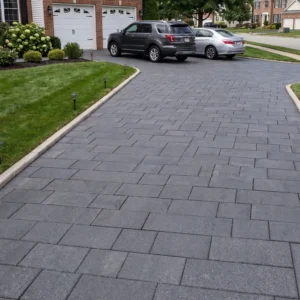
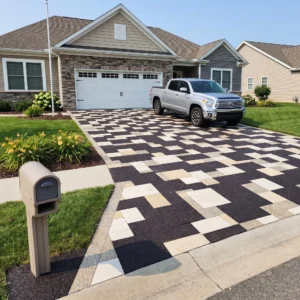
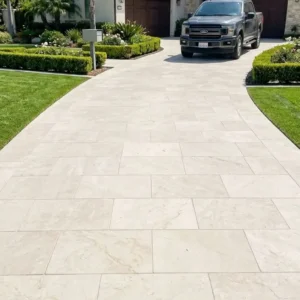
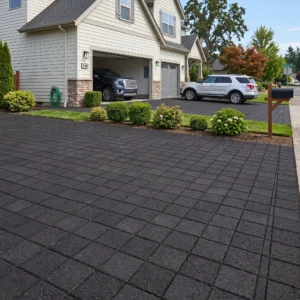
One of the most demanding pieces of paving on a typical Aruban villa is the apron where the driveway meets the public road. Every vehicle that enters or leaves turns on that spot, and turning is different from driving. A wheel under steering lock scrubs sideways across the surface while carrying the vehicle’s weight, and that combination of load and lateral force is what breaks paving that was specified for traffic rather than for turning traffic.
Setts handle it because the load spreads across many units and many joints, and because the depth available in a small unit is generous relative to its face area. A sett at roughly eight to ten centimeters deep, laid on a bound bed over a properly designed base, with the joints filled rigidly and a restrained edge, is a genuinely robust apron detail. The same area in a thin slab would be an ongoing repair schedule.
Gate thresholds deserve the same treatment for the same reason: vehicles stop, wait, start and often turn slightly there, and gate posts create a fixed edge that concentrates wear. A band of setts across the threshold, coursed to run with the gate line, both solves the engineering and reads as a deliberate detail. Ask about the setts we crate for Aruba, which are sorted by depth before packing so an installer is not grading units on site in the sun. That is a small thing on paper and it saves a real number of hours on a driveway, because a crew that has to sort while it lays never gets into a rhythm.
Working near old coral rock walls and caliche fabric
Aruba’s traditional building drew on caliche, a crusty calcium material taken from the hills in the southeast, and on dry-laid coral rock walls set without mortar so precisely that many of them still stand. That craft is described as a lost art, and walls built by it survive around older properties and across the countryside. If you are paving anywhere near that fabric, the work needs a different register from a new resort deck.
The guiding idea is that new paving should not compete with old walling. A wall built dry, from irregular pieces fitted by eye, has a scale and a rhythm of its own. A modern surface laid tight against it in a bold large format argues with it. A small unit sits quietly beside it, picks up something of the same scale, and lets the wall remain the object people look at.
- Keep new mortar off old dry-laid stonework entirely, since the wall was built to move and drain without it.
- Leave the base of an old wall free-draining where you can, rather than sealing right up to it with a rigid surface.
- Choose a sett scale that reads as similar in size to the wall’s coursing, so the two surfaces sit in proportion.
- Keep machinery and stacked material away from old walls during the build, where the real damage usually happens.
- Take advice before touching anything that may be protected, and treat surviving craft work as worth preserving on its own terms.
The same restraint applies around older cunucu houses and any property whose character comes from its age. Nothing here requires imitating a historic paving style, because the island’s inherited stonework is best known in its walls. It simply requires not shouting over it.
Patterns: fans, arcs, and where herringbone earns its keep
Pattern is not decoration in sett work, it is structure. The way units are coursed determines how load transfers between them, how a surface handles a curve and how visible the inevitable small irregularities become. Four arrangements cover the situations that come up most often.
Running bond, with courses laid across the direction of travel and joints staggered, is the straightforward choice for paths and simple driveways. It is quick to lay, easy to keep straight and forgiving on a gentle slope. Herringbone is the interlocking pattern, and it is the one to reach for under vehicles, because the diagonal arrangement resists the lateral push of a turning wheel far better than a pattern with continuous straight joint lines.
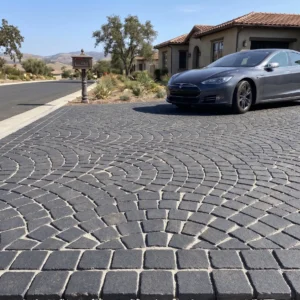
Fan and radial layouts are the classic answer to curves and to open courtyard space. Coursed as overlapping arcs, they absorb a change of direction with no cutting, they suit a turning circle, and they age well because the eye reads the arcs rather than the individual joint. Circular and segmental layouts do the same for a feature area. If you want to see how the arrangements differ before you commit, our guide to patterns that hold on a curve sets them out with the situations each one suits. Whichever is chosen, a defined edge course around the perimeter finishes the field and gives the restraint something to bear against.
- Running bond for paths, simple driveways and gentle falls, where laying speed and a straight line matter most.
- Herringbone under vehicles, aprons and turning areas, where the diagonal interlock resists a steered wheel.
- Fan and radial arcs for curves, turning circles and open courtyards, absorbing a change of direction without cutting.
- Circular and segmental layouts for a feature area, a gate approach or the center of a courtyard.
- A defined edge course around every field, giving the restraint a bearing surface and finishing the pattern cleanly.
Bedding and joints in a place where wind moves everything
Sett paving is only as good as what is under it and what is between the pieces. The build-up decision follows the traffic. For pedestrian areas, a compacted base with a bedding layer and a stabilized joint filler is normal and works well. For vehicle areas, aprons and anything taking turning loads, a bound bed over a designed base with rigid joints is the durable answer, and it is worth the extra cost precisely where the loads concentrate.
Aruba adds a consideration that wetter markets do not have to think about. Fine material moves constantly on this island, carried by a wind that does not take days off, and open or loosely filled joints are exactly the kind of place fine material comes to rest. That is a maintenance question rather than a structural one, but it should be answered on purpose. Decide the jointing method knowing what it will ask for, and write that into the handover notes so the owner is not surprised.
- Design the base for the heaviest thing that will ever stand on the surface, not the average thing.
- Use rigid jointing where vehicles turn, and a stabilized filler where the traffic is on foot.
- Build positive falls so water leaves the surface quickly instead of standing in the joints.
- Provide edge restraint everywhere the field is not held by a building or a curbstone.
- Agree the cleaning routine at handover, since swept joints and rinsed surfaces keep both grip and appearance.
The real cost balance: heavy stone, patient hands
There is a piece of received wisdom about setts that does not survive an import route, and it is worth correcting plainly because it wrecks budgets. In markets where stone is quarried locally, setts are often described as the cheap material with the expensive installation. On an island supplied by sea, the first half of that sentence is simply wrong.
The arithmetic is straightforward. A sett is deep. Covering one square meter with units eight to ten centimeters deep uses far more stone by weight than covering the same square meter with a slab at three centimeters. Freight on an imported route is driven by weight, and duty and turnover tax are calculated on a CIF value that weight has already inflated. So the same terrace, specified in setts rather than slabs, lands at a higher material cost and a higher freight cost before a single unit is laid.
Then there is labor, and labor weighs heavily in a sett budget. Every piece is placed, aligned, leveled and jointed by hand. A skilled team lays setts steadily rather than quickly, and the pattern work that makes a fan or a herringbone worth having takes even longer. That is why sett paving costs more to install than slab paving, and the reason is the hours, not a bargain on the stone.
None of which is an argument against setts. It is an argument for using them where they do work nothing else does: the apron, the turning circle, the falling ground, the curve, the band around a feature, the surface that will be lifted again. Pave the open, flat, simple areas in slabs and put the setts where the geometry or the load actually demands them, and the budget lands where it should.
Buying setts by the crate without over-ordering
Setts are sold by coverage rather than by piece, and the number of units in a given area depends on the size and depth you choose. Send us the areas, the depth the traffic requires and the pattern you intend, and we will convert that into crates, weights and a coverage figure you can check. Weight matters more than usual on this format, both for the freight calculation and for whatever equipment is going to move the crates on site.
Order in one go where the design allows. Natural stone varies between lots, and a driveway completed in two orders separated by months is more likely to show a difference than a driveway completed from one. Where a project is genuinely phased, tell us the phasing at the start so the material can be reserved rather than reordered. Your installer will add a cutting allowance based on the layout, and it is worth asking them for that figure before the order rather than after the first crate is opened.
Then look at a physical piece. A sett is a three-dimensional object with a top, four sides and a real texture, and no photograph conveys how it will read when a few hundred of them are laid in an arc on a bright afternoon. Small hand samples go out before an order, and they settle the question in a way that nothing else does. Get the depth right for the load, the pattern right for the geometry and the quantity right for the phasing, and sett paving stops being the expensive option and becomes the obvious one for the parts of a site that genuinely need it.