






















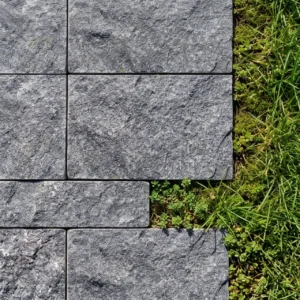
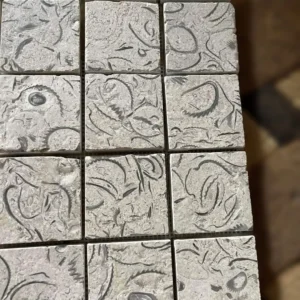
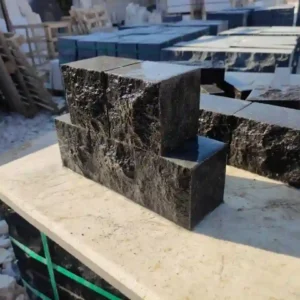
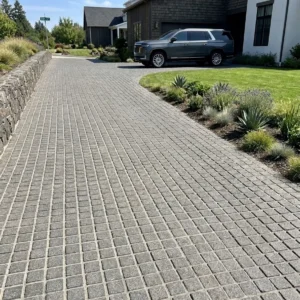
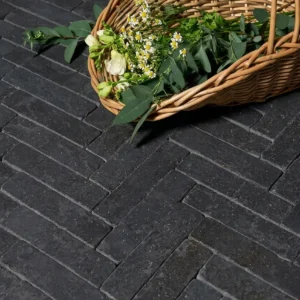
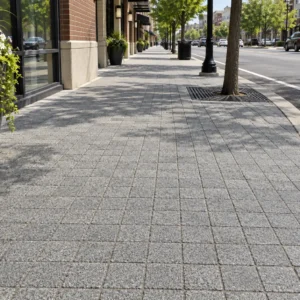
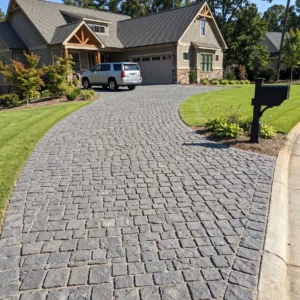
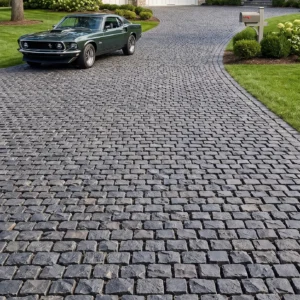
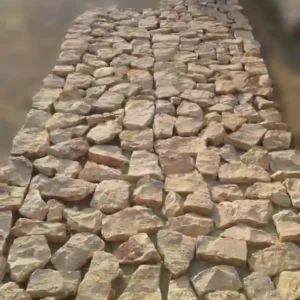
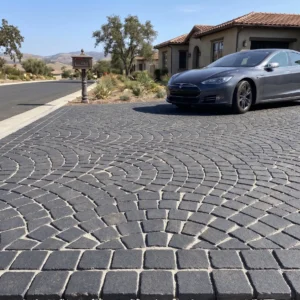
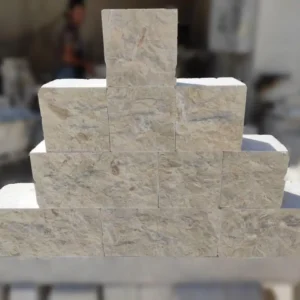



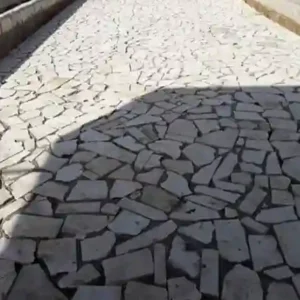
Cobblestones are the oldest answer to a problem that Antigua and Barbuda still poses constantly: how do you pave something that is not flat, not straight and not stable? Large-format paving assumes a plane. It assumes a base that will not move, edges that meet at convenient angles, and a truck that can put a pallet within reach of the setting position. A sett assumes none of those things. It is small enough to follow a fall, to turn a radius, to ride out a base that settles a little, and to be carried by hand up a driveway that no forklift will ever climb.
This page is about small-unit paving specifically: where it outperforms slabs on these islands, how it behaves under turning vehicle loads at a resort or villa gate, what happens when the site falls inside a heritage-controlled area, which patterns actually get laid here, and the cost structure that surprises almost every first-time buyer. That cost structure is the heart of it. Setts are the cheapest stone product per square foot to buy and among the most expensive to lay, and on an island where skilled setters are the scarce resource, that inversion decides whether a design is buildable. Freight and clearance are covered on our country paving page; material technicals sit on the limestone paving page.
Why Small Units Win on Antiguan Ground
Start with the ground itself. Antigua’s terrain runs from the volcanic hills of the south-west, through the mixed plain that carries St John’s toward the south-east, to the limestone country of the north-east. Barbuda is flat coral limestone. Between them you get every base condition from rock at ten inches to made ground on a filled plot, and villa sites in particular are frequently cut into a slope for the view. Very few of the surfaces people want paved on these islands are genuinely planar.
A sett handles that reality in ways a slab cannot. Because each unit is small, the joint pattern absorbs a change in fall without a visible fault line, and a surface can warp gently across its width to follow existing levels rather than forcing a rebuild of everything under it. Because the units are individually bedded, a localized settlement affects two or three stones rather than cracking a large flag in half. And because the joints are numerous, water that arrives in one of the short violent bursts typical of these islands has many routes off the surface instead of one channel that overwhelms.
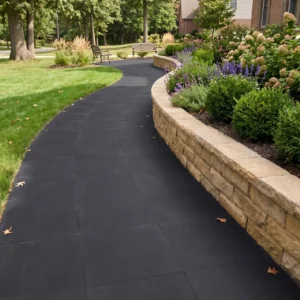
- Curves and radii. Paths around a pool, a turning circle at a gatehouse or a planted island are laid in setts without the wasteful and fragile cut pieces that a slab layout demands.
- Slopes and ramps. Small units give a grippier walking surface on a fall than a large smooth flag, and the joint lines give a foot something to register against.
- Existing trees. Roots move paving, and a sett field can be lifted, adjusted and relaid around a maturing tree without demolition.
- Awkward junctions. Where paving meets a wall that is not square, a step or an old boundary, setts absorb the geometry quietly.
- Phased work. A sett area can be extended later with a joint that does not read as a repair line, which suits properties built in stages.
Driveway Aprons and Turning Loads
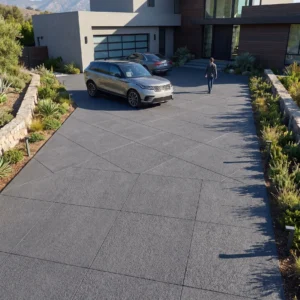
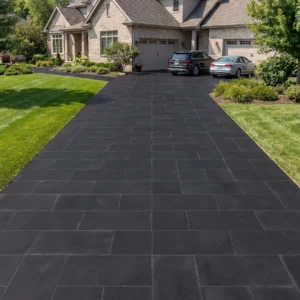
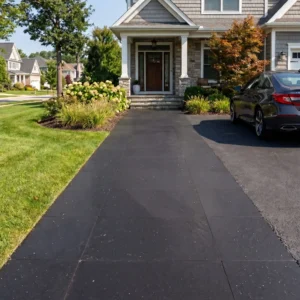
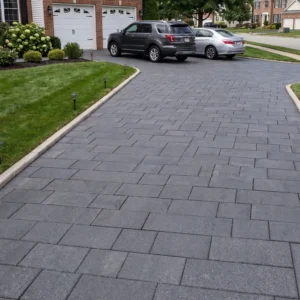
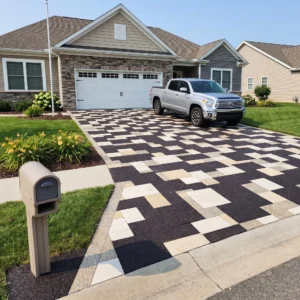
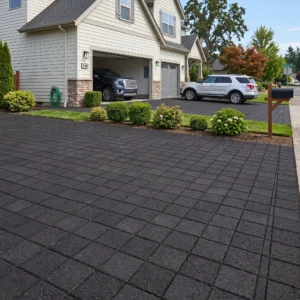
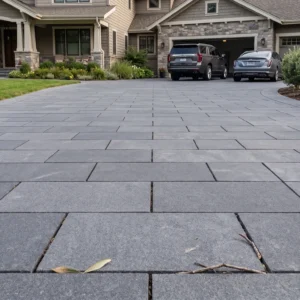
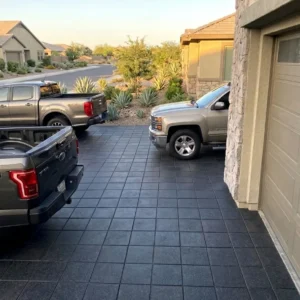
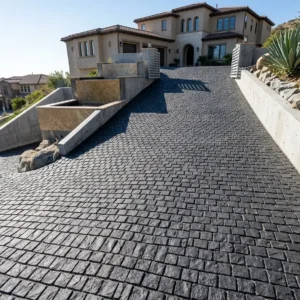
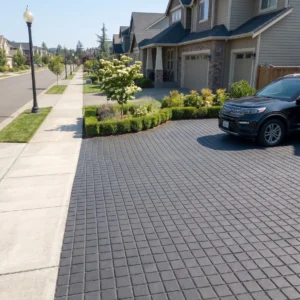
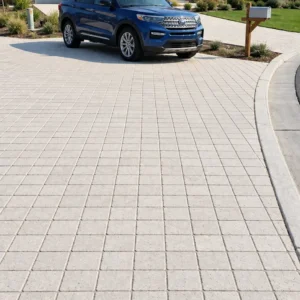
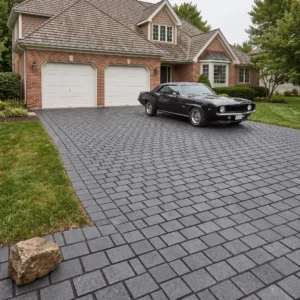
The place where setts earn their keep most obviously is the driveway apron: the zone at a gate, a gatehouse or a service entrance where vehicles slow, turn and stop. That zone takes a punishment nothing else on the property receives. A turning wheel does not simply press down, it scrubs sideways, and that lateral force is what tears a surface apart. Braking concentrates load at the same few feet of ground every day. At a resort or a villa on a delivery route, that includes loaded trucks whose axle weights bear no relation to the family car.
Small units meet that load differently from large ones. Load applied to a sett is transferred through its depth and shared into the surrounding stones through the joints, so the load spreads through the field rather than being carried by a single element in bending. A slab under the same wheel is a plate bridging its bedding, and if the bedding beneath it has voided, the slab is the thing that cracks. A sett field with proper edge restraint and a well-compacted base has enormous resistance to rutting and scrubbing, and it fails gracefully, one stone at a time, in a way that can be repaired in an afternoon.
Details that matter at a vehicle entrance on these islands:
- Increase the sett depth in the apron and the turning area, and keep the shallower section for pedestrian zones where the load never arrives.
- Use a herringbone bond in the trafficked area. Its interlocking geometry resists creep under braking and turning far better than a coursed layout.
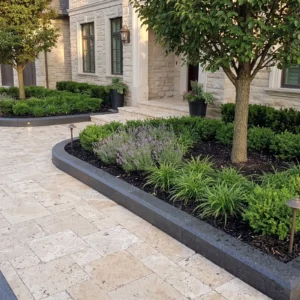
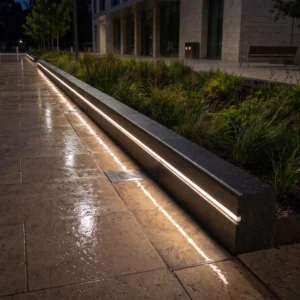
- Restrain every free edge with a bedded curbstone or a concrete haunch, because an unrestrained sett field will migrate under repeated turning within a season.
- Get the falls right at the gate line, where sheet water tends to concentrate and where a puddle sits in front of a threshold that people cross daily.
- Specify non-ferrous fixings on any gate hardware in contact with paving, since rust staining at an entrance is the first thing a visitor sees.
Heritage and Controlled Settings
Paving in parts of Antigua is not simply a design decision, it is a consent matter. Antigua Naval Dockyard and Related Archaeological Sites was inscribed on the UNESCO World Heritage List on 16 July 2016 at the 40th session of the World Heritage Committee in Istanbul, with a core zone of roughly 255 hectares in Saint Paul parish and a buffer zone of around 3,873 hectares. English Harbour and Falmouth Harbour sit inside or adjacent to that area. Work there is heritage-controlled, and controls of that kind typically reach materials, jointing and pattern rather than stopping at the outline of a building.
The site is the only continuously working Georgian-era naval dockyard in the world, begun in 1725, with the Georgian workshops built between 1745 and 1789. That construction was carried out by enslaved African craftsmen, and the site’s own interpretation now places that fact at the center rather than at the margins of the story it tells. Anyone specifying materials in or near that zone is working inside a landscape whose meaning to Antiguans and Barbudans is not decorative, and the appropriate posture is to follow the consent process closely and to keep proposals restrained.
Practical points for work in or near controlled areas:
- Establish early whether your site falls inside the core or buffer zone, and treat that answer as programing information, not as a technicality to resolve later.
- Expect the approving body to have views on unit size, joint width, bond pattern and stone tone, not only on the extent of the works.
- Submit physical samples rather than photographs. Tone in tropical daylight is not something a screen conveys accurately.
- All development runs through the Development Control Authority under the Physical Planning Act 2003, as amended in 2024, with planning permission preceding a building permit, so build the reported six to eight week planning turnaround into the schedule.
- Keep the sett palette calm. Loud contrast banding rarely survives a heritage review and rarely deserves to.
Patterns That Actually Get Laid Here
Pattern in sett work is structural before it is decorative. The bond you choose determines how load is shared, how the field resists creep, how much cutting is generated at the edges, and how many hours the crew will spend on setting out. It also determines how well the paving copes with the curve or the fall that made you choose setts in the first place, which is why picking a pattern from a photograph and then handing it to a setter is the wrong order of operations.
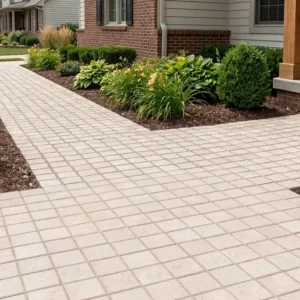
Four patterns cover the overwhelming majority of good work on these islands. Herringbone is the load pattern: its interlock resists lateral movement, which is exactly what a turning vehicle applies, so it belongs in aprons, turning areas and any drive. The fan or segmental arc pattern is the slope-and-curve pattern; it was developed for exactly this, absorbs changes of direction gracefully, and looks entirely at home on a curving approach to a villa. Running bond suits paths and narrow routes where the pattern should lead the eye along the direction of travel. Coursed or stack layouts belong in formal courtyards on a genuinely flat base, where their rigidity is an asset rather than a liability.
Mixing patterns is normal and effective: a herringbone apron, a fan-laid turning circle, a running bond path leading to the door, with a coursed border tying the whole thing together and giving the crew a clean line to work from. Borders also solve the cutting problem, because a well-placed border absorbs the awkward geometry at the perimeter and keeps small slivers out of the field. If you are weighing options before setting out, our guide to paving pattern layouts compared shows how each bond behaves under load, how much waste it generates and where it suits a slope.
The Labor-Versus-Material Cost Inversion
Here is the single most important commercial fact about cobblestones, and the one that catches out buyers who have only ever priced slabs. Setts are cheap to buy and expensive to lay. A square foot of sett material typically costs less than a square foot of large-format paving, sometimes considerably less, because the product is simpler to produce and the natural yield from a block is higher. But a square foot of laid sett contains many times more individual placements, each one bedded, aligned, leveled and jointed by hand. The labor content is where the money goes.
On an island, that inversion is amplified. Skilled setting is a craft skill in limited supply on Antigua and Barbuda, and it competes with every other demand on the construction workforce, including ongoing rebuild work. Material can be ordered from anywhere; a crew that lays a good herringbone cannot. So the honest sequencing on a sett project is: establish who is laying it and how many crew-days are realistically available, then design the area and the pattern to fit that, then order the stone. Doing it in the reverse order produces a beautiful drawing and a stalled site.
- Use complex patterns as accents and simple patterns for large fields. A fan-laid turning circle framed by a coursed border delivers most of the visual effect at a fraction of the setting hours of a fan-laid everything.
- Keep unit sizes consistent within a field. Every additional size slows a setter down more than the drawing suggests it will.
- Give the crew a generous, well-set border to work from. Setting out is where hours evaporate, and a good perimeter reference recovers them.
- Sequence setts into the program where they will not be walked over by other trades, because relaying disturbed work is entirely wasted time.
- Budget the labor line first and let it inform the area, rather than fixing the area and hoping the labor absorbs it.
Handling, Breakage and the Barbuda Leg
Small units are logistically forgiving in ways that matter enormously here. A sett can be carried by one person. It can be moved up a driveway in a wheelbarrow, passed over a wall, loaded onto a small boat by hand, and stacked in a corner of a site that no machine can reach. Large-format stone can do none of those things, and every one of them turns up on real projects on these islands.
That matters most on any order continuing to Barbuda. There is no deep-water cargo port there; goods clear in St John’s and then travel on inter-island cargo boats or ferries to River Wharf on the south-west coast, followed by a road move inland to Codrington. There is no container crane at that wharf. A product that can be handled by hand at both ends of that journey is not merely convenient, it is the difference between a delivery that happens and one that becomes a project of its own. Setts also tolerate double handling in a way thin large pieces do not, and a chipped sett is usually still a usable sett, whereas a chipped slab is scrap.
The same logic governs repair after a storm season. Wind-driven debris, scour and localized undermining damage paving in patches rather than uniformly, and a sett field is repaired by lifting the affected stones, correcting the bedding and relaying, with no formwork, no curing time and no visible patch if the replacements come from the original batch. That is why we recommend ordering spare stock deliberately and storing it dry and labeled on site. Our hand-cut cobble setts range is supplied in project quantities with matched reserve stock so a repair in year six still matches the field laid in year one.
Bedding, Joints and Drainage for Sett Work
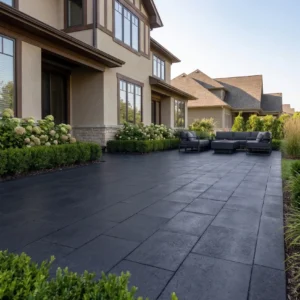
Sett construction on these islands divides cleanly by exposure and by use. In a vehicle area, on an exposed terrace or anywhere near a coast that takes real weather, bed and bond: a bound construction with a mortar or suitable bedding layer and a properly restrained perimeter. In a sheltered garden path or a courtyard where the load is footfall and the setting is informal, an unbound or semi-bound construction with a compacted base is perfectly appropriate, drains freely, and is easier to lift and relay.
Drainage design should be written for how rain actually arrives here. There are no permanent streams or rivers on either island, and rainfall comes in short high-intensity bursts rather than in steady soaking. Falls, channels and outlets have to handle a burst, and the many joints in a sett field are an advantage in that they present a large permeable area rather than a single concentrated route. Where a hard surface contributes to a cistern or a catchment, and on these islands many do, keep resin binders, chemical jointing products and surface sealers out of the construction entirely and use a compatible mortar or a clean washed sand joint. Stored water is drinking water in a country classed at extremely high water stress, and no jointing convenience is worth risking it.
- Restrain every free edge with a bedded curbstone or haunched concrete; unrestrained setts migrate under traffic, and no joint compound will stop that.
- Use non-ferrous or stainless fixings for any metalwork, gate hardware or channel gratings in contact with the paving, because salt air will corrode ferrous items and stain pale stone.
- Compact the base properly in layers, using locally produced aggregate, which is exactly what the domestic quarries are good at supplying.
- Keep joint widths consistent so the field can be swept clean of beach sand rather than picked out by hand.
- Set falls away from thresholds and toward a designed outlet, and check them with water rather than with a level alone.
Get the base, the restraint and the crew right, and a sett field laid in Antigua and Barbuda will outlive everything else on the property.