







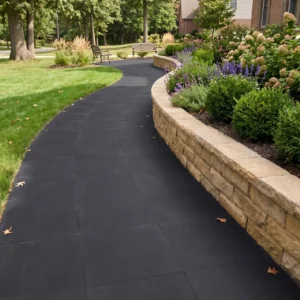
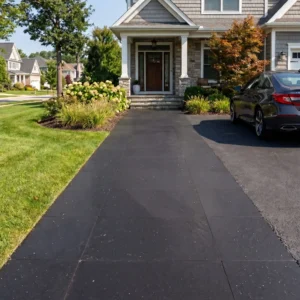
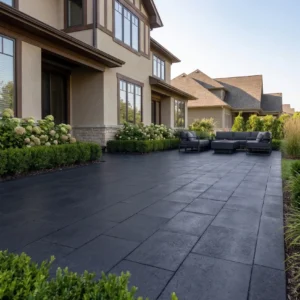















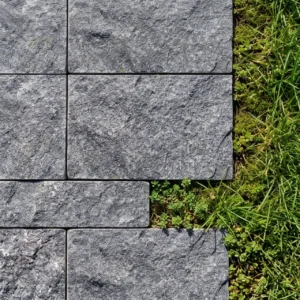
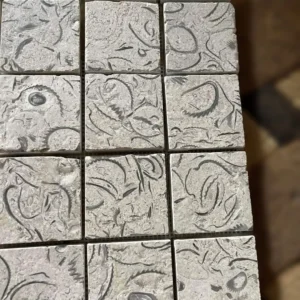
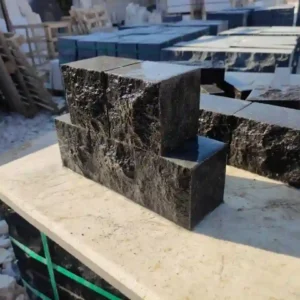
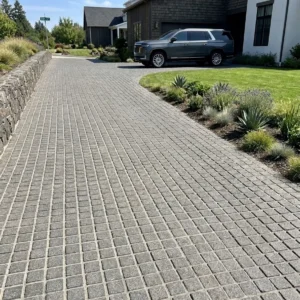

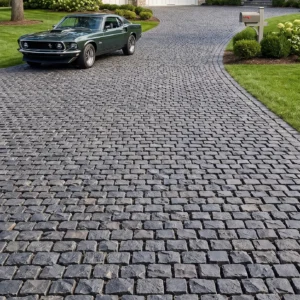
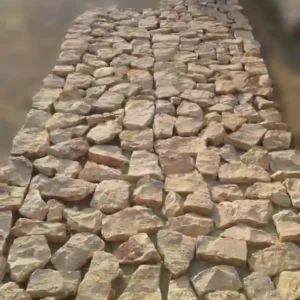
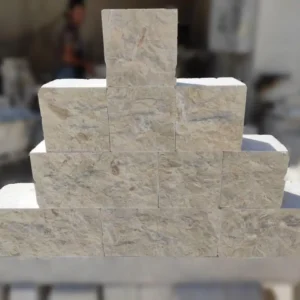


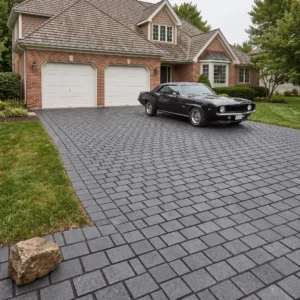



Cobblestones, or setts to give them their proper trade name, are small rectangular or cubic units of stone, usually somewhere between a hand’s width and a fist in size, laid in courses or arcs on a prepared bed. They are among the oldest paving units still in everyday use and they persist because they solve problems that large slabs cannot. Where a surface curves, climbs, twists around an obstacle or has to carry a turning wheel, dividing the paving into many small pieces is not nostalgia. It is engineering, and it has been for centuries.
On Anguilla setts have a particular set of jobs: the apron between a public road and a private drive, the turning circle at a villa entrance, borders and edge courses that frame larger paving, the tie-in around cistern and service covers, and paving in village settings in and around The Valley where large machine-cut slabs would look out of place. This page covers where small units earn their keep on this island, how they should be laid in this climate, and the cost inversion that catches out anyone who budgets them the way they budget slabs.
Where Small Units Beat Large Slabs
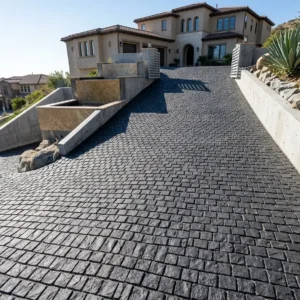
The mechanical advantage of a sett is that it can follow a surface. A slab is a plane, whereas a sett field is a mosaic that can be laid to a curve, to a crown, to a fall in two directions at once, and around an obstacle without a single awkward cut. Anguilla is a flat island but villa sites are not flat: drives rise from the road to a building platform, entrances are crowned to shed water, pool terraces step down toward the sea, and cliff-top plots above Little Bay have real level changes inside a short distance.
Small units also handle the messy reality of a working property. Cisterns, septic access, irrigation valves, generator pads and utility runs all end up beneath or beside paving, and a sett field can be opened and closed again without leaving a visible scar, because the units are lifted and relaid rather than replaced. On an island where a replacement slab has to come in on a sailing, that repairability is worth designing for from the beginning rather than discovering later.
- Curves, radii and turning circles that would otherwise need cut slabs and visible waste.
- Surfaces with falls in two directions, crowned drives and transitions between levels.
- Areas over service runs, cistern lids and valve boxes that will certainly be opened again one day.
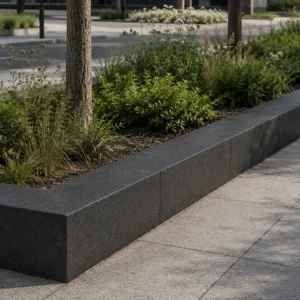
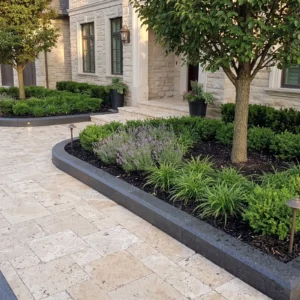
- Borders, edge courses and thresholds that frame and lock larger-format paving.
- Tight junctions where paving meets walls, steps, gate posts and planting at awkward angles.
Driveway Aprons, Water Trucks and Turning Loads
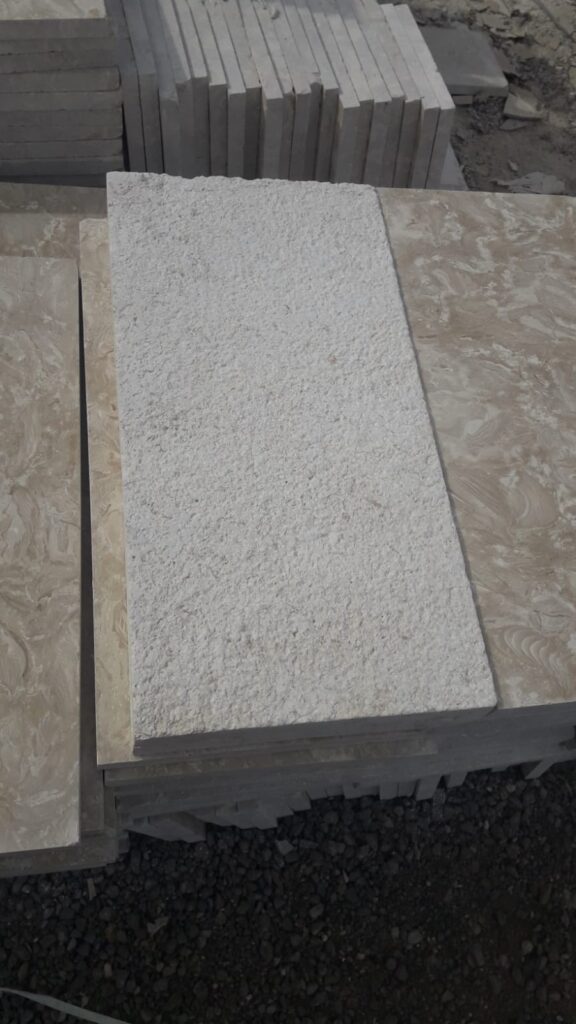
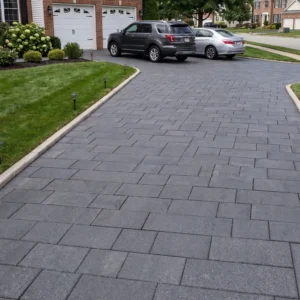
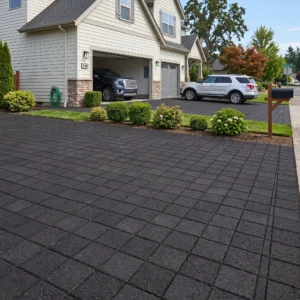
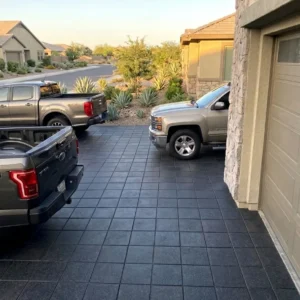
The load case that governs a residential drive here is not the family car. It is the water truck, the propane delivery, the concrete truck during construction, and later the service vehicles that keep a villa running. Anguilla has no rivers and depends on rainwater catchment, wells and desalination, so tankered water is a routine part of property life on many sites. Those vehicles arrive loaded, turn on a short apron, and put concentrated point loads through steered wheels at precisely the place where the private drive meets the public road.
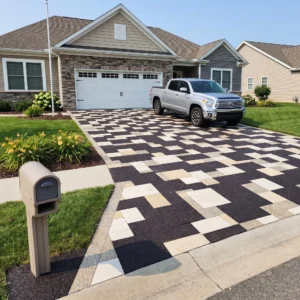
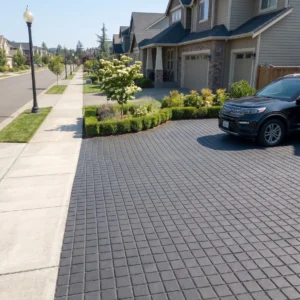
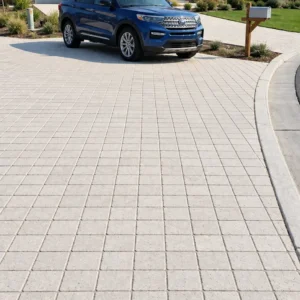
That is a sett job. A small unit set on a bound base and jointed with mortar or a suitable resin distributes turning shear far better than a large slab bedded on sand, because there is more joint, more interlock and no long lever arm across a single piece. The construction to specify at an apron is a concrete base, a bedding mortar matched to the unit depth, deep units rather than thin ones, and restraint at both edges. Get the apron right and the rest of the drive can be a lighter construction; get it wrong and the first loaded truck of the season will tell you in a single afternoon.
- Set aprons and turning areas on a bound base rather than on a flexible sand bed.
- Use deeper units in vehicular areas and keep joints narrow and completely filled.
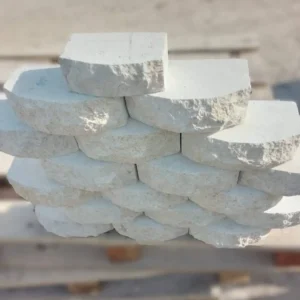
- Restrain both edges of the apron with a curbstone or a mortared edge course, never a free edge.
- Detail the tie-in to the public road so there is no step for a loaded axle to hammer.
- Keep pedestrian areas separate in the specification so you are not paying for vehicular construction across a whole drive.
Patterns and What They Actually Do
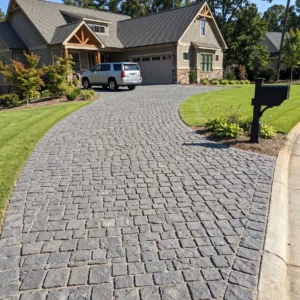
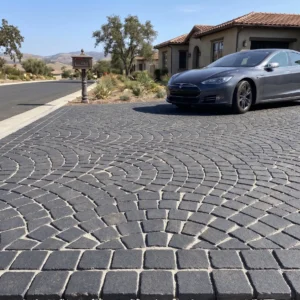
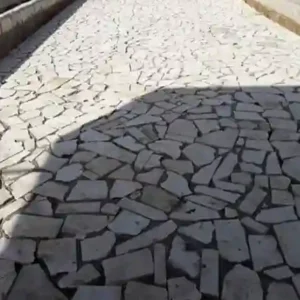
Pattern is usually presented as a style choice when it is mostly a structural one. A running bond with joints aligned across the direction of travel offers less resistance to creep than a pattern with interlock in two directions, which is why herringbone has survived centuries of cart, hoof and tire traffic without going out of fashion. Fan and arc patterns, the segmental arcs seen in old European paving, take the same principle and add the ability to absorb a curve without cutting, which is exactly what an Anguillian entrance circle needs.
Field choices then follow duty. Herringbone for driveways and anywhere braking and turning happen; fan or arc patterns for curved aprons and circular features; running bond and stack courses for pedestrian paths where the pattern should stay quiet; soldier and sailor courses as borders that lock the edge of a larger paving field. Setting out matters as much as pattern choice: a pattern that is not centered on the gate, the door or the axis of the drive announces itself for the life of the property. Our guide to the layout pattern library shows how each of these behaves in practice.
- Herringbone gives maximum interlock and is the default for vehicular areas and braking zones.
- Fan and arc patterns absorb curves and crowns without cutting and forgive slightly irregular units.
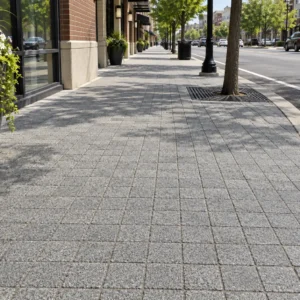
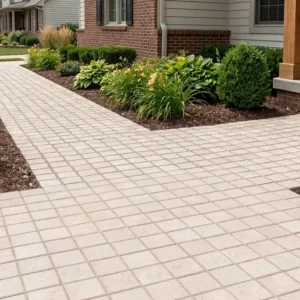
- Running bond and stack courses read calm and directional, which suits pedestrian paths and terraces.
- Soldier and sailor border courses lock the perimeter and give a clean line against planting or a wall.
- Set out from the architectural axis rather than from whichever corner the crew happens to start in.
Setts in Village and Historic Settings
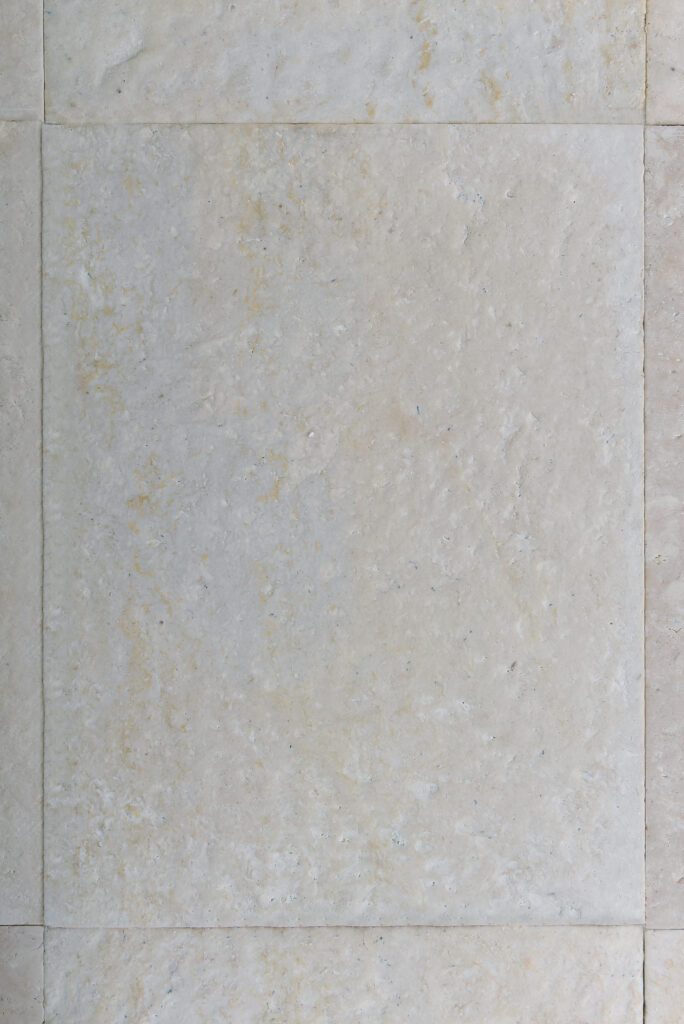
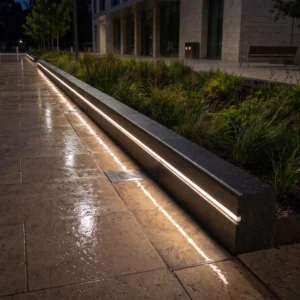
Work in and around The Valley sits in a different register from a new build villa on a headland. The island’s older buildings and boundary walls were built from what the ground provided, and the historic dressed masonry, with Wallblake House the example everyone knows, carries real cultural weight. Paving laid next to that fabric should be quiet. Small units help, because their scale matches the scale of old walling and openings, and because a sett field reads as a surface rather than as a set of manufactured objects lined up in rows.
Restraint is the whole technique. Keep the unit size modest, keep the pattern simple, avoid strong contrast against older stonework, and let the joint do the work of softening the field. Avoid the temptation to imitate historic paving that was never there in the first place; a plain, well-laid sett surface in a sympathetic tone ages into a place far better than decorative pastiche ever does. Where a scheme involves public space or a sensitive setting, expect the design to be looked at carefully as it moves through the development consent process, and allow time for that in the program.
- Match the scale of the unit to the scale of surrounding walling and openings.
- Keep the palette narrow, with one stone, one or two sizes and one pattern.
- Avoid decorative motifs and strong contrast bands close to historic fabric.
- Choose a jointing tone close to the stone so the surface reads as a single plane.
- Allow time for consents where the setting is sensitive rather than assuming a quick approval.
The Cost Inversion: Inexpensive Stone, Expensive Hands
Setts are among the least expensive natural stone products by area at the quarry and among the most expensive paving to install. That inversion is the single most important thing to understand before specifying them anywhere. A crew that lays a substantial area of large-format paving in a day will cover a fraction of that area in setts, because every unit is placed, leveled and adjusted by hand. On an island of around sixteen thousand people, where setting crews are booked well ahead and crew time has to be planned into the program, labor is the dominant line in the budget rather than the stone itself.
Handled intelligently that changes the design rather than killing it. Use setts where their properties are genuinely needed, at the apron, the turning circle, on curves, borders, thresholds and areas over services, and use larger units on the open field where a slab is simply a faster way to cover ground. The result costs less and looks more considered than a site paved uniformly in either. Small units also travel unusually well: they stack densely, individual breakage is trivial rather than a whole slab lost, and a crate of spares takes very little room. If you are pricing a first shipment, our overview of stone deliveries into Anguilla explains how consignments actually reach the island.
- Budget setts by installed area rather than by material price, because the labor line dominates.
- Concentrate them where curves, loads or repairability justify the slower laying rate.
- Use larger formats across open field areas and let setts do the difficult work at the edges.
- Sawn-bottom calibrated setts lay significantly faster than fully split ones, and the premium usually pays for itself.
- Order spares with the main load, since they stack densely and cost very little to ship.
Setting, Jointing and Curing in Heat
Bound construction is the norm for anything vehicular on this island: a concrete base, a bedding mortar suited to the unit depth, and a jointing mortar or resin compacted properly into a joint formed to a consistent width. Unbound, sand-jointed construction is perfectly good for garden paths and courtyards where loads are light, but it needs a genuinely restrained edge and a jointing sand that stays where it is put when a squall arrives. Anguillian rain comes in intense, erratic bursts, and a half-filled joint empties itself in the first one of the season.
Heat is the other variable that catches out visiting crews. Mortar and jointing products cure faster here, and a gang mixing for temperate conditions will lose workability before the joint is finished. Work early, shade the mixing area, keep batches small, and protect fresh joints from direct sun and from a sudden shower for as long as the manufacturer requires. Salt in the wind is an argument for full, well-compacted joints throughout, because an open joint is a route for salt-laden water into the bedding, and a bedding that stays damp and salty is a slow problem rather than an immediate one.
- Use bound construction with mortared joints for aprons, drives and turning areas.
- Form joints to a consistent width and fill them completely, since partial joints fail first.
- Work in the cooler hours and protect fresh jointing from sun and from sudden rain.
- Give unbound areas a properly restrained edge and a jointing material that resists washout.
- Check falls before jointing, because correcting a fall afterwards means lifting the units again.
Ordering Setts by Area, Not by the Piece
Setts are quoted and supplied by area coverage rather than by unit count, which trips up first-time buyers who try to count pieces off a drawing. What matters at order stage is the finished square footage of each area, the unit size and depth appropriate to its duty, and whether the units are split on all faces, sawn on six sides, or sawn on the bottom and split on the sides. That choice is a laying-speed decision as much as an appearance one, and on a labor-dominated island it deserves considerably more attention than it usually receives.
Order everything for a phase in one consignment. Setts, edge courses, any curbstone profiles, steps and the field paving they border should arrive together so the crew can set the whole area out before laying rather than working around a gap. Add a spares allowance for each format and keep it crated and labeled, because after a storm season the ability to relay a damaged apron from stock is worth many times the small cost of the surplus. Order a sample set early, lay a small panel, and look at it wet before the main order is released.
Tell us the areas, the duty of each one and the laying crew you have available, and we will size the order to the work rather than to the pallet. Setts reward planning more than any other paving product, and on this island planning is most of the job.