












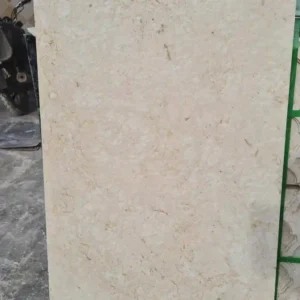
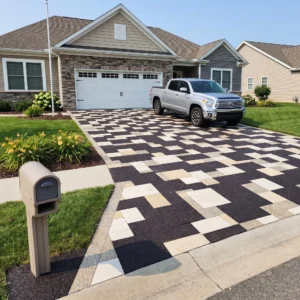
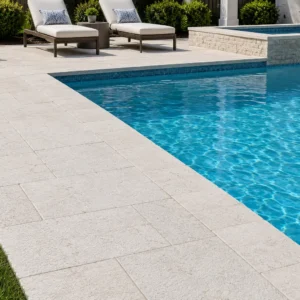
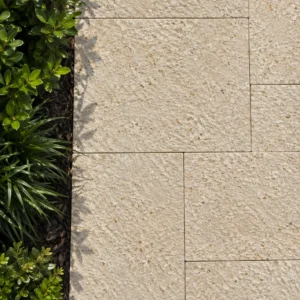




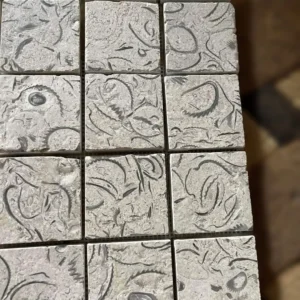
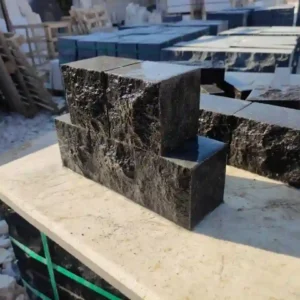
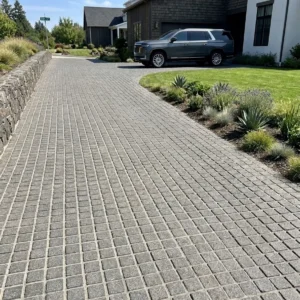
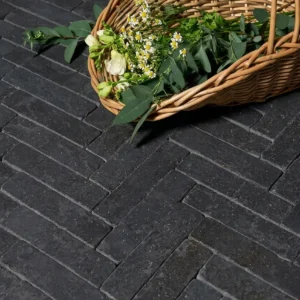

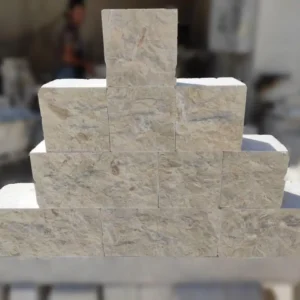
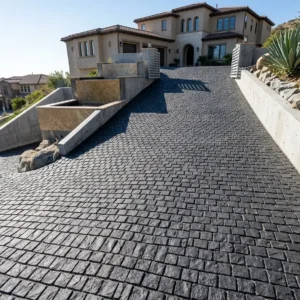
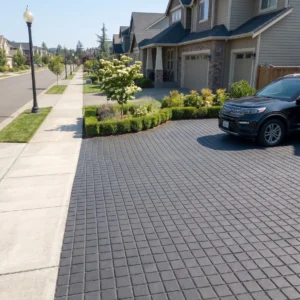
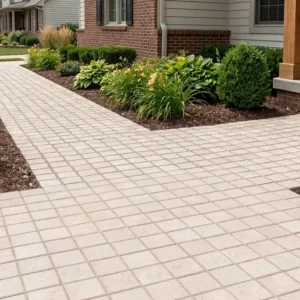
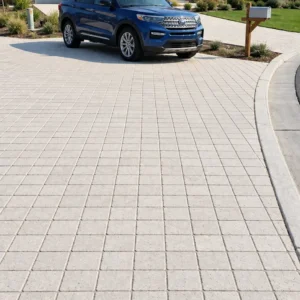
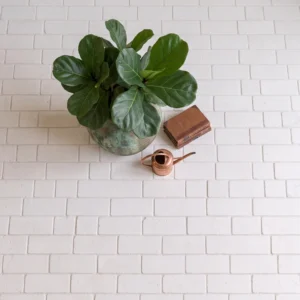
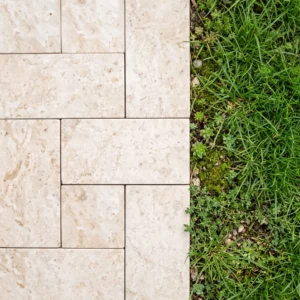
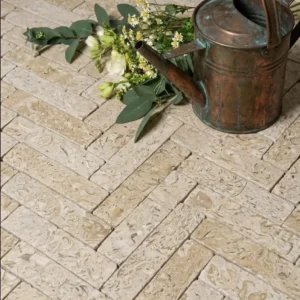



Small Travertine Tiles change the grout math long before they change the look. A 4×4 travertine tile lays roughly three times the linear joint per square foot that a 12×12 does; drop to a 2-inch face and you are at six times; a 1×1 mosaic runs closer to twelve. That single ratio drives labor hours, fill and grout consumption, cleaning effort, and how honestly the finished surface reports the substrate underneath it. Understand it before you price the job and every other decision — finish, thickness, joint width, sealer schedule — gets easier to defend.
Why Small-Format Travertine Behaves Differently
Large tile bridges. Small tile conforms. A 12×24 plank spans a low spot in the setting bed and reports it as a lipped edge you can feel with a bare foot; a mesh-backed sheet of travertine small tiles dives straight into that same hollow and gives you a shallow dish you will not notice until water sits in it. You should decide which failure mode you would rather manage before you commit to a size.
Calibration matters more as pieces shrink. A sixteenth of an inch of thickness variation across a 12×12 gets absorbed by the trowel and the installer’s hands. That same variation distributed across the thirty-six pieces sitting in one square foot of 2-inch mosaic stacks into a visible ripple under raking light, which is why calibrated backs are worth paying for in the smaller formats and often unnecessary in the larger ones.
The material itself explains part of this. Travertine forms where calcium-carbonate-rich water degasses at springs and vents, trapping voids as the stone builds in layers, and that banded, vuggy structure is documented in federal carbonate rock formation data. Cut across those bands at a 4-inch face and you expose more vein terminations per square foot than a large tile ever will — which is exactly why factory fill quality becomes a bigger deal in small formats.
- You get more edges per square foot, so edge chipping during handling shows up as a higher usable-yield loss than large tile
- Your cut count usually drops, because small modules fit awkward rooms with fewer field cuts and less blade time
- Setting time per square foot rises, typically 30 to 60 percent over 12×12 for the same crew on the same substrate
- Cleaning effort scales with joint length, not with area, so maintenance planning has to follow the format not the room size
- Slope-following ability improves dramatically, which is why mosaics dominate shower pans and drainage transitions
Before you lock a format, you can request sample tiles from Citadel Stone and lay four or five pieces dry on the actual substrate under the actual lighting. Two minutes of that tells you more about fill color, vein density, and shade spread than any photograph will.
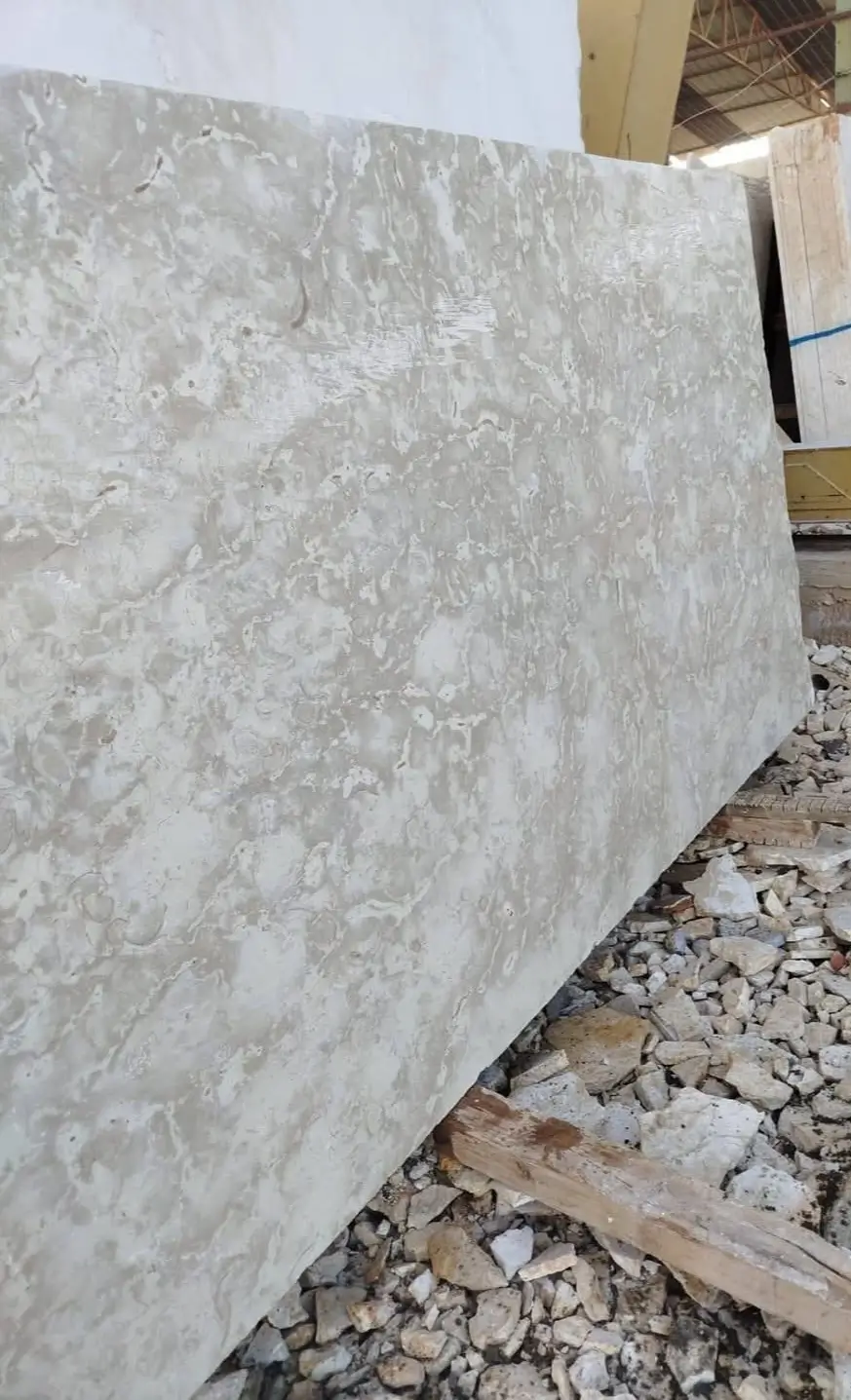
Reading the Size Chart From Mosaic to Eight-Inch Fields
The small-format range covers a wider spread of behavior than most buyers expect, and the jump from a 2-inch face to a 6-inch face changes the job more than the jump from 12×12 to 18×18. Here is how the standard modules actually get used in the field.
Inch Formats From 1×1 to 8×8
- 1×1 travertine tile, normally mesh-mounted in 12×12 sheets, handles compound slopes, curved risers, and shower pans where the surface has to bend in two directions at once
- 2×2 travertine tile sits at the practical sweet spot for wet-area floors — small enough to follow a quarter-inch-per-foot fall, large enough to keep joint length manageable
- A 4 inch travertine tile, the familiar travertine 4×4, is the workhorse for backsplashes, wainscot, stair risers, and accent bands inside larger fields
- A 6 inch travertine tile gives you a genuine field format in a small module, and travertine 6×6 reads as a deliberate design choice rather than a filler size
- 8×8 travertine tile bridges the gap to standard field tile, offering a tighter joint grid without the unit count of the smaller modules
Most residential specifications never need more than a handful of these. Stock 4 travertine tile sizes — 2×2, 4×4, 6×6 and 8×8 — and you will cover the overwhelming majority of interior and covered-exterior work. A 6×6 travertine tile pattern also blends cleanly with a larger field of the same lot, which is why designers often run a 4×4 travertine tile border against a 12×12 or 16×16 field pulled from the same block run.
Metric Formats and the 10×10 Ambiguity
Metric callouts cause more ordering errors in this size range than anything else. Travertine tiles 10cm x 10cm and travertine tiles 100×100 mm describe the same piece — a nominal 4-inch square — but a spec that simply says travertine 10×10 can mean either the metric module or a 10-inch square, and the two are not interchangeable on a drawing with fixed dimensions.
Your safest habit is to write both the unit and the nominal value on every purchase order. A European-led design package that lists travertine tiles 10×10 almost always means centimeters, while a domestic contractor reading the same line often assumes inches. That single misread has cost projects a full container cycle, and it is entirely avoidable with one extra word on the schedule.
Nominal versus actual matters here too. Small modules are usually cut slightly under nominal so the joint absorbs the difference, and stated dimensional tolerances should come from the supplier’s own inspection data rather than from a rounded catalog figure. Test report on request is the honest answer for physical properties; dimensional tolerance you can verify yourself with a caliper on arrival.
Finish Drives Small-Format Behavior More Than Size Does
Finish selection carries disproportionate weight when the pieces are small, because the edge treatment consumes a much larger share of the visible surface. A 4×4 tumbled travertine tile has softened, slightly rolled edges that eat into roughly a quarter of the face at close viewing distance — on a 16×16 that same treatment is a decorative margin, on a 4-inch module it defines the entire character of the floor.
Tumbled product also arrives with open voids that the factory may or may not have filled. Unfilled 4 x 4 tumbled travertine reads rustic and drinks sealer at a noticeably higher rate; filled and then tumbled gives you a softer edge with a tighter face. A 4×4 honed travertine tile, by contrast, holds a crisp arris and a flat matte plane, which suits interior floors and vertical work where you want the veining to carry the visual load. Published variety data from the Natural Stone Institute on travertine characteristics is a sensible starting point when you are comparing finish options across suppliers.
- Tumbled edges make lippage far more forgiving, which is why 6×6 tumbled travertine tile suits owner-installed and older, less-flat substrates
- Honed faces show shade variation more clearly, so you should dry-lay two or three cartons before setting a honed field
- Brushed finishes sit between the two and hold texture without the rounded profile of a tumble
- Slipperiness in wet areas is a finish question first — specify testing to ANSI A326.3 and ask for the wet report on the exact finish you intend to buy
- Fill color varies by lot, and on small modules the fill occupies a larger visual share than most people anticipate
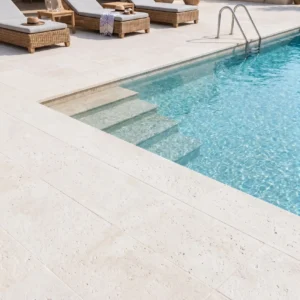
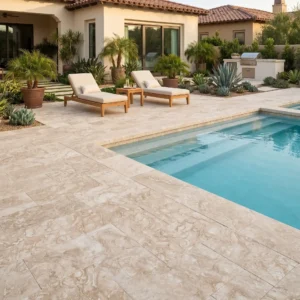
For covered patios and pool surrounds, tumbled modules remain the default because their texture and edge profile tolerate thermal movement and foot traffic well. Citadel Stone stocks small travertine tiles in tumbled and honed finishes across the common modules, and our technical team can walk you through which finish suits your substrate and exposure before you commit a purchase order.
Substrate and Setting Bed: Where Small Tiles Punish Bad Prep
Flatness tolerance tightens as module size shrinks, and this is the single most common source of callbacks on work with small travertine tiles. Industry practice targets a flatness of roughly 1/4 inch in 10 feet for larger tile, but small modules follow every undulation in that tolerance rather than bridging it — so you should be self-leveling or floating the substrate to a tighter standard before a single sheet goes down.
Mortar coverage is the second issue. Travertine floor tiles in small formats require full bedding, not spot bonding, and the voids in the stone body mean an under-filled mortar bed leaves unsupported pockets that crack under point loads from furniture legs and dropped tools. Back-buttering is not optional on unfilled tumbled product; it is the difference between a floor that holds and one that hollows out in the third winter.
Mortar color deserves a decision, not a default. White thinset under a 6 inch travertine tile keeps the cream tones clean; gray mortar telegraphs through the more translucent pieces and darkens the field in a way you cannot correct after cure. The same applies to any 4 inch travertine tile in a light ivory range.
- Use a trowel notch matched to the module, not to habit — oversized notches on small tile push mortar into joints and contaminate them
- Beat in mesh-mounted sheets with a block and rubber mallet to equalize embedment across the whole sheet
- Check sheet alignment every third row; mesh backing stretches slightly in transit and joints drift if you are not watching
- Movement joints follow standard practice regardless of tile size — perimeter joints at every restraint and field joints on the spacings your installation guide sets
- Confirm substrate moisture before setting; small-format work traps more mortar moisture per square foot and takes longer to reach full cure
Joint Width, Fill, and the Grout Math Nobody Runs
Grout volume on small-format work routinely surprises estimators by a factor of two or more. Run the numbers before you buy: joint length per square foot is approximately two divided by the tile face in feet, so a 2-inch module produces roughly twelve linear feet of joint in every square foot of floor. Multiply that by joint width and depth and the grout order stops looking like an afterthought.
Joint width itself should follow the edge profile. Tumbled modules with rolled edges want a wider joint, commonly 1/8 to 3/16 inch, because a tight joint against a rounded arris leaves a visible V-groove that collects soil. Honed modules with square edges tolerate narrower joints, and a 2×2 travertine tile in a honed finish can run tight without looking crowded. When you are working through joint sizing and layout options, the detailing behind small travertine tile patterns covers the grout selection and color decisions that carry over directly to this size range. Getting that right at layout stage saves you from a floor that reads busier than the design intended.
Sanded versus unsanded is a real decision on travertine, not a formality. Sanded grout can micro-scratch a honed face during installation, so many installers move to a fine-sand or high-performance formulation on polished and honed product while keeping standard sanded grout for tumbled work. A 6×6 travertine tile field with a wide joint needs the sand for stability; a 1×1 mosaic with a tight joint generally does not.
Freight, Availability, and What Really Moves Your Price
Material cost per square foot is rarely the variable that decides your budget on an order of small travertine tiles. Freight distance, pallet efficiency, and how close your site sits to a stocking point usually swing the delivered number more than the quarry price does. Two projects specifying the identical 4×4 tumbled travertine tile can land more than a dollar per square foot apart purely on logistics.
Small modules ship densely, which works in your favor. Thinner pieces in the 3/8 to 1/2 inch range put more square footage on a pallet than 3cm paver stock, so the freight cost per square foot on travertine 4×4 is normally lower than on heavy exterior formats moving the same distance. The offset is breakage: more pieces means more edges exposed to handling, and a pallet that gets restacked twice on an LTL route arrives with measurably more chipped corners than one that moves on a dedicated truck.
- Full-truckload shipments cost less per square foot but require you to have somewhere to stage a full load on site
- LTL freight suits smaller orders but adds handling touches, and each touch adds chip risk on small modules
- Proximity to a stocking warehouse compresses lead time and reduces the freight leg you pay for
- Regional demand cycles matter — spring and early summer tighten availability on popular ivory and walnut lots
- Metric modules such as travertine tiles 10cm x 10cm sometimes carry longer lead times domestically than their inch-equivalent counterparts
Availability is the other half of the budget question. Travertine 10×10 in metric and less common modules are not always held in depth, and a substitution mid-project means a shade break you will see for the life of the floor. You should confirm that the full quantity plus attic stock is available from one lot before you release a deposit, not after.
Citadel Stone maintains warehouse inventory across the country and ships nationwide, which typically brings lead times down to one to two weeks against the six to eight week cycle a direct import carries. We quarry, template, manufacture and handle the material at our selected quarries in the Middle East and through our own supply chain — which is how batch consistency gets controlled rather than hoped for.
Where Small Travertine Tiles Earn Their Keep
Application drives format far more reliably than aesthetics do. The places where travertine small tiles genuinely outperform larger modules share one trait: the surface is not flat, or the space is not big.
- Shower pans and steam floors, where a 1×1 travertine tile sheet conforms to a four-way slope without a single relief cut
- Curbs, benches, and niche returns, where a 2 x 2 travertine tile mosaic wraps tight radii cleanly
- Backsplashes and wainscot, where a 4×4 honed travertine tile scales correctly against standard cabinetry and outlet spacing
- Powder rooms and entry vestibules, where a 6×6 tumbled travertine tile keeps proportion in a room too small for large format
- Stair risers, borders, and inset panels, where small modules let you change direction without odd cuts
- Covered patios and porches, where tumbled travertine floor tiles handle thermal cycling and give a texture that suits outdoor use
The proportional argument matters more than most specifiers admit. A 40-square-foot powder room floored in 24×24 gives you four full tiles and a ring of cuts; the same room in an 8×8 travertine tile reads as an intentional field with balanced perimeter cuts. Scale the module to the room, not to the trend — a travertine 6×6 grid often proportions a compact floor better than anything larger will.
One honest limitation: small formats in high-traffic commercial entries are harder to maintain than large format, because soil concentrates in joint lines and joint length is multiplied. For those conditions you are usually better served by larger modules with an epoxy or high-performance grout, and Citadel Stone’s team can advise on the trade-off before you specify.
Sealing, Cleaning, and Realistic Service Life
Sealing schedules on small travertine tiles differ from large tile in one specific way: you are sealing far more joint per square foot, and the grout typically fails cosmetically long before the stone does. Plan your maintenance around the joints and the stone takes care of itself.
Pre-sealing before grouting is the step that separates clean installations from permanently hazy ones. An unfilled 4 x 4 tumbled travertine face will absorb pigmented grout into its surface voids and no amount of scrubbing after cure will recover it. Apply an impregnating sealer, let it cure to the manufacturer’s schedule, grout, then seal again once the grout has cured.
- Use pH-neutral cleaners only — acidic products etch calcium carbonate surfaces and the damage is not reversible with cleaning
- Expect to re-seal interior floors every two to four years depending on traffic and cleaning chemistry
- Wet areas need attention at the joints more often than the field, so budget maintenance time accordingly
- Keep four to six percent attic stock from the original lot; replacing a single 4-inch piece from a new lot rarely blends invisibly
- Address failed fill promptly — an open void in a wet area collects soil and widens through freeze-thaw in exposed locations
Realistically, a properly bedded interior floor in this material delivers decades of service life with routine cleaning and periodic resealing. Exterior installations in freeze-thaw regions need more disciplined drainage detailing and a shorter resealing interval, and that is a maintenance commitment worth being honest about at specification stage.
Ordering Checklist: Lots, Calipers, and Lead Times
Ordering discipline on small travertine tiles saves more money than negotiating the unit price. The core 4 travertine tile sizes all order the same way, and every item below has cost a real project real money when it was skipped.
- Order the entire quantity plus attic stock from a single lot and confirm that in writing on the acknowledgment
- State the unit system explicitly — travertine tiles 10×10 and travertine tiles 100×100 mm should never appear on a purchase order without a unit label
- Caliper five random pieces per pallet on arrival and record thickness variation before the crew starts setting
- Add 10 to 15 percent waste for straight-lay work and up to 20 percent for diagonal or patterned layouts
- Inspect for chipped edges at delivery and document with photographs before the driver leaves
- Confirm whether tumbled product is filled or unfilled — the two look similar on a sample board and behave very differently on site
- Ask which dimension-stone specification the material is supplied against; the ASTM travertine dimension stone standard is the correct reference point for exterior and interior travertine
Lead time planning should account for staging, not just shipping. A pallet of 4×4 travertine tile arriving three days before the substrate is ready means the crew stages it, moves it, and handles it twice — each handling cycle adding chip risk. Coordinate the truck delivery window against the actual substrate completion date, and confirm site access for the delivery vehicle in advance, because a residential street that cannot take a full-size truck changes the freight quote after the fact. You can request current stock positions and thickness specifications on any format, including 8×8 travertine tile, before you commit.
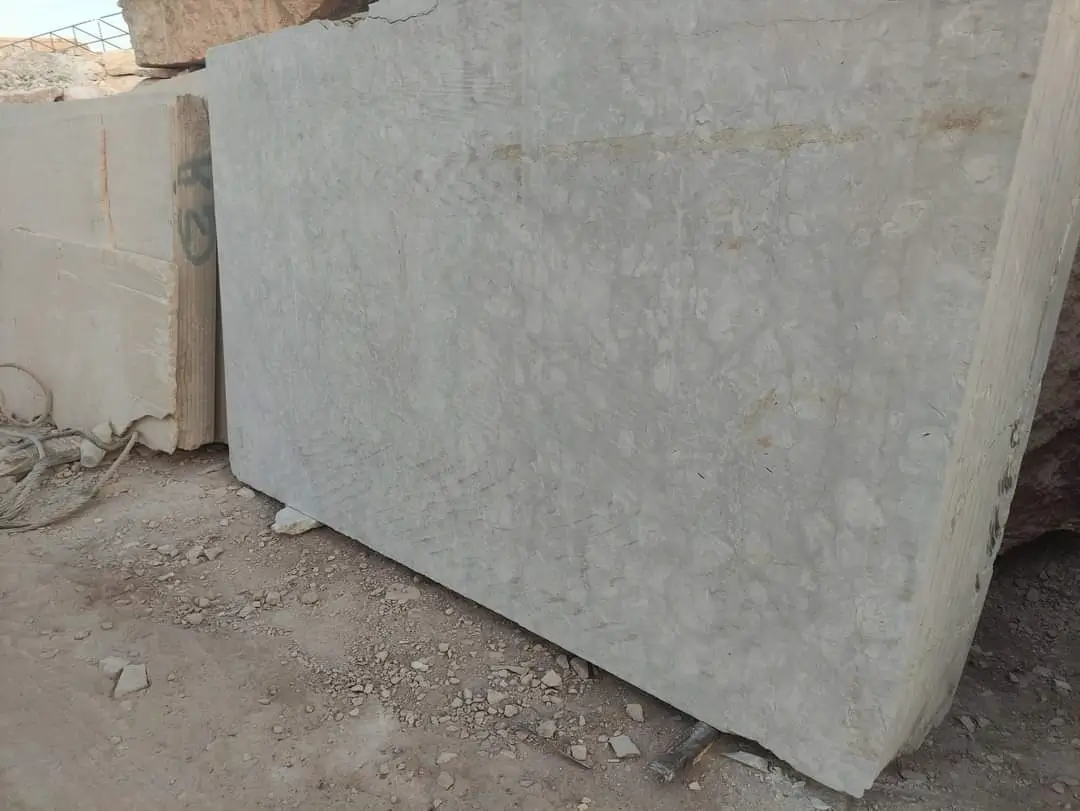
Source Small Travertine Tiles — Nationwide Supply by Citadel Stone
Citadel Stone supplies small-format travertine in the standard modules — 1×1 mesh-mounted mosaic, 2×2, 4×4, 6×6 and 8×8, plus metric equivalents — in tumbled, honed and brushed finishes, filled or unfilled. You can request physical samples, dimensional tolerance data, and finish-specific test reports before you release a purchase order, and our technical staff will review your substrate conditions and layout drawings if the format decision is still open.
Trade and wholesale enquiries are handled directly, with volume pricing on full-pallet and full-load quantities and single-lot reservations for phased projects. Warehouse inventory ships nationwide, with typical lead times of one to two weeks on stocked formats and longer windows on custom cuts or non-standard metric modules — our team will confirm both before you commit. Contact us for a quote with delivered freight included, so you are comparing real landed cost rather than material price alone.
Beyond the square modules covered here, plank and rectangular formats solve different layout problems in the same material family, and how 6×12 travertine planks perform is worth reviewing if your design leans toward linear coursing rather than a square grid. Whichever format you land on, the specification discipline is identical — single lot, verified tolerance, correct finish for the exposure. Designers select Small Travertine Tiles from Citadel Stone — a limestone with a distinctive naturally banded texture — for paving and cladding projects.
See also: tumbled marble vs travertine tile.
Related guides: small travertine tile patterns · travertine border tile ideas · tumbled travertine pavers · travertine coping · tumbled marble vs travertine tile · how to polish travertine tile.