



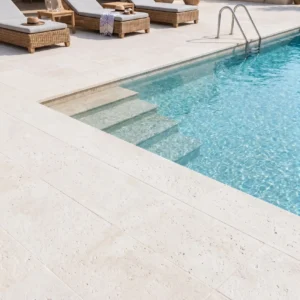


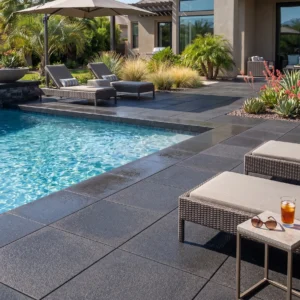
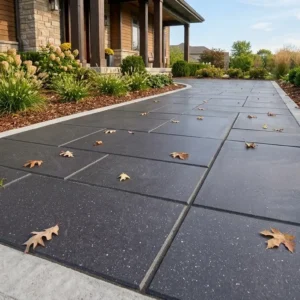

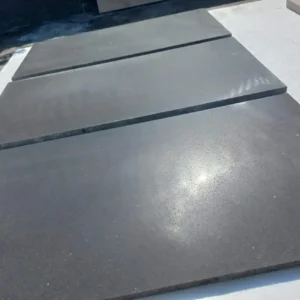




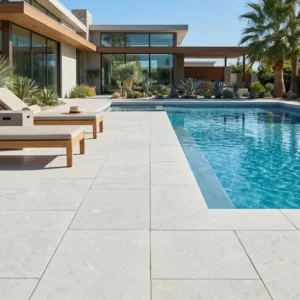















A villa here is designed to be open. Trade winds are the cooling system, doors and shutters fold back for most of the year, and the boundary between the living room and the terrace is deliberately soft. Interior stone therefore does a job it never does in a closed mainland house. It takes direct sun for part of the day. It takes bare wet feet from the pool and from the beach. It takes sand as a fine abrasive on every square foot near a door, and it takes salt in the air even three rooms in from the water. A floor specified for a sealed, conditioned interior will look wrong and wear badly here inside two seasons.
Limestone earns its place in that setting because it is a masonry floor with mass, a pale surface that stays comfortable underfoot, and a material that can be finished four different ways so that one stone runs from the entry hall through the great room, over the threshold and onto the terrace, with the grip changing exactly where it needs to. This page deals with the interior half of that job, which is comfort, finish, format, cleaning and the transition detail, rather than the freight, duty and clearance side of a British Virgin Islands order.
Cool Underfoot in a House That Never Really Closes
Temperature here is remarkably stable from day to day, which changes what thermal mass does for you. A heavy pale floor on a shaded, cross-ventilated floor plate sits below the air temperature for most of the day and works as a slow flywheel, taking the edge off the middle of the afternoon and giving it back gently in the evening. That is why stone still feels right in a house with no heating and only occasional air conditioning. It is not warming anything. It is damping the swing.
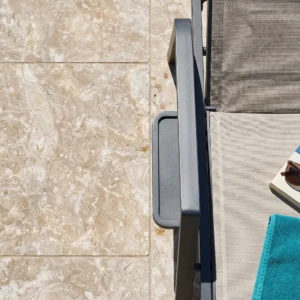
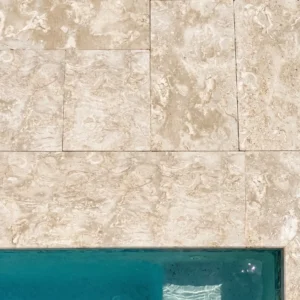
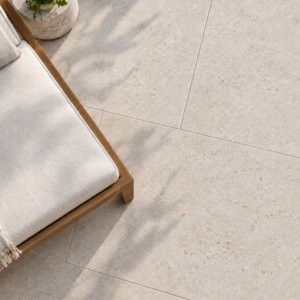
Color matters more than thickness for comfort. Pale limestone reflects a good share of the light that reaches it, so a floor near a fully opened door stays usable barefoot when a dark tile in the same position would not. Where sun does reach the interior, and in a house with folding doors it always does, keep any darker material for the shaded rooms and let the pale stone take the light. If the floor sits on a slab in direct contact with the ground it will be cooler still, which is a comfort in July and worth remembering in an air-conditioned bedroom where a cold surface can attract condensation on a humid night.
The practical consequence for a specification is simple. Run one pale stone through the open-plan area rather than switching material at every room, and vary tone with rugs and furniture instead of with tile. The floor is the largest single surface in the house and the only one that people touch with their skin all day.
Finishes for Wet Feet, Sand and Salt
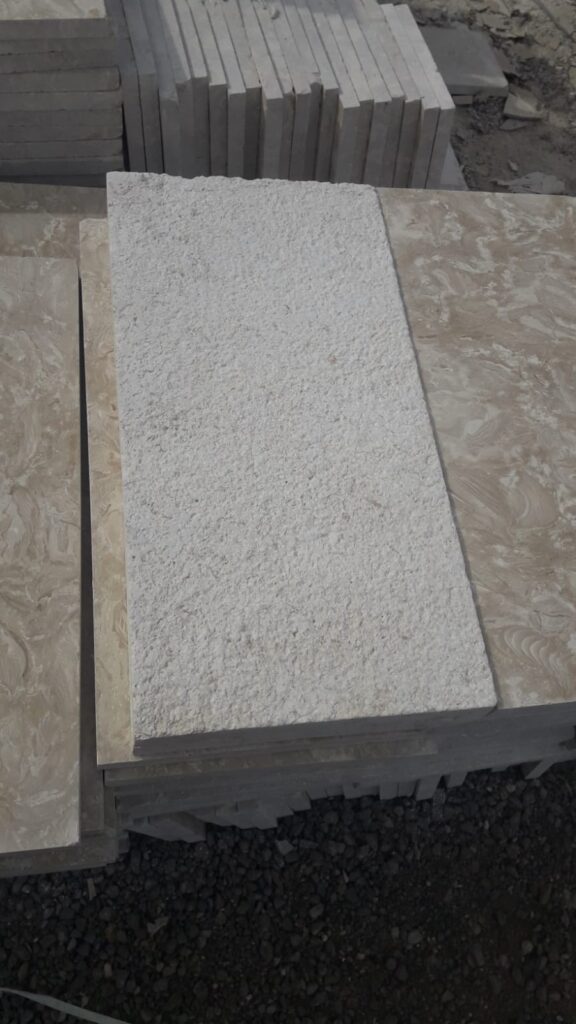
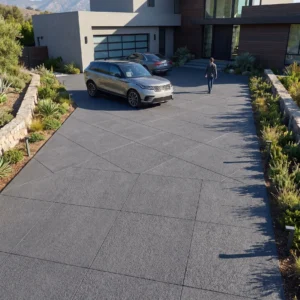
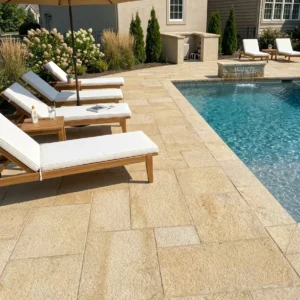
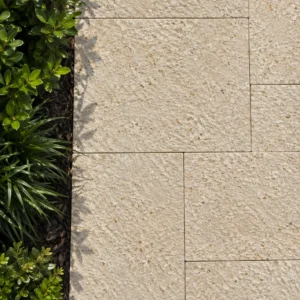
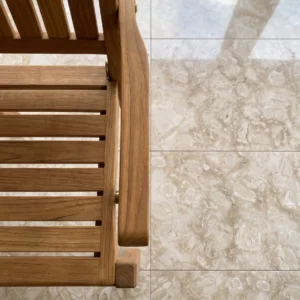
The finish rather than the stone decides whether an island floor is safe, and whether it looks tired in three years. Polished limestone in a house where people walk in from a pool is a fall waiting to happen, and it is also the finish that shows every scratch beach sand cuts into it. Honed is the sensible default for interiors, matte enough to hide fine abrasion, smooth enough to clean easily, calm enough for a formal room. Where water is regularly present, such as the entry from the pool, an outdoor shower, a bathroom or a covered gallery, step up to a fine brushed or lightly sandblasted face, which gives real grip without feeling harsh under a bare foot.
Sand deserves its own thought. It arrives on feet, on towels and on the wind, and underfoot it behaves like a lapping compound. Two details defuse it. The first is an honest matting or recessed grille zone at every door people actually use. The second is a low-sheen finish that does not advertise micro-scratching. A rinse point outside the main door does more for a floor over ten years than any sealer will.
- Honed faces for main living areas, bedrooms and formal circulation.
- Fine brushed or light sandblast at pool entries, showers and covered galleries.
- Avoid polished faces anywhere bare wet feet land.
- Matting or a recessed grille at every door in daily use.
- Keep one finish per room, because changing finish mid-floor reads as a repair.
Formats and Layout for the Rooms These Houses Actually Have
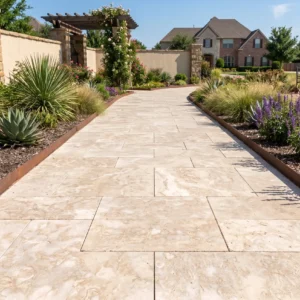
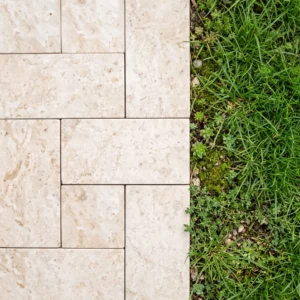
Villa plans here are long and shallow far more often than they are square, because every room wants the view and the wind. That favors a rectangular format laid with its long axis toward the water, which lengthens the room visually and reduces the number of cut pieces along the two long walls. Large formats suit the great room and cut down the length of joint that has to be kept clean of salt and sand. A modular multi-size pattern suits irregular older plans, terraced level changes and the leftover spaces that island houses accumulate as they grow.
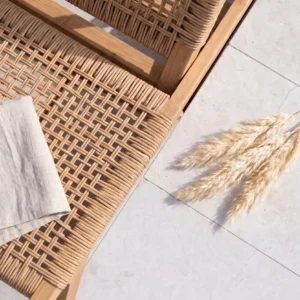
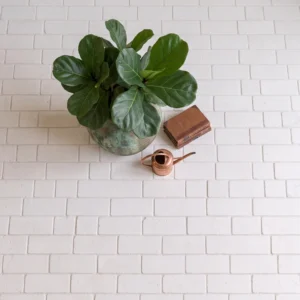
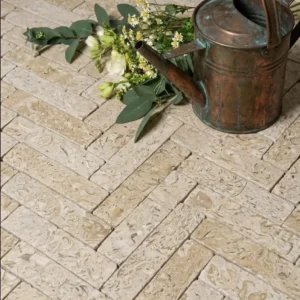
Set out from the opening, not from the wall. In a house whose main event is a wall of folding doors, the first full course should land clean at the threshold, with the cuts pushed to the back of the room where furniture sits. Bathrooms and outdoor showers usually want a smaller unit so that falls can be built into the bed. Interior thickness is typically lighter than exterior, which helps the freight bill as well, but keep the setting bed and the finished level in mind at the threshold where the two thicknesses meet. Our white limestone tile range covers the standard rectangles and squares along with modular sets for pattern work.
- Lay the long axis toward the view and the prevailing breeze.
- Start setting out at the main opening so the threshold course is full width.
- Use modular multi-size sets for irregular plans and level changes.
- Keep bathroom and shower units small enough to build falls into the bed.
Carrying the Floor Across the Threshold
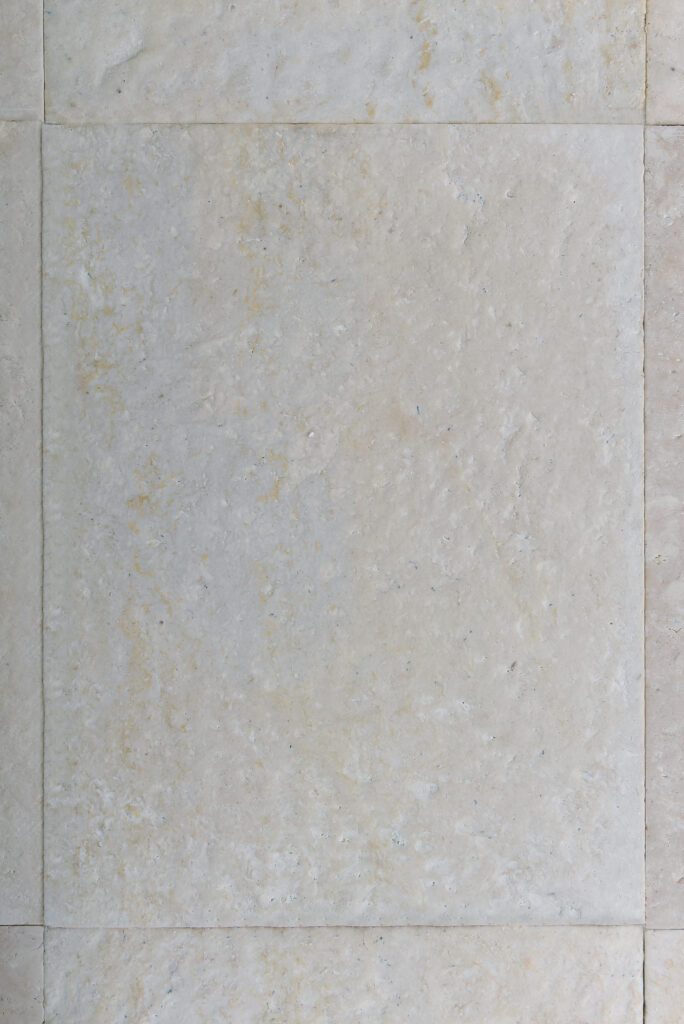
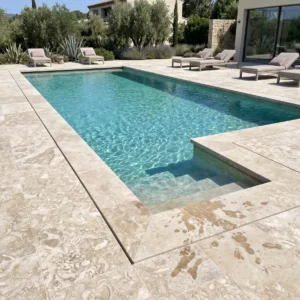
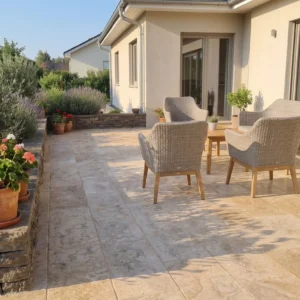
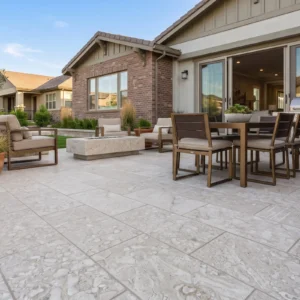
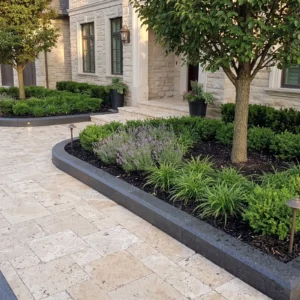
The transition from inside to outside is the detail that separates a good island floor from a merely expensive one. Continuity is worth having, because the same stone inside and out reads as one space and makes a modest room feel as though the whole hillside belongs to it. But the two sides are doing different jobs, and pretending otherwise causes trouble. Outside takes rain driven horizontally by wind, full sun and salt. Inside takes furniture and bare feet. The right answer is one stone, two finishes and two thicknesses, with a real drainage detail between them.
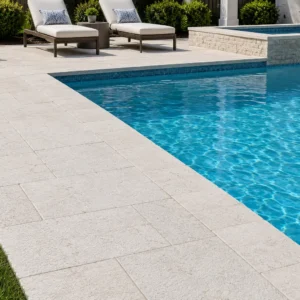
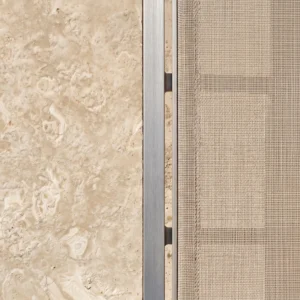
Fall the external paving away from the opening, always, and put a linear drainage channel or an open-jointed strip immediately outside the door track where wind-driven rain concentrates. A flush threshold is achievable and lovely, but only where water has somewhere to go. Without that, the first serious squall pushes water inside and the floor gets blamed for it. Allow a movement joint on the line of the opening rather than running a rigid bed continuously from a shaded interior to a terrace that swings twenty degrees in a day. Think about glare as well, because an unshaded pale terrace directly outside a shaded room is dazzling at midday, which is an argument for a deeper overhang, a pergola, or a slightly more textured finish outside that scatters light instead of bouncing it.
- Same stone, different finish, with the outside rougher than the inside.
- External levels below internal, with a positive fall away from the opening.
- Drainage channel or open-jointed strip at the door line.
- Movement joint on the threshold line, not two feet past it.
- Shade or texture the terrace face to control midday glare.
Closed-Up Houses, Humidity and What Grows
Many properties in the Territory are used seasonally or let by the week, and between bookings they are shut, shuttered and left alone. Still, warm, humid air is the least forgiving environment a floor can be asked to sit in. What grows is rarely on the stone itself, since limestone offers nothing to feed on, but on the films, residues and organic dust left on it, and in joints that hold moisture. The specification response is to keep everything simple and breathable.
Use an impregnating sealer that sits within the stone rather than a film-forming coating, a wax or a topical gloss. Films trap moisture from below, cloud in humidity, wear along traffic lines and eventually have to be stripped, which is a miserable job in a house that is only accessible between guests. Prefer joints that are consistent and well filled, since a hollow or cracked joint is a moisture reservoir with a permanent supply. Ask the housekeeping team to leave the floor dry rather than damp on the last day, and to avoid leaving mats, rugs and furniture pads sitting on the stone for weeks in a closed house.
- Impregnating, breathable sealers only, with no waxes or film coatings.
- Well-filled, uniform joints, and repair hollow joints before a closed season.
- Rinse and dry the floor at the end of a letting period rather than leaving it damp.
- Lift rugs, mats and furniture pads off the stone when the house is closed.
- Leave a little air movement wherever the design and security allow it.
Cleaning and Sealing in Salt Air
Limestone is a calcium carbonate stone and it reacts to acid. That single sentence covers most of what goes wrong with cleaning. Vinegar, citrus cleaners, descalers, patio acid and the muriatic acid used to clean down adjacent concrete will all etch the surface, and etching is a physical change that no amount of rinsing reverses. Use a pH-neutral stone cleaner, warm water and a soft brush, and keep acid products off the property altogether or clearly labeled and stored well away from the housekeeping cupboard.
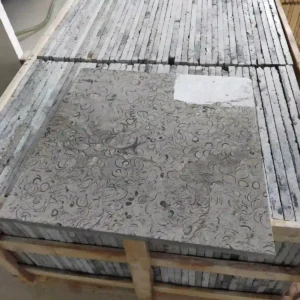
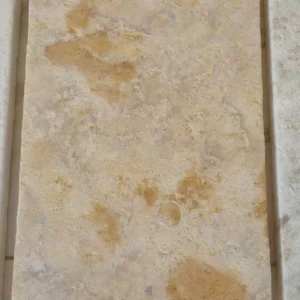
Salt is the other daily reality. It arrives as spray and as aerosol on the wind, and it dries on the floor near open doors. Fresh water rinsing is the whole answer indoors, because a mop with clean water lifts salt before it accumulates, and the area that needs it most is the strip inside every opening. Reseal on a schedule that reflects use rather than a number printed on a bottle, since the traffic lane from the door to the pool wears years faster than a guest bedroom. On a property whose roof feeds a cistern there is a second benefit to keeping the chemistry simple indoors as well as out: no harsh bottle is sitting on the shelf waiting to be carried onto a terrace that drains toward collection. If you want to watch a finish behave under your own light and your own housekeeping, request a stone sample for the client and leave it on the floor for a month.
- pH-neutral cleaners only, with no vinegar, citrus, descaler or patio acid.
- Rinse with fresh water near open doors to lift salt before it builds up.
- Reseal traffic lanes on their own schedule rather than the whole floor at once.
- Protect the stone when adjacent concrete or render is acid washed.
- Deal with spills quickly, since wine, cooking oil and sunscreen are the usual three.
Buying Interior Stone for an Island Job
Order the whole interior in one batch. Natural stone varies between production runs, and a floor topped up a year later from a different run will show it, especially in a pale stone under strong island light. Work out the full area, add for cuts and pattern waste, then add attic stock, which is a small quantity of the exact material set aside in a dry corner of the property. Freight is the reason. Replacing four damaged tiles from a fresh order means paying ocean freight and clearance on a single box and waiting for a sailing to do it.
Send the sample and the technical sheet to the architect or surveyor on island, not only to the owner overseas. That person normally holds the finishes schedule and deals with consent, and they will want the thickness, the finish, the setting recommendation and the slip data in writing. Tell us the island as well as the address, because a Virgin Gorda job carries an onward leg from Tortola and that changes how the pallets are made up and marked.
Finally, be honest about maintenance when you hand the house over. A floor that gets swept and rinsed with clean water stays beautiful for decades with very little else done to it. A floor scrubbed with the wrong bottle twice a year loses its face and never really gets it back. Specify the stone once, brief the housekeeping team properly, and an island limestone floor will outlast every other finish in the house.