




























Interior stone in Saint Lucia has a harder job than interior stone almost anywhere else, and the reason is that the interior barely exists as a sealed space. In the villa architecture of Cap Estate, the boutique rooms around Soufriere and the condominiums behind Reduit Beach, doors and louvers stand open for most of the year. Warm, humid, occasionally salted air moves through the house continuously. People walk in barefoot from a pool, a beach or a rainstorm. The floor is not a protected surface being decorated; it is a working surface being used hard, wiped constantly and asked to look calm while it happens.
That reframes the specification. The questions worth asking are not about fashion but about behavior: does the surface stay cool enough to walk on at two in the afternoon, does it grip when someone crosses it with wet soles, does it show every drop of water and every footprint, will it grow a film in a shaded room during a wet spell, and can housekeeping clean it four times a week for ten years without wearing a path through it. This page answers those questions for limestone tiles in a Saint Lucian building, and leaves freight, outdoor engineering and small-unit work to their own pages.
Heat, Humidity and Why Pale Floors Win Indoors
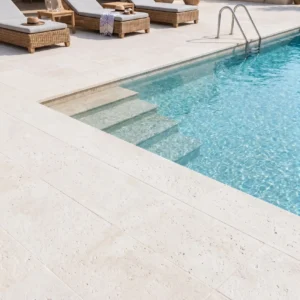
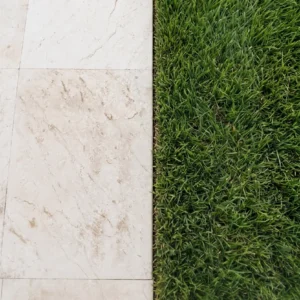
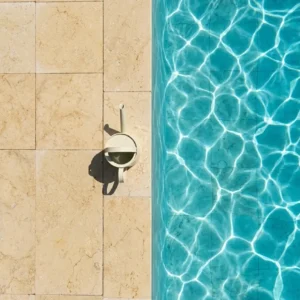
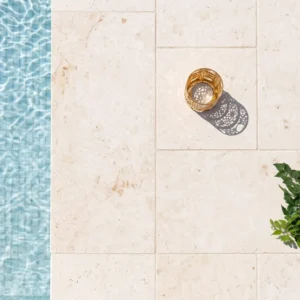
Two comfort effects decide most interior stone choices in the tropics. The first is thermal. Pale limestone reflects rather than stores solar gain, so a floor in a room that catches direct sun through open doors stays markedly kinder to bare feet than a dark surface would. In a house where children run in from the pool and adults cross barefoot between the kitchen and the shaded end of the veranda, that difference is felt daily rather than measured occasionally.
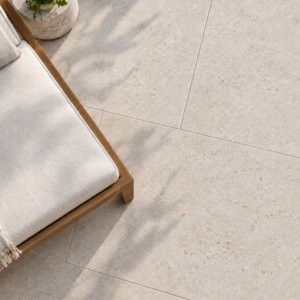
The second is light. Saint Lucian daylight is intense, and an interior floor is a large reflector. A pale honed limestone lifts a deep room that sits behind a shading roof overhang, which is how most of the good villa architecture on this island handles sun. A polished floor in the same position throws glare, doubles every reflection and quickly becomes tiring to look at. Honed and lightly brushed surfaces give the brightness without the mirror.
Humidity brings the third factor: biological film. Any floor in a shaded, poorly ventilated corner of a humid house will host something eventually. Stone is not immune, but a dense, low-absorption limestone with a sealed surface and a room that actually gets air will resist it far better than a porous, open-textured material left to sit damp. Ventilation and drying time matter more than the cleaning chemical.
- Choose pale limestone for rooms with direct sun exposure and barefoot traffic.
- Use honed rather than polished finishes wherever daylight strikes the floor at a low angle.
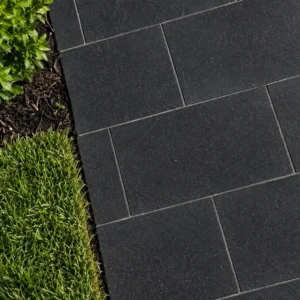
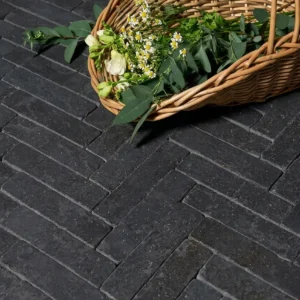
- Keep the darkest tones for shaded interiors, powder rooms, feature walls and stair risers.
- Allow air movement over stone floors in enclosed bathrooms and service corridors.
- Ask for the absorption test data before committing a whole ground floor to a batch.
Finishes for Wet Feet and Open Houses
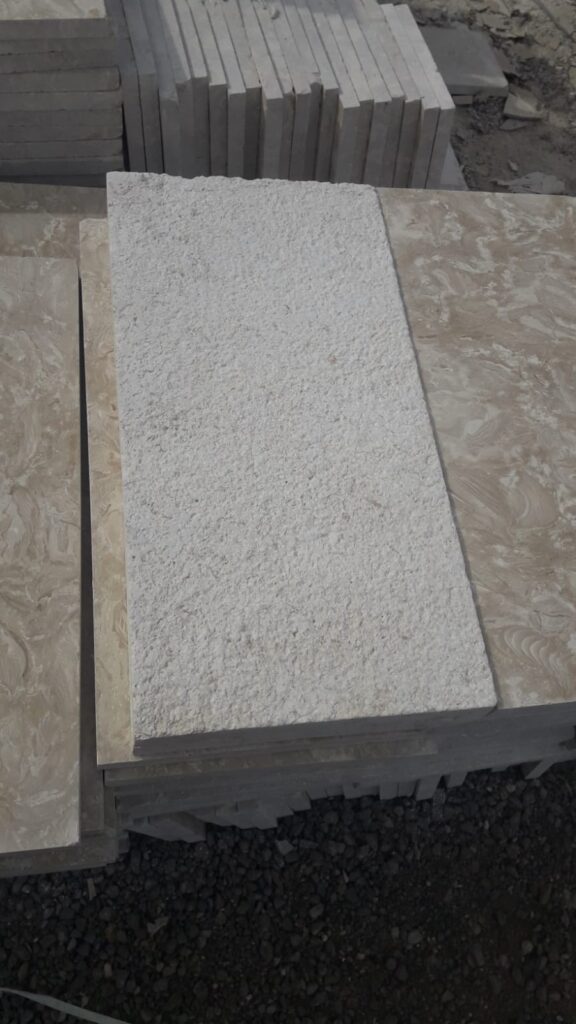
The finish is where interior specification in Saint Lucia is most often got wrong. A high-shine floor photographs beautifully and then behaves badly the first time someone crosses it in wet flip-flops. Wet feet arrive constantly here, and they arrive without warning: a rain shower that lasts four minutes will wet everyone standing on the veranda and every one of them will walk inside.
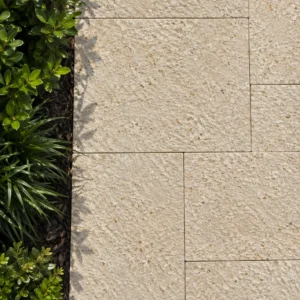
The practical hierarchy runs from honed for the main living floor, through a light brushed or antiqued texture for the transition zones near doors, showers and pool entries, to a fine bush-hammered or sandblasted face where the floor is genuinely exposed. The texture step should occur where the water arrives, not at an arbitrary architectural line. If you want to compare honed and brushed finishes side by side before deciding, do it under Saint Lucian light with the samples wet, because a dry showroom tells you very little about a floor at Marigot Bay in October.
- Main living areas and bedrooms: honed, matte and easy on the eye under strong daylight.
- Entry halls, veranda thresholds and pool doors: a light texture that keeps grip when wet.
- Shower floors and wet rooms: smaller units, more joints, and a textured or tumbled face.
- Stairs and landings: textured treads with a defined nosing detail, never a polished run.
- Kitchens and pantries: honed with good sealing, since oil and acid are the real threats there.
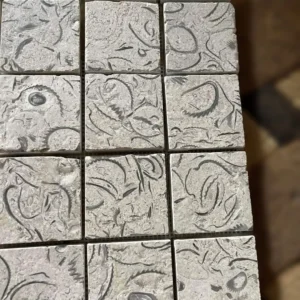
There is a nuance in wet rooms worth stating plainly. Grip comes partly from the surface and partly from the joint pattern. Smaller tiles mean more joints per pace, and joints break a film of water. A mosaic or small-format shower floor with a slightly textured face outperforms a large, smooth slab in the same position even when the two share an identical finish.
Formats That Suit Saint Lucian Rooms
Large-format tiles have become a default in international specification, and they are frequently the wrong default here. Two constraints push back. The first is architectural: a great many Saint Lucian rooms, particularly in older houses and in the boutique properties around Soufriere and Anse Chastanet, are narrower than a magazine interior and are broken by columns, level changes and door openings onto a veranda. Very large units force awkward cuts against those features and waste material.
The second constraint is physical. Tiles have to be carried up the same access that limits everything else on this island, sometimes by hand, sometimes up an external stair, sometimes off a truck parked further down the road than anyone wanted. A format two workers can lift comfortably is laid faster and broken less than one that needs three.
- Modular rectangular formats suit long veranda runs and narrow circulation better than square giants.
- A mixed-size opus or pattern layout absorbs irregular room shapes with far less cutting.
- Keep one format running through connected spaces to make a small house read larger.
- Order roughly five to ten percent extra as attic stock in the same shipment and the same color run.
- Take riser, skirting and step pieces from the same batch, cut to size, rather than site-cutting field tiles.
Attic stock deserves emphasis in an island market. A replacement tile ordered three years later comes from a different block, a different production run and a different container, and it will announce itself. Stock ordered now travels free of a second entry and sits in a storeroom costing nothing.
Substrates, Beds and Movement in a Humid Build
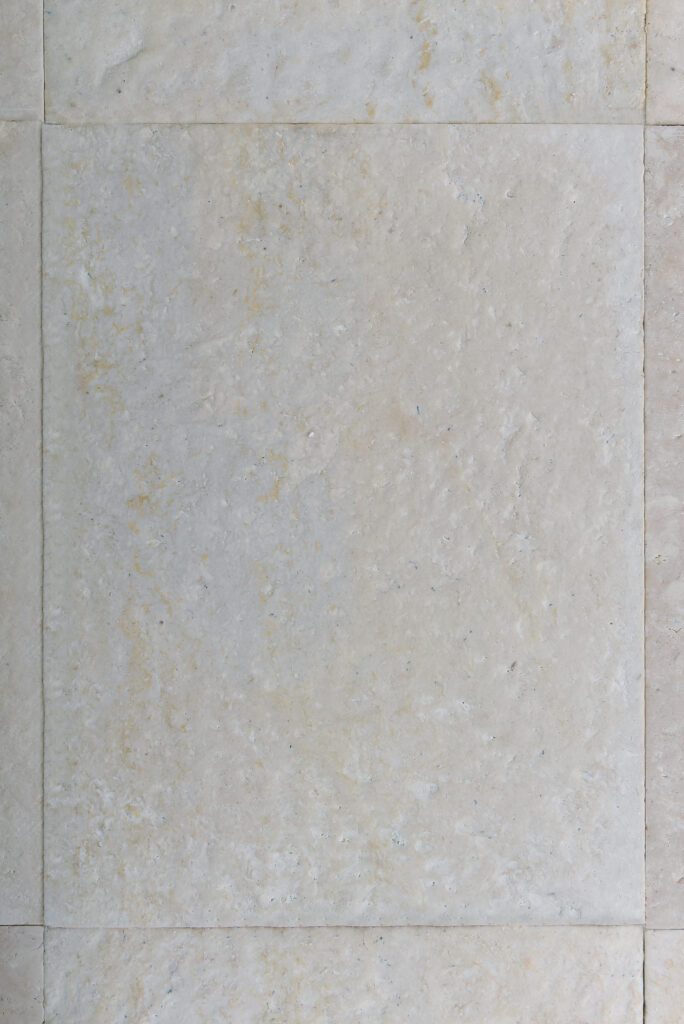
A stone floor is only ever as good as what sits under it, and tropical construction puts pressure on that layer in ways temperate specifications rarely mention. A ground-floor slab poured in a humid, warm climate loses moisture slowly, and stone laid over a slab that has not finished drying can suffer picture-framing, hazing under a sealer or, in the worst cases, a bond that never fully develops. Give the slab the drying time your builder specifies, test it rather than guessing, and resist the pressure that arrives when a project is running late and the floor is the visible item on the program.
Adhesive and bed selection matter just as much. Warm ambient temperatures shorten open times, so smaller working areas and disciplined batching beat ambitious runs. Full coverage under every tile is not a refinement; it is what stops a hollow spot becoming a cracked tile the first time a heavy trunk is dragged across it. Where a floor is laid over a suspended structure or crosses a structural joint, that joint has to be carried through the stone rather than tiled over and hoped about.
- Confirm the slab is dry enough before laying, with a test rather than an assumption.
- Use full-bed coverage under every unit; hollow spots become cracks under point loads.
- Carry structural movement joints through the finished floor, and place perimeter joints behind skirtings.
- Work in small batches, because heat shortens the open time of adhesives and grouts.
- Keep bedding materials and sand clean and salt-free, particularly on coastal sites.
Wet areas deserve their own sequence. Tanking or a waterproof membrane goes in first, falls are formed in the screed rather than in the tile, and the drain position is set before anything is bedded. In a climate where a shower runs several times a day all year, a wet room built in the wrong order will announce the mistake within a season, usually on the ceiling of the room below.
Making the Threshold Disappear
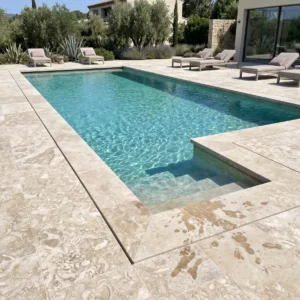
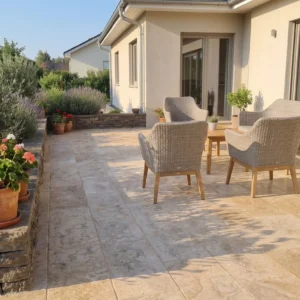
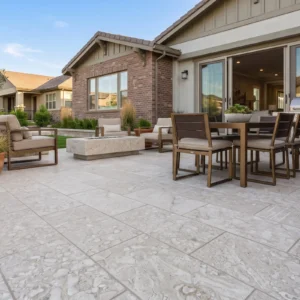
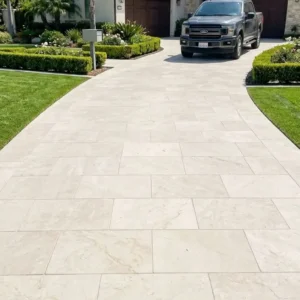
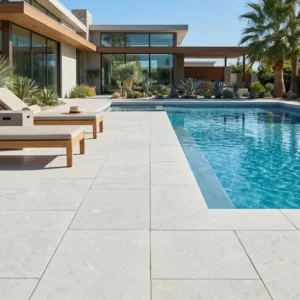
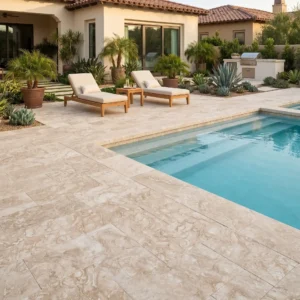
The single most valuable thing stone can do in a Saint Lucian house is erase the line between inside and outside. Because the veranda is genuinely inhabited rather than decorative, a floor that runs unbroken from the sitting room through the doors and out to the shaded terrace makes the whole ground floor read as one space. That effect is only achieved deliberately, and it is achieved with one stone in two finishes.
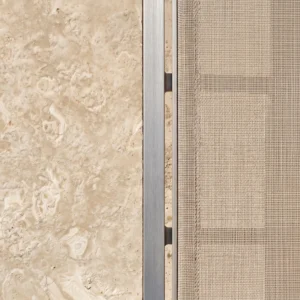
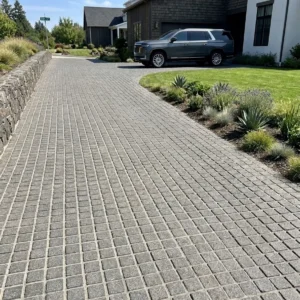
The method is straightforward. Use the same limestone inside and out, taken from the same batch. Inside, specify it honed. Outside, specify a textured face on the same stone at a thickness suited to the external bed. Keep the joint width and the coursing continuous across the doorway so that the eye reads one floor. Then handle the level: the outside surface must fall away from the building for drainage, so the continuity is visual and the levels are engineered, with a drainage channel or a slot detail taking water away at or just beyond the threshold.
- One stone, two finishes: honed within, textured beyond the door line.
- Continuous coursing and matching joints across the threshold so the pattern never breaks.
- Positive falls away from the building, with a channel or slot at the transition.
- Different thicknesses inside and out are normal; the visible face is what must align.
- Order internal and external quantities together so the color run matches across the doorway.
Cleaning and Sealing in a Humid, Salted Climate
Maintenance regimes written for temperate climates fail here for one reason: they assume the floor dries. In a Saint Lucian wet spell it may not fully dry for days, and in a north-coast property the air itself carries salt indoors through open doors. That argues for an impregnating sealer that penetrates and leaves the surface breathable, rather than a topical coating that sits on the stone, traps moisture beneath it, and eventually peels into a patchy mess that has to be stripped.
Day-to-day cleaning should be dull and consistent. A pH-neutral cleaner, warm water, frequent light passes and prompt removal of anything acidic. Limestone is a calcium carbonate stone and will react to acid, which in this climate means lime and citrus from the kitchen, some cocktail spills on a bar floor, and a surprising number of aggressive proprietary cleaners sold for bathroom use. The rule for housekeeping teams in villa rentals is simple enough to put on a laminated card in the store cupboard: neutral cleaner only, nothing acidic, wipe spills immediately.
- Use an impregnating, breathable sealer rather than a film-forming coating.
- Reseal to a schedule agreed with your supplier, and test with a water-bead check before you do.
- Keep acid away from limestone floors: no vinegar, no citrus cleaners, no descaling products.
- Mat and drain at pool and beach entries so sand does not become abrasive traffic.
- Brief the housekeeping team once, in writing, and keep the instructions with the cleaning supplies.
Rental turnover deserves its own note. In the short-term letting market around Rodney Bay a floor might be deep-cleaned fifty times a year by different hands using whatever is in the cupboard. Specifying the cleaner is part of specifying the floor.
Where Limestone Tiles Fit in a Saint Lucian Project
Not every surface in a building wants the same material, and honest advice includes saying where something is not the best answer. Limestone tiles are excellent across living areas, bedrooms, halls, bathrooms, spa areas, hotel lobbies and the covered part of a veranda. In a boutique property the calm, matte surface does the thing designers actually want in the tropics: it recedes and lets the view work.
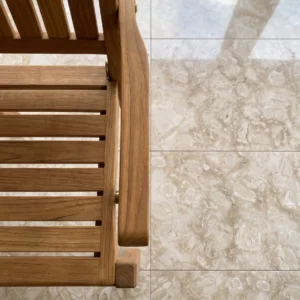
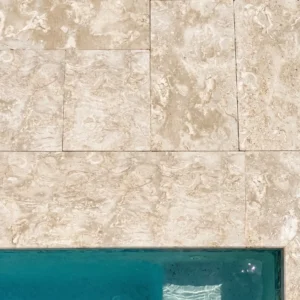
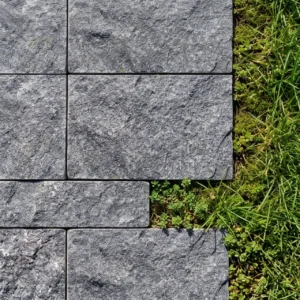
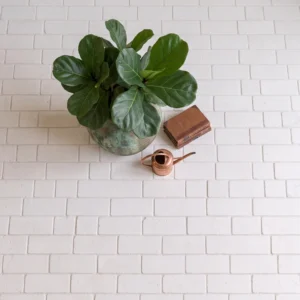
They are a weaker choice in a few specific places. A commercial kitchen floor with heavy acid and grease exposure wants a different material. A back-of-house service yard taking pallet trucks and daily abuse is not a limestone job. Any area regularly flushed with strong chemicals should be reconsidered. And a floor that will never be sealed or maintained is better specified as something more forgiving, because unmaintained limestone in a humid climate will not stay handsome. For interiors that want a paler, tighter appearance across large areas, pale limestone interior tiles hold their tone consistently in the strong reflected light typical of a coastal Saint Lucian room.
- Best: living spaces, bedrooms, bathrooms, spas, lobbies, covered verandas, stairs with textured treads.
- Consider carefully: commercial kitchens, laundries and chemical wash-down areas.
- Avoid: unmaintained rental back-of-house floors and pallet-truck service yards.
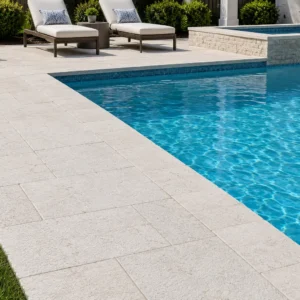
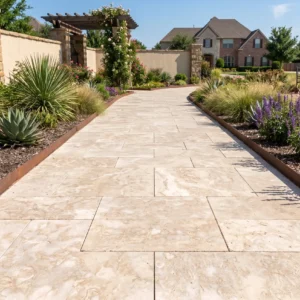
- Pair with: a textured version of the same stone for terraces, steps and pool surrounds.
- Always: a sample tested wet, in place, before the order is confirmed.
None of this is exotic. It is the ordinary discipline of choosing a floor for the climate it will actually live in, rather than the climate of the catalog photograph. Tell us the rooms, the traffic and the maintenance regime, and we will specify a limestone tile that still looks right in Saint Lucia after ten seasons.