






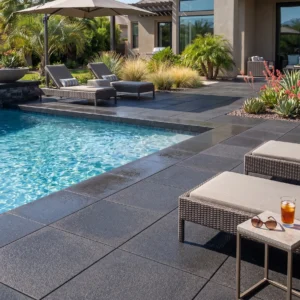
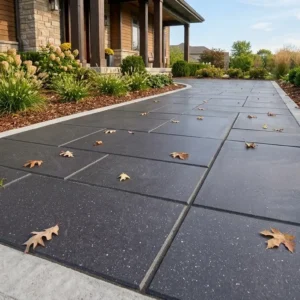


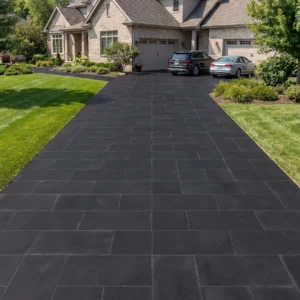
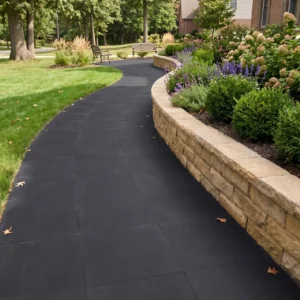





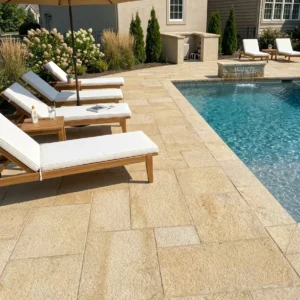

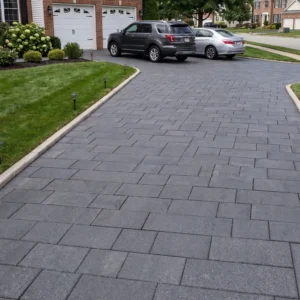
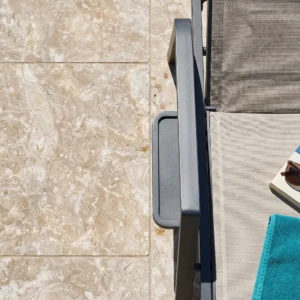

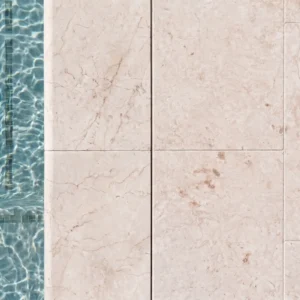

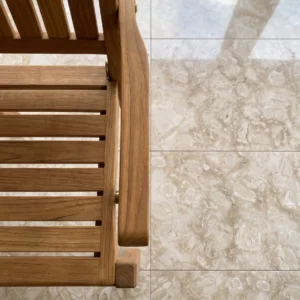
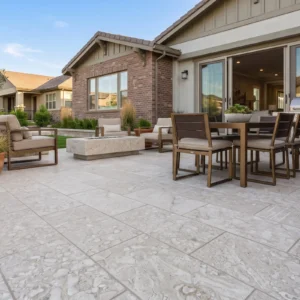
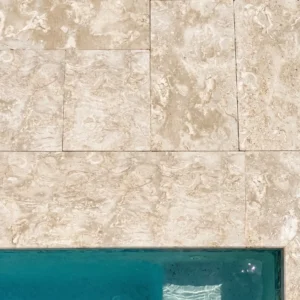
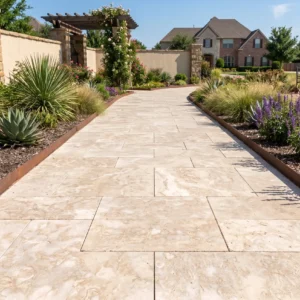
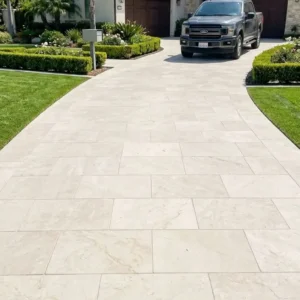
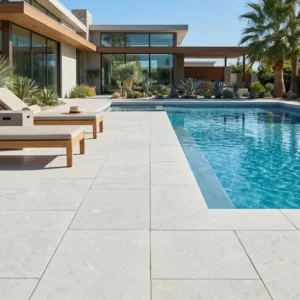
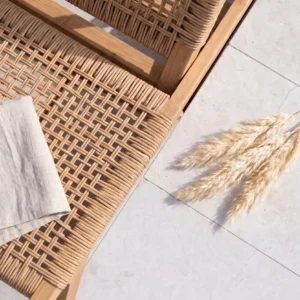
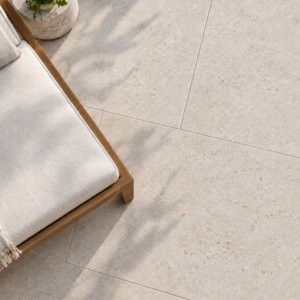


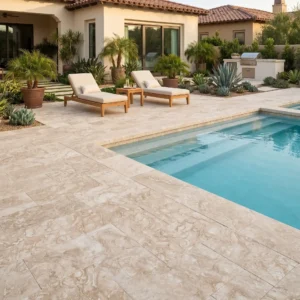

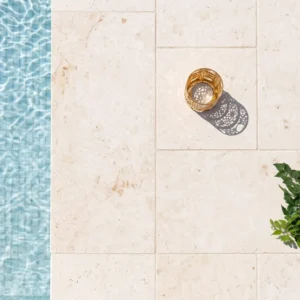
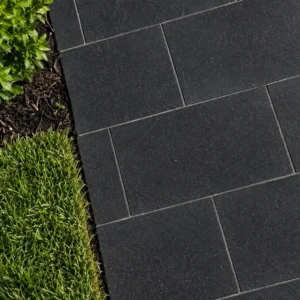
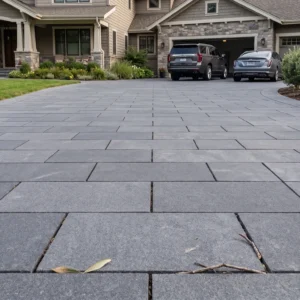
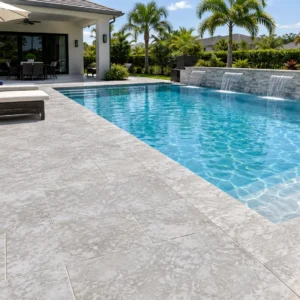



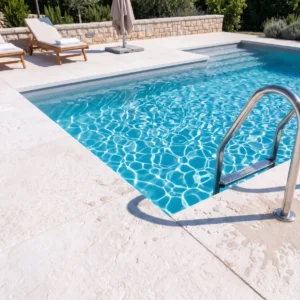







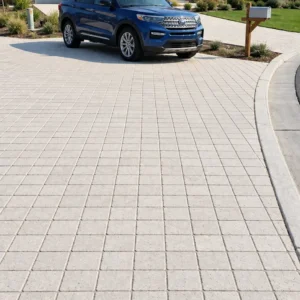
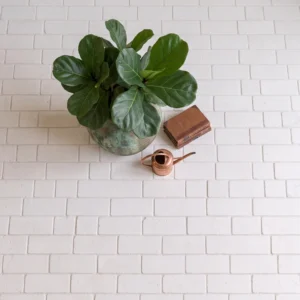
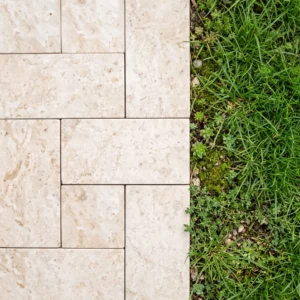
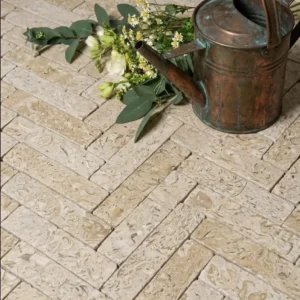

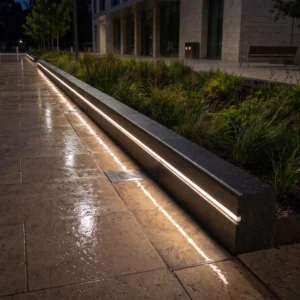





An Aruban interior is not a sealed box. Sliders stay open, terraces run straight off living rooms, people cross from a pool deck to a lobby floor without stopping, and the trade wind pushes a fine dust through every gap it can find. That is a specific set of demands to place on a floor, and it is not the same set that a humid, rainy island places on one. Damp is not the driver here. Abrasion is, along with a salt film that appears on surfaces near open doors and windows and has to be washed off rather than wiped around.
Limestone answers that well, provided the specification is made deliberately rather than borrowed from a mainland showroom. What follows is the interior half of the argument: how a pale stone floor behaves thermally in a house that runs hot outside and cool inside, which finishes hold up against a constant supply of abrasive dust, how to detail wet areas and thresholds, which formats suit Aruban rooms and Aruban service elevators, and how cleaning and sealing actually work when the water on the cloth is the least of your problems.
Pale floors in a house that runs on the trade wind
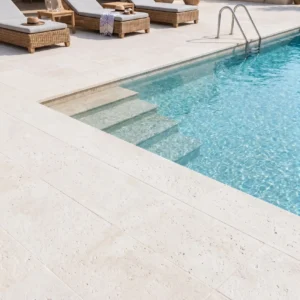
Solar gain on Aruba is relentless and it is year-round, and a floor is one of the largest single surfaces in any room that has to deal with it. A pale limestone tile reflects a good part of the light that reaches it rather than absorbing it, so it warms more slowly and runs cooler than a dark floor in the same position. In a room with a wide glazed opening facing an open plot in Noord or Malmok, that difference is not academic. It is what makes an unshaded strip of floor by the door usable barefoot in the afternoon.
Stone also carries thermal mass, which behaves differently depending on how the house is run. In a fully conditioned interior the floor holds the cool and gives it back slowly, which is comfortable and useful. In a room that is opened up in the morning and shut down at night, the mass smooths out the swing rather than eliminating it. Neither behavior is a problem, but the two ask for slightly different tone choices, and it is worth deciding early which kind of room you are flooring.
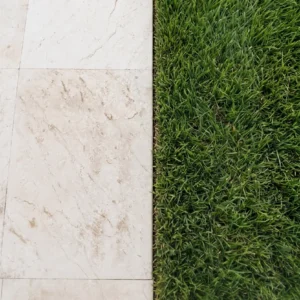
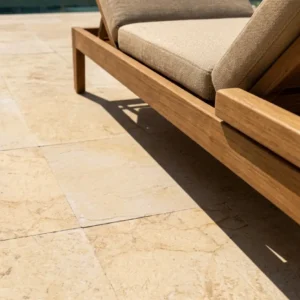
There is a related decision about tone that has nothing to do with physics. A very light floor in a room full of reflected sun can read as glare, particularly in a lobby or an open-plan living space with pale walls. A softer, warmer limestone with visible movement takes the edge off without giving up the thermal advantage, and it forgives the dust that will inevitably be on it between cleans. That last point is a real design consideration on this island rather than a decorator’s excuse.
The grit problem: why finish beats gloss here
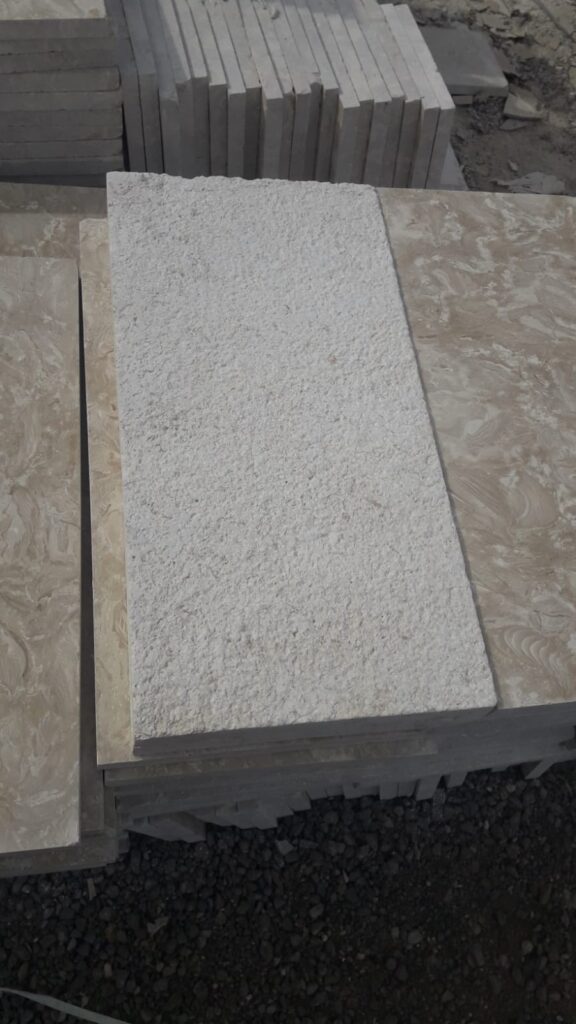
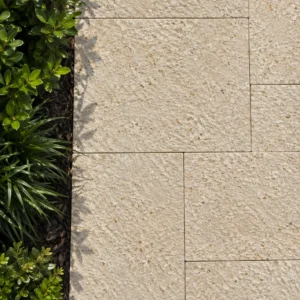
Every grain of fine dust tracked in off a terrace is a small abrasive, and on Aruba the supply is continuous. That single fact should drive the finish decision more than anything else in an interior specification. A high-gloss surface reflects light in a way that reveals every fine scratch it has ever taken, so a polished floor in a doorway position on this island is signing up to show its history. A honed, brushed or lightly textured face scatters light instead, and the same wear pattern simply does not read.
- Honed for main living floors, which gives an even, low-sheen surface that hides fine scuffing and cleans easily.
- Brushed or lightly textured at entrances, thresholds and any run of floor that connects directly to a terrace or pool deck.
- Polished reserved, if used at all, for wall applications and low-traffic rooms well away from the doors the wind comes through.
- A consistent finish across a whole floor plate, so a repair or an added room later does not read as a patch.
- Matting or a grit-trapping zone at every external door, because the cheapest abrasion control is stopping the abrasive before it lands.
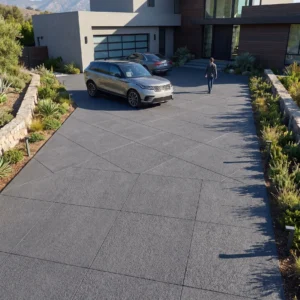
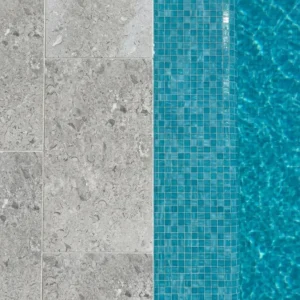
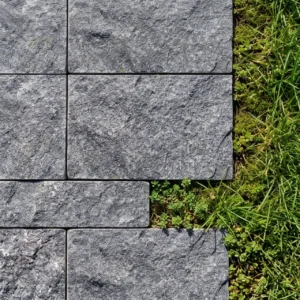
If you want to see how the same stone changes character between one face and another, compare finishes that survive blown grit side by side before committing a whole floor plate to one of them. The difference between a honed and a brushed face on the same block is far larger in a dusty, brightly lit room than it appears on a sample board under showroom lighting, which is exactly why we send physical pieces rather than swatch images.
Wet feet: pool, shower and the threshold between
Aruban buildings move people between water and floor constantly. Guests come off a pool deck into a lobby, families come in from the beach, and bathrooms in villa and resort work are frequently open, generously drained and used barefoot. Wet limestone with a smooth face is slick, and no amount of good intent from a housekeeping team changes that. The answer is textural rather than chemical, and it is decided at specification stage.
For shower floors, a smaller module is not a style preference, it is a drainage requirement. Small tiles let the installer build the falls the drain needs without cutting awkward wedges out of a large format, and the extra joint length adds grip where bare feet are most likely to slide. A textured face on the shower floor with a honed face on the surrounding floor gives a clear underfoot signal about where the wet zone begins, which is a genuinely useful piece of design and costs nothing.
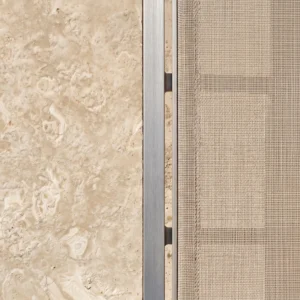
Thresholds deserve the same attention. Where an interior floor meets a terrace, you have three things to solve at once: the change in level, the change in exposure and the wind pushing water and grit inward under the door. A slight fall away from the opening, a drainage detail immediately outside, and a textured stone in that first band of floor handles all three. It is a small area of a project and it causes trouble out of all proportion to its size when it is left to be resolved on site.
- A textured face on shower floors and in the first band of floor inside every terrace door.
- A smaller module in showers, so the installer can build falls to the drain without cutting wedges.
- A visible finish change at the wet-zone boundary, which tells a bare foot where it is before the eye does.
- A fall away from external openings, with drainage immediately outside rather than immediately inside.
- Carefully detailed junctions at slider tracks, where wind pushes water and grit inward all year round.
Tile sizes that suit Aruban rooms and Aruban elevators
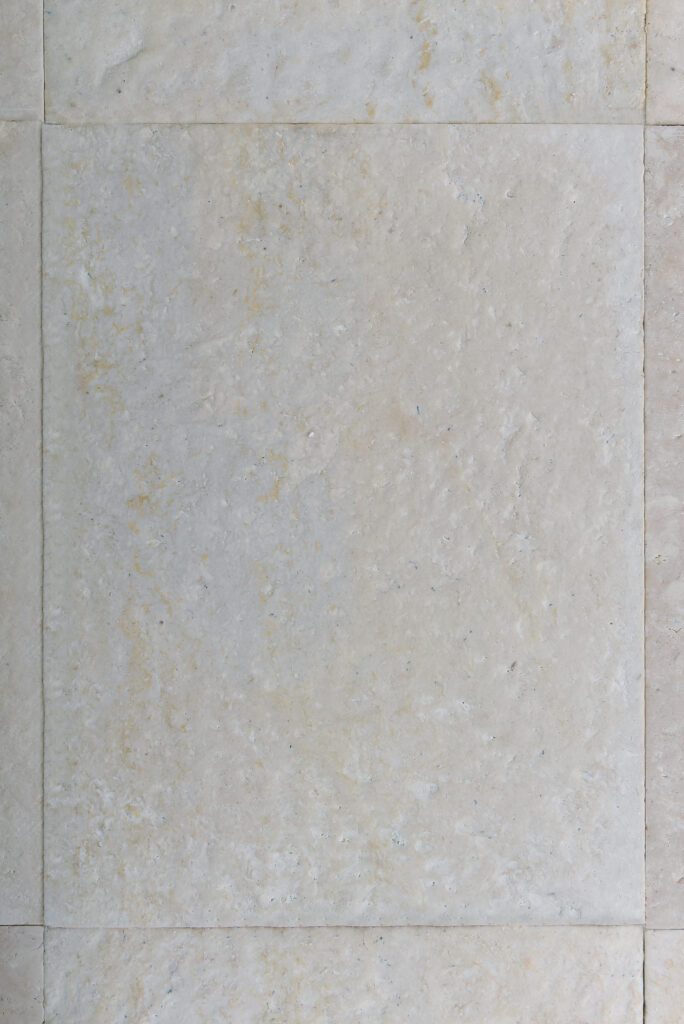
Format is a conversation between the room and the route into it. Larger tiles suit open-plan living space, reduce joint lines and make a modest room read as a larger one. Smaller modules suit wet areas, corridors and rooms cut up by fittings. Neither judgment is unusual. What is Aruba-specific is the second half of the conversation, which is how the crate reaches the room.
- Large-format tiles for open living areas and lobbies, where the run is long enough to reward fewer joints.
- Mid-size modules for bedrooms, corridors and any room where fitted furniture will interrupt the field.
- Small formats for shower floors, steps and areas that need built falls.
- Pallet weights built to the service elevator limit in high-rise work rather than to the yard standard.
- A single lot for a whole project where color consistency matters, particularly across repeated units.
That last point deserves emphasis in the timeshare and resort renovation work that comes around on a cycle in the Eagle Beach and Palm Beach corridors. When a program refurbishes many near-identical units, the floors are compared with each other constantly, by staff and by returning guests. Natural stone varies, which is the point of it, but variation should read as character within a floor rather than as a mismatch between one unit and the next. Ordering the whole run from one lot, and holding a small reserve of spare tiles from that same lot for future repairs, is cheap insurance on a renovation program. Ask for it at order stage, because a lot cannot be reconstructed after it has shipped.
Carrying one floor from the living room out to the terrace
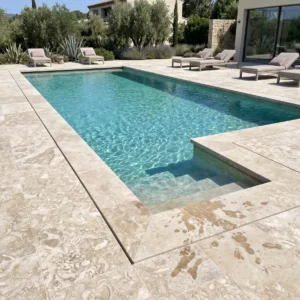
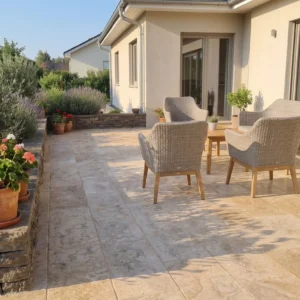
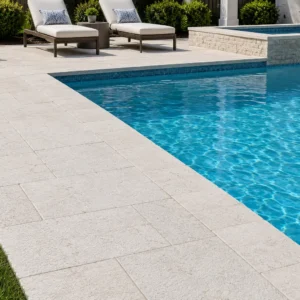
One of the most satisfying details available in an Aruban house costs almost nothing to specify: the same stone inside and out, in two different faces. A honed interior floor running to a threshold and continuing as a brushed or textured terrace in the identical limestone reads as one continuous plane, pulls the outside in visually, and quietly makes the interior feel larger than its footprint.
Getting it right involves two adjustments. The first is depth. Interior tile is normally two centimeters bonded to a prepared bed, while the exterior version wants three centimeters, so the bedding build-up either side of the threshold has to be planned to bring both surfaces to the same finished level. The second is finish, because the outdoor face must be textured for wet grip while the indoor face stays honed for comfort and cleaning. Same stone, same lot, same tone, two faces.
We can supply white limestone tegels for Aruba interiors matched to an exterior paving order from the same material so the two halves genuinely agree, rather than approximately agreeing under different site lighting. If the terrace is being laid first and the interior follows in a later phase, say so at the outset and we will hold the match, because reordering an interior floor months later against an outdoor surface that has already weathered is a much harder problem than planning for it once.
Cleaning and sealing where salt dries on every surface
Limestone is a calcium carbonate stone, which means acid attacks it. That single sentence rules out a whole aisle of supermarket cleaning products, including anything descaling, anything citrus-based and anything sold on its power to cut through mineral deposits. A pH-neutral stone cleaner, warm water and a soft mop handle almost everything a limestone floor on Aruba will meet.
The Aruban addition to the routine is rinsing rather than wiping. Salt carried in on the wind dries into a film, and a damp cloth pushed across it redistributes the salt instead of removing it. Wash and rinse, particularly on floors near open doors, near a pool deck and in any entrance zone. The same logic applies to the grit: sweep or vacuum before mopping, because mopping a dusty floor grinds the dust into the surface rather than lifting it off.
- Use a pH-neutral cleaner made for natural stone and keep acidic household products away from the floor entirely.
- Sweep or vacuum before washing, so blown grit is removed rather than dragged across the surface.
- Rinse with clean water in salt-exposed zones instead of wiping with a single bucket.
- Deal with spills promptly in kitchens and bars, where wine, juice and cleaning chemicals do the real damage.
- Test any sealer, cleaner or treatment on a spare tile from the same lot before it goes near the finished floor.
On sealing, the honest position is that it is a stain-resistance measure rather than a permanent shield, and the correct interval is set by observation rather than by a date in a maintenance manual. When water stops beading and starts darkening the stone, it is time. The test tile matters more here than anywhere, because rinse water carries whatever it carries and the only way to know how a given sealer looks on your stone under your light is to try it somewhere that does not matter.
Ordering tegels: what to settle before the crate ships
Interior stone orders go wrong in predictable ways, and nearly all of them are settled at the schedule stage rather than on site. Send a room-by-room schedule with areas, mark the wet zones separately, note which rooms open directly onto a terrace, and state whether the floor will be walked on barefoot in wet feet. That is enough for us to propose formats, finishes and a lot strategy that hold together as one specification rather than four separate decisions made by four different people.
Add the practical constraints early. If the building has a service elevator with a weight limit, tell us the number. If the renovation hands back on a fixed date, tell us the date and work backward from it, allowing for clearance at Barcadera rather than assuming the port gate is the finish line. If a designer’s drawings are still in flux, send them anyway and mark what is unresolved.
Then ask for samples. Small hand pieces of each candidate stone, in the actual finishes under consideration, placed in the actual rooms and looked at in morning light and afternoon light before anyone signs anything. It takes a week and it settles arguments that would otherwise be discovered after a floor is down. An Aruban interior floor is judged in bright light, under bare feet and against a constant film of dust, so choose it in those conditions rather than in a showroom.