

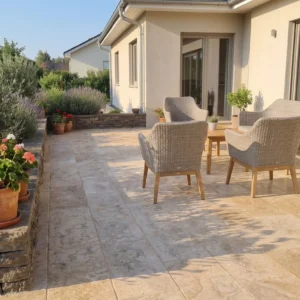

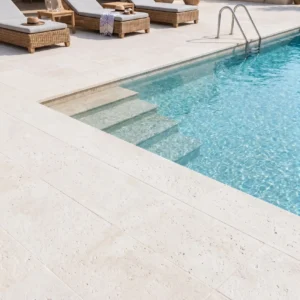


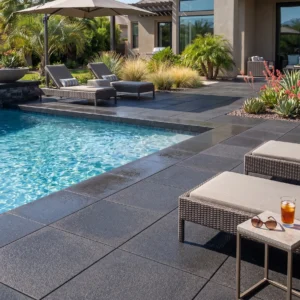
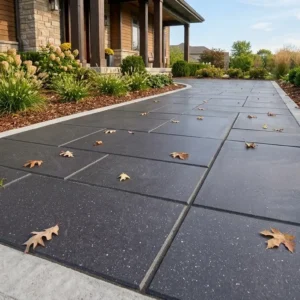







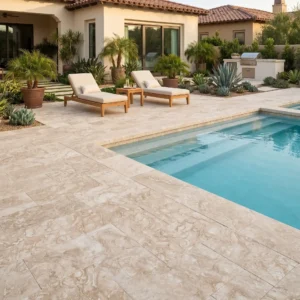
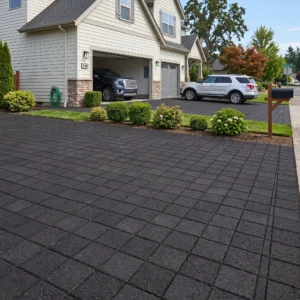
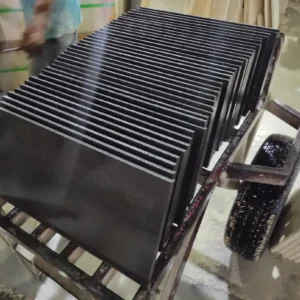

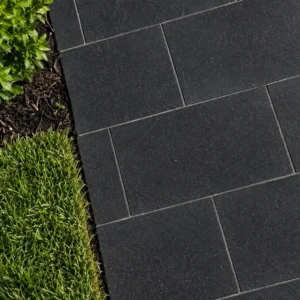

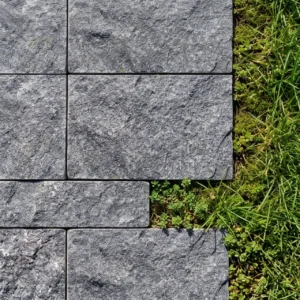
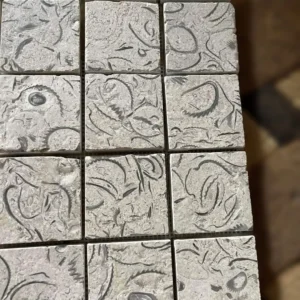
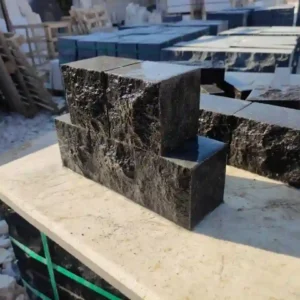
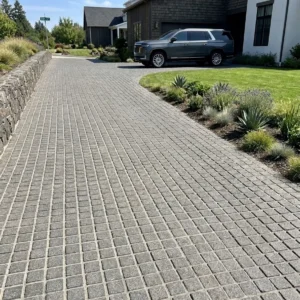
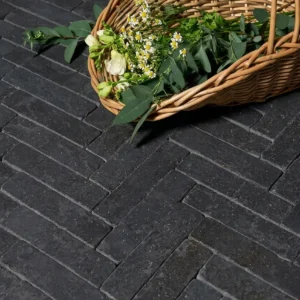
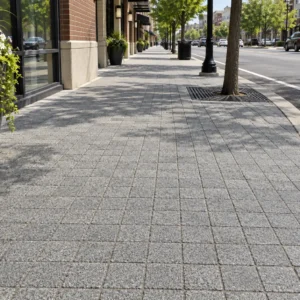
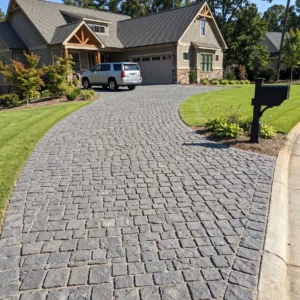
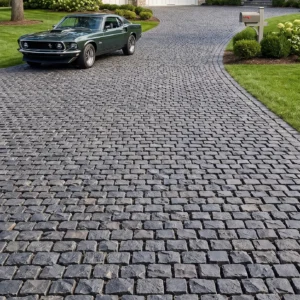
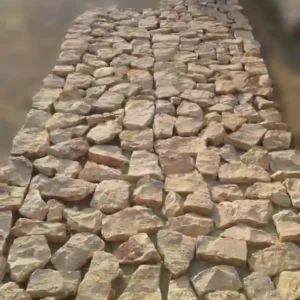
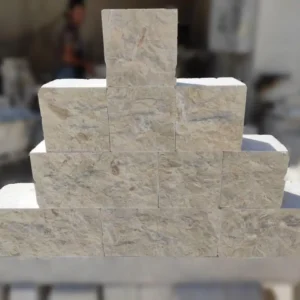
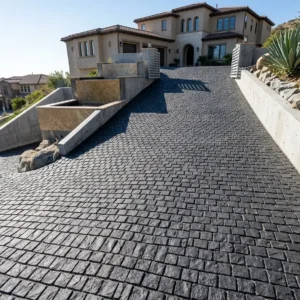
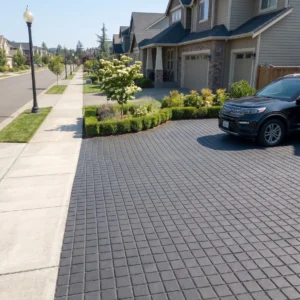
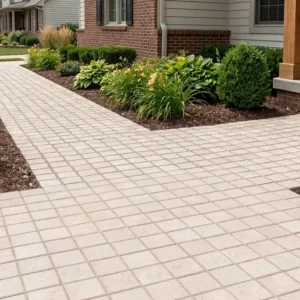
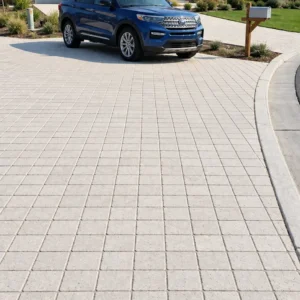
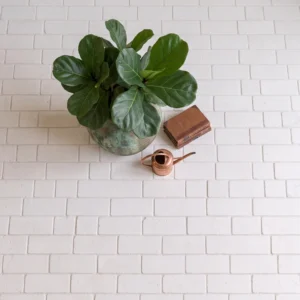
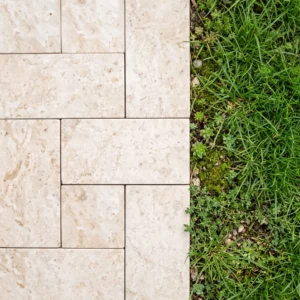

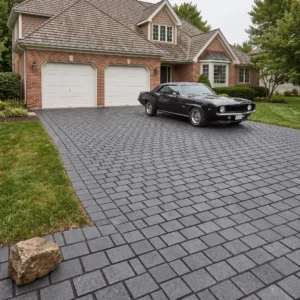
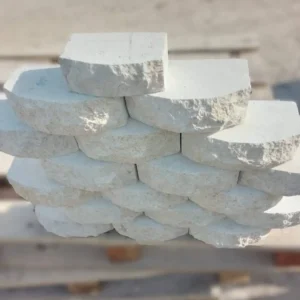
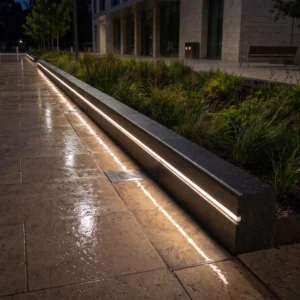
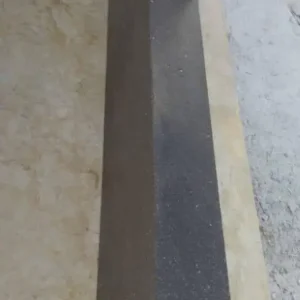
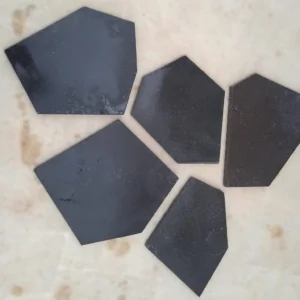
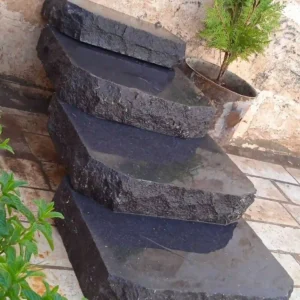
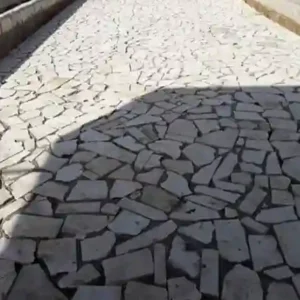
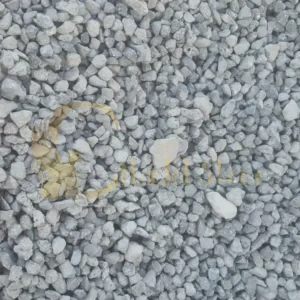
A cobblestone sett is a small block of stone, usually somewhere between a fist and a shoebox in size, cut or split with enough depth to be bedded rather than merely laid. That single characteristic is what makes it the right material in places where a slab is the wrong one. Small units follow a falling grade without needing a step at every level change. They turn a radius without a diagonal cut on every course. They sit around a cistern lid, a manhole, a tree pit or an old wall without the awkward triangular offcuts that make a slab terrace look improvised. And because each unit is bedded independently, a sett surface can be lifted and reset in a morning when a plumber needs to get underneath it.
In the Virgin Islands those advantages line up unusually well with the actual ground. St Thomas and St John are steep, St Croix is flatter but has its own demands, driveways here often meet the road at an angle no drawing anticipated, and four named historic districts have their exterior materials and landscaping reviewed by a preservation commission. This page is about small-unit work specifically: setting out on a slope, aprons that take turning traffic, curves and awkward junctions, work in and around older buildings, patterns that suit each of those conditions, and an honest account of what setts actually cost once they have crossed water to get here.
Ground that falls away: setts on a steep island lot
St Thomas and St John are steep, and that is not a figure of speech to a contractor who has tried to get a mixer up to a villa above Charlotte Amalie or behind Cruz Bay. Access roads switch back on themselves, driveways climb at gradients that would be considered aggressive on the mainland, and the useful flat ground on a plot is often a series of small terraces cut into the hillside rather than one continuous plane. St Croix, being the largest and flattest island, gives you more room to work with, though the same principles apply wherever a site drops.
Slabs on a falling site force a choice between visible steps and awkward wedge-shaped cuts. Setts do not. Because each unit is small, the surface can follow a grade continuously, taking up the fall a few degrees at a time across many joints instead of demanding one big level change. On steeper runs, stepped courses give a pedestrian something to register underfoot without ever becoming a formal staircase. The joint pattern itself provides grip, which matters more here than in a dry climate because the wet season delivers rainfall in concentrated bursts from May through October and a wet slope with a smooth surface is not a place anybody wants to walk.
- Set out from the top of the slope downward, so the last adjustment falls at the bottom where it is least visible.
- Use stepped courses across the fall rather than sloped ones along it wherever pedestrians will be walking.
- Keep the joint fill coarse enough to stay put in a downpour. Fine sand migrates downhill on a steep run and takes the bedding with it.
- Detail cross-drainage at intervals on a long fall, so water leaves the surface sideways instead of building speed along it.
- Restrain the bottom edge properly. Everything on a slope eventually pushes downhill, and the lowest course is where that force arrives.
Driveway aprons and the loads that turn on them
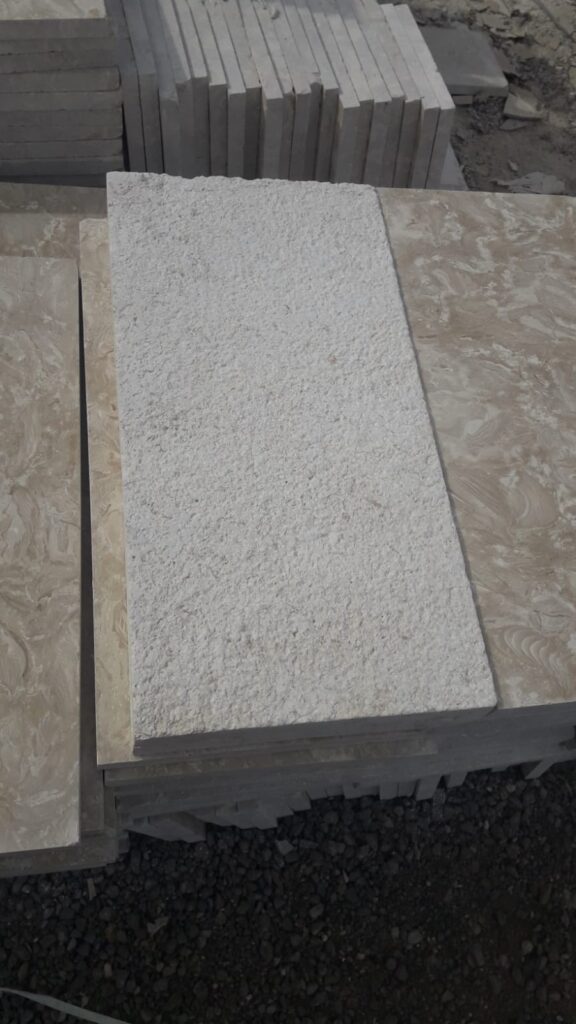
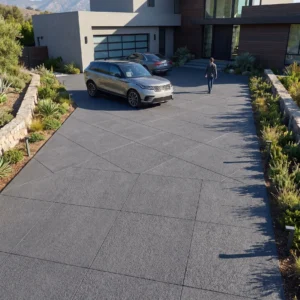
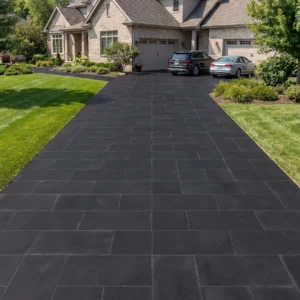
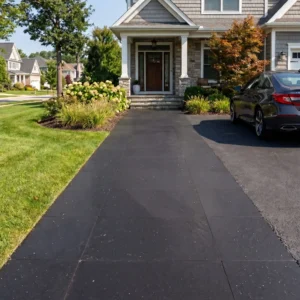
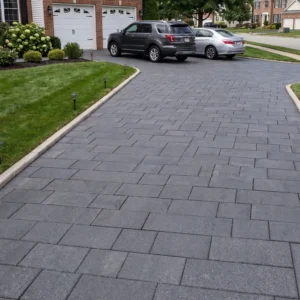
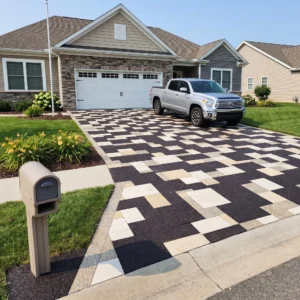
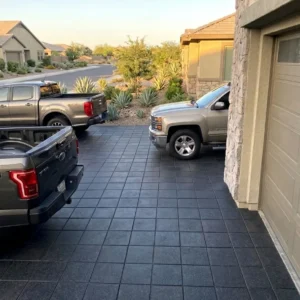
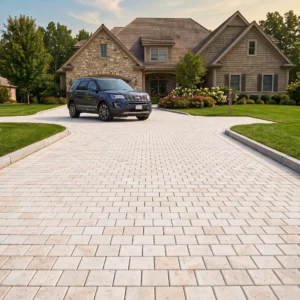
The apron where a private drive meets the public road is the hardest-worked few square yards on most Virgin Islands properties, and it is where large-format paving most often fails. The load is not simply weight; it is turning. A vehicle steering while it moves slowly grinds a horizontal force into the surface, and repeated over years that force finds the weakest joint and starts to open it. A slab resists this by being large and rigid until it cracks. A small unit resists it by being deep, tightly interlocked and individually replaceable when one does eventually chip.
There is a local complication worth planning around. The US Virgin Islands drives on the left, so the turn geometry into a driveway, the position of the vehicle while it waits to enter, and the sweep of a delivery truck’s rear axle are all reversed from a mainland assumption. Sketch the actual swept path for the largest vehicle that will use the entrance, including a concrete truck or a stone delivery flatbed during the build itself, and size the apron to that rather than to the family car. Aprons and turning areas want deep units, typically in the three to four inch range, bedded on a properly designed base rather than sand alone.
- Draw the swept path for the largest vehicle, and remember the traffic side is the left one.
- Use deeper setts on the apron than on the adjoining terrace. The two areas do different work and should not share a thickness.
- Bed apron setts on a rigid base with a concrete haunch to the perimeter, especially where the drive meets the public road surface.
- Keep joints tight and fill them with a material that will not wash out under a wheel and a downpour on the same afternoon.
- Order spare units for the apron specifically. This is the area most likely to need a repair, and a matching stone from the original lot is the only good repair.
Curves, radii and the awkward things already on site
Island plots are rarely tidy rectangles. Boundaries follow old lines, drives curve to find a workable gradient, terraces wrap around the corner of a building to catch a view, and there is nearly always something already in the ground that the paving has to accommodate. Cisterns are standard here rather than exceptional, which means access lids, and those lids need to remain reachable for the life of the building. Add utility covers, tree roots, retaining walls at odd angles and rock that would cost more to remove than to design around, and a small unit starts to look less like a style choice and more like the sensible engineering answer.
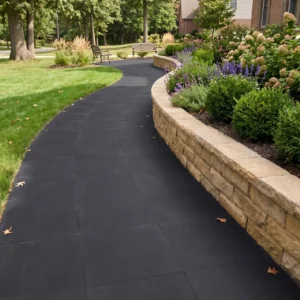
A sett handles a curve by fanning the joint slightly on the outer edge of each course rather than by being cut. That is why sett paving reads as a continuous flowing surface where slab paving on the same curve reads as a series of compromises. The same logic applies to any awkward junction: a sett surface can be dressed neatly up to a wall that is not square, around a planter that was never on the drawing, and back out again without anybody noticing the adjustment. On a site where nothing is quite parallel, that adaptability is worth real money in reduced cutting time and reduced waste.
- Identify cistern lids, utility covers and inspection points before setting out, and plan the coursing around them rather than through them.
- Use a smaller sett on tighter radii. The tighter the arc, the smaller the unit needs to be for the joint to stay even.
- Set a clean edge course along walls and boundaries first, then work the field into it. It reads far better than the reverse.
- Allow extra units for a curved layout. Fanning joints and dressing edges consumes more stone per square foot than a straight run.
- Where a curve meets a step, resolve the geometry on paper first. It is the junction that most often gets improvised badly on site.
Working in and around older properties
Four historic districts in this territory have their exterior materials reviewed, and a contractor who does not know that before quoting is going to have an uncomfortable conversation. The Virgin Islands Historic Preservation Commission approves construction within historic districts, and new work is expected to follow architectural guidelines that maintain the Danish colonial character of the towns. The DPNR State Historic Preservation Office has issued an updated Historic Districts Guide covering Charlotte Amalie, Christiansted, Frederiksted and Cruz Bay, and it addresses architectural materials, masonry repair, landscaping and the approval routes themselves. Charlotte Amalie Historic District covers 165.3 acres and was listed on the National Register of Historic Places in 1976; the Christiansted Historic District covers 135.9 acres and was listed the same year.
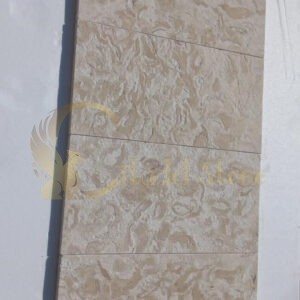
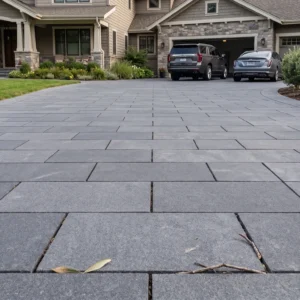
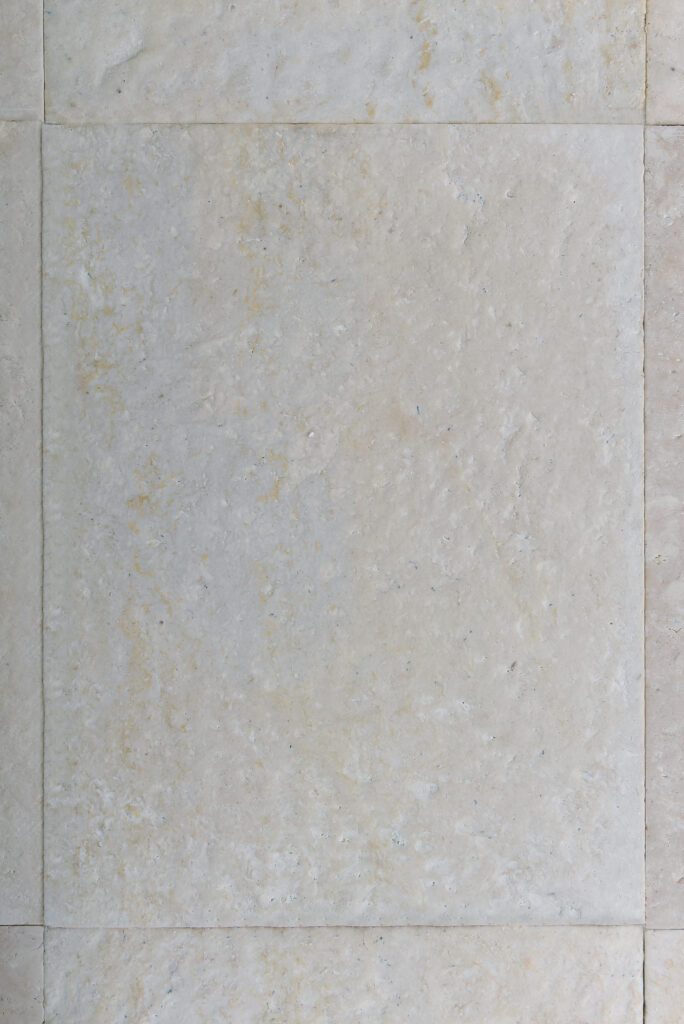
The practical instruction is simple: do not assume a material or a pattern will be accepted because it looks old. Ask, early, with a drawing and a sample. Beyond the formal districts there is also the ordinary courtesy of building next to older masonry. St Thomas has its own distinctive bluish volcaniclastic stone from the Louisenhoj Formation, named for exposures in roadcuts north of Charlotte Amalie, notoriously hard to excavate and long prized in local stone facades. Where a new apron or courtyard meets a wall of it, the paving should sit quietly against that wall rather than compete with it. Muted tones, a modest module and a hand-worked rather than machine-slick face usually do the job, and the sett sizes and surface options we hold are listed under setts cut to consistent depths.
- Confirm the district boundary before design, not after. Sites near the edge of a historic town are the ones that catch people out.
- Take a physical sample and a laying drawing to the conversation. It is a far better basis for approval than a product name.
- Choose muted, low-contrast tones next to older masonry, and avoid a high-gloss or heavily sawn face.
- Keep the module modest against a small-scale historic elevation. A large unit next to a fine wall looks borrowed from somewhere else.
- Allow additional time in the schedule for review, and price that time honestly rather than hoping it disappears.
Patterns, coursing and setting out
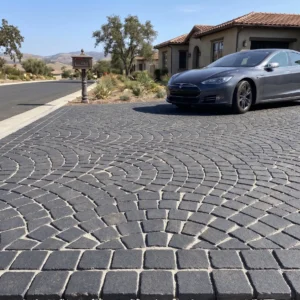
Pattern is not decoration on a sett job; it is structure. The way the units interlock decides how the surface distributes a wheel load, whether it creeps under braking, and how much cutting the crew has to do at every edge. A running bond across the direction of travel is stable and simple. Herringbone interlocks in two directions and is the standard choice for vehicle areas because a turning wheel cannot open a continuous joint line. Fan and arc patterns absorb an irregular boundary gracefully and are well suited to a courtyard or an entrance sweep where nothing is square, though they take longer to set out and more skill to keep true.
Setting out is where the hours are won or lost. Establish the string lines and the datum before the first unit goes down, decide where the pattern will be interrupted by a cistern lid or a drainage channel, and work out in advance which edge takes the closing cut. On a sloping site, decide whether the courses run with the fall or across it, because that choice affects both drainage and the feel underfoot and it cannot be changed halfway. It is worth deciding which layout suits a falling site at drawing stage, when it costs nothing, rather than on the morning the crew arrives.
- Herringbone for driveways, aprons and any area that takes turning vehicles.
- Running bond or stretcher coursing for paths and terraces where the traffic is on foot.
- Fan and arc layouts for entrance courts and irregular courtyards where the boundary is doing something interesting.
- Set the pattern out against the most visible edge, so the closing cut lands where nobody is looking.
- Confirm the coursing direction on a slope before laying starts. Running with the fall and running across it drain very differently.
The real cost balance: weight, freight and hours
There is a piece of mainland folklore that says setts are the cheap option, rough stone bought by the ton with the money going into labor. On an import route that folklore does not survive contact with the freight invoice, and it is worth correcting plainly because it leads people to budget badly. A sett is a block, not a sheet. A four inch deep sett covers roughly a third of the area per ton that a slab of an inch and a quarter covers, which means the same courtyard in setts is several times the tonnage. Ocean freight is charged on weight and volume, and the landed value that customs assesses includes that freight, so setts arrive at a higher material and freight cost per square foot than slabs do, not a lower one.
What remains true is the other half of the old saying. Setts still cost more to install than to buy. Laying, aligning, bedding and jointing thousands of small units by hand is genuinely slow work, and on a steep St Thomas driveway where every wheelbarrow load has to be walked up a slope, it is slower still. Skilled sett laying is a craft and it is priced as one. So the honest sentence is this: setts are the more expensive surface on both counts here, and you choose them because of what they do on ground that a slab cannot handle, not because somebody told you they were cheap. On a flat, square, generously accessed terrace, a slab is very often the better buy.
- Price setts by covered square foot, never by the ton. The ton figure will mislead you every time on an import route.
- Get the container arithmetic done early. Weight fills a box long before volume does with deep units.
- Budget the labor line seriously, and increase it for slope, restricted access and hand-carrying.
- Use setts where their properties earn the premium: slopes, curves, aprons, awkward junctions and reviewable historic settings.
- Mix formats across a property. Setts on the drive and apron with slabs on the flat terrace is usually the intelligent answer.
Planning a sett order for a Virgin Islands site
Ordering setts well is mostly a matter of counting carefully and then adding sensibly. Take the covered area by zone rather than the total, because the apron, the drive and the courtyard will each want a different depth. Add a waste allowance that reflects the geometry: a straight path needs little, a fanned entrance court with three curved boundaries needs considerably more. Then add spares on top, because a follow-up shipment into this territory is a separate customs entry with its own duty assessment, its own brokerage file and its own freight minimum, and a handful of setts ordered late can cost several times their value by the time they reach the site.
Send us the plan with the zones marked, the island, the access description and the offload equipment available, and we will come back with sett sizes, coverage per pallet, container counts and a delivered position by island. Where a hillside site cannot take a full trailer, we will say so and plan the transload rather than let a truck discover it on the day. Small samples travel first so a tone and a face can be checked against the building it will sit next to, which matters more with a hand-worked unit than with anything else we ship. Count the covered area by zone, order the spares in the first container, and a sett surface laid here will still be doing its job long after the crew has forgotten the address.
- Give us covered area per zone, not one total, with the intended depth for each.
- State the island and the nearest town or estate, and describe the access honestly, including the tightest bend.
- Tell us what will lift the pallets at the far end, or ask for the load to be crated for hand handling.
- Include apron spares, edge units and any step or curbstone pieces in the same lot and the same container.
- Ask for the coverage figure per pallet in square feet, so the take-off and the shipping list speak the same language.