






















Interior stone on this island is not really an interior product. Houses in Anguilla are built to be opened, with deep verandas, sliding walls that pocket away, louvered openings and cross-ventilation that make the difference between comfort and running air conditioning all day. The floor inside therefore sits at something close to outdoor temperature and outdoor humidity for much of the year, and it meets bare wet feet, beach sand and salt film as a matter of routine rather than as an accident.
That reality should drive every decision on a tile schedule here: which finish, which format, how the threshold is detailed, what the floor is cleaned with, and whether the same stone can credibly run from the great room out onto the terrace. This page deals with the inside of the building and with the line where inside becomes outside. It assumes a villa or boutique resort standard of work, because that is what is being built at Rendezvous Bay, Meads Bay and above Little Bay, where the landscape architect is named in the press release and the floor is expected to look considered for twenty years.
Comfort Underfoot in a House That Stays Open
Stone earns its place in a tropical house through thermal mass. A limestone floor sits close to the average temperature of the space rather than chasing the air temperature, so it feels cool during the hottest part of the afternoon and never becomes cold in the way a floor in a temperate climate does. In a house with the doors open to the trade wind, that mass is doing quiet work all day, and it is the main reason stone still beats timber and resilient flooring in a well-built Caribbean villa.
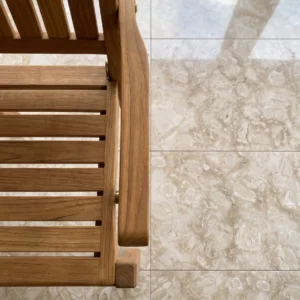
Humidity is the other half of the comfort equation. Anguillian air is salt-laden and damp even in the dry months, and a floor that holds a film of moisture feels quite different underfoot from one that dries quickly. Pale limestone in a lightly textured finish releases surface water faster than a high-gloss surface and does not show the misting that polished floors pick up when a cool, conditioned room is thrown open to warm outside air. That misting is a genuine slip risk in a house that gets opened and closed twice a day, and it is a common complaint about glossy floors in this climate.
- Thermal mass holds floor temperature steady through the hottest hours without mechanical cooling.
- Lightly textured surfaces shed moisture faster than high-gloss ones and stay safer when the doors are opened.
- Pale tones reflect rather than absorb, which matters where a floor sits in direct sun through a wide opening.
- Stone tolerates tracked-in sand and grit far better than engineered timber or vinyl products.
- A single material running through an open plan reads as calm, which is precisely what clients here are paying for.
Finishes for Wet Feet, Sand and Sunscreen
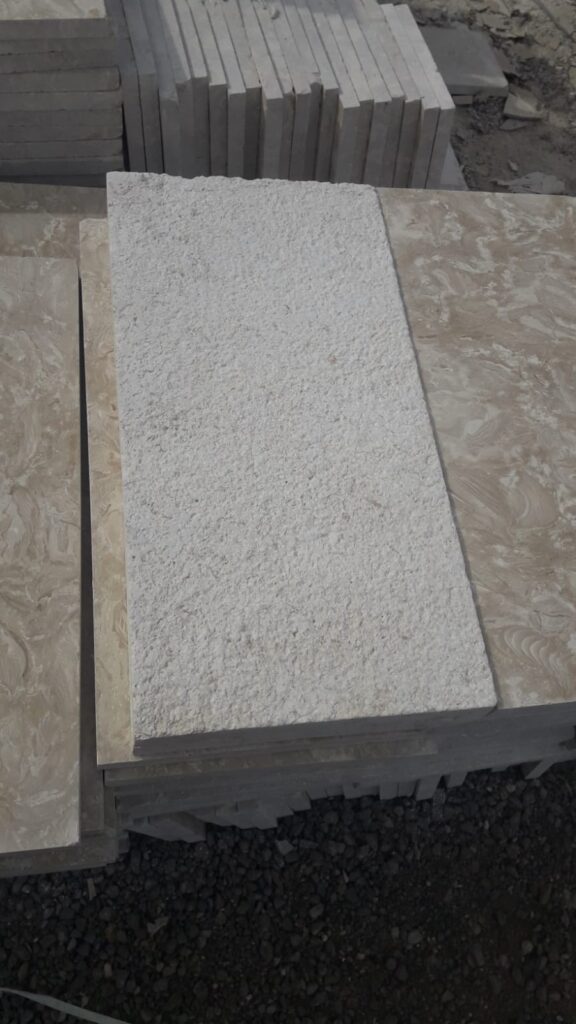
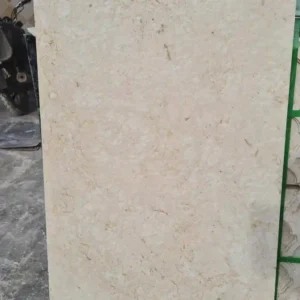
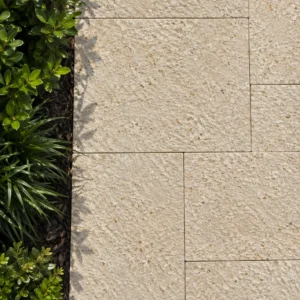
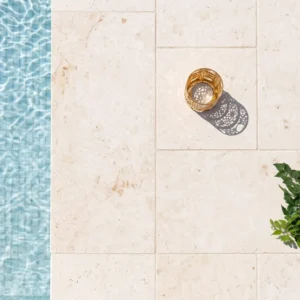
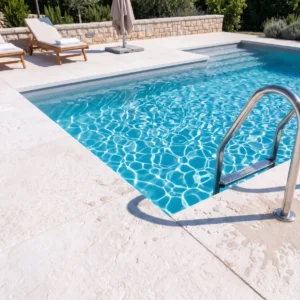
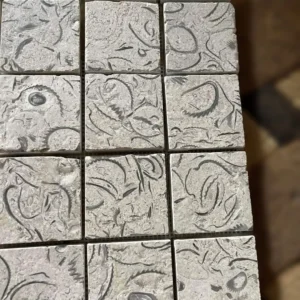
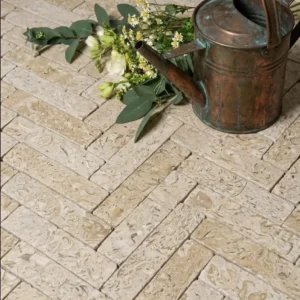
The route from the pool to the kitchen is the hardest-working line in an Anguillian villa, and it is where interior tile fails if the finish was chosen from a sample board in a cool showroom. A wet foot, a film of sunscreen and a scatter of fine beach sand is a genuinely demanding combination. Honed limestone with a low sheen is the usual compromise: enough smoothness to feel refined and to clean easily, enough tooth to stay predictable when it is wet. A brushed or lightly textured face gives more security again and suits bathrooms, outdoor showers and the first few feet inside a threshold.
Sand is the abrasive that nobody budgets for. It is carried in on feet from Shoal Bay and Meads Bay every day of the season, and it will dull a very smooth surface along traffic lines long before the stone itself is worn. That argues for texture in circulation zones, a mat or grated recess at the main door, and a maintenance habit of dry sweeping before wet cleaning. Sunscreen and body oils are the other routine contaminant, and they are far easier to lift from a sealed, lightly textured floor than from an unsealed one where they sit in the surface porosity and darken slowly over a season.
- Honed, low-sheen faces for main living areas, which are refined, easy to clean and predictable when damp.
- Brushed or lightly textured faces for bathrooms, outdoor showers and threshold bands.
- Avoid high-gloss surfaces anywhere the house is opened to warm outside air.
- Plan a grit-control zone at the main entrance instead of relying on cleaning to catch the sand.
- Seal before handover so oils and sunscreen sit on the surface rather than in it.
Formats That Suit Anguillian Rooms
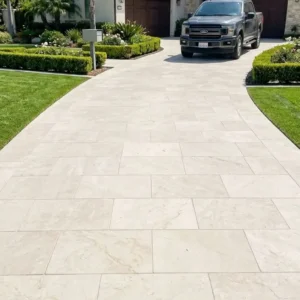
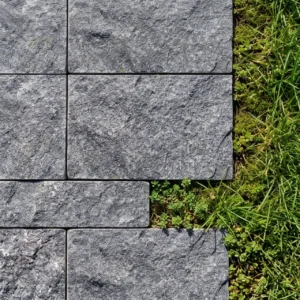
Villa plans on this island tend to be long and shallow, oriented to catch the breeze and the view, with living space that opens along an entire face. Rooms are wide rather than deep, and the eye travels along the plan rather than across it. Large-format tiles suit that geometry: fewer joints, a calmer field, and a module that can be aligned with the slider track so the floor does not fight the architecture. Smaller modules earn their place in bathrooms, on stairs and in service areas, where cutting waste and formed falls matter more than an uninterrupted field.
Format also has to survive the journey. Very large pieces are more vulnerable on a route that involves a second lift at a hub port, and they need a flatter substrate and full-bed fixing to perform properly. A practical compromise on many villas is a generous rectangular module for the main floor, with matching treads, risers and thresholds cut from the same lot. Where a project genuinely wants monolithic pieces for a stair, a vanity or a feature wall, large format limestone slabs can be cut and crated on the same schedule as the floor tile so everything clears customs together.
- Wide rectangular modules read well in long, shallow living spaces and reduce joint clutter.
- Align the tile module with slider tracks and terrace joints before the setting-out drawing is issued.
- Keep smaller modules for wet rooms, stairs and anywhere falls are formed in the screed.
- Order treads, risers, thresholds and special pieces from the same lot as the field tile.
- Remember that oversized pieces need flatter substrates, full-bed fixing and more careful handling on the feeder leg.
Running One Stone From Inside to Outside
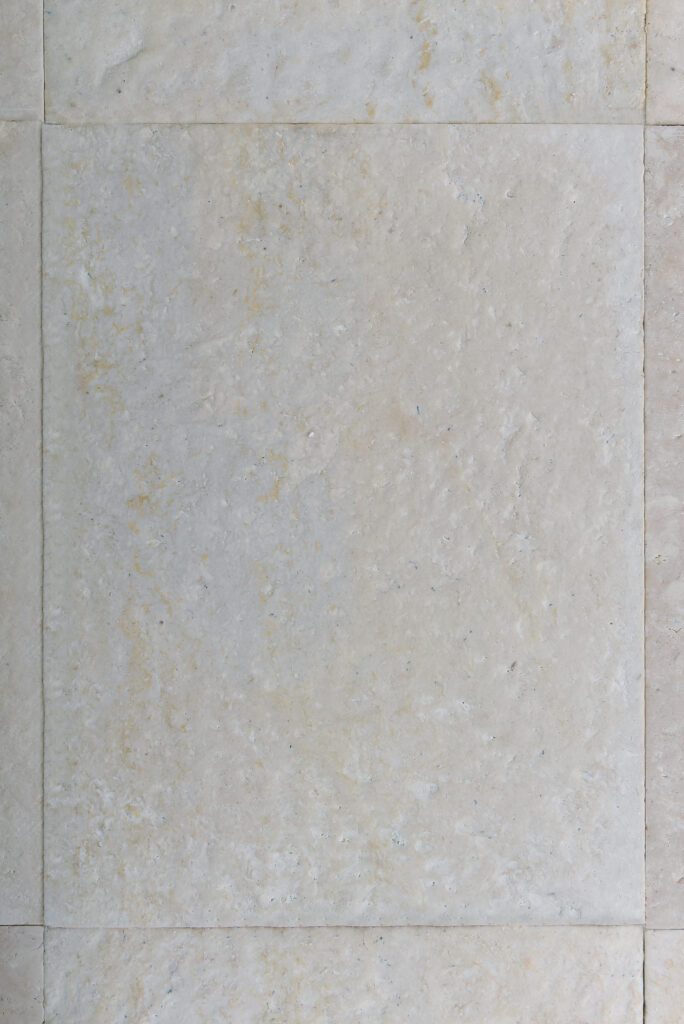
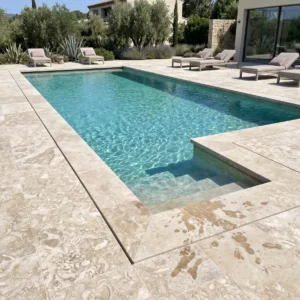
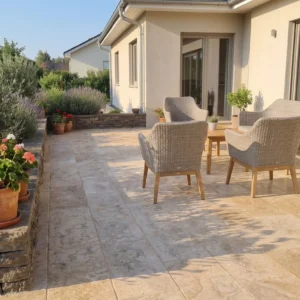
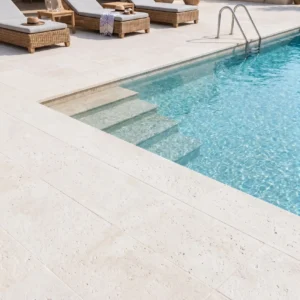
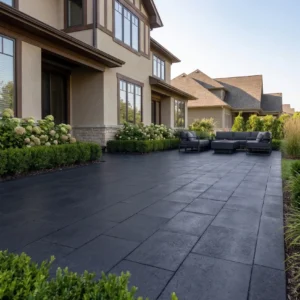
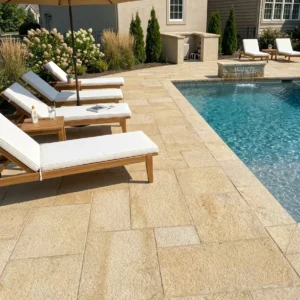
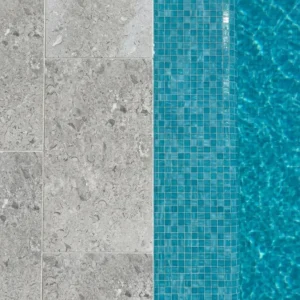
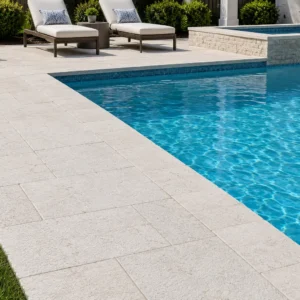
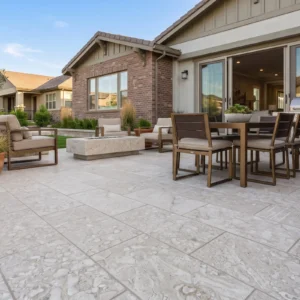
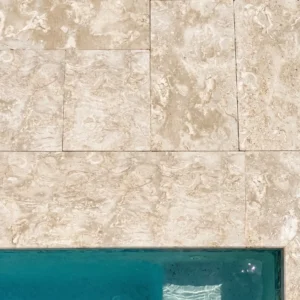
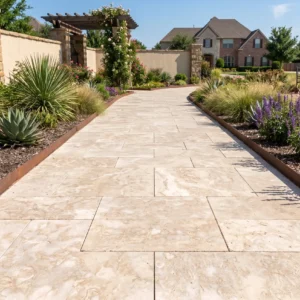
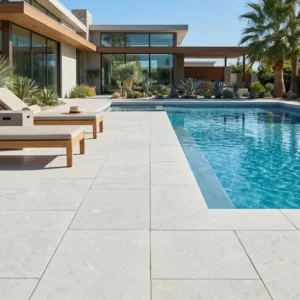
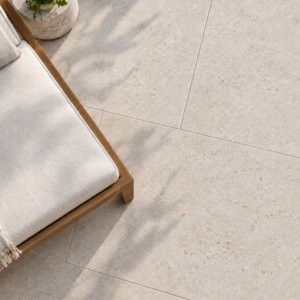
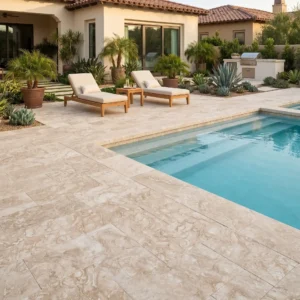
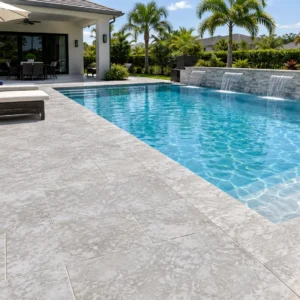
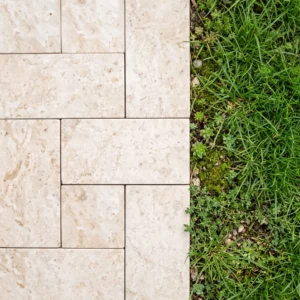
The single most effective thing a limestone floor can do in an Anguillian villa is disappear at the threshold. When the same stone runs from the living room across the veranda to the pool surround, the plan reads as one continuous space and the view does the rest of the work. The technique is straightforward: one material, one lot, two finishes, with a honed face inside and a textured face outside, and the joint pattern continuing across the line so the module never appears to step or shift.
Detailing the line itself is where the skill sits. The threshold has to shed water outward, accept a slot drain or discreet channel at the slider, and accommodate movement between a floor bonded to a slab inside and a paving build-up outside. Falls need setting so a heavy short downpour drains away from the opening rather than pooling at the track. Making a level threshold work in a place that receives most of its annual rain in a handful of violent bursts is a drainage exercise rather than a cosmetic one, and it should be drawn before the stone is ordered rather than resolved by a crew standing in the rain.
- Specify one material and one lot for interior and exterior, separated only by finish.
- Continue the joint grid across the threshold so the module never visibly steps.
- Set a slot drain or channel at the opening and drive the falls away from the slider track.
- Allow a movement joint where a bonded interior floor meets an external build-up.
- Order the exterior areas at a thickness suited to their loading rather than at interior gauge.
Cleaning and Sealing Where Water Is Precious
Anguilla has no rivers. Water comes from rainwater catchment, aquifer wells and desalination, and that shapes floor maintenance in ways that surprise contractors arriving from wetter islands. Hosing a floor down is not a neutral act here, and cleaning routines that assume unlimited fresh water simply do not get adopted by the people who run the house. The practical answer is dry maintenance first, sweeping or dust-mopping to remove sand and salt film, with damp cleaning as the follow-up rather than the default action.
Water chemistry matters too. Well water can be mineral-rich and will leave spotting on a pale floor as it evaporates in the heat, and desalinated supply behaves differently again. Whatever the source, limestone is a calcareous stone and acidic cleaners will etch it, so vinegar, descalers, bathroom acids and generic tile cleaners with an acid base need to be kept off the floor and written out of the housekeeping schedule from the first day. A pH-neutral cleaner, a soft mop and an impregnating sealer are all a well-laid limestone floor actually needs.
- Sweep or dust-mop first, because sand and salt are abrasives and removing them dry protects the finish.
- Use pH-neutral cleaners only, and keep acidic products away from calcareous stone entirely.
- Dry standing water on pale floors rather than letting mineral-rich water evaporate in place.
- Choose an impregnating sealer that leaves the surface breathable instead of a film-forming coating.
- Rehearse the maintenance routine with the housekeeping team at handover, not six months afterwards.
Substrates, Adhesives and Movement in Tropical Heat
Heat changes how a tile floor goes down. Adhesive open time shortens through an Anguillian afternoon, and a crew used to temperate conditions will find skinning happening faster than expected, which produces hollow spots that only reveal themselves months later as a drumming sound underfoot. Working early, keeping bagged materials shaded, mixing smaller batches and back-buttering large pieces to achieve genuine full-bed coverage are all standard practice here and worth writing into the method statement rather than assuming.
Movement is the second discipline. Slabs cast on this island cure in heat and are then exposed to a wide daily swing at any opening, so perimeter and intermediate movement joints are not optional extras. There is a seismic argument as well, since the northern Leewards sit near the Anegada Passage, a zone of complex tectonic deformation, and the regional reference event is the 1867 magnitude 7.5 Virgin Islands earthquake in the Anegada trough. That does not make a tile floor a structural element, but it does justify proper joint provision, flexible adhesive systems and a floor able to move slightly rather than one keyed rigidly to everything it touches. For the supply side of a project here, our Anguilla stone supply partner page covers routes, lots and lead times in detail.
- Check substrate flatness before the first tile goes down, because large formats punish an uneven screed.
- Mix smaller batches and work in the cooler part of the day to protect adhesive open time.
- Back-butter large pieces and aim for genuine full-bed coverage rather than dabs.
- Provide perimeter and intermediate movement joints, and never bridge a structural joint with tile.
- Use flexible adhesive and grout systems suited to a floor that sees a real daily temperature swing.
Ordering Tile for a Villa Program
A villa floor is usually specified a long time before it is laid, and on this island the gap between decision and delivery is filled with shipping. Order samples at design stage, lay a control panel on site as soon as there is a slab to lay it on, and agree the acceptable range of shade and marking from that panel rather than from a photograph on a screen. Natural stone varies, and the entire point of a control panel is to make that variation a decision taken in advance rather than a dispute at handover.
Quantities need the same discipline. Take off the areas properly, add a realistic cutting allowance for a plan with a great many openings, and add attic stock on top of that. Keep the surplus crated, labeled and stored indoors, because pallets left in the open through the season are not the same pallets in November. Where a project is phased across more than one year, reserve the lot at the outset. It is far cheaper to hold material than to explain a shade break between the main house and the guest pavilion two seasons later.
Samples are deliberately small: a piece to handle, wet, walk on and leave in the sun for a week before deciding. Send us the floor plan, the finish you have in mind and the handover date, and we will build the tile schedule and the shipment around it.