

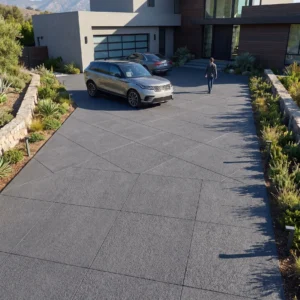
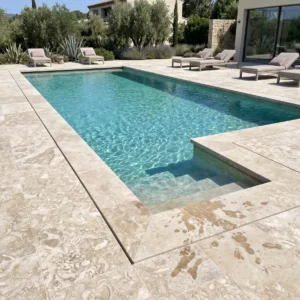
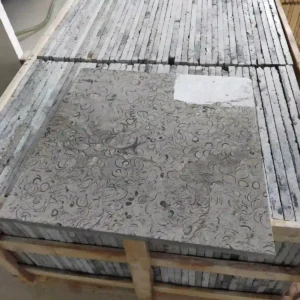
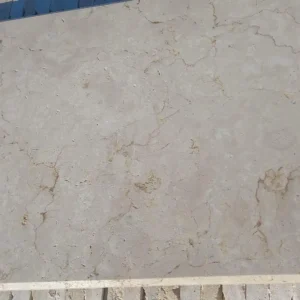
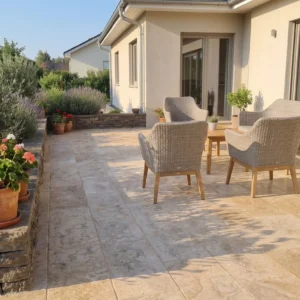

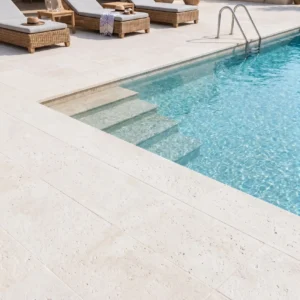



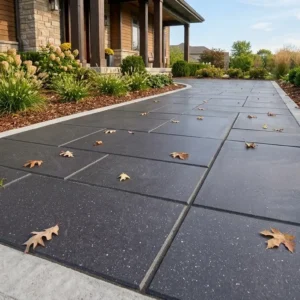
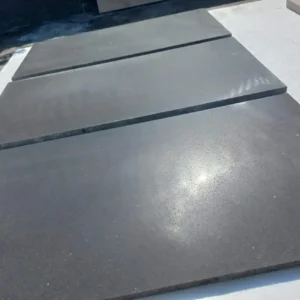
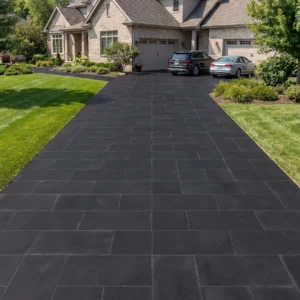
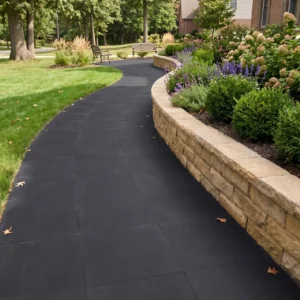
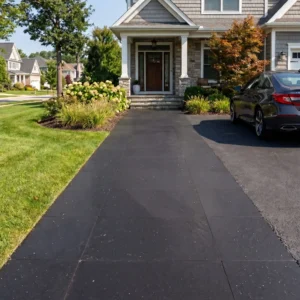








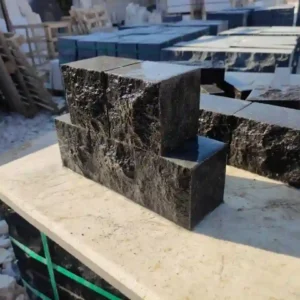
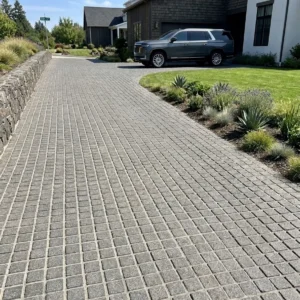
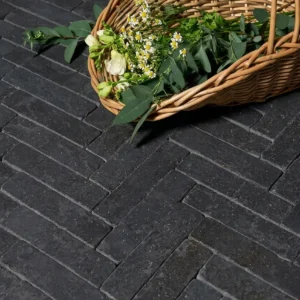
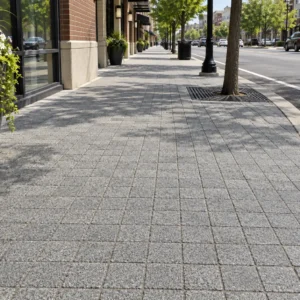
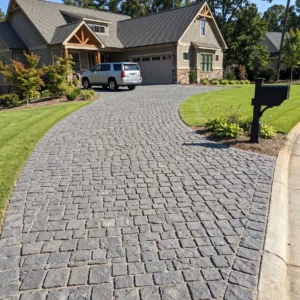

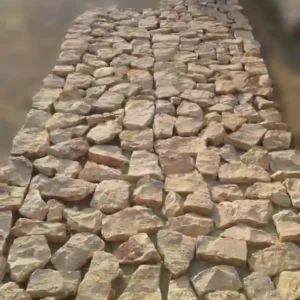
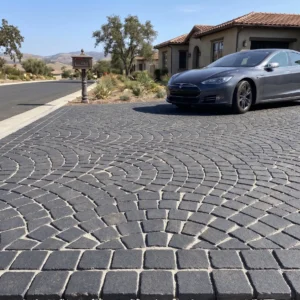
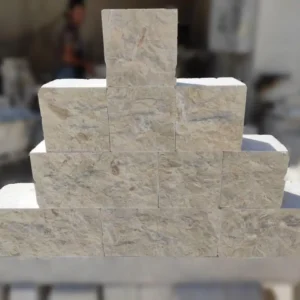
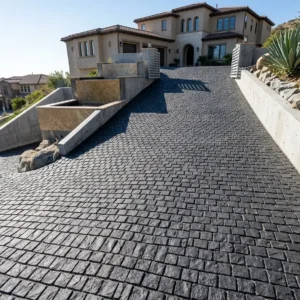


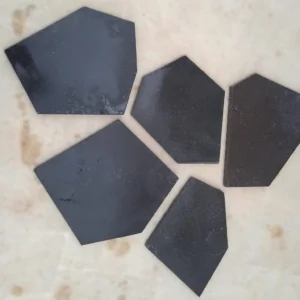
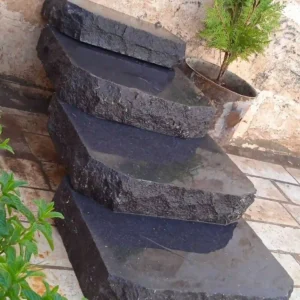
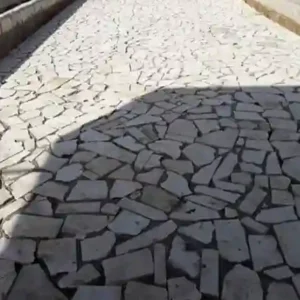
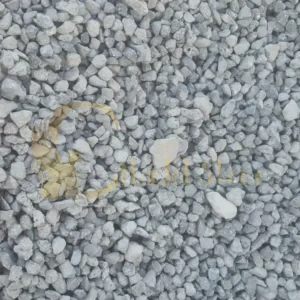
A cobblestone is a small answer to a large problem. Where a site is steep, curved, uneven or awkward to reach, a big rectangular slab fights the ground and a small unit follows it. Saint Vincent and the Grenadines is full of exactly that kind of ground. The main island is steep and volcanic, with drives that climb hard off narrow roads. The Grenadines are small and irregular, with villa approaches that curve around rock and vegetation because that was the cheapest way to build them. In both places the surface that lasts is the one that can be shaped to the ground rather than imposed on it.
There is a second reason setts suit this country, and it is logistical rather than aesthetic. Cobbles and setts travel as small, heavy, robust units in crates a two-person crew can handle at a jetty. They do not need a forklift at the far end. A dropped crate does not write off a delivery, and a single damaged unit is a single unit rather than a whole slab. On a route where cargo lands at Kingstown and then goes on by inter-island vessel, that resilience is worth real money. This page is about small-unit work: slopes, aprons, patterns, labor cost and repair. It does not repeat the freight and clearance detail set out elsewhere on the site.
Small Units on Steep Ground, Curves and Uneven Falls
Any hardscape surface has to resolve three things at once: the direction water goes, the shape of the ground and the line of the design. Large-format paving does that with cuts, and every cut is a labor hour and a potential weak edge. Setts do it with joints, and a joint is free. On a slope that changes gradient halfway up, or a drive that curves as it climbs, that difference is the whole project.
- Setts absorb a changing gradient without cutting, because each course can be adjusted slightly against the next.
- Curved edges and radii are laid as arcs rather than assembled from wedge-shaped cuts that look forced.
- Cross-falls and drainage channels can be formed within the surface, so water is guided rather than dammed.
- Around trees, rock outcrops and existing walls, small units close a gap that would otherwise need bespoke slabs.
- On ground that may settle slightly, small units move together and can be lifted and reset without a visible scar.
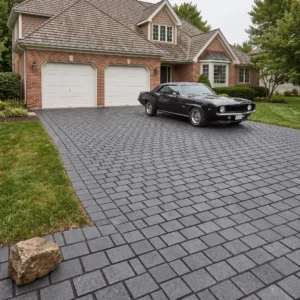
The visual argument matters too, especially on a hillside. A steep drive laid in large slabs reads as a series of steps to the eye because each slab is a flat plane on a sloping line. The same drive in setts reads as a continuous surface that follows the land. That is why so many hillside approaches in this part of the Caribbean, whether original or recent, come back to small units in the end. It is not nostalgia. It is that the format matches the terrain.
Rainfall on this coast arrives in bursts rather than steadily, and a steep surface has to move a lot of water quickly without letting it run as a single destructive sheet. Sett fields handle that well because the surface can be shaped in three dimensions. A shallow dish formed across the width of a drive gathers flow into a controlled line; a slight crown sheds it to both sides; a swale of contrasting units at a change of gradient slows and directs it before it reaches the road below. All of that is done by setting the units, not by adding a product. On a large-format surface the same result needs channels, gullies and cut pieces, each one another joint that can fail.
Driveway Aprons, Turning Loads and Gate Thresholds
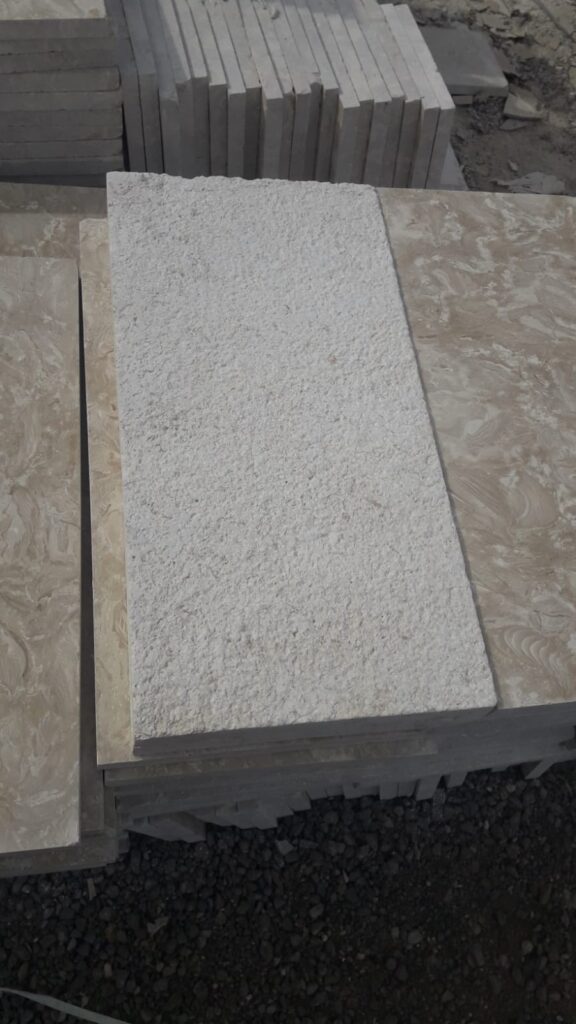
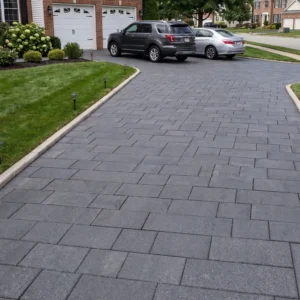
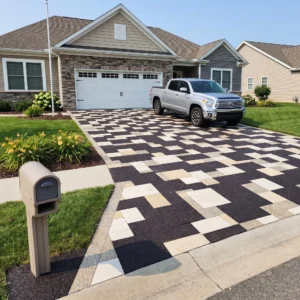
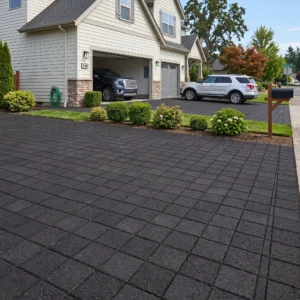
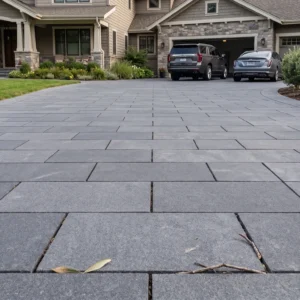
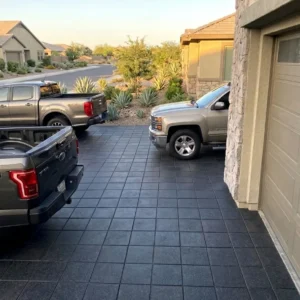
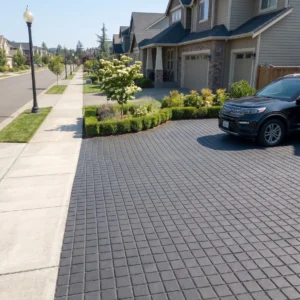
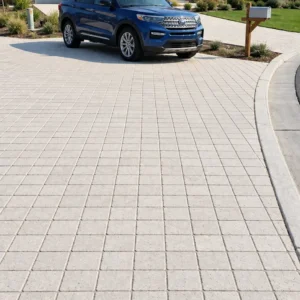
The hardest-worked square meters on most properties are the ones nobody draws carefully: the apron where the drive meets the road, the turning area in front of a garage, and the threshold under a gate. These take point loads, steering scrub from stationary wheels, and, on a wet slope, the wheelspin of a vehicle that did not quite make it first time. Large-format paving is at its most vulnerable in exactly these places, because the load concentrates at a corner and the unit levers on its bed.
- Small units distribute load through interlock, so a wheel bearing on one sett is supported by its neighbors as well.
- Steering scrub at low speed twists a surface, and a jointed sett field absorbs that twist better than rigid slabs.
- Aprons at a road junction can be laid in a contrasting pattern that marks the entrance and warns a driver of the change.
- Gate thresholds take a hard edge and a drainage line together, both of which are simpler to detail in small units.
- Where a service vehicle occasionally crosses a garden route, a sett strip carries it without redesigning the whole path.
Base construction is where a vehicular sett field is actually won. The stone is the visible layer of a system, and beneath it sits a compacted sub-base and a bedding layer that carry the load. In this country that material is local: graded volcanic aggregate from the Rabacca Dry River, screened and crushed, is what Vincentian builders use and what your groundworks contractor will specify. Imported setts sit on top of that work as the wearing surface. The two belong together, and any supplier who talks about the surface without acknowledging the layers underneath is selling you half a driveway.
Why Setts Travel Better Than Slabs to the Grenadines
Everything that reaches Bequia, Mustique, Canouan, Mayreau or Union Island has been handled at least twice: once on discharge at Kingstown, and again onto an inter-island vessel with limited handling equipment at the far end. Format decides how well a stone survives that. Setts are small, thick relative to their face area, and inherently robust, which is close to the ideal profile for a cargo that is going to be lifted, lashed and landed by hand.
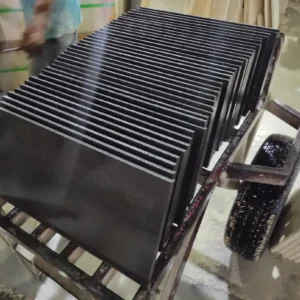
The practical benefits stack up quickly. Crates can be sized to a weight two people can move rather than to a forklift’s capacity. A knock that would crack a large slab does nothing to a sett. Breakage allowances can be smaller because the failure mode is chipping rather than fracture, and a chipped sett can often be turned or moved to a cut position rather than discarded. If a consignment has to be split across two sailings, setts split cleanly by crate count, whereas a slab order split mid-batch can leave a shade break running down the middle of a terrace.
The same qualities help after delivery. Setts can be barrowed up a slope where a slab pallet cannot go, stacked in a corner of a site without special support, and stored outdoors under cover for months without deteriorating. On a phased villa build in the Grenadines, where the terrace may follow the roof by a full season, that tolerance is worth as much as the material price.
There is one habit worth adopting on this route regardless of format. Ask for the packing list to be organized by area rather than by product code, so the crate marked for the entrance apron contains the units and the border stone for that apron and nothing else. On a mainland job an installer sorts a mixed delivery in an hour. On an island where crates may land in two batches across separate sailings, a clear crate-to-area mapping is what lets a small crew start work the day the freight arrives instead of waiting to see what the second consignment holds.
Patterns: Fans, Arcs, Herringbone and Running Bond
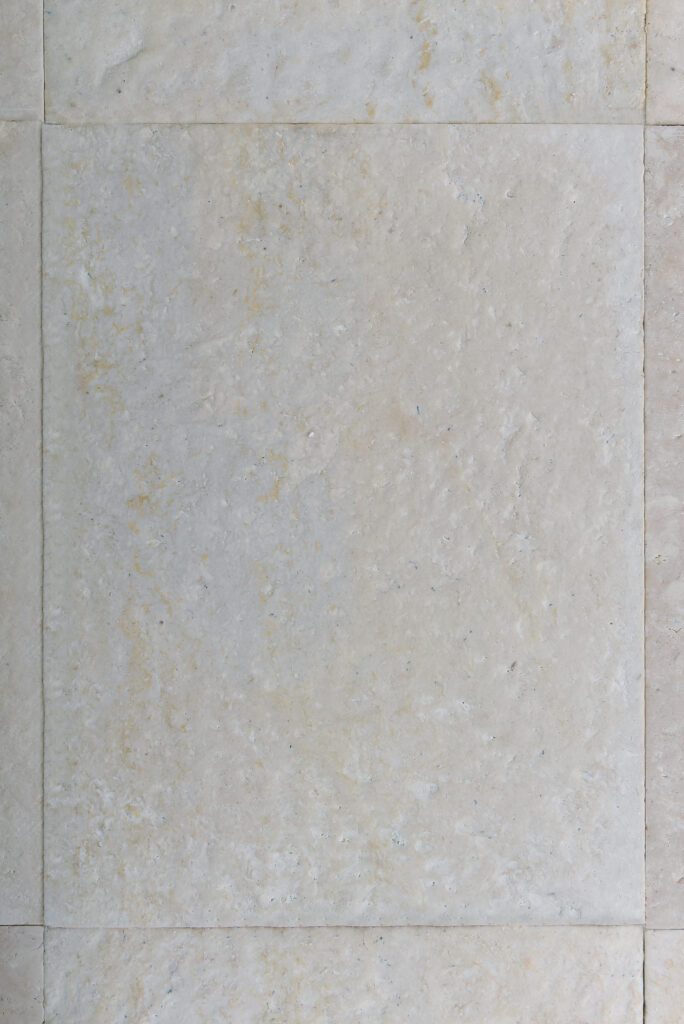
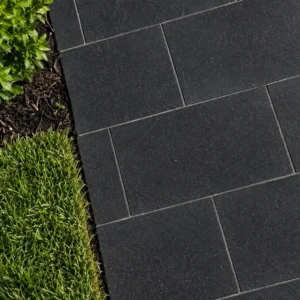
Pattern is not decoration in sett work; it is structure. The way units interlock decides how load spreads, where movement goes and whether a curve looks intentional or improvised. Choosing pattern and unit size together, at design stage, saves argument on site.
- Fan and arc patterns absorb curves and changing widths naturally, which is why they suit sloping drives and irregular courtyards.
- Herringbone interlocks strongly against turning and braking forces, making it the sensible default for vehicular aprons.
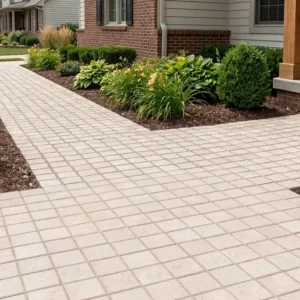
- Running bond laid across a slope keeps the joint lines working against the direction of travel and reads calmly on a path.
- Random or coursed random suits informal garden routes and older buildings where a rigid grid would look imported.
- A contrasting border or soldier course frames the field, resolves awkward edges and gives the layer a clean line to work to.
If you are weighing options before drawing, our guide to traditional sett laying patterns sets out how each one behaves under load and around curves. One local note worth making: strong directional patterns can look restless in bright tropical light, where shadow contrast is high and the sun sits high overhead in the middle of the day. Patterns that read as gentle indoors can read as busy on an open terrace here, so it is worth laying a small trial area and looking at it at midday before committing the whole surface.
Heritage Streets, Waterfronts and Quiet Settings
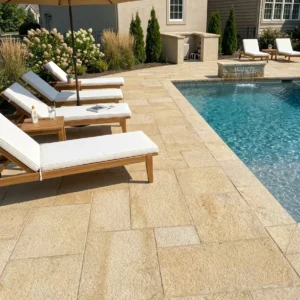
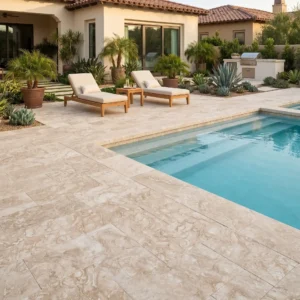
Setts carry a particular association in this region, and it is worth using deliberately rather than by accident. Established settings reward grain over scale, and the older commercial streets of Kingstown, the waterfront at Port Elizabeth on Bequia and the approaches to long-standing properties are all places where a small-unit surface reads as part of the fabric rather than as an addition to it. A new surface in tumbled setts sits into that context quietly. The same space in large sawn slabs announces itself as new, which is sometimes the intention and often is not.
For projects in sensitive or established settings, the material choices that work are the understated ones: muted tones rather than bright ones, textured rather than reflective faces, and units small enough that the surface reads as a fabric instead of a statement. Where a property sits in view of a harbor or an anchorage, a low-reflectance surface also avoids the glare that a large pale plane throws back across the water in the afternoon.
Scale is the practical control. A courtyard in setts of one size reads as an even fabric; the same courtyard in two or three closely related sizes, coursed together, reads as something that has grown rather than been installed. Reclaimed-look treatments such as tumbled edges and a slightly irregular face do a great deal of work in an older setting, and they have the side benefit of hiding the marks that a working waterfront leaves on any surface within a year of laying.
It is worth remembering that development in Saint Vincent and the Grenadines requires planning permission before work starts, under the Town and Country Planning Act as updated in 2008, administered by the Physical Planning Unit. Surface treatment in an established or visible setting is exactly the kind of thing that draws comment during that process. We supply the material and the technical data; the specification should be agreed with your own architect or engineer under the terms of the permit.
The Cost Inversion: Cheap Stone, Expensive Hands
Setts invert the usual cost structure of hardscape, and understanding that inversion is the difference between a budget that holds and one that does not. Per square meter, small units are usually not the expensive part of the job. Laying them is. A large slab covers area quickly; a sett field is placed unit by unit, screeded, aligned, jointed and compacted, and the labor content per square meter is several times higher. On a mainland project that is simply a line in a spreadsheet. In Saint Vincent and the Grenadines it is a logistics problem too.
- Price the laying rate separately from the material, and get it from someone who has actually laid setts, not slabs.
- Factor crew travel and accommodation when the site is on Mayreau, Union Island, Canouan or Mustique rather than the main island.
- Allow for setting-out time on curves and fans, which is skilled work and is where quality is visibly won or lost.
- Include jointing material and compaction in the estimate, since these are routinely forgotten and rarely trivial.
- Consider a mixed specification: setts where the ground demands them, larger units on flat terraces where they lay quickly.
The compensation for that labor cost is length of service and repairability. A sett field laid properly on a sound base has an extremely long life, and unlike most surfaces it can be maintained in sections rather than replaced wholesale. Over the life of a property that arithmetic usually favors the small unit, particularly on ground where anything else would need replacing sooner.
Currency is worth being explicit about when the estimate is assembled, because a Vincentian project routinely runs in two of them. Local labor, plant hire, groundworks and aggregate are quoted and paid in East Caribbean dollars. Imported stone, ocean freight and often the architect are transacted in US dollars. A budget that mixes the two without saying which line is in which will drift, and the drift always shows up late, when the surface is the last thing left to buy. Set the split out on the first page of the estimate and revisit it when the duty and tax position is confirmed, since VAT and the customs service charge apply to the landed value rather than to the quarry price.
Storm Repair and the Case for Attic Stock
Hurricane Beryl reached Saint Vincent and the Grenadines on 1 July 2024 as a Category 4 storm, with damage assessed at around US$230.6 million, roughly 22% of the country’s 2023 gross domestic product, and 56% of the population affected. The Southern Grenadines carried the heaviest losses. That experience changed how people here think about every external element of a building, including the ground surface. The question is no longer only whether a surface will survive but how quickly and cheaply it can be put right if it does not.
Setts answer that question better than almost any alternative. Where scour or debris has disturbed an area, the affected units are lifted, the bedding is made good, and the same units go back down. There is no cutting, no color match problem and no waiting for a replacement slab to be shipped in and cleared. A crew with hand tools can complete a repair that would otherwise be a procurement exercise. The same applies to service trenching: a sett field is opened and closed without leaving a permanent patch.
The condition of that advantage is having spare units from the original batch. Order an attic stock allowance above the measured area, keep it dry and covered, and label it. It costs a fraction of a pallet and it removes the single biggest obstacle to a fast repair. If you are pricing a project now, our cut stone cobble setts are quoted with that allowance included as standard rather than as an afterthought. Order the spare setts with the first delivery, because the cheapest repair on any island is the one that does not need a new shipment.